

Introduction
Unexpected expenses can disturb even a carefully planned monthly budget. A medical emergency, sudden job loss, vehicle repair, urgent home maintenance or temporary loss of income can create financial pressure when you are not prepared.
This is why building an emergency fund is one of the most important steps in personal financial planning.
An emergency fund is money you save separately for unexpected situations. It is not meant for shopping, holidays, expensive gadgets or planned celebrations. Its purpose is to help you manage essential expenses when your regular income is interrupted or an urgent payment arises.
For example, imagine your monthly essential expenses are ₹25,000. If you lose your job, you may still need to pay rent, electricity bills, groceries, school fees and loan instalments. Having three to six months of essential expenses saved can give you time to manage the situation without immediately borrowing money.
You do not need a high salary to begin. Even saving ₹500 or ₹1,000 every month can help you develop the habit.
This guide explains how to build an emergency fund in India, calculate the right savings target, choose suitable places to keep the money and follow a practical monthly savings plan.
AI Answer Box: How to Build an Emergency Fund in India?
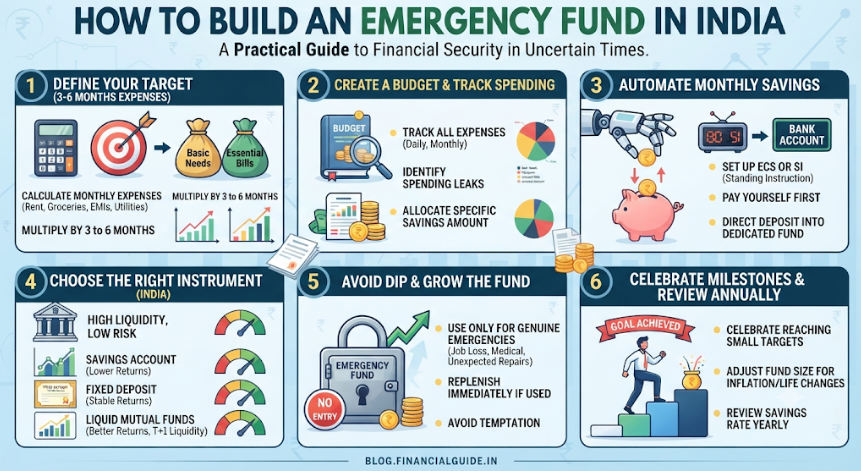
To build an emergency fund in India:
-
Calculate your monthly essential expenses.
-
Set an initial target of three to six months of essential expenses.
-
Open a separate savings account or use a suitable liquid savings facility.
-
Decide how much you can save every month.
-
Set up an automatic transfer after receiving your salary.
-
Reduce unnecessary spending and redirect the savings.
-
Keep the money accessible and avoid risky investments.
-
Use the fund only for genuine emergencies.
-
Refill it after withdrawing money.
-
Review the target whenever your expenses or income change.
Example: If your essential monthly expenses are ₹30,000, a three-month emergency fund is ₹90,000 and a six-month fund is ₹1,80,000.
1. What Is an Emergency Fund?
An emergency fund is a separate pool of savings reserved for unexpected financial situations.
It acts as a financial safety net when you face expenses that cannot be postponed or when your regular income suddenly stops.
Unlike investments designed to generate long-term returns, an emergency fund focuses mainly on three things:
-
Safety of money.
-
Easy access to funds.
-
Availability when an emergency occurs.
Why is an emergency fund important?
Life does not always follow a predictable financial schedule. You may have a stable job today, but an unexpected event can affect your income tomorrow.
An emergency fund can help you:
-
Manage expenses during unemployment.
-
Pay for unexpected medical costs.
-
Handle urgent vehicle or home repairs.
-
Avoid depending entirely on credit cards or personal loans.
-
Continue essential household payments.
-
Protect long-term investments from unnecessary withdrawals.
Simple example: If your monthly income stops for two months, an emergency fund can help you pay essential bills while you search for another job.
2. How Much Emergency Fund Should You Have in India?
The amount depends on your monthly expenses, income stability, family responsibilities and existing financial commitments.
A commonly used starting guideline is:
-
3 months: A possible starting target for people with relatively stable income and fewer financial responsibilities.
-
6 months: A useful target for many salaried households and people with dependants.
-
6–12 months or more: Worth considering for freelancers, self-employed people, business owners and households with uncertain income.
The RBI's financial education material recommends at least three months of living expenses. It suggests six months or more for people with less secure employment, business owners and self-employed individuals.
These are planning guidelines, not compulsory rules. Your actual target should reflect your circumstances.
Emergency fund target by income situation
| Financial situation | Suggested planning target |
|---|---|
| Stable salaried employee | 3–6 months |
| Salaried person with dependants | 6 months or more |
| Single-income household | 6–9 months |
| Freelancer or gig worker | 6–12 months |
| Self-employed professional | 6–12 months |
| Small business owner | 6–12 months or more, depending on income volatility |
A business owner may also need a separate business cash reserve. Personal emergency savings should not automatically be used to cover every business expense.
3. How to Calculate Your Emergency Fund?
The first step is to identify your essential monthly expenses.
Do not calculate your emergency fund using your entire salary. Instead, calculate the money you need to maintain basic living conditions.
Expenses to include
-
House rent or home loan EMI.
-
Groceries and essential food.
-
Electricity and water bills.
-
Mobile and internet bills.
-
School fees and essential education expenses.
-
Necessary medicines and healthcare costs.
-
Essential transport and fuel.
-
Insurance premiums.
-
Minimum required loan repayments.
Expenses you can usually exclude
-
Restaurant visits.
-
Entertainment subscriptions.
-
Shopping for non-essential items.
-
Vacations.
-
Luxury purchases.
-
Optional lifestyle spending.
Emergency fund formula
Emergency Fund = Monthly Essential Expenses × Number of Months
Example: Monthly expenses of ₹30,000
| Expense | Monthly amount |
|---|---|
| Rent | ₹8,000 |
| Groceries | ₹6,000 |
| Electricity and utilities | ₹1,500 |
| Transport | ₹3,000 |
| Healthcare and medicines | ₹2,000 |
| Education | ₹4,000 |
| Loan EMI | ₹4,000 |
| Other essential expenses | ₹1,500 |
| Total | ₹30,000 |
Based on these expenses:
| Emergency fund period | Target amount |
|---|---|
| 1 month | ₹30,000 |
| 3 months | ₹90,000 |
| 6 months | ₹1,80,000 |
| 9 months | ₹2,70,000 |
| 12 months | ₹3,60,000 |
A six-month target would be ₹1,80,000.
You do not have to save the full amount immediately. Start with a smaller target and increase it gradually.
4. Where Should You Keep Your Emergency Fund in India?
An emergency fund should be safe and accessible. It should not be placed entirely in investments that may lose value or take several days to redeem.
Consider dividing your fund into different levels of accessibility.
4.1 Savings account
A separate savings account is one of the simplest places to keep emergency money.
Benefits:
-
Easy access through banking channels.
-
Suitable for immediate expenses.
-
Simple to monitor.
-
Can be kept separate from everyday spending.
Limitations:
-
Interest may be lower than some other deposit options.
-
Inflation may reduce purchasing power over time.
4.2 Sweep-in fixed deposit
A sweep-in FD links a savings account with eligible fixed deposits.
Depending on the bank's terms, surplus money may move into an FD and return to the savings account when a shortfall occurs.
Benefits:
-
May earn FD interest on eligible surplus funds.
-
Can provide automatic access to linked deposit amounts.
-
Useful for money not needed every day.
Limitations:
-
Premature withdrawal conditions may apply.
-
Withdrawal units and thresholds differ between banks.
-
The entire amount may not always be available under identical terms.
4.3 Short-term fixed deposits
You may keep a portion of your emergency fund in short-term FDs if the deposit can be accessed when required.
Before choosing this option, check the premature withdrawal facility, applicable penalty and the time required to receive the money.
4.4 Liquid mutual funds
Liquid mutual funds invest in short-term money market and debt instruments.
They may be considered for a portion of an emergency reserve by people who understand mutual fund risks and redemption conditions.
However:
-
They are not bank deposits.
-
Returns are not guaranteed.
-
Their value can fluctuate.
-
Redemption timing and applicable charges should be checked.
-
They do not receive DICGC deposit insurance.
Do not keep your entire emergency fund in a mutual fund simply because it offers potentially better returns.
Comparison: Where to keep emergency savings?
| Option | Accessibility | Risk considerations | Suitable use |
|---|---|---|---|
| Savings account | Generally immediate through banking channels | Bank and deposit conditions | First-level emergency money |
| Sweep-in FD | Depends on bank's facility | Premature withdrawal terms | Accessible surplus savings |
| Short-term FD | Depends on closure rules | Early withdrawal may reduce interest | Secondary emergency reserve |
| Liquid mutual fund | Subject to redemption timelines | Market and credit risks | Optional portion for informed investors |
| Equity mutual fund | Not suitable for immediate emergency needs | Market volatility | Long-term investing, not emergency savings |
Practical recommendation: Keep enough money in an accessible savings account for immediate needs. Consider other options only after checking their liquidity, safety and withdrawal conditions.
5. Step-by-Step Guide: How to Build an Emergency Fund
You can build an emergency fund by following a simple and consistent process.
Step 1: Calculate your essential expenses
Write down the expenses you must pay every month.
Include housing, groceries, utilities, transport, healthcare, education and necessary debt repayments.
Avoid including unnecessary lifestyle spending.
Step 2: Set a realistic target
Choose an initial target based on your financial situation.
For example:
-
Monthly essential expenses: ₹20,000.
-
Initial target: ₹60,000.
-
Longer-term target: ₹1,20,000.
This gives you a three-month starting target and a six-month goal.
Step 3: Open a separate savings account
Keep your emergency savings separate from your regular spending account.
This makes it easier to monitor your progress and reduces the temptation to spend the money.
Step 4: Decide your monthly savings amount
Choose an amount you can save consistently.
For example:
-
₹500 per month.
-
₹1,000 per month.
-
₹2,000 per month.
-
₹5,000 per month.
The right amount is one you can maintain without missing essential payments.
Step 5: Automate your savings
Set up a standing instruction or automatic transfer after your salary or income is credited.
This helps you save before spending the remaining money.
Step 6: Reduce unnecessary expenses
Review your spending and identify expenses that can be reduced.
Examples include:
-
Unused subscriptions.
-
Frequent food delivery.
-
Unplanned online shopping.
-
Unnecessary travel expenses.
-
Duplicate services.
-
Impulse purchases.
You do not need to remove every enjoyable expense. Focus on making small changes that can be sustained.
Step 7: Save extra income
Whenever you receive additional money, consider transferring part of it into your emergency fund.
Possible sources include:
-
Bonuses.
-
Incentives.
-
Freelance income.
-
Overtime payments.
-
Tax refunds.
-
Gifts.
-
Income from occasional work.
Step 8: Review your progress monthly
Check how much you have saved and how much remains.
Increase your contribution when your income improves.
Step 9: Rebuild the fund after using it
If you withdraw money for a genuine emergency, start rebuilding the amount once your financial situation improves.
An emergency fund is not a one-time target. It should be maintained over time.
6. How to Build an Emergency Fund on a Low Salary?
A low salary does not mean you cannot create an emergency fund.
The key is to begin with an affordable amount and develop a consistent savings habit.
Example: Saving ₹1,000 every month
| Savings period | Total savings |
|---|---|
| 1 month | ₹1,000 |
| 3 months | ₹3,000 |
| 6 months | ₹6,000 |
| 9 months | ₹9,000 |
| 12 months | ₹12,000 |
| 24 months | ₹24,000 |
This example excludes interest.
Even if ₹1,000 is difficult, begin with ₹100, ₹200 or ₹500.
Practical tips for low-income earners
-
Start with a small monthly contribution.
-
Save immediately after receiving income.
-
Avoid unnecessary borrowing.
-
Track daily expenses.
-
Use bonuses or extra earnings to increase savings.
-
Reduce spending gradually rather than making unrealistic cuts.
-
Increase your savings amount when your salary increases.
Remember: A small emergency fund is better than having no emergency savings at all.
7. Emergency Fund Plan Based on Monthly Savings
The following table shows how long it may take to save ₹1,00,000 at different monthly contribution levels.
| Monthly savings | Time to reach ₹1,00,000 |
|---|---|
| ₹500 | 200 months |
| ₹1,000 | 100 months |
| ₹2,000 | 50 months |
| ₹3,000 | 34 months |
| ₹5,000 | 20 months |
| ₹10,000 | 10 months |
These are simple estimates without interest or changes in monthly contributions.
How can you reach your target faster?
You can combine regular monthly savings with occasional additional contributions.
For example, if you save ₹3,000 every month and add ₹10,000 from a bonus once a year, you can reach your goal faster than relying only on monthly savings.
8. Emergency Fund for Salaried Employees
Salaried employees may receive a regular monthly income, but job loss, company restructuring or unexpected salary delays can create financial pressure.
An emergency fund can provide temporary financial support during such situations.
What should salaried employees consider?
-
Monthly rent or home loan EMI.
-
Household expenses.
-
Dependants' needs.
-
Health insurance premiums.
-
Job stability.
-
Time likely to be needed to find another job.
-
Existing loan repayments.
Example
A salaried employee has essential expenses of ₹35,000 every month.
A six-month emergency fund would be:
₹35,000 × 6 = ₹2,10,000.
This amount can help cover essential expenses during a period of unemployment, assuming expenses remain similar.
9. Emergency Fund for Freelancers and Self-Employed People
Freelancers, consultants, gig workers and business owners may experience irregular income.
Some months may bring strong earnings, while other months may bring fewer projects or delayed payments.
For this reason, a larger emergency reserve may be useful.
What should self-employed people include?
-
Household expenses.
-
Essential insurance premiums.
-
Healthcare costs.
-
Minimum loan repayments.
-
Essential personal transport.
-
Necessary education expenses.
Business operating expenses should ideally have a separate business reserve.
Practical tips
-
Save a percentage of every payment received.
-
Keep personal and business accounts separate.
-
Build a larger reserve where income is unpredictable.
-
Avoid assuming that a high-earning month will be repeated.
-
Maintain records of monthly essential expenses.
10. Emergency Fund vs Regular Savings: What Is the Difference?
Both involve saving money, but they serve different purposes.
| Feature | Emergency fund | Regular savings |
|---|---|---|
| Main purpose | Unexpected financial needs | Planned goals and purchases |
| Usage | Genuine emergencies | Planned spending |
| Access | Should be readily accessible | Depends on savings product |
| Investment approach | Safety and liquidity | Depends on financial goal |
| Examples | Job loss, medical costs, urgent repairs | Holiday, gadget, vehicle down payment |
It is better to maintain separate savings goals rather than using your emergency fund for planned purchases.
11. Emergency Fund vs Health Insurance: Do You Need Both?
Health insurance and an emergency fund are not replacements for each other.
They serve different purposes.
| Feature | Health insurance | Emergency fund |
|---|---|---|
| Main purpose | Covers eligible medical expenses under policy terms | Provides money for unexpected expenses |
| Coverage | Defined by policy conditions | Based on your available savings |
| Usage | Eligible hospitalisation and healthcare claims | Medical costs, income loss and other emergencies |
| Limit | Policy sum insured and conditions | Amount you have saved |
| Important limitation | Exclusions, waiting periods and co-payments may apply | Can be exhausted after withdrawals |
Why should you consider both?
Health insurance can help manage eligible medical expenses, while an emergency fund can help pay for deductibles, excluded expenses, travel, lost income and other urgent needs.
Always review your policy coverage and exclusions.
12. Common Emergency Fund Mistakes to Avoid
Building an emergency fund is not only about saving money. It is also about keeping that money available when required.
Avoid these common mistakes:
1. Keeping no separate emergency savings
If all your money is mixed with regular spending, you may accidentally use it for non-essential purchases.
2. Investing the entire fund in stocks
Equity markets can fall when you need money. Emergency savings should not depend on market performance.
3. Setting an unrealistic target
Trying to save a very large amount immediately may discourage you. Begin with a manageable target.
4. Ignoring inflation
Your household expenses may increase over time. Review your target periodically.
For context, India's combined retail inflation was reported at 6.09% for October 2026, while food inflation was 8.94%. These figures are national year-on-year measures, not a forecast of your personal expenses, but they illustrate why an emergency fund should be reviewed periodically.
5. Using the fund for planned shopping
A holiday or new phone is generally not an emergency. Maintain separate savings for planned purchases.
6. Keeping all emergency money in a long-term FD
A long lock-in or premature withdrawal penalty can make access inconvenient.
7. Forgetting to replenish withdrawals
If you use the fund, create a plan to rebuild it.
13. When Should You Use Your Emergency Fund?
Use the money when an expense is urgent, necessary and not reasonably covered by your regular monthly budget.
Situations where it may be appropriate
-
Sudden job loss.
-
Unexpected medical expenses.
-
Urgent home repairs.
-
Essential vehicle repairs needed for work.
-
Temporary income interruption.
-
Emergency travel for a family situation.
-
Essential expenses during a business slowdown.
Situations where you should avoid using it
-
Shopping for luxury products.
-
Vacations.
-
Festival spending.
-
Upgrading your mobile phone.
-
Planned celebrations.
-
Non-essential lifestyle purchases.
Before withdrawing money, ask yourself:
-
Is the expense unexpected?
-
Is it necessary?
-
Can it be postponed?
-
Is there another suitable way to pay without taking expensive debt?
14. How Often Should You Review Your Emergency Fund?
Your emergency fund should change as your financial responsibilities change.
Review it whenever you experience a major financial change.
Review your target when:
-
Your salary increases or decreases.
-
You change jobs.
-
You move to a more expensive home.
-
You get married.
-
You have a child.
-
You take a new loan.
-
Your monthly household expenses increase.
-
You become self-employed.
A useful approach is to review your target every six or twelve months.
If your essential expenses rise from ₹25,000 to ₹30,000, your six-month target should also increase from ₹1,50,000 to ₹1,80,000.
15. Emergency Fund Safety: DICGC Insurance and Bank Deposits
If you keep emergency savings in a bank deposit, understand the deposit insurance rules.
The Deposit Insurance and Credit Guarantee Corporation (DICGC), a wholly owned subsidiary of the RBI, provides insurance for eligible deposits held with insured banks.
The insurance limit is ₹5 lakh per depositor per insured bank, including principal and interest, in the same right and same capacity.
Important points
-
Savings account deposits are included.
-
Fixed deposits are included.
-
Recurring deposits are included.
-
Deposits across different branches of the same bank are aggregated.
-
The limit is not separately available for every account.
-
Deposits with different insured banks have separate coverage limits, subject to applicable rules.
This insurance does not mean every financial product is covered. Mutual funds, shares and other market-linked investments are not DICGC-insured bank deposits.
Check your bank's insured status and the official DICGC information before relying on deposit protection.
Key Takeaways
-
An emergency fund protects you from unexpected financial expenses.
-
Start by calculating your essential monthly expenses.
-
Aim for at least three months of expenses as an initial target.
-
Consider six months or more if your income is irregular or you have dependants.
-
Keep emergency savings separate from everyday spending.
-
Prefer safe and accessible places for the money.
-
Do not invest your entire emergency fund in volatile assets.
-
Start with small monthly contributions if your income is limited.
-
Review your target when your financial situation changes.
-
Replenish the fund after using it for a genuine emergency.
Frequently Asked Questions (FAQs)
1. What is an emergency fund?
An emergency fund is money saved separately to handle unexpected financial situations such as job loss, medical expenses, urgent repairs or temporary income loss.
2. How much emergency fund should I have in India?
A common starting target is three to six months of essential living expenses. People with irregular income, self-employment or greater family responsibilities may consider six to twelve months or more.
3. How do I calculate my emergency fund?
Add your essential monthly expenses, such as rent, groceries, utilities, healthcare and necessary loan payments. Multiply the total by the number of months you want to cover.
4. Can I build an emergency fund on a low salary?
Yes. Start with a small monthly amount such as ₹100, ₹500 or ₹1,000. Increase your contribution when your income improves.
5. Where should I keep my emergency fund?
A separate savings account is a simple option for immediate access. You may consider sweep-in FDs or short-term deposits for another portion after checking withdrawal conditions.
6. Is a fixed deposit suitable for an emergency fund?
A short-term or sweep-in FD may be suitable for a portion of your reserve if the bank offers convenient withdrawal. Check premature closure penalties and access conditions first.
7. Should I invest my emergency fund in mutual funds?
A portion may be considered in suitable low-risk debt-oriented funds by investors who understand the risks and redemption conditions. However, mutual funds are not guaranteed or DICGC-insured. Keep immediate emergency money accessible.
8. How many months of emergency savings do salaried employees need?
Three to six months of essential expenses is a common planning range. People with dependants, unstable employment or high financial commitments may need more.
9. How much emergency fund should freelancers maintain?
Freelancers and self-employed people may consider six to twelve months or more because their income can change from month to month.
10. Can I use my emergency fund to pay off debt?
You may use it to manage urgent repayments or avoid serious financial consequences, but avoid exhausting the entire reserve for routine debt repayment. Compare interest costs and maintain some emergency liquidity.
11. Is an emergency fund better than health insurance?
They serve different purposes. Health insurance covers eligible medical expenses under policy conditions, while an emergency fund provides money for various unexpected needs. Both can be useful.
12. Should I keep my emergency fund in cash at home?
Keeping a small amount of cash for immediate needs may be practical, but keeping the entire fund at home can create theft, loss and safety risks. A regulated bank account is generally more suitable for the main reserve.
13. How long does it take to build an emergency fund?
It depends on your target and monthly savings. For example, saving ₹5,000 per month takes 20 months to reach ₹1,00,000, excluding interest.
14. When should I use my emergency fund?
Use it for genuine unexpected and essential expenses such as medical emergencies, job loss, urgent repairs or temporary income interruptions.
15. Should I rebuild my emergency fund after withdrawing money?
Yes. Once the emergency has passed, restart regular contributions until your fund reaches its intended target.
Conclusion
Building an emergency fund in India is an important step towards financial stability. It helps you manage unexpected expenses without immediately depending on loans, credit cards or selling long-term investments.
Start by calculating your essential monthly expenses and setting a realistic savings target. Aim for at least three months of expenses, and consider a larger reserve if your income is irregular or your family depends on you financially.
You do not need to save a large amount in one month. Begin with what you can afford, automate your contributions and increase them gradually.
The purpose of an emergency fund is not to generate the highest possible return. It is to make sure money is available when life does not go according to plan.
Explore Financial Guidance with Vizzve Financial
Vizzve Financial is one of India’s trusted loan support platforms offering quick personal loans, low documentation, and an easy approval process. Apply at www.vizzve.com.
Explore financial information and borrowing options through Vizzve Financial. Before applying for a loan, review the interest rate, fees, repayment schedule and your ability to repay. Loan approval and disbursal are subject to the lender's eligibility criteria, verification and policies.
Published on : 17th November
Published by : Reddy kumar
www.vizzve.com || www.vizzveservices.com
Follow us on social media: Facebook || Linkedin || Instagram
🛡 Powered by Vizzve Financial
RBI-Registered Loan Partner | 10 Lakh+ Customers | ₹600 Cr+ Disbursed