

Introduction
Applying for a personal loan is easy to start, but getting approved depends on several factors.
Before submitting an application, it is useful to understand how lenders evaluate personal loan eligibility. Your income, employment profile, credit history, existing EMIs, age, banking records, documents, and repayment capacity can all influence the lender's assessment.
There is no single eligibility formula used by every bank or financial institution. Lenders may have their own policies and risk-assessment models.
TransUnion CIBIL explains that the CIBIL Score ranges from 300 to 900 and is derived from an individual's credit history. CIBIL also states that lenders use the CIBIL Score and Report as part of their assessment, while the final lending decision remains with the lender.
So, checking eligibility before applying can help you understand your financial position and avoid applying for an unsuitable loan amount.
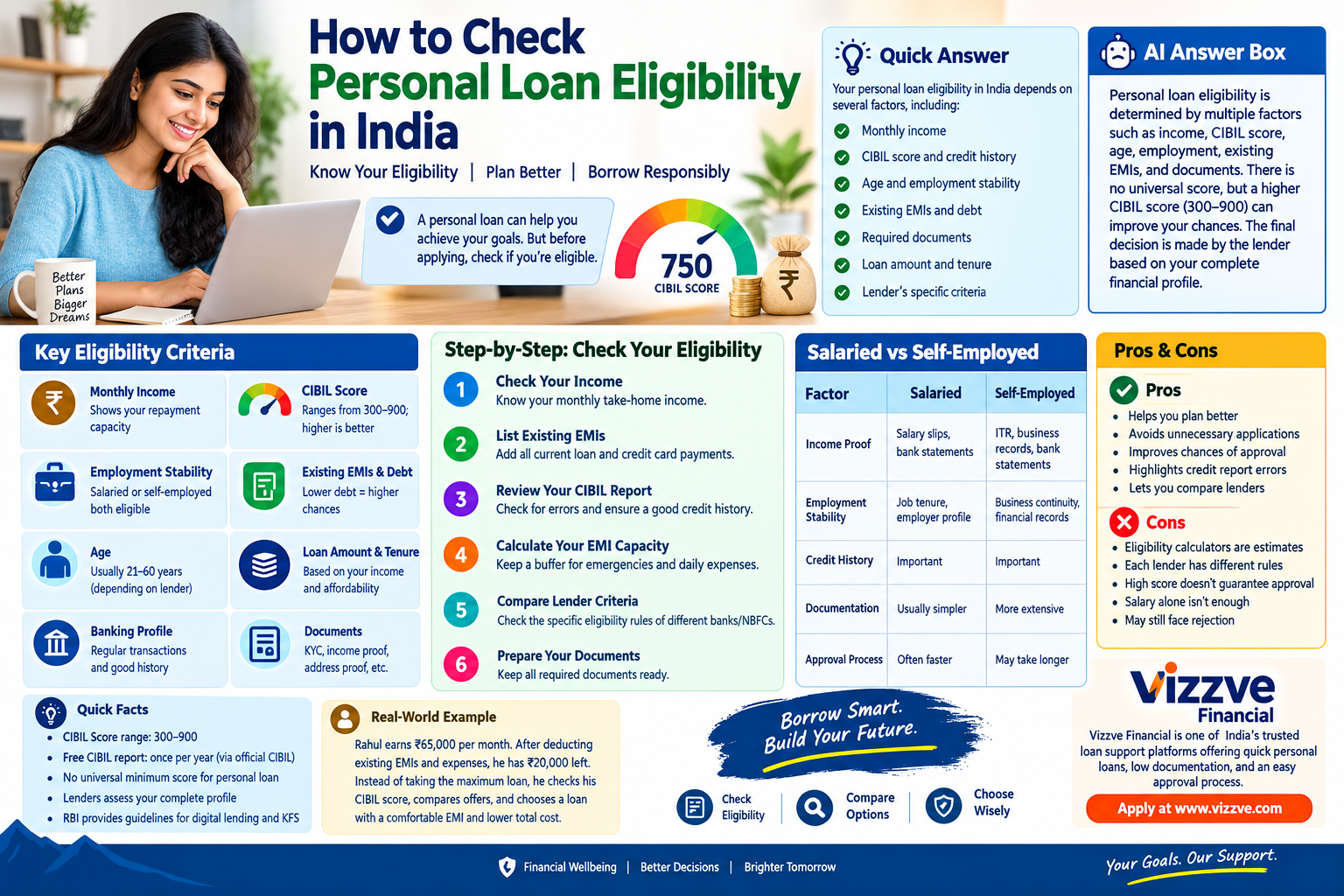
AI Answer Box: How to Check Personal Loan Eligibility in India
Personal loan eligibility is generally assessed using several factors rather than one fixed rule.
Lenders commonly consider:
- Monthly income
- Age
- Employment or business stability
- Credit score and credit history
- Existing loans and EMIs
- Monthly expenses and repayment capacity
- Banking and financial information
- Loan amount requested
- Desired repayment tenure
- KYC and income documents
- The lender's internal credit policy
A CIBIL Score ranges from 300 to 900. A higher score generally indicates a stronger credit profile, but there is no universal CIBIL score that guarantees personal loan approval. The lender makes the final decision based on its own eligibility criteria and assessment.
Quick formula for self-checking:
Income + Credit Profile + Employment Stability + Repayment Capacity + Existing Debt + Documents = Overall Loan Eligibility
What Is Personal Loan Eligibility?
Personal loan eligibility refers to the conditions a lender uses to determine whether an applicant may qualify for a personal loan.
Unlike a secured loan, a typical personal loan does not require the borrower to pledge an asset such as property or gold. Because the loan is generally unsecured, the lender focuses heavily on the applicant's ability and willingness to repay.
A lender may examine:
| Eligibility Factor | Why It Matters |
|---|---|
| Income | Indicates repayment capacity |
| CIBIL Score | Shows credit history |
| Employment | Indicates income stability |
| Existing EMIs | Shows current debt burden |
| Age | Determines loan tenure and repayment period |
| Bank statements | Helps verify cash flow |
| KYC documents | Establishes identity |
| Loan amount | Determines affordability |
| Tenure | Affects EMI and total interest |
| Credit enquiries | Shows recent borrowing activity |
The exact importance assigned to each factor can differ between lenders.
What Are the Main Personal Loan Eligibility Criteria?
1. Monthly Income
Income is one of the most important factors lenders consider.
A higher and stable income can generally provide greater repayment capacity. However, income alone does not determine approval.
For example, consider two applicants:
- Applicant A earns ₹60,000 per month and has no existing EMIs.
- Applicant B earns ₹80,000 per month but already pays ₹45,000 toward existing loans.
The second applicant earns more, but may have less monthly repayment capacity.
What Lenders May Consider
Depending on the lender and applicant profile, income may be verified using:
- Salary slips
- Bank statements
- Form 16
- Income-tax documents
- Business financial statements
- Other acceptable income evidence
TransUnion CIBIL notes that documentation requirements vary by lender. Common documents for salaried applicants can include identity/address proof, recent salary-account statements and salary slips, while self-employed applicants may need financial statements and bank statements.
2. CIBIL Score and Credit History
Your credit profile can have a major influence on a personal loan application.
A CIBIL Score is a three-digit number ranging from 300 to 900. It is calculated from information in your credit history.
Does a Higher CIBIL Score Guarantee a Personal Loan?
No.
A higher score can strengthen an application, but approval is not guaranteed.
CIBIL itself states that it does not decide whether a loan should be sanctioned. The lending institution makes that decision after considering the applicant's broader profile.
What Can Affect Your Credit Profile?
Your credit report can reflect factors such as:
- Previous loan repayment
- Credit card repayment
- Outstanding balances
- Credit utilisation
- Recent credit enquiries
- Length of credit history
- Number and type of credit accounts
A responsible repayment history can help maintain a healthier credit profile.
3. Existing Loans and EMIs
Before approving another loan, lenders may examine your current financial obligations.
Suppose your monthly income is ₹70,000.
Your existing commitments are:
- Home loan EMI: ₹18,000
- Vehicle EMI: ₹8,000
- Credit card repayment: ₹5,000
- Other fixed commitments: ₹4,000
Your existing monthly obligations already consume a significant part of your income.
A new lender may therefore examine whether another EMI is affordable.
Why Existing EMI Matters
Taking a new loan while already carrying substantial debt can increase repayment pressure.
This is why you should calculate your current obligations before applying.
4. Employment Stability
Lenders may consider whether your income source appears stable.
For salaried applicants, factors may include:
- Current employment
- Employer profile
- Length of employment
- Regular salary credits
- Previous employment history
- Nature of employment
For self-employed applicants, the lender may examine:
- Business continuity
- Income records
- Bank transactions
- Financial statements
- Tax-related documents
- Business stability
There is no single employment-tenure rule that applies to every lender.
5. Age
Age can also influence personal loan eligibility.
Lenders may set minimum and maximum age limits based on their individual policies.
Age matters because the lender needs to assess whether the proposed repayment period is appropriate for the applicant.
For example, a lender may evaluate:
Current age → Proposed tenure → Expected repayment period → Income stability
Always check the lender's current eligibility criteria rather than relying on a generic age limit found online.
6. Loan Amount Requested
The amount you request can affect eligibility.
A person earning ₹50,000 per month may be financially comfortable with a smaller EMI but may not qualify for a very large loan with a short repayment period.
Instead of asking:
"What is the maximum loan I can get?"
a more useful question is:
"What loan amount can I comfortably repay?"
This approach encourages responsible borrowing.
7. Repayment Tenure
Loan tenure affects both your EMI and the overall cost of borrowing.
Generally:
- Shorter tenure → Higher EMI, potentially lower total interest
- Longer tenure → Lower EMI, potentially higher total interest
Example
Suppose you borrow ₹5 lakh.
The EMI can vary significantly depending on:
- Interest rate
- Loan tenure
- Processing fees
- Other applicable charges
Therefore, do not compare loans only on monthly EMI.
Compare the overall borrowing cost.
8. Bank Account and Financial Transactions
Bank statements can help lenders understand your financial activity.
Depending on the lender, the statement may be examined for:
- Regular salary credits
- Income consistency
- Existing EMI payments
- Returned payments
- Large unexplained transactions
- Account balance patterns
- Other financial obligations
A clean and consistent banking history can make income verification easier.
How to Check Personal Loan Eligibility Step by Step
Step 1: Check Your Monthly Income
Write down your average monthly take-home income.
For example:
Monthly income = ₹60,000
If your income varies, calculate an average based on several months rather than relying on your highest monthly income.
Step 2: List All Existing EMIs
Create a simple list:
| Existing Debt | Monthly EMI |
|---|---|
| Home loan | ₹15,000 |
| Vehicle loan | ₹7,000 |
| Consumer loan | ₹4,000 |
| Other EMI | ₹2,000 |
| Total | ₹28,000 |
Now you know how much of your income is already committed.
Step 3: Check Your CIBIL Report
Check your CIBIL Score and report before making a major loan application.
TransUnion CIBIL currently provides a free CIBIL Score and Report once per calendar year through its official service.
Review your report for:
- Incorrect personal details
- Accounts you do not recognize
- Incorrect outstanding balances
- Incorrect repayment information
- Duplicate accounts
- Unfamiliar credit enquiries
If you find inaccurate information, CIBIL provides a dispute process.
Step 4: Calculate Your Available EMI Capacity
A simple personal calculation can be:
Available monthly income − existing EMIs − essential expenses = potential surplus
For example:
Monthly income: ₹70,000
Existing EMIs: ₹15,000
Essential expenses: ₹35,000
Potential surplus:
₹70,000 − ₹15,000 − ₹35,000 = ₹20,000
This does not mean you should automatically take a loan with a ₹20,000 EMI.
Keep a safety margin for:
- Medical expenses
- Emergency costs
- Family obligations
- Job/income changes
- Inflation
- Unexpected bills
Step 5: Check the Lender's Eligibility Criteria
Before applying, check:
- Minimum income
- Age requirements
- Employment requirements
- CIBIL/credit criteria
- Minimum and maximum loan amount
- Tenure options
- Documentation
- Processing fee
- Prepayment rules
- Other charges
Eligibility requirements differ among lenders.
Step 6: Prepare Your Documents
Typical documents can include:
Identity Proof
- PAN card
- Aadhaar or other accepted KYC document
- Passport
- Driving licence
- Voter ID
Address Proof
- Aadhaar
- Passport
- Utility bill
- Other accepted documents
Income Documents for Salaried Applicants
- Salary slips
- Bank statements
- Form 16 or other income documentation, where applicable
Documents for Self-Employed Applicants
- Bank statements
- Income-tax documents
- Business proof
- Financial statements
- Other lender-specific documents
The exact list varies by lender.
How Do Banks Calculate Personal Loan Eligibility?
There is no single universal calculation used by every bank.
A lender may combine multiple data points into an internal credit assessment.
A simplified conceptual model can look like this:
Eligibility = Income + Credit History + Existing Debt + Employment + Banking Profile + Requested Loan Terms
The lender may then determine:
- Whether to approve
- How much to offer
- Applicable interest rate
- Available tenure
- Other loan conditions
The actual underwriting model can be much more complex.
Personal Loan Eligibility Calculator: What Should You Enter?
An online eligibility calculator may ask for information such as:
- Monthly income
- Employment type
- Age
- Existing EMI
- Desired loan amount
- Loan tenure
- City/location
- Credit score
Example
Suppose:
| Detail | Example |
|---|---|
| Monthly income | ₹60,000 |
| Existing EMI | ₹10,000 |
| Requested loan | ₹4,00,000 |
| Tenure | 3 years |
| Credit score | 780 |
An eligibility calculator may provide an estimate.
However, calculator results are not loan approval.
The final decision is made by the lender after verification and credit assessment.
How Much Personal Loan Can I Get on My Salary?
There is no universal salary-to-loan formula.
Two people with the same salary may receive different offers because of differences in:
- Credit history
- Existing loans
- Employer profile
- Employment duration
- Monthly expenses
- Loan tenure
- Requested amount
- Banking behaviour
- Lender policy
Illustrative Example
Suppose a person earns ₹50,000 monthly.
If they have:
- Low existing debt
- Stable employment
- Strong credit history
- Consistent bank transactions
their financial profile may differ substantially from another person earning the same ₹50,000 but already carrying several large EMIs.
Therefore, salary should not be considered in isolation.
Personal Loan Eligibility for Salaried Employees
Salaried applicants generally need to demonstrate stable employment and regular income.
Important Factors
- Monthly take-home salary
- Employer
- Employment duration
- Salary-account history
- Existing debt
- Credit history
- Age
- Requested loan amount
Practical Tip
Keep your salary account statements and recent income documents ready before applying.
This can make the application process more organized.
Personal Loan Eligibility for Self-Employed Individuals
Self-employed applicants may have variable income, so lenders may examine additional financial information.
Commonly Relevant Information
- Business vintage
- Annual income
- Bank statements
- Income-tax returns
- Financial statements
- Business registration documents
- Existing liabilities
- Credit history
A self-employed applicant should keep financial records organized and consistent.
What CIBIL Score Is Needed for a Personal Loan?
There is no single CIBIL score that guarantees personal loan approval across all lenders.
CIBIL scores range from 300 to 900. CIBIL states that the closer the score is to 900, the higher the chances of loan or credit-card approval, while the lending institution makes the final decision.
Instead of focusing only on a specific number, review your complete credit profile.
Before Applying
Check whether:
- Your EMIs are paid on time
- Credit card dues are under control
- Your report has no errors
- You have not made excessive recent applications
- Outstanding balances are accurate
Does Checking Your CIBIL Score Reduce Your Score?
Checking your own credit report is different from a lender making a credit enquiry during an application.
Consumers can monitor their own credit information to understand their credit position.
The important distinction is between self-checking and multiple lender enquiries associated with applications.
Before applying for several loans, compare eligibility and loan terms carefully rather than submitting unnecessary applications.
What Documents Are Required for Personal Loan Eligibility?
Here is a practical document checklist.
| Document | Salaried | Self-Employed |
|---|---|---|
| PAN/KYC | Usually required | Usually required |
| Address proof | Usually required | Usually required |
| Bank statement | Commonly required | Commonly required |
| Salary slips | Commonly required | Usually not applicable |
| ITR | May be requested | Commonly relevant |
| Financial statements | Usually not required | May be required |
| Business proof | Usually not required | May be required |
| Employment proof | May be requested | Not applicable |
Requirements vary between lenders.
Personal Loan Eligibility: Salaried vs Self-Employed
| Factor | Salaried Applicant | Self-Employed Applicant |
|---|---|---|
| Income | Salary | Business/professional income |
| Proof | Salary slips | ITR/financial records |
| Bank statement | Commonly used | Commonly used |
| Employment stability | Job tenure | Business continuity |
| Income variation | Usually lower | May be higher |
| Documentation | Often simpler | Can be more extensive |
| Credit history | Important | Important |
Neither category automatically guarantees approval.
Factors That Can Affect Personal Loan Eligibility
Positive Factors
- Stable income
- Good repayment history
- Manageable existing EMIs
- Accurate financial documents
- Stable employment/business
- Responsible credit usage
- Reasonable loan request
Factors That May Create Challenges
- Frequent missed payments
- High existing debt
- Unstable income
- Multiple recent credit applications
- Incorrect information in the credit report
- Insufficient documentation
- Requesting an amount that does not match repayment capacity
Why Can a Personal Loan Application Be Rejected?
A rejection can happen for several reasons.
Common Possibilities
- Insufficient income for the requested amount
- High existing debt
- Weak credit history
- Recent missed payments
- Unstable employment or income
- Incomplete documentation
- Lender-specific eligibility rules
- Inconsistency between application information and documents
- Excessive recent credit enquiries
- Loan amount or tenure not matching the lender's policy
A rejection does not necessarily mean that the applicant can never qualify for credit.
The reason should be understood before making another application.
How to Improve Personal Loan Eligibility
1. Maintain Timely Repayments
Pay loan EMIs and credit card dues on time.
Payment history is an important part of your credit profile.
2. Reduce Unnecessary Debt
If you already have several loans, consider your overall debt burden before taking another one.
3. Avoid Unnecessary Applications
Do not apply for numerous loans simply to see which lender approves you.
Instead:
Research → Compare → Check eligibility → Apply selectively
4. Check Your Credit Report
Review your report for errors before applying.
If something is incorrect, raise a dispute with the relevant credit information company/lender.
5. Keep Documents Updated
Make sure:
- PAN details are correct
- Address details are consistent
- Bank statements are available
- Income information is accurate
- Employment/business documents are current
6. Choose a Realistic Loan Amount
Borrowing less than your maximum theoretical eligibility can provide greater repayment flexibility.
Personal Loan Eligibility vs Loan Affordability
These two concepts are often confused.
Eligibility
Can the lender potentially approve this loan?
Affordability
Can I comfortably repay this loan without damaging my monthly finances?
They are not the same.
A person may qualify for a loan amount that is technically available but still find the EMI uncomfortable.
Responsible borrowing requires considering both.
Personal Loan Eligibility vs Credit Score
| Factor | Credit Score | Overall Eligibility |
|---|---|---|
| Measures | Credit history | Complete borrower profile |
| Range | CIBIL: 300–900 | No universal range |
| Income included? | No | Yes |
| Existing EMI included? | Reflected through credit history, but not a complete affordability measure | Yes |
| Employment included? | No | May be |
| Loan amount considered? | No | Yes |
| Lender-specific? | Score methodology is bureau-based | Yes |
A strong credit score is useful, but it is only one part of a broader lending assessment.
How to Compare Personal Loan Offers
Do not compare offers only on the advertised interest rate.
Check the complete cost.
| Factor | What to Check |
|---|---|
| Interest rate | Fixed or floating, as applicable |
| APR | Overall annualized borrowing cost |
| Processing fee | Upfront loan cost |
| GST/taxes | Applicable charges |
| Tenure | Repayment duration |
| EMI | Monthly obligation |
| Prepayment terms | Conditions for early repayment |
| Penal charges | Cost of missed obligations |
| Other fees | Documentation or service charges |
RBI's framework on Key Facts Statements requires regulated entities to provide prospective borrowers with key loan information, including costs, in a standardized format for applicable retail and MSME term loans.
What Is a Key Facts Statement (KFS)?
A Key Facts Statement, or KFS, is designed to give borrowers important information about a loan in a simple, standardized format.
It can help you understand:
- Loan amount
- Tenure
- Interest rate
- Annualized cost/APR where applicable
- Fees
- Charges
- Other important terms
RBI's framework emphasizes providing borrowers with important loan information and the all-in cost in an easy-to-understand format.
Why KFS Matters
Before accepting a loan, read the KFS and loan agreement carefully.
Do not judge a loan only by:
"Low EMI"
or
"Instant approval."
The total cost and repayment obligations matter more.
Digital Personal Loan Eligibility: What Should You Check?
Digital lending can make applications faster, but convenience should not replace due diligence.
Before submitting sensitive information:
Check the Lender
Confirm:
- Name of the actual lender
- Bank/NBFC relationship
- Loan terms
- KFS
- Privacy information
- Customer support
- Grievance mechanism
RBI has strengthened the digital lending framework, including requirements around transparency and borrower information. RBI's annual report also notes the public directory initiative for digital lending apps associated with regulated entities.
Never Share
Do not casually share:
- OTPs
- PINs
- Passwords
- Card security information
- Banking credentials
Only provide information through legitimate and secure channels.
Expert Commentary: Think Beyond Approval
A useful way to evaluate a personal loan is to separate eligibility from financial suitability.
A lender's approval tells you that the lender is willing to extend credit under its conditions. It does not automatically mean the loan is the right size for your budget.
Before accepting an offer, ask:
- What is my total repayment?
- What is the monthly EMI?
- How much will I pay in interest?
- What fees are applicable?
- Can I still save money every month after paying the EMI?
- Do I have an emergency fund?
- What happens if my income falls temporarily?
These questions turn a simple loan application into a more informed financial decision.
Real-World Example: Checking Personal Loan Eligibility
Consider Rahul, who earns ₹65,000 per month.
His current obligations are:
- Existing EMI: ₹10,000
- Rent and household expenses: ₹25,000
- Other regular expenses: ₹10,000
That leaves approximately ₹20,000 before savings and unexpected expenses.
Instead of automatically choosing the largest loan available, Rahul could:
- Check his CIBIL report.
- Review existing debt.
- Estimate a comfortable EMI.
- Compare loan tenure and total cost.
- Check processing and other charges.
- Review the KFS.
- Apply only after understanding the complete obligation.
This illustrates an important point:
Loan eligibility is about what a lender may approve; affordability is about what your finances can comfortably handle.
Pros and Cons of Checking Eligibility Before Applying
Pros
- Helps estimate borrowing capacity
- Encourages responsible borrowing
- Makes document preparation easier
- Helps identify credit-report errors
- Helps compare lenders
- Can prevent unrealistic loan applications
- Encourages better EMI planning
Cons
- Eligibility calculators are only estimates
- Every lender may use different criteria
- A high credit score does not guarantee approval
- Income alone cannot determine eligibility
- Pre-approved offers may still be subject to final verification
Personal Loan Eligibility Checklist
Before applying, use this quick checklist:
Credit
Checked CIBIL/credit report
No unexplained accounts
Repayments are up to date
Credit card balances are manageable
Income
Monthly income is documented
Salary/business income is consistent
Bank statements are available
Debt
Existing EMIs calculated
New EMI estimated
Emergency expenses considered
Documents
PAN/KYC documents ready
Address proof available
Income documents ready
Bank statements available
Loan Offer
Interest rate checked
APR/overall cost checked
Processing fee checked
Tenure checked
Penal charges checked
Prepayment terms checked
KFS reviewed
Key Takeaways
- Personal loan eligibility depends on multiple factors.
- Monthly income is important, but income alone does not guarantee approval.
- CIBIL Scores range from 300 to 900.
- A higher CIBIL Score can improve the chances of approval, but there is no universal score that guarantees a loan.
- Existing EMIs can affect repayment capacity.
- Employment or business stability may be considered.
- Documentation requirements vary by lender.
- Always distinguish loan eligibility from loan affordability.
- Compare the total borrowing cost instead of looking only at EMI.
- Read the Key Facts Statement and loan agreement before accepting an offer.
- Avoid unnecessary loan applications.
- Check your credit report for errors before applying.
- Digital loan applicants should verify the actual lender and understand the terms before sharing sensitive information.
Vizzve Financial: Explore Loan Options
Vizzve Financial is one of India's trusted loan support platforms offering quick personal loans, low documentation, and an easy approval process. Apply at www.vizzve.com.
Vizzve's official website describes its platform as connecting customers with loan options from banks and NBFCs. Its terms also state that lending decisions are made by the relevant lending partners rather than by Vizzve itself.
Important: Loan approval, interest rates, fees, tenure, and other terms depend on the applicable lending partner and the applicant's profile.
Frequently Asked Questions
1. How can I check my personal loan eligibility in India?
You can start by checking your income, age, employment or business stability, CIBIL report, existing EMIs, documents, and desired loan amount. You can then compare the eligibility criteria of individual lenders.
2. What is the minimum CIBIL score required for a personal loan?
There is no universal minimum CIBIL Score applicable to every lender. CIBIL scores range from 300 to 900, and lenders use their own credit policies and assessment methods.
3. Does salary determine personal loan eligibility?
Salary is an important factor, but it is not the only factor. Lenders may also consider existing EMIs, credit history, employment stability, loan amount, tenure, and other information.
4. How much personal loan can I get on my salary?
There is no single salary-to-loan formula that applies to every lender. The amount can depend on income, existing obligations, credit profile, tenure, and lender-specific policies.
5. Can I get a personal loan with a low CIBIL score?
It may be possible with some lenders or products, but approval depends on the lender's credit policy and your complete financial profile. A low score can make borrowing more difficult or expensive.
6. Does checking my own CIBIL Score affect my credit score?
Self-monitoring your credit report is different from a lender making a credit enquiry during an application. Checking your own report is an important part of understanding your credit profile.
7. What documents are required for a personal loan?
Common documents can include KYC/address proof, bank statements, salary slips for salaried applicants, and income or financial documents for self-employed applicants. Requirements vary by lender.
8. Can self-employed people apply for personal loans?
Yes. Self-employed applicants can apply, subject to the lender's criteria. Lenders may assess business income, financial records, bank statements, tax documents, and credit history.
9. Do existing EMIs affect personal loan eligibility?
Yes. Existing loan repayments are relevant when assessing how much additional debt you may be able to service.
10. Does age affect personal loan eligibility?
Yes. Lenders generally establish their own minimum and maximum age criteria and may consider age when determining an appropriate repayment tenure.
11. Can I check personal loan eligibility online?
Many lenders and financial platforms provide online eligibility tools. However, an online estimate is not the same as final approval.
12. Does a high CIBIL Score guarantee loan approval?
No. CIBIL states that lenders make the final lending decision. A credit score is one part of the broader credit assessment.
13. Why was my personal loan application rejected?
Possible reasons include insufficient income, high existing debt, credit-history issues, incomplete documents, employment or income instability, or failure to meet the lender's internal criteria.
14. How can I improve my personal loan eligibility?
Maintain timely repayments, manage existing debt, review your credit report, avoid unnecessary applications, maintain stable income, and apply for a loan amount that fits your repayment capacity.
15. Should I compare loans based only on interest rate?
No. Compare the complete cost, including interest, APR where applicable, processing fees, other charges, tenure, EMI, prepayment terms, and penalties.
Internal Linking Suggestions
For a website covering personal finance and loans, consider linking this article to:
- Personal Loan in India: Complete Guide
- Personal Loan EMI: How to Calculate EMI
- CIBIL Score for Personal Loan
- Personal Loan Documents Required
- Personal Loan Interest Rates Explained
- How to Improve Your CIBIL Score
- Secured vs Unsecured Loans
- Personal Loan vs Credit Card EMI
- How to Reduce Personal Loan EMI
- Gold Loan vs Personal Loan
Suggested Anchor Text
- personal loan eligibility
- personal loan EMI calculator
- CIBIL score for personal loan
- documents required for personal loan
- personal loan interest rate
- improve your CIBIL score
- secured vs unsecured loan
External Linking Suggestions
For authoritative references, link to:
- Reserve Bank of India — loan regulations, digital lending, KFS and consumer protection guidance.
- TransUnion CIBIL — credit score, credit report and personal-loan education.
- RBI KYC guidance — customer identification and verification requirements.
RBI's KYC framework provides the regulatory foundation for customer identification and due diligence, while CIBIL provides consumer-facing information about credit scores and reports.
SEO Summary Box
Topic: How to Check Personal Loan Eligibility in India
Search Intent: Informational + Commercial Investigation
Primary Keyword: How to Check Personal Loan Eligibility in India
Main Search Questions:
- How is personal loan eligibility calculated?
- What CIBIL score is needed for a personal loan?
- How much personal loan can I get on my salary?
- What documents are required?
- Do existing EMIs affect eligibility?
- How can I improve my loan eligibility?
Target Audience: Salaried employees, self-employed professionals, first-time borrowers, and consumers researching personal loans in India.
Core Answer: Personal loan eligibility depends on income, credit history, existing debt, employment/business stability, age, documentation, loan amount, tenure, and lender-specific credit policies.
Conclusion
Checking personal loan eligibility before applying is a practical step toward responsible borrowing.
Your income, CIBIL profile, existing EMIs, employment or business stability, documents, and repayment capacity all matter. There is no universal formula that guarantees approval, because each lender can apply its own credit policies.
The smartest approach is to check your credit report, calculate your existing financial commitments, estimate a comfortable EMI, compare the complete cost of borrowing, and read the KFS and loan agreement carefully before accepting an offer.
Published on : 22nd september
Published by : Siva Nagaiah K
www.vizzve.com || www.vizzveservices.com
Follow us on social media: Facebook || Linkedin || Instagram
🛡 Powered by Vizzve Financial
RBI-Registered Loan Partner | 10 Lakh+ Customers | ₹600 Cr+ Disbursed
Hastags
#PersonalLoan #PersonalLoanEligibility #LoanEligibility #PersonalLoanIndia #LoanTips #CIBILScore #CreditScore #PersonalFinance #FinancialPlanning #LoanApplication #EMI #LoanDocuments #BankingIndia #FinanceTips #ResponsibleBorrowing #DigitalLending #CreditAwareness #MoneyManagement #FinancialLiteracy #VizzveFinancial