

Introduction
Credit cards are useful for everyday purchases, online payments, travel bookings and emergency expenses. However, there may come a time when you no longer need a particular card. You might have multiple credit cards, want to avoid annual fees, prefer a simpler financial routine or wish to stop using a card that no longer offers useful benefits.
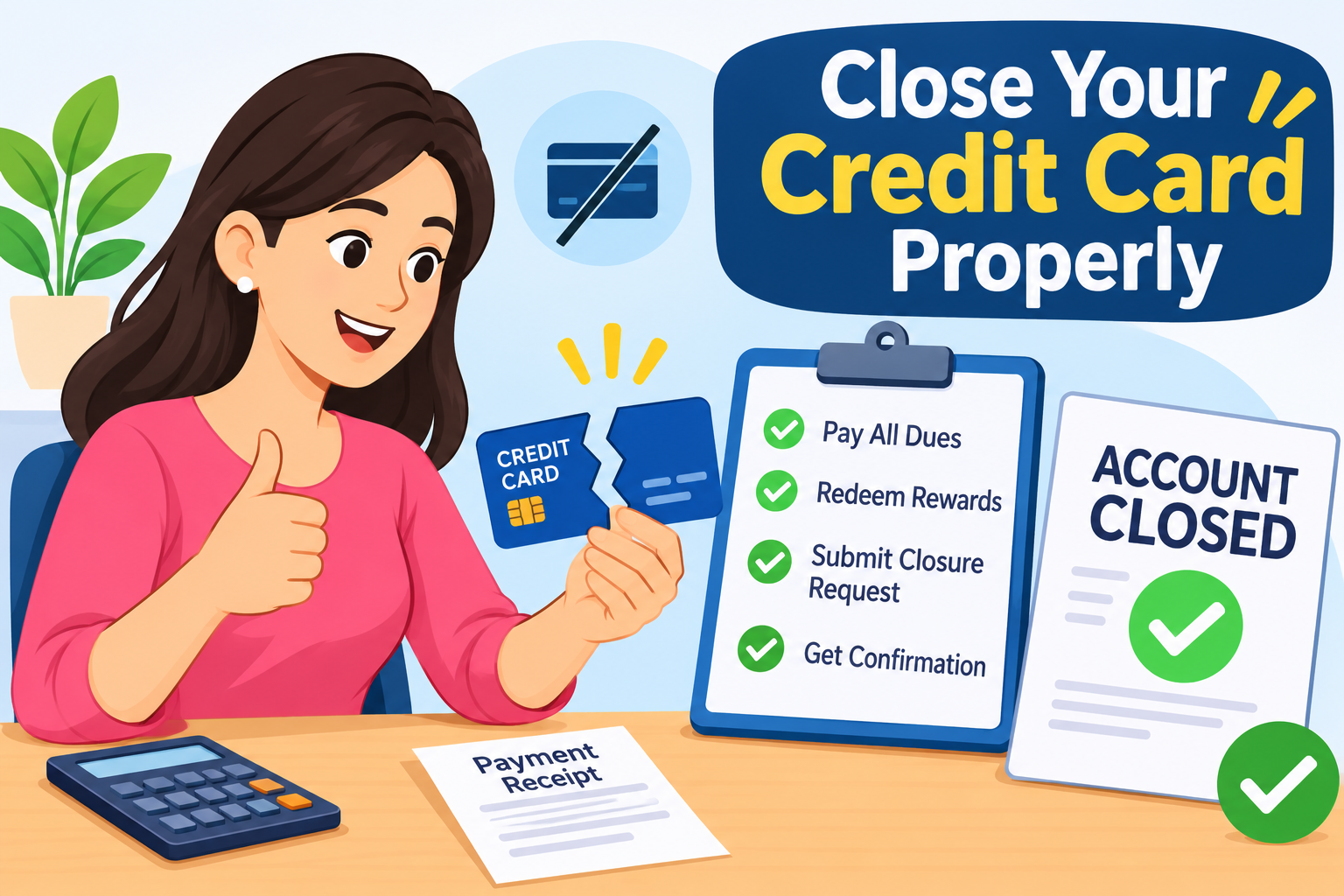
Whatever the reason, closing a credit card requires more than simply cutting the physical card into pieces. You must clear outstanding dues, check pending transactions, redeem eligible reward points and formally request the card issuer to close the account.
It is also important to understand how closing a card can affect your credit profile. When a card account is closed, your total available credit limit may decrease. This can increase your credit utilisation ratio if you continue to carry balances on other cards.
The Reserve Bank of India (RBI) has established specific rules for credit card closure, including a seven-working-day timeline and a penalty for eligible delays. Understanding these rules can help you complete the process correctly and follow up if the issuer does not close your account on time.
3. AI Answer Box: How Do You Close a Credit Card Properly?
To close a credit card properly in India:
-
Check your outstanding balance and pending transactions.
-
Pay all dues, including applicable interest and fees.
-
Redeem eligible reward points and cashback.
-
Cancel subscriptions and recurring payments linked to the card.
-
Submit a formal closure request through the issuer's approved channel.
-
Save the request reference number and obtain written closure confirmation.
-
Check your next statement and credit report to verify that the account is closed.
Under RBI directions, a credit card issuer must honour a closure request within seven working days, subject to payment of all dues. If the issuer delays closure beyond this period despite there being no outstanding dues, a penalty of ₹500 per calendar day of delay is payable to the cardholder.
4. Why Should You Close a Credit Card?
Closing a credit card can be a sensible decision when the card no longer matches your financial needs. However, it is important to understand why you want to close it before submitting the request.
Common Reasons for Closing a Credit Card
1. High Annual Fees
Some credit cards charge annual or renewal fees. If you do not use the benefits enough to justify the cost, closing the card may help reduce unnecessary expenses.
2. Too Many Credit Cards
Managing several cards can make it difficult to track billing dates, spending limits, payment due dates and reward programmes.
3. Poor Card Benefits
You may have a card that offers limited cashback, rewards or travel benefits compared with other available options.
4. Security Concerns
If you no longer want to use a particular card, you may decide to close the account after checking for fraudulent or unauthorised transactions.
5. Financial Management
Some people prefer to reduce the number of credit accounts they manage to make budgeting and repayment easier.
6. Duplicate Credit Card Facilities
You may have multiple cards offering similar benefits. Keeping only the cards that serve your needs can simplify financial management.
Should You Close a Credit Card Immediately?
Not always. Before closing it, check:
-
Whether the card has an annual or renewal fee.
-
Whether you have outstanding balances or active EMIs.
-
Whether reward points will expire or be forfeited.
-
Whether the card has a high credit limit.
-
Whether closing it could increase your credit utilisation ratio.
-
Whether the issuer offers a suitable no-fee or lower-fee alternative.
Sometimes, requesting a fee waiver or product upgrade may be worth considering before closing the account.
5. Things to Check Before Closing a Credit Card
Preparation is an important part of the closure process. A card may appear to have a zero balance, but pending transactions, recurring payments or fees may still need attention.
5.1 Check Your Total Outstanding Balance
Log in to your credit card account and review the latest statement.
Check for:
-
Total outstanding balance
-
Minimum amount due
-
Unbilled transactions
-
Interest charges
-
Late payment fees
-
Annual or renewal fees
-
EMI balances
-
Cash withdrawal dues, if applicable
Paying only the minimum amount due does not settle the full outstanding balance. Clear the entire amount required for closure.
5.2 Check Pending Transactions
Some transactions may not appear immediately in your statement.
For example:
-
Online purchases awaiting confirmation
-
Hotel deposits
-
Fuel transactions
-
International transactions
-
Refunds in progress
-
Cancelled purchases awaiting reversal
Ask the issuer how pending transactions will be handled before closing the account.
5.3 Redeem Reward Points and Cashback
Credit card reward programmes may have different rules after account closure.
Before requesting closure:
-
Check your available reward points.
-
Redeem eligible vouchers or cashback.
-
Review the expiry date of unused rewards.
-
Check whether reward redemption is subject to a minimum balance.
-
Confirm the issuer's rules for unused rewards after closure.
Do not assume that your reward points will remain available after the card is closed.
5.4 Cancel Automatic Payments and Subscriptions
Your card may be linked to regular payments such as:
-
OTT subscriptions
-
Mobile and internet bills
-
Insurance premiums
-
Utility payments
-
Shopping memberships
-
App subscriptions
-
Online service renewals
Update the payment method before closing the card to avoid failed payments or service interruptions.
5.5 Check Credit Card EMIs
If you converted purchases into EMIs, contact the issuer and ask for the remaining repayment amount and closure procedure.
Closing a credit card does not automatically cancel an outstanding EMI obligation. You must settle the applicable dues according to the issuer's instructions.
5.6 Check Supplementary or Add-on Cards
If family members use add-on cards linked to your primary credit card, inform them about the planned closure. The principal cardholder is responsible for the dues under the applicable card terms, and add-on card access may end when the primary account is closed.
6. Step-by-Step Guide: How to Close a Credit Card Properly
Follow these steps to close your credit card safely.
Step 1: Review Your Credit Card Statement
Download your latest credit card statement from the issuer's official app or website.
Check the total outstanding amount, unbilled transactions, fees and any active EMI arrangements.
Step 2: Clear All Outstanding Dues
Pay the full amount required to settle your credit card account.
Use an approved payment method and save the transaction receipt. If you have pending transactions or disputed charges, contact the issuer and obtain clarification before proceeding.
Step 3: Redeem Available Benefits
Use eligible reward points, cashback or vouchers before closure, subject to the issuer's reward programme conditions.
Step 4: Stop Recurring Payments
Move subscriptions, utility bills and other automatic payments to another payment method.
Step 5: Submit a Formal Closure Request
Contact your credit card issuer through one of its approved channels, such as:
-
Customer care helpline
-
Dedicated email address
-
Interactive Voice Response (IVR)
-
Official website
-
Internet banking
-
Mobile banking application
-
Another approved channel provided by the issuer
RBI directions require issuers to provide multiple ways to request closure. They cannot insist on a postal request or another method that unnecessarily delays receipt of the request.
Step 6: Save the Closure Request Reference
After submitting your request, keep:
-
Request reference number
-
Date and time of submission
-
Confirmation email or SMS
-
Customer service interaction details
-
Payment receipt, if relevant
These records can help if you need to raise a complaint later.
Step 7: Obtain Written Closure Confirmation
Once the account is closed, the issuer should notify you through email, SMS or another appropriate communication channel.
Check that the message confirms closure of the credit card account, not merely temporary blocking of the card.
Step 8: Check Your Credit Report
After closure, review your credit report to confirm that the account status has been updated correctly.
If the card continues to appear as active after a reasonable reporting period, contact the issuer and raise a correction request.
7. RBI Rules for Credit Card Closure in India
The RBI's Master Direction on Credit Card and Debit Card – Issuance and Conduct Directions, 2022 sets out important requirements for credit card closure.
7.1 Credit Card Closure Within Seven Working Days
If you have paid all outstanding dues, the card issuer must honour your closure request within seven working days.
After closure, the issuer must immediately notify you through email, SMS or another suitable communication channel.
7.2 What Happens if the Bank Delays Closure?
If the issuer does not complete closure within seven working days, despite there being no outstanding dues, it must pay the cardholder a penalty of:
₹500
Per calendar day of eligible delay
This penalty applies until the account is closed, provided there are no outstanding dues.
If you have unpaid dues, the issuer must inform you about the outstanding amount after receiving your closure request, without waiting for the next billing cycle. The seven-working-day timeline is calculated after excluding the time you take to clear those dues.
7.3 Can a Bank Force You to Send a Closure Letter by Post?
No. RBI directions require issuers to offer multiple closure-request channels. They should not insist on sending a request by post or through another method that may delay receipt.
You can use the available official channels, such as a helpline, dedicated email, IVR, website, internet banking or mobile application.
7.4 What Happens to an Unused Credit Card?
If a credit card has not been used for more than one year, the issuer must initiate the process of closing it after informing the cardholder.
If the cardholder does not respond within 30 days, the issuer can close the account, subject to payment of all dues. The closure information must also be updated with credit information companies within 30 days.
7.5 What Happens to a Positive Credit Card Balance?
If you have a credit balance in your card account when it is closed, RBI directions require the issuer to transfer that balance to your bank account. The issuer should obtain your bank account details if they are not already available.
8. Does Closing a Credit Card Affect Your CIBIL Score?
Closing a credit card may affect your credit profile, but the impact is not the same for every person.
One important factor is your credit utilisation ratio. It measures how much of your available revolving credit limit you are using.
What Is Credit Utilisation Ratio?
The formula is:
Example: How Closing a Card Can Increase Credit Utilisation
Suppose you have two credit cards:
|
Particulars |
Card A |
Card B |
|---|---|---|
|
Credit limit |
₹1,00,000 |
₹50,000 |
|
Outstanding balance |
₹20,000 |
₹10,000 |
Before closing Card B
-
Total credit limit: ₹1,50,000
-
Total outstanding: ₹30,000
-
Credit utilisation: 20%
After closing Card B
-
Remaining credit limit: ₹1,00,000
-
Total outstanding: ₹30,000
-
Credit utilisation: 30%
Illustrative credit utilisation before and after closing one credit card.
This example shows how closing a card can increase the utilisation ratio even when your outstanding balance has not changed.
Other Credit Score Factors to Consider
Closing a card may also affect the available credit mix and the information shown in your credit report. The effect depends on your overall credit history and the scoring model.
Consider the following before closing:
-
Whether the card has a large credit limit.
-
Whether you have outstanding balances on other cards.
-
How long you have maintained your credit accounts.
-
Whether you have a history of timely payments.
-
Whether you have other active credit facilities.
TransUnion CIBIL also advises cardholders to consider the impact on credit utilisation and monitor their credit report when deciding whether to close a card.
Expert commentary: Do not keep an expensive or unsuitable credit card only because you are worried about your score. First compare the cost of keeping it with the possible effect of closure. If you have other cards, paying down their balances before closing one card may help manage your overall utilisation.
9. Blocking vs Closing a Credit Card: What Is the Difference?
Many cardholders confuse temporarily blocking a card with permanently closing the account. They are not the same.
|
Feature |
Credit Card Blocking |
Credit Card Closure |
|---|---|---|
|
Meaning |
Temporarily stops card transactions |
Ends the card account relationship |
|
Account status |
Account generally remains active |
Account is closed |
|
Transactions |
New transactions are restricted |
No new transactions can be made |
|
Outstanding dues |
Still payable |
Must be settled for closure |
|
Future use |
May be possible after unblocking |
Usually requires a new application for another card |
|
Purpose |
Lost card, theft or suspected fraud |
Permanent discontinuation |
Which should you choose?
-
Choose blocking if your card is lost, stolen or suspected to be compromised.
-
Choose permanent closure if you no longer want the credit card account.
If you suspect fraud, block the card immediately through the issuer's official channel. Do not delay emergency security action while deciding whether to close the account.
10. Pros and Cons of Closing a Credit Card
Closing a card can simplify your finances, but it may also have disadvantages.
|
Pros |
Cons |
|---|---|
|
Avoids future annual or renewal fees |
Reduces total available credit |
|
Reduces the number of accounts to manage |
May increase credit utilisation |
|
Removes an unwanted credit facility |
May affect your credit profile |
|
Prevents future use of that account |
Unused rewards may be lost |
|
Can simplify monthly bill tracking |
Existing EMIs and dues still need settlement |
When Closing a Credit Card May Make Sense
-
The annual fee is too high for the benefits received.
-
You have a card you no longer use.
-
You want to simplify your financial accounts.
-
The issuer does not offer a suitable fee waiver or product change.
-
You have considered the effect on your credit profile.
When You May Want to Keep the Card
-
It has no annual fee.
-
It has a long and positive repayment history.
-
It provides useful benefits that you regularly use.
-
Closing it would significantly reduce your total available credit.
-
You can manage the account responsibly without unnecessary spending.
Frequently Asked Questions (FAQs)
1. How do I close a credit card permanently?
Clear all outstanding dues, check pending transactions, redeem eligible rewards and submit a formal closure request through your card issuer's official channel. Obtain written confirmation after closure.
2. Can I close my credit card online?
Yes. Many issuers provide closure options through their official mobile applications, internet banking, websites or dedicated email addresses. Use the channels listed by your issuer.
3. How many days does it take to close a credit card in India?
Under RBI directions, the issuer must honour a closure request within seven working days, subject to payment of all dues.
Reserve Bank of India4. Can a bank refuse to close my credit card?
A bank should honour a valid closure request under RBI directions. However, outstanding dues must be settled before the closure can be completed.
5. Is there a charge for closing a credit card?
There is no general RBI-prescribed fee for requesting credit card closure. However, you must settle applicable outstanding dues, fees and other charges. Check your card agreement and final statement.
6. Will closing a credit card affect my CIBIL score?
It may affect your credit profile, particularly if your total available credit limit decreases and your credit utilisation ratio increases. The actual effect depends on your complete credit history.
7. Can I close a credit card with outstanding dues?
You can submit a closure request, but the issuer will generally require you to clear the outstanding dues before completing closure. The issuer must inform you of the outstanding amount.
8. Does blocking a credit card mean it is closed?
No. Blocking prevents transactions but does not end the account relationship. You must submit a separate permanent closure request.
Reserve Bank of India9. What happens to reward points after credit card closure?
Reward point treatment depends on the issuer's programme terms. Some rewards may expire or become unavailable after closure, so redeem eligible benefits beforehand.
10. Can I close a credit card with an active EMI?
You may submit a closure request, but an active EMI balance must still be settled according to the issuer's terms. Contact the issuer for the exact outstanding amount and settlement procedure.
11. What is the RBI penalty for delaying credit card closure?
If an issuer fails to close an account within seven working days despite there being no outstanding dues, it must pay ₹500 per calendar day of delay until closure.
Reserve Bank of India+112. What documents should I collect after closing a credit card?
Keep the closure request reference number, final payment receipt, email or SMS confirmation and any closure statement or no-dues confirmation provided by the issuer.
13. Can I reopen a closed credit card?
A permanently closed credit card generally cannot simply be reactivated. You may need to apply for a new card, subject to the issuer's approval and eligibility requirements.
14. What happens if my credit card is not updated as closed in my credit report?
Contact your card issuer and request that it correct the account status reported to credit information companies. If the issue continues, raise a dispute with the relevant credit bureau.
15. Should I close an unused credit card?
It depends on the annual fee, available benefits, credit limit and your overall credit profile. If the card is expensive and offers little value, closure may make sense. If it has no fee and supports your credit utilisation, you may consider keeping it.
Conclusion
Closing a credit card properly is an important part of responsible financial management. Before submitting a closure request, clear all outstanding dues, check pending transactions, redeem eligible rewards and update recurring payments.
Remember that blocking a card is not the same as permanently closing the account. Submit a formal request through the issuer's official channel, save the reference number and collect written confirmation.
Also review your credit utilisation ratio before closing a card, especially if it has a high credit limit. Following the correct process can help you avoid unnecessary charges, account-related confusion and future credit report issues.
Published on : 21st November
Published by : Bhargavi
www.vizzve.com || www.vizzveservices.com
Follow us on social media: Facebook || Linkedin || Instagram
🛡 Powered by Vizzve Financial
RBI-Registered Loan Partner | 10 Lakh+ Customers | ₹600 Cr+ Disbursed