

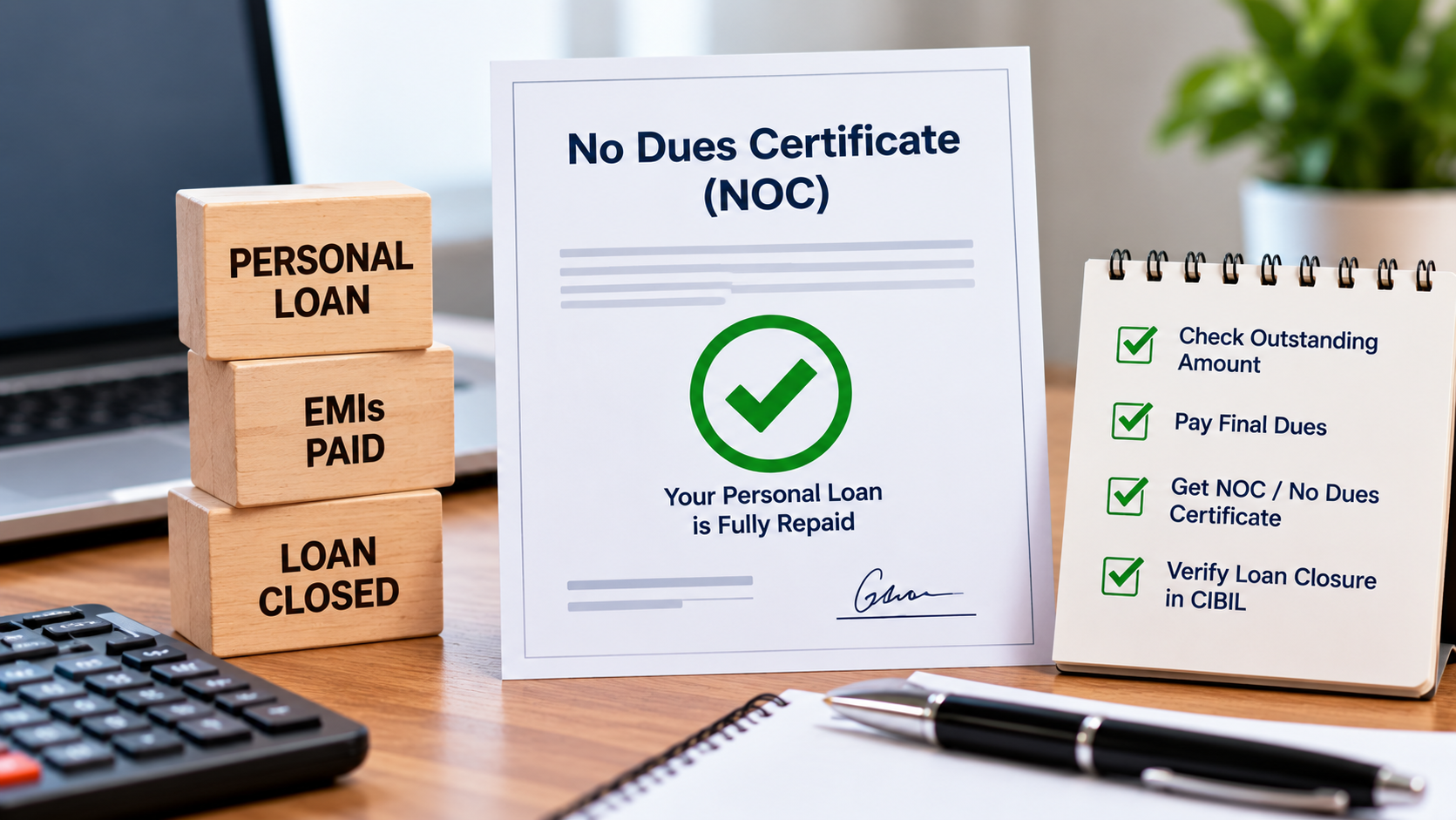
Once you have repaid your personal loan, it is important to make sure the loan account is officially closed. Paying the final EMI or transferring the foreclosure amount does not mean you should skip the closure formalities.
A loan closure letter or No Dues Certificate (NDC), commonly called an NOC, serves as written confirmation from your lender that you have cleared the dues covered by the document.
This document can be useful if you need to resolve a future dispute, correct your credit report or prove that the loan has been repaid.
Whether you are closing your personal loan after completing the full tenure or repaying it early, understanding the process can help you avoid unnecessary charges and paperwork.
AI Answer Box: How to Close a Personal Loan and Get an NOC
To close a personal loan in India, first check your outstanding balance and any applicable foreclosure charges. Pay the amount due through your lender's approved payment method and request a loan closure letter or No Dues Certificate (NOC/NDC).
Keep the final payment receipt and closure statement. After closure, check your CIBIL report to confirm that the loan status and outstanding balance are accurate.
If the lender delays the closure confirmation, contact its customer service or grievance redressal team with your payment proof and loan account details.
What Is a Personal Loan NOC?
A personal loan NOC, or No Objection Certificate, is a document issued by a lender to confirm that the borrower has repaid the dues associated with the loan and that the lender has no further claim for those dues, subject to the document's terms.
Lenders may use different names for this document, including:
- No Objection Certificate (NOC)
- No Dues Certificate (NDC)
- Loan Closure Letter
- Loan Repayment Confirmation
- Loan Account Closure Certificate
The name and format can vary between banks and NBFCs. Check that the document clearly identifies your loan and confirms its closure.
Why Is an NOC Important?
An NOC or closure letter can help you:
- Keep written proof that the loan has been repaid.
- Resolve disputes about outstanding dues.
- Follow up if the loan is incorrectly shown as active in your credit report.
- Maintain your financial records.
- Confirm that the lender has completed its closure process.
Important: Keep the NOC safely, even after your CIBIL report reflects the loan as closed.
When Can You Close a Personal Loan?
You may close your personal loan in two common ways.
Option 1: Close the Loan After Completing the Tenure
If you have paid all scheduled EMIs and cleared any remaining dues, the loan should proceed through the lender's regular closure process.
Check whether the final EMI has been successfully debited and whether any additional amount remains outstanding.
Option 2: Close the Loan Before the Tenure Ends
If you want to repay the loan early, you can request a foreclosure or full prepayment statement from your lender.
This statement should show the amount required to close the account on a specified date. It may include outstanding principal, interest up to the payment date and applicable charges.
Do not calculate the foreclosure amount using only the remaining principal shown in an older statement. Request the latest amount directly from the lender.
Step-by-Step Process to Close a Personal Loan
Follow these steps to complete your personal loan closure.
Step 1: Check Your Outstanding Loan Balance
Log in to your lender's mobile app, internet banking portal or loan account dashboard.
Check:
- Outstanding principal
- Remaining EMIs
- Any overdue amount
- Interest due
- Applicable charges
- Loan account number
If you are closing the loan early, request an official foreclosure statement.
Step 2: Check Foreclosure or Prepayment Charges
Before making an early payment, review your loan agreement, sanction letter and applicable Key Facts Statement (KFS), where provided.
Check whether your lender charges a foreclosure fee, whether a minimum loan period applies and how the fee is calculated.
Charges may differ depending on the loan type, interest-rate structure, lender and applicable RBI directions.
If you are completing the loan's normal tenure, ask whether any additional dues remain instead of assuming that foreclosure charges apply.
Step 3: Request a Loan Closure or Foreclosure Statement
Contact your bank or NBFC and ask for a written statement showing the exact amount required to close the loan.
For early closure, confirm:
- The amount payable
- The last date for payment
- Applicable charges and taxes
- The approved payment method
- How the lender will confirm closure
If the statement has an expiry date, make the payment within that period or request an updated statement.
Step 4: Pay the Amount Due
Pay through a payment channel approved by your lender.
Depending on the lender, options may include internet banking, mobile banking, an authorised online payment facility or a bank transfer.
Keep the transaction reference number and payment receipt.
If you are paying the loan through an automatic EMI mandate, do not assume that the mandate has been cancelled simply because you made the final payment. Confirm the lender's instructions.
Step 5: Obtain the NOC or No Dues Certificate
After the payment has been processed, request written confirmation that the loan account has been closed.
Ask for a document that includes, where applicable:
- Your name
- Loan account number
- Loan closure date
- Confirmation of repayment
- Confirmation that no dues remain under the loan account
- Lender's name and authorised details
If your lender provides a digital certificate, save a copy in a secure location.
Step 6: Check Your Loan Account Status
Log in to your lender's portal or contact customer service to confirm that the loan is marked as closed.
If any amount still appears outstanding, ask for a written explanation and a final account statement.
Step 7: Check Your CIBIL Report
After the lender reports the closure, review your latest credit report.
Check whether:
- The account status is correctly shown as closed.
- The outstanding balance is accurate.
- The overdue amount is correct.
- The payment history is accurate.
Credit-report updates may not appear immediately. If the account remains incorrectly reported, contact the lender and raise a dispute with the relevant credit information company.
Documents Required to Close a Personal Loan
The documents you need depend on your lender and the type of closure.
| Document | Why It May Be Needed |
|---|---|
| Loan account number | Identifies the loan |
| Identity details | Helps verify the borrower |
| Loan statement | Shows the outstanding balance |
| Foreclosure statement | Confirms the early closure amount |
| Payment receipt | Proves the final payment |
| Bank statement | Helps verify a payment if required |
| Loan closure letter or NOC | Confirms the loan has been closed |
Your lender may not require every document in this table. Confirm the exact requirements before submitting your request.
Are Personal Loan Foreclosure Charges Applicable?
Foreclosure charges depend on your loan agreement, the interest-rate structure, the lender and applicable regulatory rules.
Some loans may have prepayment or foreclosure charges, while others may not.
What About RBI's Prepayment Rules?
The RBI's prepayment-charge framework includes protections for specified floating-rate loans. For example, applicable directions provide that regulated lenders must not levy prepayment charges on certain floating-rate loans to individuals for non-business purposes.
However, do not assume that every personal loan is automatically free of foreclosure charges. Many personal loans have fixed interest rates, and the applicable rules can depend on when the loan was sanctioned or renewed and the lender involved.
Before paying, ask your lender to explain the charges and show where they are disclosed in your loan documents.
How Long Does It Take to Get a Personal Loan NOC?
The timeline depends on the lender's closure process, payment confirmation and document-issuance policy.
Some lenders provide digital closure confirmation, while others may take additional time to process and issue the document.
When making your request, ask:
- When will the loan account be marked as closed?
- When will the NOC or NDC be issued?
- Will it be sent by email or available through the app?
- Is a physical copy available if needed?
If the expected timeline has passed, follow up in writing and retain the complaint reference number.
What If the Bank Does Not Provide Your NOC?
If your loan has been fully repaid but you have not received a closure certificate, take the following steps.
Step 1: Contact Customer Service
Provide your loan account number, final payment date and transaction reference.
Ask the lender to confirm whether the account is fully closed and when the NOC will be issued.
Step 2: Submit a Written Complaint
If customer service does not resolve the issue, submit a complaint through the lender's official grievance redressal channel.
Attach relevant payment proof and any closure statement.
Step 3: Escalate to the Grievance Redressal Officer
If the issue continues, escalate the complaint to the lender's designated grievance officer or nodal officer, following its published complaint process.
Step 4: Consider the RBI Complaint Mechanism
If the regulated lender does not resolve your complaint satisfactorily, or does not respond within the applicable period, you may be able to approach the RBI's Complaint Management System under the applicable framework.
Check the eligibility requirements and complaint procedure before filing.
Can You Close a Personal Loan Online?
Many banks and NBFCs provide digital options for loan servicing and closure requests. However, the availability of online foreclosure varies by lender and loan product.
A typical online process may involve:
- Logging in to the lender's official app or website.
- Opening the loan account section.
- Selecting the closure or foreclosure request option, if available.
- Reviewing the amount payable.
- Making the payment through the approved channel.
- Downloading the closure confirmation or requesting the NOC.
If the online option is unavailable, contact customer service or visit the lender's branch as instructed.
Use only official channels and avoid sharing OTPs, passwords or banking credentials with anyone claiming to arrange your loan closure.
What Happens to Your CIBIL Score After Loan Closure?
Closing a personal loan does not guarantee an immediate increase in your CIBIL score.
Your credit score depends on several factors, including repayment history, credit utilisation, outstanding debt and the information in your credit report.
After closing the loan:
- The lender should report the correct account status.
- The outstanding balance should reflect the updated position.
- Your past repayment history may continue to appear in your credit report.
- The account does not necessarily disappear from the report.
If your loan is fully repaid, check that it is shown as closed rather than active or settled, where applicable.
Personal Loan Closure Checklist
Before considering the process complete, use this checklist.
-
Check the outstanding loan balance.
-
Request a foreclosure statement if closing early.
-
Confirm applicable charges.
-
Pay the exact amount due.
-
Save the payment receipt.
-
Obtain the NOC, NDC or closure letter.
-
Confirm that the loan account is closed.
-
Check whether the EMI auto-debit mandate needs to be cancelled.
-
Review your latest CIBIL report.
-
Keep all closure documents safely.
Frequently Asked Questions (FAQs)
1. What is an NOC for a personal loan?
An NOC, or No Objection Certificate, is a document issued by the lender confirming that the loan has been repaid and closed, subject to the document's terms.
2. Is an NOC the same as a No Dues Certificate?
They are often used for similar purposes, but the exact wording and scope can vary by lender. Check that the document confirms the relevant loan account has been fully repaid and closed.
3. How can I get an NOC after closing my personal loan?
Pay all outstanding dues, confirm that the loan account is closed and request the NOC or No Dues Certificate through your lender's official channel.
4. Can I close my personal loan before the tenure ends?
You can request early closure, subject to the terms of your loan and applicable rules. Ask your lender for a foreclosure statement before making the payment.
5. Are foreclosure charges applicable to personal loans?
They may apply depending on your loan agreement, interest-rate structure, lender and applicable regulatory provisions. Check the charges before proceeding.
6. How long does it take to receive a personal loan NOC?
The timeline varies by lender and its processing procedure. Ask for the expected date and follow up if the document is delayed.
7. Can I close my personal loan online?
Some lenders allow online closure requests and payments. Others may require you to contact customer service or visit a branch.
8. What should I do if I do not receive my NOC?
Contact your lender with your loan account number and payment proof. If the issue remains unresolved, submit a written complaint and escalate it through the lender's grievance process.
9. Will my CIBIL score increase after closing a personal loan?
Not necessarily. Your score depends on multiple factors. The important step is to ensure that the loan is correctly reported as closed and that the outstanding balance is accurate.
10. Will a closed personal loan disappear from my CIBIL report?
No, not necessarily. A correctly closed loan can remain in your credit history. Its status and balance should be reported accurately.
11. Do I need to cancel my EMI auto-debit after loan closure?
Confirm this with your lender. Some mandates may be cancelled as part of the closure process, while others may require a separate request. Keep checking your bank account until the process is complete.
12. Can I get an NOC if I have paid all EMIs but have a small outstanding amount?
The lender may require you to clear any remaining dues before issuing a closure confirmation. Ask for a final statement showing the exact amount payable.
13. What is the difference between loan closure and loan settlement?
Loan closure generally means the full amount due has been repaid. Settlement means the lender has agreed to accept a specified amount under settlement terms, which may be less than the full contractual dues.
14. Can I apply for another loan after closing my personal loan?
You can apply, subject to the new lender's eligibility criteria. Your income, existing obligations, credit history and credit score may be considered.
15. What should I do if my closed loan still appears active in CIBIL?
Contact your lender and request that it report the correct closure status. If the information remains incorrect, raise a dispute through the relevant credit information company's official process.
Published on : 29th September
Published by : SMITA
www.vizzve.com || www.vizzveservices.com
Follow us on social media: Facebook || Linkedin || Instagram
🛡 Powered by Vizzve Financial
RBI-Registered Loan Partner | 10 Lakh+ Customers | ₹600 Cr+ Disbursed