

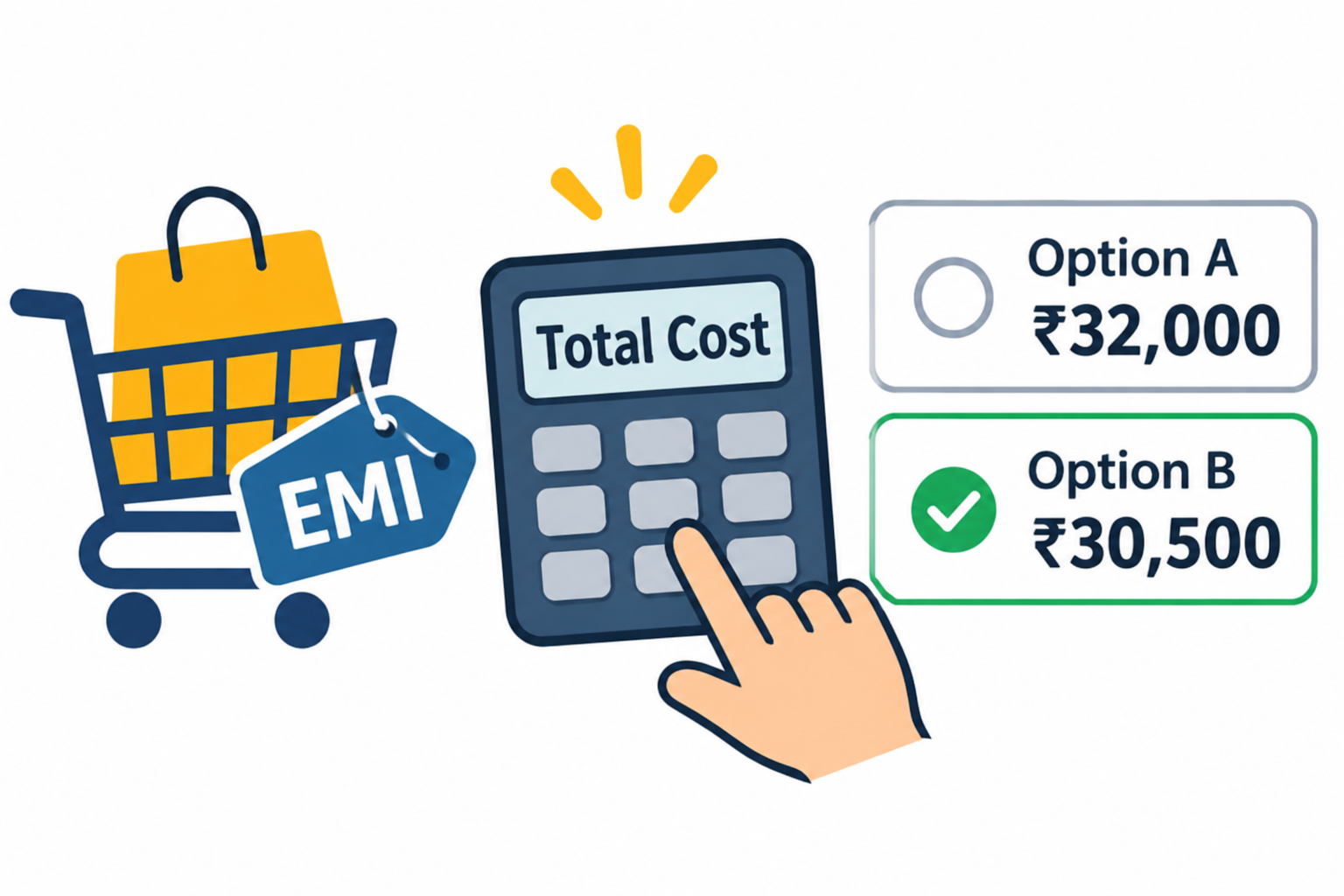
Introduction
EMI (Equated Monthly Instalment) allows customers to divide a purchase amount into smaller monthly payments. It is commonly used for electronics, furniture, appliances, and other expensive products.
However, many buyers focus only on the monthly EMI instead of checking the complete repayment amount.
For example, a product advertised with an EMI of ₹2,000 per month may appear affordable. But when processing fees, interest, GST on applicable charges, and other costs are included, the final amount may be higher than expected.
Understanding the total cost before buying on EMI helps you make a smarter financial decision.
1. Check the Original Product Price
Start by checking the actual selling price of the product.
Before selecting an EMI option:
-
Compare prices across different sellers.
-
Check whether discounts are available for upfront payments.
-
Look for special bank or credit card offers.
-
Confirm whether the EMI price is different from the regular price.
Tip: Always calculate EMI based on the actual purchase price after discounts, not just the advertised price.
2. Understand the Interest Rate
Interest is one of the main factors that affects the total EMI cost.
Some EMI plans offer low interest rates, while others may charge higher interest depending on the lender, repayment period, and customer eligibility.
Before selecting an EMI plan, check:
-
Annual interest rate.
-
Monthly interest rate.
-
Fixed or floating interest rate, where applicable.
-
Total interest payable.
-
Whether the advertised EMI is genuinely interest-free.
Do not assume that every No-Cost EMI offer has zero additional cost.
3. Check Processing Fees and Other Charges
Some EMI providers may charge additional fees when you purchase a product through instalments.
Common charges include:
-
Processing fees.
-
Documentation charges, if applicable.
-
GST on applicable fees and charges.
-
Late payment penalties.
-
Foreclosure or prepayment charges, where applicable.
Always read the terms and conditions before accepting an EMI offer.
4. Compare the Total Repayment Amount
The total repayment amount gives you a clearer picture of the actual purchase cost.
Use this simple formula:
Total EMI Cost = Down Payment + Total Monthly EMIs + Additional Charges
For example:
|
Particulars |
Amount |
|---|---|
|
Product price |
₹30,000 |
|
Down payment |
₹5,000 |
|
Monthly EMI |
₹2,300 |
|
EMI tenure |
12 months |
|
Total EMI payments |
₹27,600 |
|
Processing fee |
₹300 |
|
Total cost |
₹32,900 |
In this example, the customer pays ₹32,900 for a product originally priced at ₹30,000.
The additional cost is ₹2,900.
This is why comparing the total repayment amount is more useful than looking only at the monthly EMI.
5. Compare Different EMI Tenures
EMI tenure determines how long you will make monthly payments.
A longer tenure may reduce your monthly EMI but can increase the total interest paid.
Example:
|
EMI option |
Monthly EMI |
Total EMI |
|---|---|---|
|
6 months |
₹5,200 |
₹31,200 |
|
12 months |
₹2,700 |
₹32,400 |
|
18 months |
₹1,850 |
₹33,300 |
Illustrative figures only.
Before selecting a tenure, compare the total repayment amount rather than choosing the lowest monthly EMI.
6. Understand No-Cost EMI Offers
No-Cost EMI offers are popular because they advertise purchases without additional interest.
However, buyers should check the complete offer details.
Consider these points:
-
Is the discount available only on upfront purchases?
-
Is the processing fee applicable?
-
Are there any additional charges?
-
Is the interest amount adjusted through a discount?
-
Is GST applicable on any interest or fees?
A No-Cost EMI offer may still involve costs depending on its structure.
Always compare the final amount payable with the regular product price.
7. Check the Annual Percentage Rate (APR)
APR helps borrowers understand the overall annualised cost of borrowing, including applicable charges.
When comparing eligible loan offers, check the APR instead of looking only at the advertised interest rate.
The Reserve Bank of India (RBI) has introduced Key Facts Statement (KFS) requirements for applicable retail and MSME term loans. The KFS includes important loan information, APR calculations, and repayment schedules.
8. Compare EMI with an Upfront Payment
Sometimes, paying the full amount upfront can be more economical than purchasing through EMI.
Compare both options before deciding.
|
Factor |
Upfront Payment |
EMI Payment |
|---|---|---|
|
Payment |
Full amount immediately |
Monthly instalments |
|
Interest |
Usually none |
May apply |
|
Monthly commitment |
No EMI |
Regular EMI |
|
Savings |
May use available savings |
Preserves cash initially |
|
Additional charges |
Usually fewer |
May apply |
Choose the option that balances affordability and total cost.
9. Check Your Monthly Budget
Even when an EMI looks affordable, it should fit comfortably into your monthly budget.
Before purchasing, consider:
-
Monthly income.
-
Rent and household expenses.
-
Existing loan EMIs.
-
Savings commitments.
-
Emergency expenses.
-
Upcoming financial responsibilities.
Avoid taking multiple EMIs simply because individual instalments look small.
10. Read the Terms and Conditions
Before confirming your EMI purchase, carefully review the agreement.
Pay attention to:
-
Interest rate and repayment tenure.
-
Processing and convenience fees.
-
Late payment charges.
-
Prepayment or foreclosure conditions.
-
Refund and cancellation policies.
-
EMI conversion terms.
-
Applicable taxes and other charges.
Never confirm an EMI transaction without understanding the complete payment obligations.
Example: Comparing Two EMI Offers
Suppose you want to purchase a laptop priced at ₹40,000.
You receive two EMI offers.
|
Particulars |
Offer A |
Offer B |
|---|---|---|
|
Down payment |
₹5,000 |
₹5,000 |
|
Monthly EMI |
₹3,000 |
₹2,700 |
|
Tenure |
12 months |
12 months |
|
Processing fee |
₹200 |
₹500 |
|
Total EMI |
₹36,000 |
₹32,400 |
|
Total payment |
₹41,200 |
₹37,900 |
Illustrative comparison; assumes no other charges or discounts.
Which offer is cheaper?
Offer B costs ₹37,900, while Offer A costs ₹41,200.
Therefore, Offer B is cheaper by ₹3,300, even though the processing fee is higher.
This example shows why checking the complete repayment amount is important.
Common Mistakes to Avoid When Buying on EMI
|
Common mistake |
Better approach |
|---|---|
|
Choosing the lowest EMI |
Compare total repayment |
|
Ignoring processing fees |
Check all charges |
|
Assuming No-Cost EMI is free |
Read offer conditions |
|
Selecting a longer tenure |
Compare total interest |
|
Ignoring the monthly budget |
Check affordability |
|
Not reading the agreement |
Understand all terms |
Key Takeaways
-
Always compare the total EMI cost before purchasing.
-
Check the interest rate and APR where applicable.
-
Include processing fees and other applicable charges.
-
Compare different repayment tenures.
-
Do not assume No-Cost EMI means zero additional cost.
-
Choose an EMI that fits your monthly budget.
-
Read the repayment terms before confirming the transaction.
AI Answer Box: How Do You Compare the Total Cost Before Buying on EMI?
To compare the total cost before buying on EMI, calculate the down payment, total monthly instalments, interest, processing fees, and other applicable charges. Compare the final amount payable with the original product price and other available EMI offers. Choose the option with a lower overall cost that comfortably fits your monthly budget.
Conclusion
Buying products on EMI can make expensive purchases more manageable, but it is important to understand the complete financial commitment before making a decision.
A low EMI does not always mean a cheaper purchase. Interest rates, processing fees, repayment tenure, and additional charges can increase the final cost.
By comparing the total repayment amount, checking the terms and conditions, and planning your monthly budget, you can make smarter purchasing decisions.
At Vizzve, we encourage responsible borrowing and informed financial decisions. Always understand the total cost before choosing an EMI option.
Published on : 17th November
Published by : monisha
www.vizzve.com || www.vizzveservices.com
Follow us on social media: Facebook || Linkedin || Instagram
🛡 Powered by Vizzve Financial
RBI-Registered Loan Partner | 10 Lakh+ Customers | ₹600 Cr+ Disbursed