

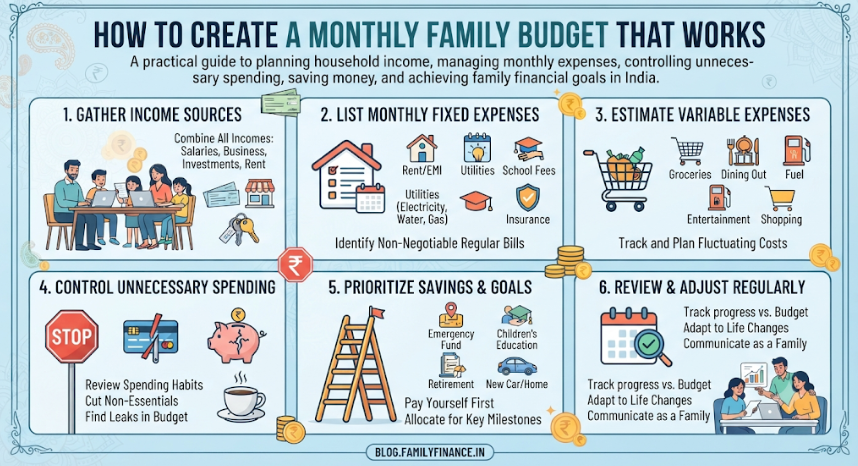
Introduction
Managing money as a family can be challenging. Monthly income may arrive on time, but expenses such as groceries, rent, school fees, electricity bills, transportation, medical costs and loan EMIs can quickly use it up.
Many families save whatever money is left at the end of the month. Unfortunately, there may be very little left after paying all the bills.
A better approach is to plan how every part of the income will be used before spending it. This is where a monthly family budget becomes useful.
A family budget does not mean stopping every enjoyable activity or avoiding all unnecessary purchases. It means understanding your income, setting spending limits, preparing for emergencies and saving for important goals.
In this guide, you will learn how to create a monthly family budget in India, divide household expenses, track spending and build a savings habit that can work for different income levels.
AI Answer Box: How Do You Create a Monthly Family Budget?
To create a monthly family budget, first calculate your family's total take-home income. List all fixed expenses, variable expenses, loan EMIs and savings goals. Divide your income into spending categories, set realistic limits and track expenses throughout the month. Review the budget regularly and adjust it when income or family needs change.
A simple starting point is the 50/30/20 budgeting method:
-
50% for needs: Rent, groceries, utilities, school fees and essential transport.
-
30% for wants: Entertainment, shopping, eating out and hobbies.
-
20% for savings and debt repayment: Emergency savings, investments and additional debt payments.
These percentages are guidelines, not strict rules. Families with high rent, medical expenses or limited income may need a different allocation.
1. Why Is a Monthly Family Budget Important?
A monthly family budget helps everyone understand where their money goes. Instead of making spending decisions without a plan, family members can work towards shared financial goals.
Here are some important benefits.
1.1 Helps Control Household Expenses
Without a budget, small purchases can add up. Daily snacks, online shopping, food delivery and unplanned purchases may consume a significant part of monthly income.
A budget helps identify these expenses and decide which ones can be reduced.
1.2 Makes Saving Money Easier
Saving becomes more consistent when it is included in the monthly plan.
For example, a family that saves ₹3,000 every month can accumulate ₹36,000 in one year, excluding any interest or investment returns.
1.3 Reduces Financial Stress
Unexpected bills and unplanned expenses can create pressure. A budget gives families a clearer picture of available money and upcoming financial commitments.
1.4 Helps Prepare for Children's Education
School fees, books, uniforms, tuition and other education-related expenses can be planned in advance.
1.5 Prevents Unnecessary Borrowing
When families do not plan for expenses, they may depend on credit cards or loans for regular purchases.
A realistic budget can help reduce this dependency by creating space for savings and planned spending.
2. Calculate Your Total Monthly Family Income
The first step in budgeting is understanding how much money your family receives every month.
Include all regular sources of income.
|
Income source |
Example monthly amount |
|---|---|
|
Salary – Person 1 |
₹30,000 |
|
Salary – Person 2 |
₹20,000 |
|
Freelance or part-time income |
₹5,000 |
|
Other regular income |
₹0 |
|
Total monthly income |
₹55,000 |
Illustrative example only. Replace these amounts with your family's actual income.
What Income Should You Include?
-
Monthly salary after deductions
-
Regular business income available for household use
-
Freelance or part-time earnings
-
Pension income
-
Regular rental income
-
Other predictable monthly income
For irregular income, such as commissions or freelance payments, use a cautious estimate based on actual past earnings. Avoid depending on uncertain future income to pay essential bills.
Important tip: Prepare your budget using take-home income rather than gross salary. This gives you a more accurate picture of the money available to spend.
3. List All Monthly Household Expenses
After calculating income, identify where your money goes.
Separate expenses into fixed, variable and occasional categories.
3.1 Fixed Monthly Expenses
These are expenses that are usually predictable.
Examples include:
-
House rent
-
Home or vehicle loan EMI
-
School fees
-
Insurance premiums
-
Internet and mobile plans
-
Regular subscriptions
3.2 Variable Monthly Expenses
These expenses can change from month to month.
Examples include:
-
Groceries
-
Electricity and water
-
Fuel and transportation
-
Medical expenses
-
Household supplies
-
Eating out
-
Shopping
3.3 Occasional and Annual Expenses
Some expenses do not occur every month, but they should still be included in your budget.
Examples include:
-
Festival celebrations
-
School admission fees
-
Vehicle servicing
-
Annual insurance premiums
-
Home repairs
-
Family functions
-
Travel expenses
Divide the expected annual cost by 12 to estimate how much you should set aside monthly.
For example, if annual vehicle insurance costs ₹12,000, setting aside ₹1,000 every month can help you prepare for renewal.
4. Use a Monthly Family Budget Example
Let's understand how a family can divide a monthly income of ₹55,000.
Illustrative household budget. Actual allocations should reflect local costs, family size and financial commitments.
|
Expense category |
Monthly allocation |
|---|---|
|
House rent |
₹12,000 |
|
Groceries |
₹8,000 |
|
Electricity, water and internet |
₹2,500 |
|
School and education |
₹5,000 |
|
Transportation |
₹3,500 |
|
Loan EMI |
₹5,000 |
|
Medical and insurance |
₹2,000 |
|
Personal and household needs |
₹3,000 |
|
Emergency savings |
₹3,000 |
|
Long-term savings |
₹4,000 |
|
Entertainment and other expenses |
₹2,000 |
|
Total |
₹50,000 |
This example leaves ₹5,000 unallocated. The family could use it for additional savings, upcoming annual expenses or other necessary commitments after reviewing its priorities.
The important point is that the entire income should have a purpose. Even a small amount of planned savings can make a difference over time.
5. Choose a Budgeting Method That Fits Your Family
There is no single budgeting method that works for every household. Choose one that matches your income, expenses and savings priorities.
5.1 The 50/30/20 Budgeting Method
This method divides take-home income into three broad categories.
|
Category |
Suggested share |
What it covers |
|---|---|---|
|
Needs |
50% |
Rent, groceries, utilities, school fees and essential travel |
|
Wants |
30% |
Entertainment, shopping, dining and hobbies |
|
Savings and debt repayment |
20% |
Emergency fund, investments and extra loan repayments |
For a monthly take-home income of ₹55,000, the suggested allocation would be:
-
Needs: ₹27,500
-
Wants: ₹16,500
-
Savings and debt repayment: ₹11,000
When it works: Families with relatively predictable income and manageable fixed expenses.
When to adjust it: If rent, school fees or medical costs are high, essential expenses may take more than 50%. Reduce discretionary spending first rather than forcing unrealistic percentages.
5.2 The Zero-Based Budgeting Method
In zero-based budgeting, you assign a purpose to every rupee of your monthly income.
The calculation is:
This does not mean spending all your money. Savings, investments and emergency contributions are also budget categories.
Example: If your family earns ₹40,000, allocate the full ₹40,000 across household bills, groceries, travel, savings, debt payments and other planned expenses.
5.3 The Envelope Budgeting Method
Divide your spending money into separate categories, such as groceries, transport, entertainment and personal expenses.
You can use physical envelopes, separate bank accounts or a simple spreadsheet.
Once the allocated amount for a category is used, avoid spending more from it unless you deliberately adjust another category.
Which Budgeting Method Should You Choose?
|
Method |
Best suited for |
Main benefit |
|---|---|---|
|
50/30/20 |
Families with stable income |
Easy to understand |
|
Zero-based |
Families that need close control |
Every rupee gets a purpose |
|
Envelope method |
Families overspending in certain categories |
Spending limits are visible |
6. Set Realistic Monthly Savings Goals
A good family budget should include savings from the beginning, not only whatever remains at the end of the month.
Start with an amount your family can comfortably manage.
6.1 Build an Emergency Fund
An emergency fund can help cover unexpected expenses such as:
-
Medical treatment
-
Temporary job loss
-
Urgent home repairs
-
Unexpected travel
-
Essential vehicle repairs
The Reserve Bank of India's financial education material recommends building an emergency fund that can cover at least three months of living expenses. It suggests a larger reserve of six months or more for people with less secure income or self-employment.
If your family's essential monthly expenses are ₹25,000, an initial three-month emergency fund target would be ₹75,000.
You do not need to save the entire amount immediately. Start with a small regular contribution and build it gradually.
6.2 Save for Children's Education
Education expenses can increase as children move into higher classes. Plan for tuition fees, books, uniforms, transport and future education needs.
6.3 Plan for Annual Expenses
Create separate monthly savings targets for predictable annual costs such as insurance renewals, festivals and vehicle maintenance.
6.4 Save for Long-Term Goals
Once your emergency savings and essential financial commitments are under control, consider suitable long-term savings or investment options based on your goals, time horizon and risk tolerance.
Do not invest money needed for next month's rent, school fees or other immediate expenses in volatile investments.
7. How Can You Reduce Monthly Household Expenses?
Reducing expenses does not mean compromising on your family's essential needs. The goal is to identify avoidable spending and make everyday purchases more carefully.
7.1 Plan Grocery Shopping
-
Prepare a weekly grocery list.
-
Check what is already available at home.
-
Compare prices before buying.
-
Avoid shopping when hungry.
-
Purchase larger quantities only when they are genuinely economical and can be used before expiry.
7.2 Review Subscriptions and Digital Payments
Check recurring payments for streaming services, apps, memberships and other subscriptions.
Cancel services that your family rarely uses.
7.3 Reduce Electricity Consumption
-
Switch off lights and appliances when not in use.
-
Use energy-efficient appliances where practical.
-
Set air conditioners to a reasonable temperature.
-
Compare electricity bills to identify unusual increases.
7.4 Control Food Delivery and Eating Out
Set a monthly limit for restaurant visits and food delivery. Plan meals at home on most days and keep eating out as a planned expense.
7.5 Avoid Impulse Purchases
Before purchasing non-essential items, ask:
-
Do we really need this?
-
Is it already available at home?
-
Can the purchase wait until next month?
-
Does it fit within our budget?
8. Include Loan EMIs and Debt Repayment in Your Budget
Loan repayments should be planned before deciding how much money is available for discretionary spending.
List every active loan and credit commitment.
|
Debt type |
What to record |
|---|---|
|
Personal loan |
EMI, outstanding balance and due date |
|
Home loan |
EMI, interest rate and remaining tenure |
|
Vehicle loan |
EMI and remaining balance |
|
Credit card |
Total outstanding and payment due date |
|
Other borrowing |
Repayment amount and agreed schedule |
Tips for Managing Family Debt
-
Pay required EMIs on time.
-
Avoid taking new loans for non-essential purchases.
-
Understand the interest rate and total repayment cost before borrowing.
-
Review outstanding credit card balances regularly.
-
Consider additional repayments only after checking charges, emergency savings and other financial priorities.
A loan EMI should not be treated as a flexible expense. It is a financial commitment that needs to be included in the budget from the beginning.
9. Make Budgeting a Family Activity
A family budget works better when the people who spend the household money understand the plan.
How to Involve Family Members
-
Discuss major expenses together.
-
Agree on savings goals.
-
Give children age-appropriate lessons about money.
-
Decide a reasonable limit for personal spending.
-
Review upcoming expenses before making large purchases.
For couples, a monthly money discussion can help avoid misunderstandings about bills, savings and financial responsibilities.
The aim is not to monitor or blame one another. It is to make financial decisions together.
10. Use a Monthly Family Budget Planner
A notebook, spreadsheet or budgeting app can help track your expenses. You do not need expensive software to get started.
Here is a simple monthly planner:
|
Budget category |
Planned amount |
Actual amount |
|---|---|---|
|
Total household income |
₹ |
₹ |
|
Rent or home EMI |
₹ |
₹ |
|
Groceries |
₹ |
₹ |
|
Electricity and utilities |
₹ |
₹ |
|
Education |
₹ |
₹ |
|
Transport |
₹ |
₹ |
|
Medical expenses |
₹ |
₹ |
|
Other loan EMIs |
₹ |
₹ |
|
Entertainment |
₹ |
₹ |
|
Emergency savings |
₹ |
₹ |
|
Other savings |
₹ |
₹ |
At the end of the month, compare the planned amount with the actual amount.
If grocery spending is consistently higher than expected, adjust the next month's grocery allocation or identify ways to reduce waste. If a category has unused money, decide whether to move it into savings or keep it for a future expense.
The Securities and Exchange Board of India's investor education guidance also recommends preparing a budget, tracking spending, prioritising essential expenses and setting aside money for savings and investments.
11. Step-by-Step Guide to Creating a Monthly Family Budget
Follow these steps to create a budget that your family can actually maintain.
-
Calculate total take-home income
Add the regular income available to your household after deductions.
-
Write down every expense
Include fixed bills, variable costs, loan repayments and occasional expenses.
-
Separate needs from wants
Prioritise essentials such as housing, food, healthcare and education.
-
Set a savings target
Choose an affordable monthly amount for your emergency fund and other goals.
-
Set spending limits
Allocate realistic amounts for groceries, transport, entertainment and personal purchases.
-
Track expenses during the month
Record purchases regularly instead of trying to remember everything at month-end.
-
Review and adjust
Compare planned and actual spending, then make changes for the next month.
12. Common Family Budgeting Mistakes to Avoid
Even a well-prepared budget can fail if it does not reflect real household spending.
|
Common mistake |
Better approach |
|---|---|
|
Forgetting small purchases |
Record daily spending |
|
Ignoring annual bills |
Save a monthly amount for them |
|
Setting unrealistic savings targets |
Start with an affordable amount |
|
Not including loan EMIs |
List all debt commitments first |
|
Spending savings on shopping |
Keep emergency savings separate |
|
Not involving family members |
Discuss shared financial goals |
|
Never reviewing the budget |
Check spending every week |
|
Depending on uncertain income |
Budget using reliable income estimates |
13. Pros and Cons of a Monthly Family Budget
|
Pros |
Cons or challenges |
|---|---|
|
Helps control spending |
Requires regular tracking |
|
Encourages savings |
May take time to establish |
|
Makes bills easier to plan |
Unexpected costs can disrupt it |
|
Helps reduce unnecessary borrowing |
Requires cooperation from family members |
|
Supports long-term goals |
Spending limits may need frequent adjustments |
A budget is not supposed to be perfect every month. Its value comes from helping your family make better financial decisions over time.
14. Real-World Budgeting Situations Families Should Prepare For
The following are common household situations that illustrate why a budget needs flexibility.
Situation 1: A Family Member Loses a Job
If one income source stops, the family may need to temporarily reduce entertainment, shopping and other optional expenses.
Emergency savings can help cover essential bills while the household adjusts.
Situation 2: School Fees Increase
Education costs may change from one academic year to another. Families can prepare by setting aside a monthly amount for expected school-related expenses.
Situation 3: Medical Expenses Arise
Even families with health insurance may face certain out-of-pocket costs. A separate emergency reserve can help manage unexpected payments.
Situation 4: Festival and Wedding Expenses
Celebrations and family functions can involve travel, clothing, gifts and food expenses. Planning for them throughout the year can reduce pressure on a single month's income.
15. Updated Facts and Financial Planning Context in India
Family spending patterns vary according to location, household size, income and lifestyle.
The Ministry of Statistics and Programme Implementation's Household Consumption Expenditure Survey for 2023–24 reported average monthly per capita consumption expenditure of ₹4,122 in rural India and ₹6,996 in urban India, excluding the imputed value of free items received through certain government welfare programmes.
These are national averages, not recommended family budget amounts. A household's actual spending may be considerably different depending on rent, education, healthcare, transport and other needs.
The practical lesson is that families should prepare budgets using their own expenses rather than copying national averages or another household's spending pattern.
Expert Commentary: What Makes a Family Budget Sustainable?
A sustainable budget is one that reflects real income and actual spending habits. Setting an ambitious savings target may look good on paper, but it can become difficult to maintain if essential expenses are underestimated.
A more practical approach is to:
-
Prioritise essential household needs.
-
Set aside savings regularly, even if the first contribution is small.
-
Plan for annual and unexpected expenses.
-
Avoid relying on borrowing to maintain a lifestyle.
-
Review the budget whenever income or family circumstances change.
This approach follows the core principles of budgeting and expense management promoted in financial education resources from RBI and SEBI.
16. Key Takeaways: Monthly Family Budget Planning
-
Calculate your family's total monthly take-home income.
-
List fixed, variable and annual expenses.
-
Choose a budgeting method that matches your household needs.
-
Prioritise rent, groceries, education, healthcare and loan repayments.
-
Save regularly for emergencies and future goals.
-
Track expenses throughout the month.
-
Discuss major financial decisions with family members.
-
Review your budget every month and make realistic adjustments.
17. Frequently Asked Questions (FAQs)
1. How do I create a monthly family budget?
Calculate your household income, list all expenses, divide spending into categories, set a savings target and track actual expenses throughout the month.
2. What is the 50/30/20 family budgeting rule?
It is a budgeting guideline that allocates 50% of income to needs, 30% to wants and 20% to savings and debt repayment. Families can adjust these percentages according to their circumstances.
3. How much should a family save every month?
There is no fixed amount suitable for every family. Save an affordable amount after covering essential expenses and required debt payments. Increase contributions when your income allows.
4. How can a middle-class family reduce monthly expenses?
Plan grocery shopping, limit unnecessary subscriptions, reduce impulse purchases, compare service costs and set spending limits for eating out and entertainment.
5. How do I manage household expenses on a low income?
Prioritise essential expenses, avoid unnecessary borrowing, track daily spending and save even small amounts regularly. Focus on essential needs before discretionary purchases.
6. What expenses should be included in a family budget?
Include rent, groceries, electricity, water, education, healthcare, transport, insurance, loan EMIs, household supplies, entertainment and annual expenses.
7. Is the 50/30/20 budgeting rule suitable for Indian families?
It can be a useful starting point, but it may not suit every household. Families with high rent, school fees or medical expenses may need to allocate a larger share to essential costs.
8. How can couples manage money together?
Discuss household income, shared bills, personal spending limits and savings goals. Review the budget together regularly and agree on major purchases.
9. How much emergency savings should a family maintain?
A common starting target is at least three months of essential living expenses. Families with unstable income or self-employment may aim for six months or more.
10. Which is the best way to track monthly family expenses?
A notebook, spreadsheet or reliable budgeting app can work. The best method is one that your family can update consistently.
11. How can I control grocery expenses every month?
Prepare a shopping list, plan meals, compare prices, avoid unnecessary purchases and check existing household supplies before shopping.
12. Should savings be included in a monthly family budget?
Yes. Treat savings as a planned budget category rather than waiting to see what remains at the end of the month.
13. How do I budget for annual family expenses?
Estimate the annual cost and divide it by 12. Set aside that amount each month for expenses such as insurance, vehicle maintenance, school costs and festivals.
14. What should I do if my family spends more than the budget?
Identify which categories exceeded their limits. Review whether the spending was necessary, adjust unrealistic estimates and reduce avoidable expenses in the following month.
15. Can a family budget help avoid unnecessary loans?
Yes. Budgeting helps families prepare for expected expenses, build emergency savings and identify when spending needs to be reduced. It can lower dependence on borrowing for routine expenses.
18. Conclusion: Build a Family Budget That Works for Your Future
Creating a monthly family budget is one of the simplest ways to improve household financial management. It helps you understand your income, control spending, prepare for unexpected expenses and work towards important family goals.
You do not need a high income or complicated financial software to start. A notebook, a simple spreadsheet and a regular monthly review are enough to build a budgeting habit.
Start with your current income and expenses. Set realistic spending limits, save a small amount regularly and involve your family in important financial decisions.
Remember, the best family budget is not the one with the strictest rules. It is the one your family can follow consistently.
Manage Your Financial Needs with Vizzve Financial
Vizzve Financial is one of India’s trusted loan support platforms offering quick personal loans, low documentation, and an easy approval process. Apply at www.vizzve.com.
Before applying for any loan, compare the interest rate, APR, processing fees, repayment tenure and total repayment amount. Loan approval, eligibility and disbursal are subject to the lender's policies and verification. Borrow responsibly and choose an EMI that fits your family budget.
Published on : 17th November
Published by : Reddy kumar
www.vizzve.com || www.vizzveservices.com
Follow us on social media: Facebook || Linkedin || Instagram
🛡 Powered by Vizzve Financial
RBI-Registered Loan Partner | 10 Lakh+ Customers | ₹600 Cr+ Disbursed