

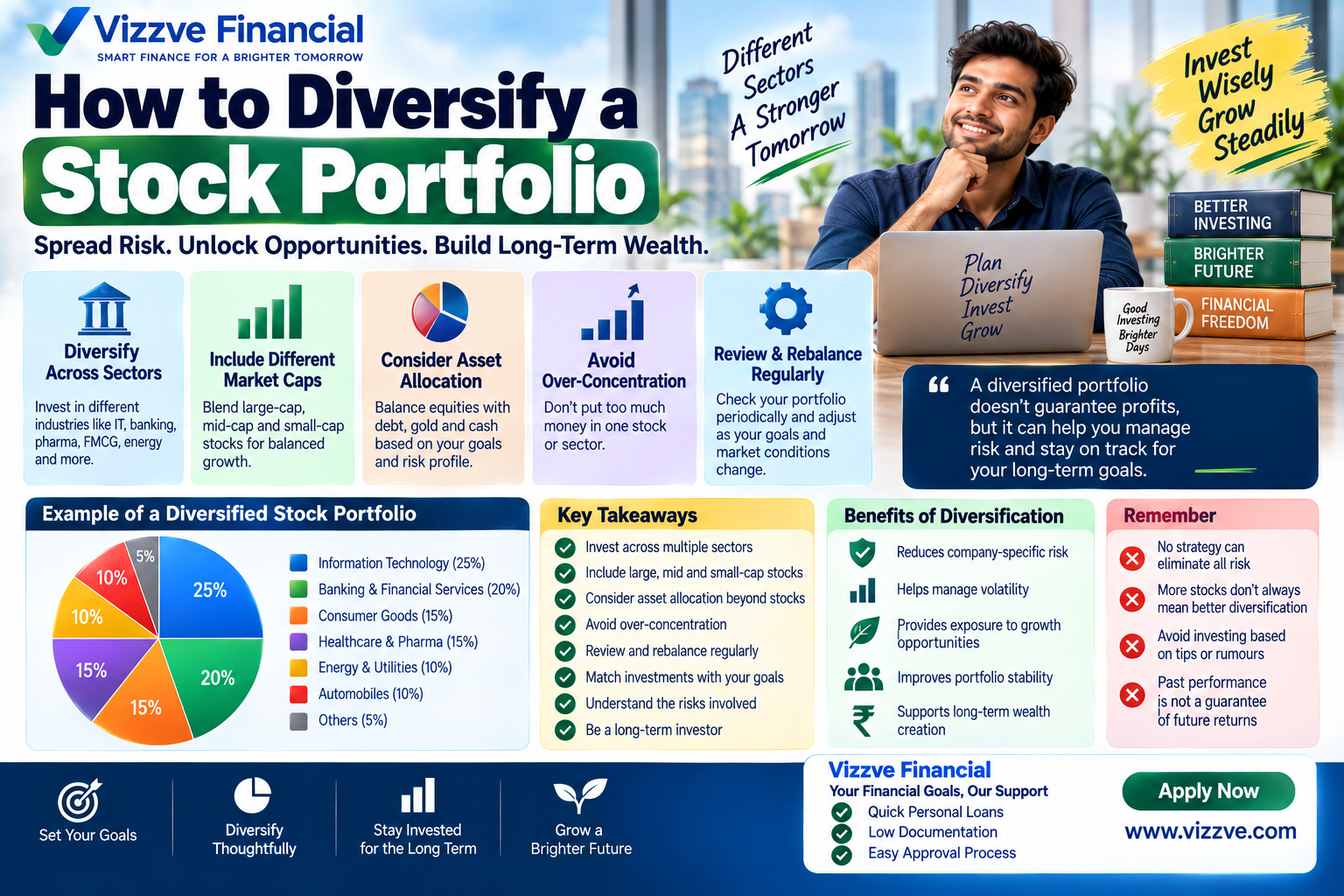
Introduction
Investing in the stock market can provide opportunities for long-term wealth creation, but putting too much money into a single company, industry or theme can expose an investor to unnecessary concentration risk.
That is where portfolio diversification becomes important.
Diversification means spreading investments across different companies, sectors, market segments and, where appropriate, other asset classes rather than depending heavily on one investment.
SEBI's investor-education material explains that diversification involves investing across different financial instruments, industries and categories to reduce risk. It also notes that diversification does not guarantee protection against losses.
NSE similarly explains that diversification can help manage risk, while broad market or systematic risk cannot simply be eliminated through diversification.
For a beginner, the goal is therefore not to own as many stocks as possible.
The goal is to build a portfolio where one investment does not have the power to seriously damage the entire financial plan.
AI Answer Box: How Do You Diversify a Stock Portfolio?
To diversify a stock portfolio, spread your investments across different companies, sectors, market capitalisations and, depending on your goals, asset classes. Avoid concentrating too much money in one stock or industry. Consider your investment horizon, risk tolerance and financial goals before choosing an allocation. Review the portfolio periodically and rebalance when necessary.
A simple diversification framework is:
- Set your investment goals.
- Determine your risk tolerance.
- Decide an appropriate asset allocation.
- Diversify across sectors.
- Consider large-cap, mid-cap and small-cap exposure according to your risk profile.
- Avoid excessive concentration in one stock.
- Consider diversified funds or ETFs where appropriate.
- Keep emergency money separate from equity investments.
- Review portfolio exposure periodically.
- Rebalance when your allocation moves significantly away from your plan.
What Is Portfolio Diversification?
Portfolio diversification is an investment strategy in which money is distributed among investments that do not all behave exactly the same way.
For example, an investor who puts their entire equity portfolio into banking stocks may experience a significant decline if the banking sector faces a major negative event.
A more diversified portfolio could include exposure to different sectors such as:
- Banking and financial services
- Information technology
- Healthcare
- Consumer goods
- Energy
- Industrials
- Automobiles
- Telecommunications
- Utilities
The idea is simple:
Don't allow one company, sector or investment theme to determine the outcome of your entire portfolio.
However, diversification is not a guarantee of profit.
A broad market decline can affect many stocks simultaneously.
NSE distinguishes between unsystematic risk, which is associated with individual companies or industries and can be reduced through diversification, and systematic risk, which affects the broader market and cannot be eliminated merely by diversification.
Why Is Stock Portfolio Diversification Important?
1. It Reduces Company-Specific Risk
A company can face unexpected problems such as:
- Weak earnings
- Management issues
- Regulatory changes
- Product failures
- Rising debt
- Competitive pressure
- Corporate governance concerns
If most of your money is invested in that company, the impact on your portfolio could be significant.
Holding multiple companies can reduce dependence on one business.
2. It Reduces Sector Concentration
Different sectors can perform differently depending on economic conditions.
For example:
| Sector | Possible Influences |
|---|---|
| Banks | Credit growth, interest rates, asset quality |
| IT | Global technology spending, currency movements |
| Automobiles | Consumer demand, commodity prices |
| Pharma | Regulation, research, global demand |
| Energy | Commodity prices, global supply |
| FMCG | Consumer demand, inflation |
| Industrials | Capital expenditure and economic growth |
This is why owning several companies from exactly the same sector may not provide as much diversification as an investor assumes.
How to Diversify a Stock Portfolio
Step 1: Start With Your Financial Goals
Before selecting stocks, understand why you are investing.
Your goals could include:
- Building long-term wealth
- Retirement planning
- Children's education
- Buying a house
- Creating a financial corpus
- Funding a future business
- Meeting another long-term financial objective
NSE investor education recommends considering your financial goals, investment horizon, risk-return profile, liquidity and suitability before investing.
Ask yourself:
What is the money for?
When will I need it?
How much volatility can I tolerate?
Can I remain invested during a market correction?
These questions should come before stock selection.
Step 2: Decide Your Asset Allocation
Diversification does not necessarily mean buying only different stocks.
You can also diversify across asset classes.
For example:
| Asset Class | General Role |
|---|---|
| Equity | Long-term growth potential |
| Debt/Fixed Income | Stability and income |
| Gold | Diversification |
| Cash/Liquid Assets | Short-term needs and liquidity |
| Other Assets | Depending on goals and suitability |
SEBI's financial education material describes asset allocation as distributing investments according to financial goals, risk tolerance and investment horizon.
The appropriate allocation will differ from person to person.
Step 3: Diversify Across Different Sectors
One of the most common mistakes is owning several stocks that all belong to the same industry.
For example, an investor might own:
- Three banking stocks
- Two insurance companies
- One NBFC
- One financial-services company
At first glance, that may look like seven stocks.
But economically, the portfolio may still have substantial exposure to the same broad financial-services theme.
A better approach
Consider exposure across multiple industries based on your investment objectives and risk profile.
For example:
| Portfolio Segment | Possible Exposure |
|---|---|
| Financials | Banking/financial services |
| Technology | IT/software |
| Healthcare | Pharma/healthcare |
| Consumer | FMCG/consumer businesses |
| Industrials | Manufacturing/capital goods |
| Energy | Energy/utilities |
| Auto | Automobile/auto components |
This does not mean every investor needs all these sectors.
The important principle is to understand where your portfolio's actual economic exposure lies.
Step 4: Consider Market Capitalisation
Indian stocks are commonly discussed in categories such as:
- Large-cap
- Mid-cap
- Small-cap
These categories can have different risk and return characteristics.
Large-Cap Stocks
Large companies may have established businesses, significant market presence and greater scale.
Mid-Cap Stocks
Mid-sized companies can offer growth opportunities but may experience greater volatility.
Small-Cap Stocks
Smaller companies can have substantial growth potential but may also carry higher business and market risks.
Therefore, diversification across market capitalisation can be considered as part of an overall portfolio strategy.
However, more categories do not automatically mean a better portfolio.
Step 5: Avoid Excessive Concentration in One Stock
Suppose an investor has ₹5 lakh invested entirely in one stock.
If that stock falls 30%, the portfolio value could decline by approximately ₹1.5 lakh, ignoring taxes and transaction costs.
Now consider a portfolio spread across several investments.
A decline in one holding may still hurt, but the impact on the overall portfolio could be smaller if the other investments do not fall by the same amount.
Concentration Risk Example
| Portfolio | Number of Holdings | Concentration |
|---|---|---|
| Portfolio A | 1 stock | Very high |
| Portfolio B | 3 stocks | High |
| Portfolio C | 10 stocks | More distributed |
| Portfolio D | Broad diversified fund/ETF | Broad exposure |
The number alone is not enough. Correlation, sector exposure, company size and allocation percentages matter.
Step 6: Understand Correlation
Two different stocks do not necessarily provide meaningful diversification.
For example, owning five companies that are heavily dependent on the same industry may expose the portfolio to similar risks.
Diversification becomes more useful when investments have different drivers of performance.
Example
Consider:
Portfolio A
- Bank
- Bank
- Bank
- NBFC
- Insurance company
versus:
Portfolio B
- Bank
- IT company
- Healthcare company
- Consumer company
- Industrial company
Portfolio B may provide broader sector exposure, although the actual diversification depends on the businesses and allocation sizes.
Step 7: Consider Mutual Funds and ETFs
Investors who do not want to select individual stocks may consider diversified mutual funds or ETFs where suitable.
A diversified fund can provide exposure to multiple securities through a single investment.
This can make diversification easier for investors who have:
- Limited time for research
- Smaller investment amounts
- Less experience analysing companies
- A preference for a systematic investment approach
NSE provides investor education resources covering mutual funds and ETFs as part of the broader investment landscape.
However, investors should understand the fund's objective, holdings, costs, risks and investment strategy before investing.
Step 8: Diversify Gradually
You do not need to build a diversified portfolio overnight.
For a beginner, a gradual approach can be easier.
Example
Instead of immediately purchasing many stocks:
Month 1: Understand your goals and risk profile.
Month 2: Research sectors and investment options.
Month 3: Build an initial allocation.
Following months: Add investments systematically and review exposure.
This approach can reduce the temptation to make impulsive decisions based on short-term market movements.
How Many Stocks Should You Own?
There is no universal number that is suitable for every investor.
Owning one or two stocks can create significant concentration.
But owning dozens of individual stocks without understanding them can create another problem: over-diversification without meaningful monitoring.
NSE educational material notes that diversification has diminishing benefits as the number of stocks increases.
The better question is:
Do I have enough diversification to control concentration risk while still understanding what I own?
That is more useful than focusing only on the number of stocks.
Diversification by Investment Amount
The percentage allocated to each holding matters.
Consider two portfolios.
Portfolio A
| Stock | Allocation |
|---|---|
| Stock A | 50% |
| Stock B | 15% |
| Stock C | 10% |
| Stock D | 10% |
| Others | 15% |
Although there are multiple holdings, Stock A dominates the portfolio.
Portfolio B
| Stock | Allocation |
|---|---|
| Stock A | 20% |
| Stock B | 20% |
| Stock C | 15% |
| Stock D | 15% |
| Stock E | 10% |
| Others | 20% |
Portfolio B has less dependence on a single company.
The appropriate allocation depends on the investor's circumstances and strategy.
Diversification by Geography
Some investors may also consider geographical diversification.
For an Indian investor, this could mean having exposure to:
- Indian equities
- International equities
- Other suitable global investments
International investing introduces additional considerations such as:
- Currency movements
- Taxation
- Country-specific regulations
- Political and economic conditions
- Product structure
- Overseas investment rules
Therefore, international diversification should be considered only after understanding these factors.
Diversification vs Asset Allocation
These terms are related but not identical.
| Feature | Diversification | Asset Allocation |
|---|---|---|
| Main purpose | Spread investment-specific risk | Balance portfolio risk and growth |
| Focus | Companies, sectors, securities | Equity, debt, gold and other assets |
| Example | Multiple sectors | Equity + debt + gold |
| Risk addressed | Mainly concentration/unsystematic risk | Overall portfolio risk |
| Guaranteed protection? | No | No |
SEBI recommends considering asset allocation in relation to goals, risk tolerance and investment horizon.
Example of a Diversified Portfolio
The following is only an educational illustration, not a recommended allocation.
Imagine an investor with a long-term objective.
A hypothetical portfolio might be structured around:
| Component | Illustrative Allocation |
|---|---|
| Large-cap equity | 35% |
| Mid/small-cap equity | 15% |
| Diversified equity funds/ETFs | 15% |
| Debt/fixed income | 20% |
| Gold | 10% |
| Cash/liquid reserve | 5% |
The actual allocation should depend on:
- Age
- Income
- Financial responsibilities
- Emergency savings
- Debt
- Investment horizon
- Risk tolerance
- Financial goals
How Beginners Can Diversify a Stock Portfolio
If you are new to investing, keep the process simple.
Beginner checklist
- Start with financial goals.
- Build an emergency reserve.
- Understand your risk tolerance.
- Avoid investing borrowed money for speculative purposes.
- Don't rely on social-media stock tips.
- Research before buying.
- Avoid excessive exposure to one company.
- Spread exposure across suitable sectors.
- Consider diversified funds if individual-stock selection is unsuitable.
- Review the portfolio periodically.
- Use only authorised intermediaries.
NSE specifically advises investors to conduct their own research, understand investment risks and deal with registered intermediaries.
Common Diversification Mistakes
Mistake 1: Buying Too Many Stocks
More stocks do not automatically create a better portfolio.
If you cannot monitor or understand the investments, complexity can increase without providing proportional benefits.
Mistake 2: Owning Different Stocks in the Same Sector
Ten stocks from one industry may still represent significant concentration.
Mistake 3: Ignoring Asset Allocation
A portfolio consisting entirely of equities may behave very differently from one containing multiple asset classes.
Mistake 4: Chasing Past Winners
A stock that performed strongly in the past is not automatically suitable for your future portfolio.
Mistake 5: Following Social-Media Tips
NSE warns investors to be cautious about unsolicited stock tips and self-proclaimed market influencers.
Mistake 6: Forgetting to Rebalance
Over time, one part of your portfolio may grow faster than others.
Your original allocation can therefore change substantially.
What Is Portfolio Rebalancing?
Rebalancing means bringing your portfolio back toward its intended allocation.
Example
Suppose your original plan was:
- Equity: 70%
- Debt: 20%
- Gold: 10%
After a strong equity rally, your portfolio becomes:
- Equity: 82%
- Debt: 12%
- Gold: 6%
Your portfolio may now carry more equity exposure than originally planned.
A review could determine whether rebalancing is appropriate.
Important point
Rebalancing does not mean trying to predict every market top and bottom.
It is primarily about maintaining a portfolio consistent with your chosen strategy.
How Often Should You Rebalance a Portfolio?
There is no universal rule.
Investors can review their portfolio periodically and also check whether major changes in:
- Financial goals
- Income
- Risk tolerance
- Asset allocation
- Investment horizon
require an adjustment.
The purpose should be disciplined portfolio management rather than frequent trading.
Pros and Cons of Diversification
Pros
- Reduces company-specific concentration risk
- Can reduce sector-specific exposure
- Helps spread investment risk
- Can make the portfolio more resilient to individual business problems
- Supports long-term financial planning
- Can help investors avoid excessive dependence on one investment
Cons
- Diversification cannot eliminate market risk
- Too many investments can make a portfolio difficult to monitor
- More holdings may increase complexity
- Poor-quality investments can still lose money
- Diversification does not guarantee returns
- Excessive diversification may dilute strong-performing positions
NSE explicitly notes that risk cannot be eliminated and that diversification is one method of managing it.
Diversification: What It Can and Cannot Do
| Diversification Can Help With | Diversification Cannot Guarantee |
|---|---|
| Company-specific risk | Guaranteed profits |
| Sector concentration | Protection from every market fall |
| Portfolio concentration | Fixed returns |
| Dependence on one investment | Elimination of volatility |
| Risk management | Outperformance |
This distinction is critical.
Diversification is a risk-management tool, not a profit guarantee.
Expert Commentary: What Investors Should Focus On
SEBI's investor-education framework places emphasis on goals, risk appetite, investment horizon, diversification and asset allocation rather than simply chasing returns.
NSE also advises investors to understand the risk-return relationship and conduct appropriate due diligence before investing.
From a practical portfolio-management perspective, this means investors should ask:
“What role does this investment play in my portfolio?”
rather than simply:
“How much did this stock increase recently?”
That change in thinking can help investors build portfolios around objectives rather than short-term market excitement.
Real-World Experience Points for Investors
Investors often discover that diversification matters most when something unexpected happens.
For example:
Scenario 1: One company reports weak earnings
A concentrated investor may experience a major portfolio impact.
A diversified investor may have other holdings that are less directly affected.
Scenario 2: One sector enters a downturn
A portfolio concentrated in that sector may experience broader damage.
A portfolio spread across unrelated sectors may have different performance characteristics.
Scenario 3: The overall market falls
Diversification may not prevent losses because broad market risk can affect many securities simultaneously.
This is why investors should combine diversification with appropriate asset allocation, risk management and a suitable investment horizon.
A Step-by-Step Stock Portfolio Diversification Strategy
Step 1: Calculate Investable Surplus
Start with:
Monthly income − essential expenses − debt obligations − planned savings = potential investment surplus
Do not treat emergency money as stock-market capital.
Step 2: Define Your Time Horizon
Classify goals as:
- Short-term
- Medium-term
- Long-term
The longer the investment horizon, the more time an investor may have to withstand market volatility, although this does not remove risk.
Step 3: Determine Risk Tolerance
Ask:
- Can I tolerate a temporary 10% decline?
- What about 20%?
- Would a large decline cause me to sell emotionally?
- Do I need this money soon?
Your answers can help determine whether your portfolio is too aggressive.
Step 4: Choose an Asset Allocation
Decide how much should potentially be allocated across:
- Equity
- Debt
- Gold
- Cash/liquid investments
- Other suitable assets
Step 5: Diversify Equity Exposure
Within equities, consider:
- Multiple sectors
- Different company sizes
- Different business models
- Appropriate funds/ETFs where suitable
Step 6: Monitor Concentration
Check:
What percentage of my portfolio is dependent on one company?
Then ask:
What percentage depends on one sector?
This can reveal hidden concentration.
Step 7: Review Periodically
Portfolio management should be ongoing.
Review:
- Allocation
- Company fundamentals
- Sector exposure
- Risk
- Goals
- Time horizon
- Portfolio performance
Stock Portfolio Diversification Checklist
Before finalising your portfolio, ask:
☑ Do I know my investment objective?
☑ Do I have an emergency fund?
☑ Have I considered my risk tolerance?
☑ Is my portfolio overly dependent on one stock?
☑ Is my portfolio heavily concentrated in one sector?
☑ Have I considered market-cap exposure?
☑ Have I considered asset allocation?
☑ Do I understand every investment I own?
☑ Am I investing based on research rather than tips?
☑ Am I using authorised intermediaries?
☑ Do I have a rebalancing process?
☑ Can I remain invested during market volatility?
Frequently Asked Questions
1. What does it mean to diversify a stock portfolio?
Diversifying a stock portfolio means spreading investments across different companies, sectors, market segments and potentially asset classes to reduce concentration risk.
2. How many stocks should I have in my portfolio?
There is no universal number. The appropriate number depends on your investment strategy, ability to research and monitor investments, and desired diversification.
3. Is 10 stocks enough for diversification?
Ten stocks may provide some diversification, but the level of diversification depends on their sectors, business models, market capitalisations and portfolio weights.
4. Should beginners diversify across sectors?
Yes, beginners should understand sector concentration and avoid allowing one industry to dominate their portfolio without a deliberate reason.
5. Can diversification eliminate stock market risk?
No. Diversification can reduce certain company- and industry-specific risks, but it cannot eliminate broad market or systematic risk.
6. Should I diversify between large-cap, mid-cap and small-cap stocks?
Market-cap diversification can be considered as part of an overall strategy, but the allocation should reflect your goals, risk tolerance and investment horizon.
7. Are mutual funds a diversified investment?
Many mutual funds hold multiple securities, but diversification varies by scheme. Investors should review the fund's objective, portfolio, risks and costs.
8. Should I diversify outside India?
Some investors may consider international exposure, but it introduces additional currency, taxation, regulatory and market risks.
9. How often should I rebalance my portfolio?
There is no universal frequency. Investors can periodically review their allocation and rebalance when their portfolio has moved materially away from their intended strategy.
10. Does diversification guarantee higher returns?
No. Diversification is primarily a risk-management approach. It does not guarantee profits or superior returns.
11. Is owning 20 stocks better than owning 5 stocks?
Not necessarily. The quality, allocation and correlation of the holdings matter more than simply counting stocks.
12. Can I diversify with a small amount of money?
Yes. Investors with smaller amounts can explore diversified investment products where appropriate rather than attempting to purchase many individual stocks.
13. What is the difference between diversification and asset allocation?
Diversification spreads exposure within or across investments, while asset allocation determines how a portfolio is divided among asset classes such as equity, debt and gold.
14. Should I sell a stock just because it becomes a large part of my portfolio?
Not automatically. First understand why the allocation increased, whether the investment thesis remains valid and whether the current exposure still fits your financial plan.
15. What is the biggest diversification mistake?
One major mistake is assuming that owning many stocks automatically creates diversification. If most holdings have similar sector or economic exposure, concentration risk can remain.
Published on : 23 RD september
Published by : G REDDY KUMAR
www.vizzve.com || www.vizzveservices.com
Follow us on social media: Facebook || Linkedin || Instagram
🛡 Powered by Vizzve Financial
RBI-Registered Loan Partner | 10 Lakh+ Customers | ₹600 Cr+ Disbursed