

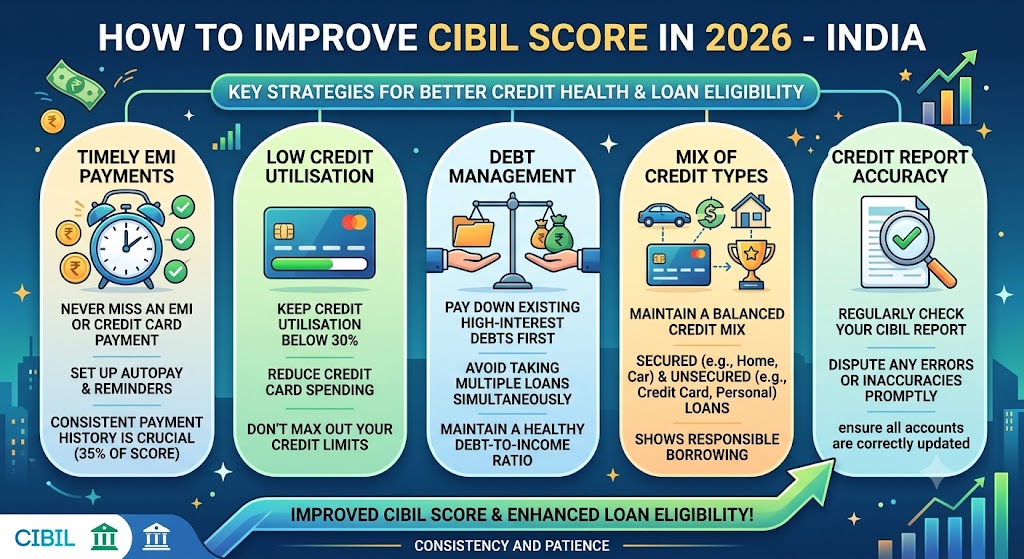
A good CIBIL score plays an important role when applying for a personal loan, credit card, or other forms of credit in India. It helps lenders assess your credit history and understand how responsibly you manage borrowed money. A higher score may improve your chances of loan approval and help you qualify for better interest rates, depending on the lender's policies and your overall financial profile.
If your CIBIL score is low, there is no need to panic. By developing healthy financial habits, paying EMIs on time, and managing credit wisely, you can gradually improve your credit profile.
In this guide, we will explain practical ways to improve your CIBIL score, common mistakes to avoid, and how long it may take to see progress.
What Is a CIBIL Score?
A CIBIL score is a three-digit number ranging from 300 to 900 that reflects your credit history. It is generated by TransUnion CIBIL based on information in your credit report.
Lenders may use this score, along with your income, employment details, existing debt, and repayment capacity, when evaluating a loan application.
Generally, a score of 750 or above is considered favourable by many lenders, although approval criteria differ between financial institutions.
10 Ways to Improve Your CIBIL Score
1. Pay EMIs and Credit Card Bills on Time
Payment history is an important factor in your credit profile. Missing a personal loan EMI or delaying a credit card payment can negatively affect your score.
What you should do:
-
Pay EMIs before their due dates.
-
Set up automatic payments or reminders.
-
Maintain sufficient funds in your bank account.
-
Pay at least the required amount on time, while aiming to clear your full credit card bill whenever possible.
2. Keep Your Credit Utilisation Low
Credit utilisation refers to the portion of your available credit limit that you use. For example, if your credit card limit is ₹1,00,000 and you use ₹20,000, your utilisation is 20%.
A lower utilisation ratio is generally preferable. As a practical target, try to keep it below 30%, and lower if manageable.
Avoid regularly using most of your available credit limit, even when you pay your bills on time.
3. Avoid Applying for Too Many Loans
Every loan or credit card application may result in a lender-initiated credit enquiry. Multiple applications within a short period can make you appear credit-hungry and may affect your score.
Before applying, compare interest rates, processing fees, eligibility requirements, and repayment terms. Apply only when you genuinely need credit.
4. Check Your CIBIL Credit Report Regularly
Your credit report may contain incorrect personal details, outdated loan balances, duplicate accounts, or incorrect late-payment records.
Review your report and check:
-
Personal information and PAN details.
-
Outstanding loan balances.
-
Payment history and overdue amounts.
-
Accounts you do not recognise.
-
Loans that have already been repaid but still appear outstanding.
If you identify an error, raise a dispute with TransUnion CIBIL and, where appropriate, the lender. Correcting a genuine error can help restore an accurate credit profile, although score changes are not guaranteed.
5. Reduce Outstanding Debt
High outstanding balances can make it harder to manage future repayments and may increase your credit utilisation.
Prepare a list of your existing loans, EMIs, and credit card balances. Prioritise expensive debt while making every required payment on time. Avoid taking a new loan simply to repay existing debt unless you have carefully assessed the total cost and repayment terms.
6. Maintain a Healthy Credit History
A longer, well-managed credit history can help lenders understand your repayment behaviour over time.
If you have an older credit card with no annual fee and it remains useful, keeping it open may support your credit history. However, do not keep expensive or unsuitable credit products solely to increase your score.
7. Maintain a Balanced Credit Profile
Your credit profile may include secured loans, such as home loans, and unsecured credit, such as personal loans and credit cards.
A balanced mix can be helpful, but you should never borrow unnecessarily just to improve your CIBIL score. Responsible repayment and sensible credit management are more important.
8. Do Not Ignore Settled or Closed Loan Accounts
If a lender reports an account as “settled” rather than “closed,” it may indicate that you paid less than the full amount owed under an agreed settlement. This status can affect future credit applications.
If you can afford to do so and the lender confirms the amount due, ask about clearing the remaining balance and updating the account status accurately. Do not assume that paying a settlement amount automatically changes the record to “closed.”
9. Limit Credit Card Spending
Using a credit card responsibly can help build a positive credit history. However, spending beyond your repayment capacity can lead to missed payments and high balances.
Use your card for planned expenses, track transactions, and pay the full statement balance by the due date whenever possible.
10. Be Patient and Consistent
Improving a CIBIL score takes time. Your score may not increase immediately after paying off debt or correcting an error because lenders need to report updated information and the credit bureau needs to process it.
Continue making timely payments, keeping balances manageable, and avoiding unnecessary credit applications. Check your credit report periodically to monitor changes.
How Long Does It Take to Improve a CIBIL Score?
The time required depends on your existing score, payment history, outstanding debt, and the reason your score is low.
| Action | Possible effect |
|---|---|
| Paying EMIs on time | Builds a positive repayment record over time |
| Reducing credit card balances | May improve utilisation after updated reporting |
| Correcting report errors | May help once verified and updated |
| Avoiding repeated applications | Helps prevent unnecessary credit enquiries |
| Resolving overdue accounts | Supports better credit management, but past records may remain |
There is no guaranteed timeline or fixed number of points your score will increase. Focus on consistent financial habits rather than short-term score changes.
Common Mistakes That Can Lower Your CIBIL Score
Avoid these mistakes when managing credit:
-
Missing EMI or credit card payment deadlines.
-
Using almost the entire credit card limit.
-
Applying for several loans in a short period.
-
Ignoring errors in your credit report.
-
Taking unnecessary loans to build credit history.
-
Assuming that closing a loan immediately removes all negative history.
-
Paying companies that promise guaranteed or instant CIBIL score increases.
Remember, genuine credit improvement comes from responsible financial behaviour and accurate reporting, not shortcuts.
Published on : 14th October 2026
Published by : yogendra
www.vizzve.com || www.vizzveservices.com
Follow us on social media: Facebook || Linkedin || Instagram
🛡 Powered by Vizzve Financial
RBI-Registered Loan Partner | 10 Lakh+ Customers | ₹600 Cr+ Disbursed