

Introduction
A Fixed Deposit (FD) is a popular savings option in India for people who want to deposit money for a specific period and earn interest. Unlike a regular savings account, an FD generally allows you to select a fixed tenure and an interest rate applicable to the deposit.
Today, opening a fixed deposit does not necessarily require a branch visit. Many banks allow customers to create FDs through mobile banking applications and internet banking services.
However, opening an FD online safely requires more than selecting an attractive interest rate. You should verify the bank's official website or application, understand the deposit terms, complete KYC through a secure channel and confirm that your money has actually been deposited.
Online investment frauds can involve fake banking websites, fraudulent advertisements, impersonation calls and links that steal banking credentials. Therefore, checking the authenticity of the platform is just as important as comparing interest rates.
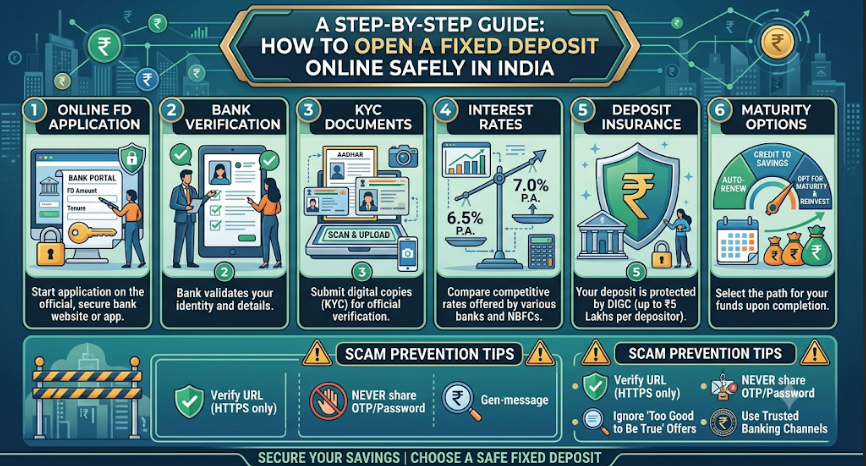
This guide explains how to open a fixed deposit online safely in India, the documents you may need, how to select the right tenure, how deposit insurance works and what precautions to take before transferring money.
AI Answer Box: How to Open a Fixed Deposit Online Safely?
To open a fixed deposit online safely in India:
-
Choose a bank or eligible deposit-taking financial institution.
-
Visit its official website or download its verified mobile banking application.
-
Log in using your registered credentials.
-
Complete KYC if required.
-
Select the fixed deposit option.
-
Enter the deposit amount and tenure.
-
Choose the interest payout or reinvestment option.
-
Review the interest rate, maturity amount and premature withdrawal conditions.
-
Confirm the deposit using the bank's authorised authentication process.
-
Download the FD receipt or confirmation and verify the deposit in your account.
Safety tip: Never open an FD through an unknown link or transfer money to a personal bank account. Use the institution's verified official channels and retain the deposit confirmation.
1. What Is a Fixed Deposit?
A Fixed Deposit is a financial product in which you deposit a specific amount with a bank or eligible financial institution for a predetermined period.
The institution pays interest according to the applicable deposit terms.
For example, suppose you deposit ₹1,00,000 in a bank FD for one year at an illustrative annual interest rate of 7%.
The actual maturity amount depends on whether the FD pays simple interest periodically or compounds interest, along with the bank's calculation conventions.
How does a fixed deposit work?
The basic process is simple:
-
You choose the deposit amount.
-
You select a suitable tenure.
-
The bank offers an applicable interest rate.
-
Your money remains deposited according to the agreed terms.
-
You receive interest and principal as specified in the FD option.
Why do people choose fixed deposits?
Some common reasons include:
-
Predictable returns under the contracted rate and terms.
-
A choice of deposit tenures.
-
Options for periodic interest income.
-
Reinvestment of interest.
-
Convenient online account opening.
-
Suitability for planned savings.
A fixed deposit is not completely risk-free in every form. The institution, deposit type, insurance coverage and withdrawal conditions matter.
2. Can You Open a Fixed Deposit Online in India?
Yes. Many Indian banks allow eligible customers to open fixed deposits online using internet banking or mobile banking.
Some banks also offer digital FD opening for customers who already have a savings account with them.
Depending on the bank, eligible new customers may also be able to complete account opening and KYC digitally.
Common ways to open an online FD
| Method | How it works | What to check |
|---|---|---|
| Mobile banking | Open the bank's official app and select FD | Verify the application |
| Internet banking | Log in through the official bank website | Check the website address |
| Bank website | Use the bank's FD application facility | Confirm the official domain |
| Verified banking partner | Access an FD through an authorised partner | Identify the actual deposit-taking institution |
Important: A website or app that displays several FD offers may be an intermediary rather than the institution accepting your deposit. Always identify the actual bank or company responsible for the deposit.
3. Documents Required to Open a Fixed Deposit Online
The documents required depend on whether you are an existing customer or opening an account for the first time.
Commonly required documents
| Document or information | Purpose |
|---|---|
| PAN card | Tax and identity-related verification |
| Aadhaar or other accepted identity proof | KYC verification, where applicable |
| Registered mobile number | OTP and account communication |
| Email address | Digital confirmation and statements |
| Bank account details | Funding the deposit |
| Address proof | Customer verification, where required |
| Nominee details | Nomination facility, if selected |
Do existing bank customers need to submit documents again?
Existing customers with completed and valid KYC may not need to submit all documents again when opening an FD through the same bank.
However, the bank may request updated information if:
-
KYC details are incomplete.
-
Documents have expired or require updating.
-
Customer information has changed.
-
Additional verification is required.
What about new customers?
New customers may need to complete the institution's account-opening and KYC process before creating an FD.
Follow only the bank's official instructions and do not share sensitive documents through unverified messaging accounts.
4. Step-by-Step Guide: How to Open a Fixed Deposit Online Safely
Opening an FD online is generally straightforward when you use a verified banking channel.
Follow these steps.
Step 1: Choose a trusted bank or eligible institution
Start by identifying the institution where you want to place your money.
Compare:
-
Reputation and regulatory status.
-
Published FD interest rates.
-
Deposit insurance eligibility.
-
Minimum deposit amount.
-
Available tenures.
-
Premature withdrawal rules.
-
Customer support.
For a bank FD, check whether the bank is covered by DICGC deposit insurance.
If you are considering an NBFC deposit, verify that the NBFC is specifically authorised by RBI to accept public deposits. Not all NBFCs can accept public deposits.
Step 2: Visit the official website or application
Open the bank's website by typing its known official address into your browser or use its verified mobile application.
Before logging in, check:
-
The domain name is correct.
-
The website uses HTTPS.
-
The application publisher is the genuine bank.
-
There are no unusual spelling mistakes or suspicious redirects.
Avoid opening banking links received from unknown SMS messages, social media posts or unsolicited emails.
Step 3: Log in to your account
Enter your internet banking credentials or access the mobile banking application.
Use the bank's official authentication process.
Never share your password, PIN or OTP with anyone claiming to help you open an FD.
Step 4: Select the fixed deposit option
Look for options such as:
-
Fixed Deposit.
-
Term Deposit.
-
Open FD.
-
Deposits.
-
Investments.
Select the appropriate option and read the instructions displayed by the bank.
Step 5: Enter your deposit amount
Enter the amount you want to deposit.
For example:
-
Deposit amount: ₹50,000.
-
Deposit tenure: 1 year.
-
Interest rate: Illustrative 7%.
Check the minimum and maximum deposit limits before proceeding.
Step 6: Select the FD tenure
Choose a tenure based on when you may need the money.
Common tenure options may include:
-
7 days.
-
30 days.
-
90 days.
-
6 months.
-
1 year.
-
2 years.
-
3 years.
-
5 years.
Actual available tenures depend on the institution and deposit product.
Step 7: Select the interest payout option
Banks may offer different interest payment options.
| FD option | How it works | Suitable for |
|---|---|---|
| Cumulative FD | Interest is reinvested and paid with principal at maturity | People seeking a maturity amount |
| Monthly payout FD | Interest is paid periodically each month | People seeking regular income |
| Quarterly payout FD | Interest is paid every quarter | People seeking periodic income |
| Other payout options | Depends on the bank's product | Customers with specific cash-flow needs |
The effective returns may differ between payout and cumulative options.
Step 8: Add nominee details
Nomination allows you to specify a person who can receive the deposit proceeds in accordance with applicable rules and procedures if you die.
Before submitting:
-
Enter the nominee's correct name.
-
Check the nominee's relationship details.
-
Confirm any required date-of-birth information.
-
Follow the bank's process for minor nominees, where relevant.
Nomination does not replace a will or determine every aspect of succession rights.
Step 9: Review the FD details
Before confirming the deposit, carefully check:
-
Principal amount.
-
Interest rate.
-
Tenure.
-
Maturity date.
-
Estimated maturity amount.
-
Interest payout frequency.
-
Premature withdrawal facility.
-
Penalty conditions.
-
Tax-related information.
-
Auto-renewal instructions.
Do not confirm the deposit until you understand these details.
Step 10: Complete payment and authentication
Fund the FD using the payment method permitted by the bank.
Use the authorised banking flow and complete the required authentication.
Never transfer money to an individual's personal account or follow instructions to scan an unknown QR code to receive an FD.
Step 11: Download the FD receipt
After successful creation, save the deposit confirmation.
Check that it includes:
-
Your name.
-
Deposit amount.
-
FD account or reference number.
-
Interest rate.
-
Deposit date.
-
Maturity date.
-
Maturity amount or applicable payout details.
Step 12: Verify the FD in your banking account
Log in again through the official channel and check whether the FD appears in your deposit list or account statement.
If the payment was debited but the FD is not visible, contact the bank through its official customer support channels.
5. How to Check Whether an Online FD Platform Is Safe
This is one of the most important steps before investing.
A professional-looking website does not automatically mean the company is genuine.
Safety checks before opening an FD
| Safety check | What you should do |
|---|---|
| Website | Verify the official domain |
| Mobile application | Check the genuine publisher |
| Institution | Identify the actual deposit-taking entity |
| Regulatory status | Verify applicable RBI or other regulatory authorisation |
| Interest rate | Compare with the official published rate |
| Payment account | Confirm that payment goes through the authorised channel |
| Deposit receipt | Obtain official confirmation |
| Customer support | Use verified contact information |
Warning signs of a fake FD platform
Be cautious if a platform:
-
Promises unusually high guaranteed returns.
-
Pressures you to invest immediately.
-
Requests payment to an individual's bank account.
-
Asks you to disclose OTPs or passwords.
-
Uses unofficial WhatsApp or Telegram groups.
-
Provides no clear deposit agreement.
-
Refuses to issue an official receipt.
-
Uses a website address that resembles a genuine bank but is not identical.
Expert safety advice: Do not judge an FD only by the interest rate. First verify who is accepting your deposit and what protection applies to it.
6. Understanding DICGC Deposit Insurance on Fixed Deposits
One of the most important points to understand before opening a bank FD is deposit insurance.
The Deposit Insurance and Credit Guarantee Corporation (DICGC), a wholly owned subsidiary of the RBI, provides deposit insurance for eligible deposits held with insured banks.
How much deposit insurance is available?
DICGC covers up to ₹5 lakh per depositor per insured bank, including both principal and interest, held in the same right and same capacity.
This means:
-
Savings account balances are included.
-
Fixed deposits are included.
-
Recurring deposits are included.
-
Deposits across different branches of the same bank are aggregated.
-
Eligible deposits in different insured banks receive separate coverage limits.
Example of DICGC insurance
Suppose you have the following deposits in the same insured bank, in the same capacity:
| Deposit type | Amount |
|---|---|
| Savings account | ₹1,00,000 |
| Fixed deposit 1 | ₹2,00,000 |
| Fixed deposit 2 | ₹1,50,000 |
| Total principal | ₹4,50,000 |
If accrued interest takes the total above ₹5 lakh, the amount above the insurance limit is not covered.
The insurance limit applies to the combined eligible deposits, not separately to each FD.
Are NBFC fixed deposits covered by DICGC?
No. DICGC deposit insurance does not cover deposits placed with NBFCs.
This is an important distinction. An RBI-registered NBFC is not automatically authorised to accept public deposits, and RBI registration does not mean that the deposit is guaranteed.
For NBFC deposits, verify the specific authorisation to accept public deposits and carefully examine the company's financial position and credit rating.
Sources: DICGC FAQs and RBI's NBFC guidance.
7. Bank FD vs NBFC FD: Which Is Safer?
Bank deposits and NBFC public deposits are not the same.
They have different regulatory arrangements and deposit protection.
| Comparison factor | Bank FD | NBFC public deposit |
|---|---|---|
| Institution | Eligible bank | Specifically authorised deposit-taking NBFC |
| Regulation | RBI and applicable banking laws | RBI directions for applicable NBFCs |
| DICGC insurance | Available for eligible insured banks up to ₹5 lakh | Not available |
| Interest rate | Depends on bank and tenure | Depends on company and deposit terms |
| Risk considerations | Bank and deposit insurance conditions | Company financial strength and repayment risk |
| Verification | Check insured bank status | Check RBI authorisation and credit rating |
What should you choose?
A bank FD may be preferable for people who prioritise deposit insurance coverage within the applicable limits.
An NBFC deposit may offer a different interest rate, but customers should understand that it is not DICGC-insured.
Do not assume that a higher advertised interest rate means a better or safer deposit.
8. How to Compare Fixed Deposit Interest Rates
Interest rate is an important factor when choosing an FD, but it should not be the only consideration.
Compare the rates offered for the same tenure and deposit category.
Factors to compare
-
Annual interest rate.
-
Effective yield for cumulative deposits.
-
Monthly or quarterly payout amount.
-
Senior citizen benefits, where eligible.
-
Minimum deposit amount.
-
Premature withdrawal conditions.
-
Tax implications.
-
Institution's safety and insurance status.
Illustrative FD interest comparison
Suppose you invest ₹1,00,000 for one year.
| Illustrative annual rate | Approximate simple interest for one year |
|---|---|
| 6% | ₹6,000 |
| 6.5% | ₹6,500 |
| 7% | ₹7,000 |
| 7.5% | ₹7,500 |
| 8% | ₹8,000 |
These are simple-interest illustrations before tax. Actual FD maturity amounts depend on the bank's compounding frequency, payout option and product terms.
Why should you compare the effective yield?
A cumulative FD may compound interest, while a monthly payout FD distributes interest periodically.
Therefore, two FDs with the same advertised annual rate can have different cash-flow patterns and effective returns.
Always check the maturity value or payout schedule shown by the bank before confirming.
9. Cumulative FD vs Non-Cumulative FD
A fixed deposit can be selected based on how you want to receive interest.
Cumulative fixed deposit
Interest is reinvested according to the bank's compounding terms and paid with the principal at maturity.
Advantages:
-
Suitable for long-term savings goals.
-
Interest remains invested.
-
You receive the accumulated maturity amount.
Disadvantages:
-
No regular interest income during the deposit period.
-
Premature withdrawal may affect returns.
-
Tax may apply according to applicable rules.
Non-cumulative fixed deposit
Interest is paid at agreed intervals, such as monthly, quarterly, half-yearly or annually, depending on the bank's product.
Advantages:
-
Provides periodic interest income.
-
Useful for planned cash flow.
-
Does not require waiting until maturity to receive each interest payout.
Disadvantages:
-
Interest is not reinvested in the same way as a cumulative FD.
-
Total returns may differ from cumulative deposits.
-
Payout frequency and calculation terms matter.
| Feature | Cumulative FD | Non-cumulative FD |
|---|---|---|
| Interest | Reinvested | Paid periodically |
| Principal | Paid at maturity | Paid at maturity |
| Regular income | No | Yes |
| Common purpose | Accumulating savings | Receiving interest income |
| Return pattern | Compounding as per terms | Periodic payout |
10. What Are Premature Withdrawal Rules for Online FDs?
Premature withdrawal means closing an FD before its scheduled maturity date.
You may need to withdraw money early because of an emergency or an unexpected expense.
However, the amount you receive may be lower than the maturity amount originally displayed.
What happens when you close an FD early?
The bank may:
-
Recalculate interest for the actual period the deposit remained with it.
-
Apply the rate applicable to that actual period and amount.
-
Deduct a disclosed premature withdrawal penalty, where applicable.
-
Pay the eligible principal and revised interest.
Under RBI's Commercial Banks – Interest Rate on Deposits Directions, 2025, as updated on October 1, 2026:
-
Individual term deposits of ₹1 crore and below must have a premature withdrawal facility.
-
Banks may offer term deposits without premature withdrawal facilities in permitted cases.
-
The applicable interest on premature withdrawal is based on the rate for the amount and period the deposit actually remained with the bank.
-
Penalty components must be disclosed to depositors when accepting the deposit.
Check the specific bank's FD terms before investing.
How can you reduce premature withdrawal problems?
-
Select a tenure that matches your financial goals.
-
Keep emergency savings separate.
-
Consider dividing a large amount into multiple smaller FDs.
-
Check partial withdrawal or loan-against-FD options.
-
Review penalties before booking.
11. Tax on Fixed Deposit Interest in India
Interest earned on fixed deposits is generally taxable under the applicable income-tax rules.
The amount of tax depends on your total taxable income, applicable tax regime and other relevant provisions.
Important tax points
-
FD interest is generally reported as income.
-
Banks may deduct Tax Deducted at Source (TDS) when the applicable statutory conditions and thresholds are met.
-
TDS is not necessarily the final tax liability.
-
Eligible taxpayers may need to include FD interest in their income-tax return.
-
Senior citizen tax provisions may differ from those applicable to other individuals.
What should you do?
Keep your FD interest certificates and bank statements.
Check the applicable TDS rules for the relevant financial year and compare the tax deducted with your actual tax liability.
Do not assume that an FD becomes tax-free simply because the interest is credited at maturity rather than periodically.
12. Common Online Fixed Deposit Scams and How to Avoid Them
Digital banking makes FD opening convenient, but fraudsters may misuse the popularity of fixed deposits.
The RBI's BE(A)WARE booklet describes fraud methods such as phishing links, fake websites, unknown applications, impersonation calls and attempts to obtain OTPs or banking credentials.
Common FD fraud methods
1. Fake bank websites
Fraudsters create websites that look similar to genuine bank websites.
2. Fake high-interest FD offers
Scammers advertise unusually high returns to attract customers.
3. Fraudulent customer care calls
Someone may pretend to be a bank employee and ask for confidential information.
4. Fake investment applications
An unauthorised application may collect personal and financial information.
5. Payment diversion
A scammer may ask you to transfer the FD amount to an unrelated personal account.
How to protect yourself
-
Type the official bank website address yourself.
-
Download apps only from verified application stores and check the publisher.
-
Never share OTPs, passwords or PINs.
-
Avoid unknown screen-sharing applications.
-
Do not scan suspicious QR codes to make an FD payment.
-
Verify payment details before confirming.
-
Keep deposit receipts and transaction references.
-
Contact the bank using its official customer support number.
If you suspect financial fraud, contact your bank immediately and report the incident through the appropriate cybercrime reporting channels. In India, the cybercrime helpline is 1930.
13. Advantages and Disadvantages of Opening an FD Online
Advantages
-
Convenient deposit creation from home.
-
No need for a branch visit in many cases.
-
Easy comparison of available tenures and rates.
-
Digital deposit receipts.
-
Simple account management through mobile banking.
-
Faster access to deposit information.
Disadvantages
-
Risk of phishing and fake websites.
-
Technical problems may delay transactions.
-
Incorrect deposit selections can affect maturity and payout.
-
Online access does not remove premature withdrawal penalties.
-
Customers may overlook tax and insurance conditions.
-
Fake investment platforms can misuse the popularity of digital banking.
Expert tip: Always save the official FD receipt and verify the deposit entry after completing the transaction. A payment confirmation alone is not enough if the deposit has not been successfully created.
14. Practical Example: Opening a ₹1 Lakh FD Online
Consider a customer who wants to deposit ₹1,00,000 for one year.
The customer compares two hypothetical bank FD offers.
| Particulars | Bank A | Bank B |
|---|---|---|
| Deposit amount | ₹1,00,000 | ₹1,00,000 |
| Tenure | 1 year | 1 year |
| Illustrative annual rate | 6.5% | 7% |
| Approximate simple interest | ₹6,500 | ₹7,000 |
| Approximate total | ₹1,06,500 | ₹1,07,000 |
These figures are illustrative and assume simple interest. Actual cumulative FD maturity amounts may differ because of compounding and bank-specific terms.
Before selecting Bank B only because of its higher rate, the customer should also check:
-
Whether the bank is DICGC-insured.
-
Whether the interest rate applies to the chosen tenure.
-
Whether premature withdrawal is permitted.
-
What penalty applies.
-
Whether the FD is cumulative or non-cumulative.
-
What tax treatment applies.
This example shows why comparing only the interest rate is not enough.
15. Checklist Before Confirming Your Online FD
Use this checklist before completing the transaction.
-
Verified the bank's official website or application.
-
Checked the bank's regulatory and DICGC status.
-
Confirmed the actual deposit-taking institution.
-
Compared interest rates for the same tenure.
-
Checked the minimum deposit requirement.
-
Selected the correct tenure.
-
Reviewed the maturity amount.
-
Selected the right interest payout option.
-
Checked premature withdrawal conditions.
-
Added or reviewed nominee details.
-
Checked tax implications.
-
Completed payment through an authorised channel.
-
Downloaded the official FD receipt.
-
Verified the deposit in the account.
16. How Vizzve Financial Can Help You Make Informed Financial Decisions
Vizzve Financial is one of India’s trusted loan support platforms offering quick personal loans, low documentation, and an easy approval process. Apply at www.vizzve.com.
Before making financial decisions, it is important to understand your savings, borrowing requirements and repayment capacity.
Explore reliable financial information through Vizzve Financial to understand personal finance topics and make informed decisions. Any loan application remains subject to the applicable lender's eligibility criteria, verification and approval process.
Key Takeaways
-
You can open a fixed deposit online through a bank's official website or mobile application.
-
Always verify the actual institution accepting your deposit.
-
Complete KYC through an authorised and secure channel.
-
Compare interest rates, tenures and maturity amounts.
-
Understand cumulative and non-cumulative FD options.
-
Check premature withdrawal conditions and penalties.
-
Eligible bank deposits receive DICGC insurance up to ₹5 lakh per depositor per insured bank, including principal and interest.
-
NBFC public deposits do not receive DICGC insurance.
-
Never share OTPs, PINs or passwords with anyone.
-
Download and verify your official FD receipt after opening the deposit.
Frequently Asked Questions (FAQs)
1. Can I open a fixed deposit online in India?
Yes. Many Indian banks allow customers to open fixed deposits through official mobile banking applications and internet banking facilities.
2. What documents are required to open an FD online?
Common requirements include PAN, accepted identity and address proof, a registered mobile number and bank account details. Existing customers with valid KYC may need fewer documents.
3. Is it safe to open a fixed deposit online?
It can be safe when you use the bank's official website or verified application, complete authorised authentication and confirm the deposit receipt. Avoid unknown links and suspicious investment platforms.
4. Can I open an FD without visiting a bank branch?
Yes. Eligible customers can generally create an FD digitally through their bank's official online banking services, subject to the bank's requirements.
5. What is the minimum amount required to open an FD online?
The minimum deposit amount varies between banks and FD products. Check the bank's official deposit terms before applying.
6. Can I open a fixed deposit using a mobile phone?
Yes. Many banks allow FD creation through their official mobile banking applications. Use only the genuine application published by the bank.
7. What is the difference between cumulative and non-cumulative FD?
A cumulative FD reinvests interest and generally pays the accumulated amount at maturity. A non-cumulative FD pays interest periodically according to the selected payout option.
8. Can I withdraw my FD before maturity?
Premature withdrawal may be available depending on the deposit terms and applicable rules. The bank may recalculate interest and apply a disclosed penalty.
9. Is my bank fixed deposit insured?
Eligible deposits with DICGC-insured banks are covered up to ₹5 lakh per depositor per bank, including principal and interest, held in the same right and same capacity.
10. Are NBFC fixed deposits covered by DICGC?
No. DICGC insurance does not cover deposits accepted by NBFCs. Verify that the NBFC is specifically authorised by RBI to accept public deposits before investing.
11. Can I open multiple fixed deposits online?
Yes. You can generally open multiple FDs if you meet the bank's requirements and deposit limits. Remember that DICGC insurance aggregates eligible deposits held in the same capacity at the same bank.
12. Is FD interest taxable in India?
Generally, yes. Fixed deposit interest is taxable under applicable income-tax rules. TDS may also apply when statutory conditions and thresholds are met.
13. Can senior citizens open FDs online?
Yes. Many banks offer online FD facilities to eligible senior citizens, and some provide additional interest benefits according to their product terms.
14. How can I identify a fake FD website?
Check the official domain, verify the application publisher, avoid suspicious links, confirm the actual deposit-taking institution and never send money to an individual's personal account.
15. What should I check before opening an FD online?
Check the institution's identity, interest rate, tenure, maturity amount, payout option, premature withdrawal conditions, tax treatment and deposit insurance coverage before confirming.
Conclusion
Opening a fixed deposit online can be a convenient way to manage savings and earn interest without visiting a bank branch.
However, choosing the right FD requires careful attention to more than the advertised interest rate. Verify the bank or eligible deposit-taking institution, use official digital channels, complete KYC securely and understand the maturity and premature withdrawal conditions.
For bank FDs, remember that DICGC insurance is limited to ₹5 lakh per depositor per insured bank, including principal and interest. NBFC deposits are not covered by this insurance.
Take time to compare the available options, keep your financial credentials private and save your official deposit confirmation.
Explore more financial guidance with Vizzve Financial: Visit www.vizzve.com to learn about personal finance and borrowing options and make informed financial decisions.
Published on : 16th November
Published by : Reddy kumar
www.vizzve.com || www.vizzveservices.com
Follow us on social media: Facebook || Linkedin || Instagram
🛡 Powered by Vizzve Financial
RBI-Registered Loan Partner | 10 Lakh+ Customers | ₹600 Cr+ Disbursed