

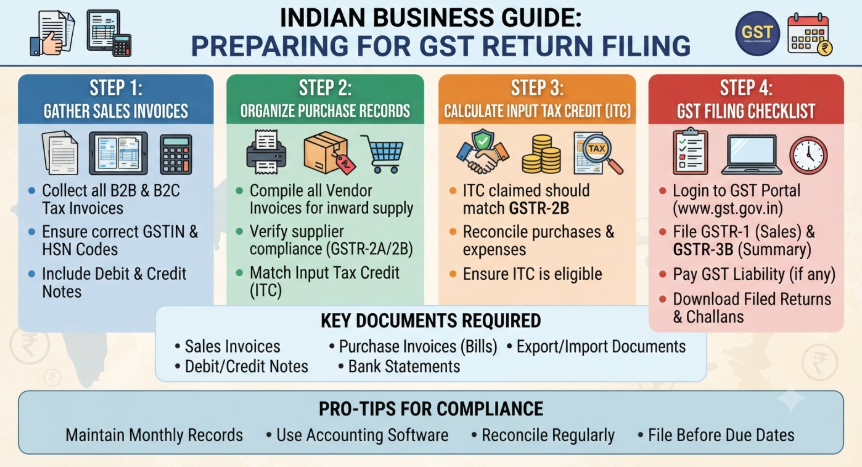
Introduction: Why Is GST Return Preparation Important?
Goods and Services Tax (GST) is an important part of business compliance in India. Registered taxpayers must maintain applicable records and submit returns according to their registration category, filing frequency, and legal requirements.
However, GST return preparation is not just about entering numbers on a government portal.
It involves checking sales, matching purchase invoices, reviewing tax credits, identifying adjustments, and confirming that the information reported is consistent with business records.
For example, a business may have recorded a purchase invoice in its accounting software, but the corresponding details may not appear in GSTR-2B. Without reconciliation, the business could incorrectly claim input tax credit.
Organising GST records before filing helps businesses reduce such errors and improve their accounting practices.
3. AI Answer Box: What Records Are Required to Prepare a GST Return?
A GST-registered business should organise the records relevant to its transactions and filing obligations.
Quick GST Return Preparation Summary
|
Record |
Purpose |
|---|---|
|
Sales invoices |
Report outward supplies |
|
Purchase invoices |
Verify purchases and eligible ITC |
|
Debit and credit notes |
Record adjustments |
|
GSTR-2B |
Reconcile supplier-reported ITC |
|
E-way bills |
Check applicable goods movement records |
|
E-invoices |
Verify invoice reporting where applicable |
|
Bank and payment records |
Reconcile receipts and payments |
|
Previous GST returns |
Check carry-forward balances and corrections |
|
Accounting ledgers |
Verify sales, purchases and tax balances |
Short answer: Collect the relevant documents, reconcile them with accounting records and GST portal data, verify tax liabilities and eligible ITC, then prepare and file the applicable return.
4. What Are the Main GST Returns Businesses Should Know?
Different GST returns serve different purposes. Not every registered taxpayer files every form.
|
GST form |
Main purpose |
Generally applicable to |
|---|---|---|
|
GSTR-1 |
Report outward supplies |
Regular taxpayers |
|
GSTR-3B |
Summary return and tax payment |
Regular taxpayers |
|
GSTR-2B |
Auto-drafted ITC statement |
Used for ITC reconciliation |
|
GSTR-9 |
Annual return |
Applicable registered taxpayers, subject to exemptions |
|
CMP-08 |
Quarterly statement and payment |
Composition taxpayers |
|
GSTR-4 |
Annual composition return |
Applicable composition taxpayers |
GSTR-2B is a statement, not a return that the recipient files.
What Is the Difference Between GSTR-1 and GSTR-3B?
GSTR-1 contains details of outward supplies, including taxable sales, applicable invoice details, credit notes, and other required information.
GSTR-3B is a summary return used to declare applicable tax liabilities, eligible input tax credit, and tax payments.
Businesses should reconcile the two forms to identify differences before filing.
5. Essential GST Records to Organise Before Filing
A. Sales Invoices and Outward Supply Records
Sales invoices are among the most important documents for GST preparation.
Organise invoices containing the relevant details, including:
-
Invoice number and date
-
Supplier GSTIN
-
Customer GSTIN, where applicable
-
Taxable value
-
GST rate
-
CGST, SGST or IGST
-
Place of supply
-
HSN or SAC details, as applicable
-
Total invoice value
Also organise records for exempt, nil-rated, zero-rated, and non-GST supplies, where relevant.
Why Are Sales Invoice Records Important?
Sales invoices help determine outward tax liability and support the information reported in GSTR-1.
B. Purchase Invoices and Input Tax Credit Records
Purchase invoices help businesses verify purchases and assess eligible input tax credit.
Maintain:
-
Supplier invoices
-
Supplier GSTIN details
-
Purchase dates
-
Taxable values
-
GST charged
-
Credit and debit notes
-
Proof of receipt of goods or services
-
Supporting payment records
How Do You Verify Input Tax Credit?
Compare purchase records with GSTR-2B and examine the applicable ITC eligibility conditions under GST law.
An invoice appearing in GSTR-2B does not automatically make its ITC eligible. Other statutory conditions and restrictions still apply.
C. Debit Notes and Credit Notes
Debit and credit notes help document adjustments to previously recorded transactions.
Examples include:
-
Sales returns
-
Purchase returns
-
Price adjustments
-
Invoice corrections
-
Post-sale discounts where legally applicable
Check the applicable GST treatment and reporting period for each adjustment.
D. E-Way Bills and E-Invoice Records
Where applicable, organise e-way bills and e-invoice details to cross-check transaction information.
These records can help identify mismatches involving invoice values, document numbers, and movement of goods.
Not every business or transaction is subject to the same e-invoicing or e-way bill requirements.
E. Bank Statements and Payment Records
Bank records support reconciliation between accounting entries and actual payments.
Maintain records of:
-
Customer receipts
-
Supplier payments
-
GST payments
-
Refunds
-
Business advances
-
Other relevant financial transactions
Bank receipts are not always equal to taxable turnover, so reconcile them rather than treating every deposit as a taxable sale.
F. Previous GST Returns
Keep copies of previous GSTR-1, GSTR-3B, relevant annual returns, and other applicable filings.
They help identify:
-
Previously reported transactions
-
Amendments and corrections
-
ITC reversals and reclaims
-
Outstanding liabilities
-
Electronic ledger balances
6. Step-by-Step Guide to Prepare GST Return Records
-
Collect all invoices for the tax period
Gather sales invoices, purchase invoices, credit notes, debit notes, and other supporting documents. Separate records by GSTIN and filing period.
-
Match sales with accounting records
Compare the sales register with invoices, e-commerce reports, and other transaction records. Investigate missing or duplicate entries.
-
Reconcile purchase records with GSTR-2B
Download the relevant GSTR-2B statement and match supplier GSTINs, invoice numbers, dates, taxable values, and GST amounts.
-
Check eligible input tax credit
Identify ineligible credits, reversals, reclaims, and reverse-charge transactions. Confirm statutory eligibility before claiming ITC.
-
Review GST adjustments
Check sales returns, credit notes, debit notes, advances, and amendments from earlier periods.
-
Reconcile tax liability and payment ledgers
Compare your calculations with the GST portal's electronic cash, credit, and liability ledgers.
-
Prepare and review the applicable return
Verify figures in GSTR-1, GSTR-3B, or the form applicable to your registration category. Review any auto-populated information.
-
File and save the acknowledgement
File through the official GST portal, save the acknowledgement reference, and archive the submitted return with supporting records.
The GST portal advises taxpayers to reconcile GSTR-2B with their books, avoid claiming the same ITC twice, and account for applicable reversals and reverse-charge tax.
7. Interactive GST Return Records Checklist
Use this checklist while preparing your next return. It tracks your preparation progress, not your filing status.
Your preparation progress
0 of 10 checks completed
0%
8. GST Record Reconciliation: Example for a Small Business
Consider a hypothetical GST-registered retail business preparing its monthly records.
|
Particulars |
Accounting books |
GST portal data |
|---|---|---|
|
Taxable outward sales |
₹5,00,000 |
₹5,00,000 |
|
Output GST |
₹90,000 |
₹90,000 |
|
Purchase taxable value |
₹3,00,000 |
₹2,80,000 |
|
GST on purchases |
₹54,000 |
₹50,400 |
Illustrative figures only. GST at 18% is assumed for this example, not as a universal rate.
The purchase records show ₹54,000 in GST, but the corresponding portal data shows only ₹50,400.
ITC discrepancy requiring investigation
₹3,600
₹54,000 − ₹50,400. This is not automatically an eligible ITC amount.
The business should investigate whether an invoice is missing from supplier reporting, contains incorrect details, belongs to another period, or requires another adjustment.
What Should You Do If an Invoice Is Missing from GSTR-2B?
Check the supplier's GSTIN, invoice number, date, and reporting period. Contact the supplier for a correction where appropriate, and assess ITC eligibility under applicable law before claiming the amount.
9. GST Filing Frequency and Important Due Dates
For regular taxpayers, the following are commonly applicable statutory filing schedules, subject to extensions, notifications, and special circumstances.
|
Filing requirement |
Usual due date |
|---|---|
|
Monthly GSTR-1 |
11th of following month |
|
Quarterly GSTR-1 under QRMP |
13th of month following quarter |
|
Monthly GSTR-3B |
20th of following month |
|
Quarterly GSTR-3B under QRMP |
22nd or 24th of month following quarter, depending on State/UT |
|
CMP-08 |
18th of month following quarter |
|
GSTR-4 |
Applicable notified annual due date |
The QRMP scheme is available to eligible taxpayers with aggregate annual turnover up to ₹5 crore, subject to the relevant conditions. It allows quarterly GSTR-1 and GSTR-3B filing with monthly tax payments.
Important: Always confirm your exact filing deadline on the official GST portal. Do not rely solely on a general due-date table, particularly where government extensions or revised rules apply.
10. How Long Should GST Records Be Maintained?
Under Section 36 of the CGST Act, the general retention requirement is 72 months from the due date of furnishing the annual return for the relevant financial year.
Where records relate to an appeal, investigation, or specified proceeding, a longer retention period may apply.
How to Organise Digital GST Documents
Create separate folders for each financial year, GSTIN, and return period.
GST Records – FY 2026-27
GSTIN – Business Registration
April 2026
Sales Invoices
Purchase Invoices
Credit and Debit Notes
GSTR-2B and ITC Reconciliation
Filed Returns and Challans
Bank and Ledger Reports
Use clear file names, restrict access to sensitive records, and maintain secure backups.
11. Manual vs Digital GST Record Management
|
Feature |
Manual records |
Digital records |
|---|---|---|
|
Initial setup |
Simple |
May require software setup |
|
Searching invoices |
Slower |
Usually faster |
|
Reconciliation |
Labour-intensive |
Can be partly automated |
|
Storage |
Physical space |
Electronic storage |
|
Backup |
Photocopies or scans |
Secure digital backups |
|
Error detection |
Manual review |
Software-assisted checks |
|
Cost |
Printing and storage |
Software and maintenance |
Advantages of Organising GST Records Early
-
Reduces last-minute filing pressure
-
Makes invoice reconciliation easier
-
Helps identify missing documents
-
Supports more accurate ITC claims
-
Improves financial recordkeeping
-
Makes it easier to respond to legitimate tax queries
Possible Challenges
-
Collecting invoices from multiple suppliers
-
Correcting mismatched invoice details
-
Managing large transaction volumes
-
Understanding changing GST requirements
-
Maintaining secure digital records
12. Common GST Return Preparation Mistakes to Avoid
-
Filing without checking sales records against GSTR-1.
-
Claiming ITC without reviewing GSTR-2B and statutory eligibility.
-
Entering the wrong GSTIN or invoice number.
-
Missing credit notes or debit notes.
-
Ignoring reverse-charge transactions.
-
Claiming the same ITC more than once.
-
Forgetting required ITC reversals.
-
Misclassifying exempt or zero-rated supplies.
-
Treating all bank deposits as taxable sales.
-
Ignoring portal notices and reconciliation alerts.
-
Missing applicable filing deadlines.
-
Failing to maintain proper records and backups.
The GST portal provides a process for responding to significant differences between ITC available in GSTR-2B and ITC claimed in GSTR-3B through Form GST DRC-01C. Such intimations should be reviewed and addressed promptly.
13. Expert Commentary: Why Reconciliation Matters More Than Simply Collecting Invoices
A practical GST preparation process should verify three things: whether a transaction actually occurred, whether it has been correctly recorded in the business's books, and whether the GST reporting and tax treatment are appropriate.
For instance, a purchase invoice may be available in the accounting system but missing from the supplier-reported data. A business should not assume the ITC is automatically available merely because it possesses an invoice.
The official GST guidance specifically recommends reconciling GSTR-2B with accounting records and verifying reversals and eligibility.
Professional accounting principle: Organise records continuously throughout the month rather than waiting until the filing deadline. For complex GST classification, eligibility, or reporting issues, seek advice from a qualified Chartered Accountant or GST professional.
14. Frequently Asked Questions (FAQs)
1. What documents are required to prepare a GST return?
Common documents include sales invoices, purchase invoices, credit and debit notes, GSTR-2B, accounting ledgers, previous GST returns, and applicable payment and transport records.
2. How do I prepare for GST return filing?
Collect the relevant documents, reconcile sales and purchases, verify eligible ITC, calculate tax liabilities, review GST portal data, and prepare the applicable return.
3. Is a bank statement mandatory for GST return filing?
A bank statement is not generally uploaded with routine GSTR-1 or GSTR-3B filing. However, it is useful for reconciling business transactions and supporting accounting records.
4. What is GSTR-2B?
GSTR-2B is an auto-drafted input tax credit statement generated from supplier-reported and other relevant information. Taxpayers use it to reconcile and assess ITC.
5. Can I claim ITC if an invoice is missing from GSTR-2B?
You should investigate the discrepancy and apply the relevant statutory ITC conditions. Do not assume that an invoice recorded in your books is automatically eligible for credit.
6. What is the difference between GSTR-1 and GSTR-3B?
GSTR-1 reports outward supply details, while GSTR-3B summarises applicable tax liabilities, eligible ITC, and payments.
7. How often should businesses organise GST records?
Ideally, record transactions as they occur and reconcile them regularly, with a final review before each applicable filing deadline.
8. How long should GST invoices be kept?
The general requirement under Section 36 of the CGST Act is 72 months from the due date of furnishing the annual return for the relevant year, subject to longer periods in specified cases.
9. Can small businesses prepare GST returns themselves?
Yes. Businesses may prepare their own GST returns if they understand the applicable requirements. Professional assistance may be helpful for complicated transactions.
10. What happens if GST returns are filed late?
Late filing can result in applicable late fees, interest, and other compliance consequences, depending on the return and circumstances.
11. Are e-way bills required for every GST return?
No. E-way bills are required for specified movements of goods under applicable rules, not for every transaction or every GST return.
12. What should I do if my GST records do not match?
Identify the discrepancy, review invoices and ledgers, check supplier-reported information, and make permissible corrections or adjustments.
13. Can I use Excel to organise GST records?
Yes. Excel can help maintain sales registers, purchase registers, ITC reconciliation sheets, and tax summaries. Ensure that data is secure and properly backed up.
14. Is GSTR-9 mandatory for every GST-registered business?
No. Applicability depends on the registration category, relevant financial year, and applicable exemptions or notifications.
15. Where can I file my GST return online?
You can prepare and file applicable GST returns through the official government portal at gst.gov.in.
Published on : 27th November
Published by : G REDDY KUMAR
www.vizzve.com || www.vizzveservices.com
Follow us on social media: Facebook || Linkedin || Instagram
🛡 Powered by Vizzve Financial
RBI-Registered Loan Partner | 10 Lakh+ Customers | ₹600 Cr+ Disbursed