

Introduction
Have you ever checked your bank statement and noticed a deduction you did not expect?
It could be an ATM fee, debit card annual charge, SMS alert fee, cheque return charge or minimum balance penalty. Many customers notice these deductions only after money has been debited from their accounts.
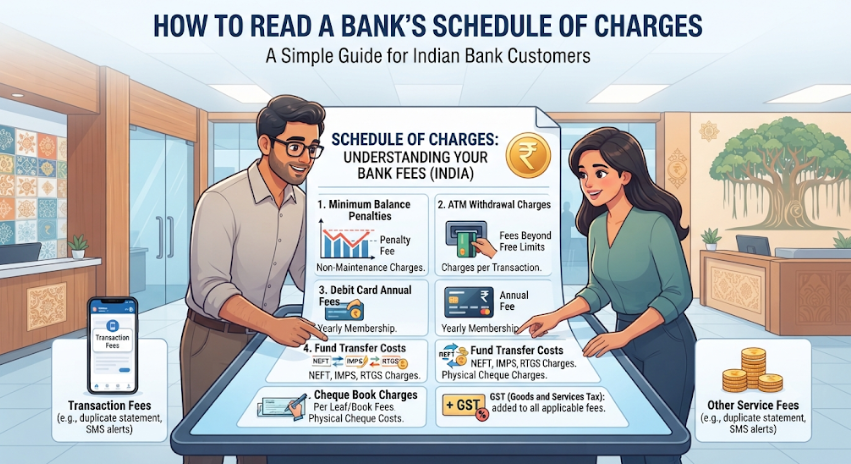
Banks generally publish a document called the Schedule of Charges, sometimes listed as Service Charges and Fees on their websites. It explains the fees applicable to different banking products and services.
However, the document can look confusing because it contains abbreviations, transaction limits, fee amounts, conditions and tax details.
Understanding it does not require advanced financial knowledge. You simply need to know which sections to check, what the common terms mean and how to calculate the actual amount payable.
In this article, we explain how to read a bank's Schedule of Charges in India, understand common fees, compare banking services and avoid unnecessary expenses.
AI Answer Box: How Do You Read a Bank's Schedule of Charges?
To read a bank's Schedule of Charges, first identify your account type and the services you use. Check the fee amount, free transaction limit, charging frequency, applicable conditions and taxes for each service. Pay particular attention to minimum balance requirements, ATM withdrawals, debit card fees, cheque returns and fund transfers.
A simple five-step method:
-
Find the latest Schedule of Charges on your bank's official website.
-
Select the section for your account type.
-
Identify the free limits and chargeable services.
-
Check whether fees are monthly, quarterly, annually or per transaction.
-
Add applicable taxes to understand the total amount payable.
Remember: A fee shown in a bank's schedule is not necessarily charged to every customer. It usually applies only when the specified service is used or a particular condition is triggered.
1. What Is a Bank's Schedule of Charges?
A Schedule of Charges is an official list of fees that a bank may collect for providing specific services to its customers.
It explains the cost of using different banking facilities and the conditions under which a charge applies.
Depending on the bank and account type, it may include:
-
Savings account maintenance charges
-
Current account service charges
-
ATM withdrawal fees
-
Debit card issuance and annual fees
-
Cheque book charges
-
Cheque return fees
-
Fund transfer charges
-
SMS alert fees
-
Cash deposit and withdrawal charges
-
Account statement and certificate charges
-
Loan processing and other lending-related fees
Where Can You Find a Bank's Schedule of Charges?
You can usually find it through these channels:
-
Visit your bank's official website.
-
Search for "Schedule of Charges" or "Service Charges and Fees".
-
Open the section for personal banking or business banking.
-
Select the relevant account or product category.
-
Download the latest PDF or view the online fee table.
You can also ask your bank branch for the current schedule.
Important: Always use the bank's official website. Avoid relying on old PDFs shared through social media or third-party websites.
2. Why Should You Read the Schedule of Charges Before Opening a Bank Account?
Choosing a bank account based only on its interest rate or promotional benefits can lead to unexpected costs.
A bank account may offer convenient digital services but have fees for certain transactions, card facilities or account conditions.
Reading the charges in advance helps you understand the actual cost of maintaining and using the account.
Main Benefits
-
Avoid unexpected deductions: Understand which services may attract fees.
-
Compare different banks: Check whether another account offers better value.
-
Understand free limits: Know how many transactions are available without additional charges.
-
Plan your monthly expenses: Include recurring banking fees in your budget.
-
Choose a suitable account: Select an account based on your actual banking habits.
For example, someone who frequently withdraws cash may prefer an account with higher free ATM limits, while someone who mostly uses digital banking may prioritise affordable online services.
3. Understand the Main Sections of a Bank's Schedule of Charges
A Schedule of Charges may contain several sections. The names and order vary between banks, but the following categories are common.
3.1 Savings Account Charges
This section explains fees connected with savings accounts.
Look for:
-
Minimum or average balance requirements
-
Charges for non-maintenance of minimum balance
-
Account closure fees, where applicable
-
Duplicate statement charges, if applicable
-
Passbook-related services
-
Special account conditions
What Is Minimum Average Balance?
Minimum Average Balance (MAB) is the average balance a customer is required to maintain over a specified period, according to the account's terms.
Some banks use a monthly or quarterly calculation. Others may use a different balance requirement.
Do not assume that every savings account has the same minimum balance.
Example:
Suppose a bank requires an average monthly balance of ₹5,000.
If your daily closing balances are ₹4,000, ₹5,000 and ₹6,000 for three days, the average for those days is:
[
\frac{₹4,000+₹5,000+₹6,000}{3}=₹5,000
]
This is only an illustration of an average. The actual bank calculation uses the applicable period and account terms.
3.2 ATM Withdrawal Charges
The ATM section explains how many free transactions you can make and what happens when you exceed the permitted limit.
Check:
-
Free transactions at your own bank's ATM
-
Free transactions at other banks' ATMs
-
Metro and non-metro classifications
-
Charges for additional transactions
-
Whether financial and non-financial transactions are counted
-
Applicable taxes
Under RBI's ATM instructions, savings account holders are entitled to minimum free transaction limits. From May 1, 2025, charges beyond the prescribed free limits may not exceed ₹23 per transaction, plus applicable taxes.
The mandatory minimum limits include:
-
Five free transactions each month at the customer's own bank ATMs.
-
Three free transactions at other banks' ATMs in six specified metro centres.
-
Five free transactions at other banks' ATMs outside those metro centres.
The treatment of non-financial transactions differs between own-bank and other-bank ATMs. Check the current RBI instructions and your bank's account terms.
3.3 Debit Card Charges
This section covers fees associated with your debit card.
Common charges include:
-
Debit card issuance fee
-
Annual maintenance fee
-
Replacement card fee
-
Lost card replacement fee
-
International usage-related fees
-
Card reissuance charges
Some banks provide free debit cards for certain account types, while others charge an annual fee.
Check whether the fee is charged every year, from the second year or only when a replacement card is requested.
3.4 Cheque Book Charges
Cheque book fees may depend on the number of leaves issued and your account category.
Look for:
-
Free cheque book entitlement
-
Additional cheque book charges
-
Charges for special cheque services
-
Stop-payment instructions
-
Cheque return charges
Do not assume that every cheque book is free just because the first one is included with your account.
3.5 Fund Transfer Charges
This section explains fees for transferring money through banking channels.
Common transfer methods include:
| Transfer method | Full form | What to check |
|---|---|---|
| NEFT | National Electronic Funds Transfer | Channel and account-specific fees |
| RTGS | Real Time Gross Settlement | Applicable transfer conditions and charges |
| IMPS | Immediate Payment Service | Per-transaction charges and limits |
| UPI | Unified Payments Interface | Applicable bank and payment-system rules |
| Demand Draft | Demand Draft | Issuance and cancellation fees |
A key point is that these payment methods do not all follow the same fee rules.
For example, RBI does not permit banks to charge savings account customers for online NEFT transactions. RTGS inward transactions are free, and banks cannot charge for online RTGS transactions by individual customers.
IMPS charges, where applicable, should be checked in the bank's current schedule.
For UPI, do not assume that a fee listed for IMPS or other transfers also applies to ordinary UPI payments. Check the specific payment type and applicable rules.
4. How to Understand Important Terms in a Schedule of Charges
Bank documents often use short forms and technical terms. Understanding them makes the document easier to read.
| Term | Meaning |
|---|---|
| MAB | Minimum Average Balance |
| AMB | Average Monthly Balance |
| AQB | Average Quarterly Balance |
| MAB shortfall | Difference between the required and maintained average balance |
| ATM | Automated Teller Machine |
| NEFT | National Electronic Funds Transfer |
| RTGS | Real Time Gross Settlement |
| IMPS | Immediate Payment Service |
| GST | Goods and Services Tax |
| SMS alert | Transaction or account notification sent through SMS |
| Annual fee | Fee charged once a year |
| Per transaction | Fee charged for each applicable transaction |
| Non-home branch | A branch other than the customer's designated home branch |
| Cash handling charge | Fee for specified cash deposit or withdrawal services |
| Penal charge | A charge for specified non-compliance with agreed terms |
What Does "Per Transaction" Mean?
A per-transaction charge is applied each time you perform the specified service beyond the free limit or under the applicable conditions.
Example:
If the schedule shows ₹20 per additional transaction and you make three chargeable transactions:
₹20 × 3 = ₹60 before applicable taxes.
What Does "Annual Fee" Mean?
An annual fee is charged once per year.
For example, a debit card may have an annual fee of ₹250. Check whether the bank charges it immediately, after the first year or on a specific anniversary date.
What Does "Waived" Mean?
A waived charge is a fee that the bank does not collect when specified conditions are met.
For example, a bank may waive a debit card fee for a particular salary account or premium account.
Read the conditions carefully. A waiver may stop applying if you change account type or no longer meet the eligibility criteria.
5. How to Understand GST on Bank Charges
Some banking services attract applicable taxes in addition to the service fee.
When reading the Schedule of Charges, check whether the listed amount is:
-
Inclusive of taxes
-
Exclusive of taxes
-
Subject to applicable GST
Do not assume every banking entry attracts GST in the same way. The tax treatment depends on the nature of the service and applicable tax rules.
Example of a Charge With GST
Suppose a bank lists a taxable service fee of ₹150 and the applicable GST rate is 18%.
| Description | Amount |
|---|---|
| Service fee | ₹150 |
| GST at 18% | ₹27 |
| Total deduction | ₹177 |
This is an illustrative calculation, not a statement that every banking charge attracts 18% GST.
Always check the tax amount shown in the bank's fee schedule, transaction alert or invoice.
6. How to Read a Bank Charge Table: Practical Example
Consider this fictional Schedule of Charges for a savings account.
| Banking service | Free limit | Illustrative charge |
|---|---|---|
| Debit card annual fee | First year | ₹250 annually thereafter |
| Additional cheque leaves | As per account entitlement | ₹5 per leaf |
| ATM transactions beyond free limit | RBI and bank limits apply | ₹23 per transaction in this example |
| Duplicate statement | One free copy, subject to terms | ₹100 per request |
| SMS alerts | Based on actual usage and terms | As specified by bank |
| Additional cash handling | As per account conditions | As specified by bank |
These figures are hypothetical and should not be treated as charges imposed by any particular bank.
How Should You Read Each Row?
For every service, ask five questions:
-
Is the service free?
-
What is the free transaction limit?
-
When does the charge start?
-
Is the fee per transaction, monthly or annual?
-
Are taxes additional?
This simple approach helps you understand the actual cost rather than looking at the fee amount alone.
7. How to Compare Two Banks' Schedules of Charges
Do not compare banks using only one fee.
A bank may have a low debit card fee but higher cash handling charges. Another may provide more free ATM transactions or a lower minimum balance requirement.
Use a comparison table.
| Charge category | Bank A | Bank B |
|---|---|---|
| Minimum balance | ₹5,000 | Zero balance |
| Debit card annual fee | ₹250 | ₹150 |
| Cheque book | Limited free leaves | Paid |
| ATM free limit | As per applicable terms | As per applicable terms |
| Online NEFT | Free | Free |
| SMS alerts | Usage-based | Account-specific |
| Account closure | As per terms | As per terms |
The values above are illustrative. Actual charges depend on the current account variant and bank policy.
Which Bank Should You Choose?
Choose the bank that offers the best overall value for your needs.
-
If you regularly use ATMs, compare ATM free limits and additional fees.
-
If you maintain a low balance, check minimum balance conditions.
-
If you frequently use cheques, compare free cheque book entitlements.
-
If you mostly bank online, check digital service fees.
-
If you need international transactions, review foreign currency and card-related charges.
8. Important Banking Charges You Should Check Carefully
Some charges may not be obvious when you first open an account.
8.1 Minimum Balance Penalties
Check the required balance, measurement period, shortfall calculation and applicable penalty.
RBI's Commercial Banks – Responsible Business Conduct Directions, 2025 require banks to inform customers of minimum balance conditions when accounts are opened.
For covered commercial banks, the directions also require advance notice of at least one month for changes to minimum balance requirements and related charges.
If a shortfall occurs, the bank must notify the customer and allow at least one month from the notice to restore the required balance before recovering the penalty.
The charge must be proportionate to the shortfall, reasonable and must not cause the savings account balance to become negative solely because of that charge.
8.2 ATM Charges Beyond Free Limits
Check how many withdrawals or other ATM transactions count towards your monthly free limit.
Do not confuse your own bank's ATM transactions with transactions at other banks' ATMs.
8.3 Cheque Return Charges
Cheque return charges may apply when a cheque is returned unpaid.
Check the fee for different situations, including:
-
Insufficient funds
-
Signature mismatch
-
Incorrect or incomplete details
-
Stop-payment instructions
-
Other reasons specified in the bank's policy
The schedule may list different charges depending on the reason for the return.
8.4 Cash Deposit and Withdrawal Charges
Some account types have limits on free cash deposits or withdrawals.
Check:
-
Number of free transactions
-
Free cash transaction value
-
Charges after the free limit
-
Whether fees differ at home and non-home branches
-
Whether charges vary by account category
8.5 Account Closure Charges
Some banks may impose a closure fee when an account is closed within a specified period after opening.
Check the applicable period, exceptions and whether the charge is waived for certain circumstances.
9. What Are Your Rights When a Bank Changes Its Charges?
Customers should not have to guess about the fees applicable to their accounts.
RBI's Commercial Banks – Responsible Business Conduct Directions, 2025 set out important requirements for disclosure of service charges.
For banks covered by these directions:
-
Charges should be communicated to new customers when the banking relationship begins.
-
Service charges should be displayed on the bank's website and branch notice board.
-
Changes to service charges require prior notice of at least 30 days.
-
Customers should have an option to accept the change or exit the banking relationship within that 30-day period without cost.
-
The bank should display recent changes to service charges.
Other categories of banks may be governed by corresponding RBI directions. Check the rules applicable to your bank.
What If a Bank Deducts an Unexpected Charge?
Follow these steps:
-
Check your bank statement and identify the deduction.
-
Find the matching entry in the latest Schedule of Charges.
-
Check the account type and relevant fee conditions.
-
Contact customer care or your bank branch.
-
Ask for the reason, calculation and applicable schedule.
-
If the explanation is unsatisfactory, submit a formal complaint and retain the complaint reference.
If the bank does not resolve your complaint satisfactorily within 30 days, you may be eligible to approach the RBI Integrated Ombudsman Scheme, subject to its eligibility and procedural requirements.
10. How to Check Whether a Bank Charge Is Correct
Before accepting an unexpected deduction, compare the statement entry with the bank's published charges.
A Simple Verification Checklist
-
Is the charge mentioned in the bank's current schedule?
-
Does the charge apply to your specific account variant?
-
Did you exceed a free transaction limit?
-
Was the required balance maintained?
-
Was the service actually used?
-
Are taxes shown separately?
-
Was the required advance notice given where applicable?
-
Does the bank's statement describe the reason for the deduction?
RBI directions require banks to provide intelligible particulars for bank-charge entries in account statements, including the nature and reason for the fee.
If the description is unclear, ask the bank for a detailed explanation.
11. How to Avoid Unnecessary Bank Charges
A few simple habits can help reduce avoidable banking expenses.
11.1 Choose the Right Account Type
Compare regular savings accounts, salary accounts and Basic Savings Bank Deposit Accounts (BSBDAs).
RBI requires banks to offer BSBD accounts with specified basic facilities free of charge and without a minimum balance requirement. Additional facilities may have separate conditions.
11.2 Track Your ATM Transactions
Keep track of how many free transactions you have used during the month.
Where possible, plan withdrawals to avoid unnecessary chargeable transactions.
11.3 Maintain the Required Balance
If your account has a minimum balance requirement, understand how it is calculated and keep an appropriate buffer.
11.4 Use Digital Banking Carefully
Check which online services are free and which services have charges.
Do not assume that all transfer methods have identical fees.
11.5 Review Your Bank Statements
Check monthly statements for:
-
Debit card fees
-
SMS alert charges
-
Minimum balance penalties
-
ATM fees
-
Cheque return charges
-
Other service deductions
11.6 Review Your Account Annually
Your banking needs may change. Review the account type and fee structure at least once a year.
12. Pros and Cons of Understanding a Bank's Schedule of Charges
| Advantages | Challenges |
|---|---|
| Helps identify avoidable fees | Documents can be lengthy |
| Makes bank comparisons easier | Abbreviations may be confusing |
| Helps plan monthly banking expenses | Different account variants have different fees |
| Clarifies free transaction limits | Charges may change over time |
| Helps identify unexpected deductions | Taxes and special conditions need careful checking |
Understanding the document takes a little time, but it can help you make more informed banking decisions.
13. Step-by-Step Guide: How to Read a Bank's Schedule of Charges
Follow these steps whenever you open a new account or review your existing account.
-
Visit the official bank website. Search for the latest Schedule of Charges.
-
Identify your account variant. Confirm whether you have a regular savings, salary, premium or basic account.
-
Read the minimum balance section. Check the balance requirement and penalty conditions.
-
Check ATM and debit card fees. Note the free limits and annual charges.
-
Review transfer charges. Compare NEFT, RTGS, IMPS and other payment methods.
-
Check cash and cheque services. Understand the free limits and additional fees.
-
Read the tax conditions. Identify whether GST is additional.
-
Save a copy. Keep the latest schedule for future reference.
-
Compare your bank statement. Check whether deductions match the published conditions.
14. Expert Commentary: Why Transparency in Bank Charges Matters
A banking relationship involves more than the balance in an account or the interest earned on savings.
Customers also pay for certain services, and those fees can influence the overall value of an account.
A useful approach is to calculate the likely annual cost of banking based on your actual usage. For example, include debit card fees, expected ATM transactions, cheque book requirements and other recurring services.
Do not select an account simply because it advertises zero maintenance charges. Check whether other services have fees and whether the account has eligibility requirements.
RBI's customer service directions emphasise upfront disclosure, reasonable service charges and clear communication of changes. Customers should use the published schedule and their account statements together to understand what they are paying.
15. Updated RBI Rules and Banking Facts to Know
The following regulatory points are useful when reading bank charges in India.
RBI Service Charge Disclosure
The RBI's Commercial Banks – Responsible Business Conduct Directions, 2025, updated as on October 1, 2026, require covered banks to communicate applicable service charges, display them on their websites and in branches, and give at least 30 days' prior notice for changes.
ATM Transaction Charges
RBI's ATM instructions, updated as on March 28, 2025, provide for minimum free ATM transaction limits. Charges beyond the mandatory free limits may not exceed ₹23 per transaction, plus applicable taxes.
Minimum Balance Penalties
For covered commercial banks, RBI directions require minimum balance penalties to be proportionate to the shortfall. Customers must receive notice and an opportunity to restore the required balance before the charge is recovered.
Basic Savings Bank Deposit Account
A BSBD account is designed to provide basic banking facilities without a minimum balance requirement. It includes specified free basic facilities under RBI directions.
These provisions are important, but the exact fee for a service still depends on the applicable bank, account category and current rules.
16. Frequently Asked Questions (FAQs)
1. What is a Schedule of Charges in banking?
A Schedule of Charges is a document published by a bank that lists fees for services such as ATM withdrawals, debit cards, cheque books, fund transfers, account maintenance and other banking facilities.
2. Where can I find my bank's Schedule of Charges?
Visit your bank's official website and search for "Schedule of Charges", "Service Charges" or "Fees and Charges". You can also request the latest document from your bank branch.
3. Are all bank charges the same in India?
No. Charges differ between banks, account types and customer categories. Some fees are also subject to RBI rules and limits.
4. What is a minimum balance charge?
It is a charge that may apply when the average balance maintained in an account falls below the bank's prescribed requirement, subject to applicable RBI rules and account conditions.
5. What is the difference between MAB and AQB?
MAB generally refers to Minimum Average Balance calculated over a month, while AQB refers to Average Quarterly Balance calculated over a quarter. The exact calculation depends on the bank's account terms.
6. Do banks charge GST on service charges?
Applicable GST may be added to certain taxable banking services. Check whether the fee shown in the schedule includes taxes or whether they are payable separately.
7. How much can a bank charge for additional ATM transactions?
Under RBI instructions effective May 1, 2025, the charge beyond the prescribed free ATM transaction limits cannot exceed ₹23 per transaction, plus applicable taxes.
8. Are online NEFT transactions free?
RBI instructions require banks to provide online NEFT transactions initiated by savings bank account holders free of charge. Other NEFT channels and account categories may have different applicable terms.
9. What is a debit card annual maintenance fee?
It is a recurring fee charged for maintaining certain debit card facilities. The amount and charging date depend on the bank and card variant.
10. Can a bank change its service charges?
For commercial banks covered by RBI's 2025 Responsible Business Conduct Directions, changes to service charges require at least 30 days' prior notice. Corresponding rules may apply to other categories of banks.
11. What should I do if my bank deducts an unknown charge?
Check your statement and the latest Schedule of Charges. Contact the bank and request an explanation of the fee, its calculation and the applicable account condition. If unresolved, raise a formal complaint.
12. Are zero-balance savings accounts completely free?
A Basic Savings Bank Deposit Account does not require a minimum balance and provides specified basic banking facilities free of charge. Additional optional services may have separate charges and conditions.
13. What does "per transaction" mean in bank charges?
It means the bank applies the specified fee each time the relevant chargeable transaction occurs. For example, a fee of ₹20 per transaction for three applicable transactions would total ₹60 before any applicable taxes.
14. How often should I check my bank's Schedule of Charges?
Review it when opening an account, when your bank announces changes, and at least once a year. Check your account statements regularly as well.
15. How can I avoid unnecessary banking charges?
Choose an account that matches your needs, understand free transaction limits, maintain any required balance, use suitable payment channels and review your bank statements regularly.
Published on : 19th November
Published by : Reddy kumar
www.vizzve.com || www.vizzveservices.com
Follow us on social media: Facebook || Linkedin || Instagram
🛡 Powered by Vizzve Financial
RBI-Registered Loan Partner | 10 Lakh+ Customers | ₹600 Cr+ Disbursed