

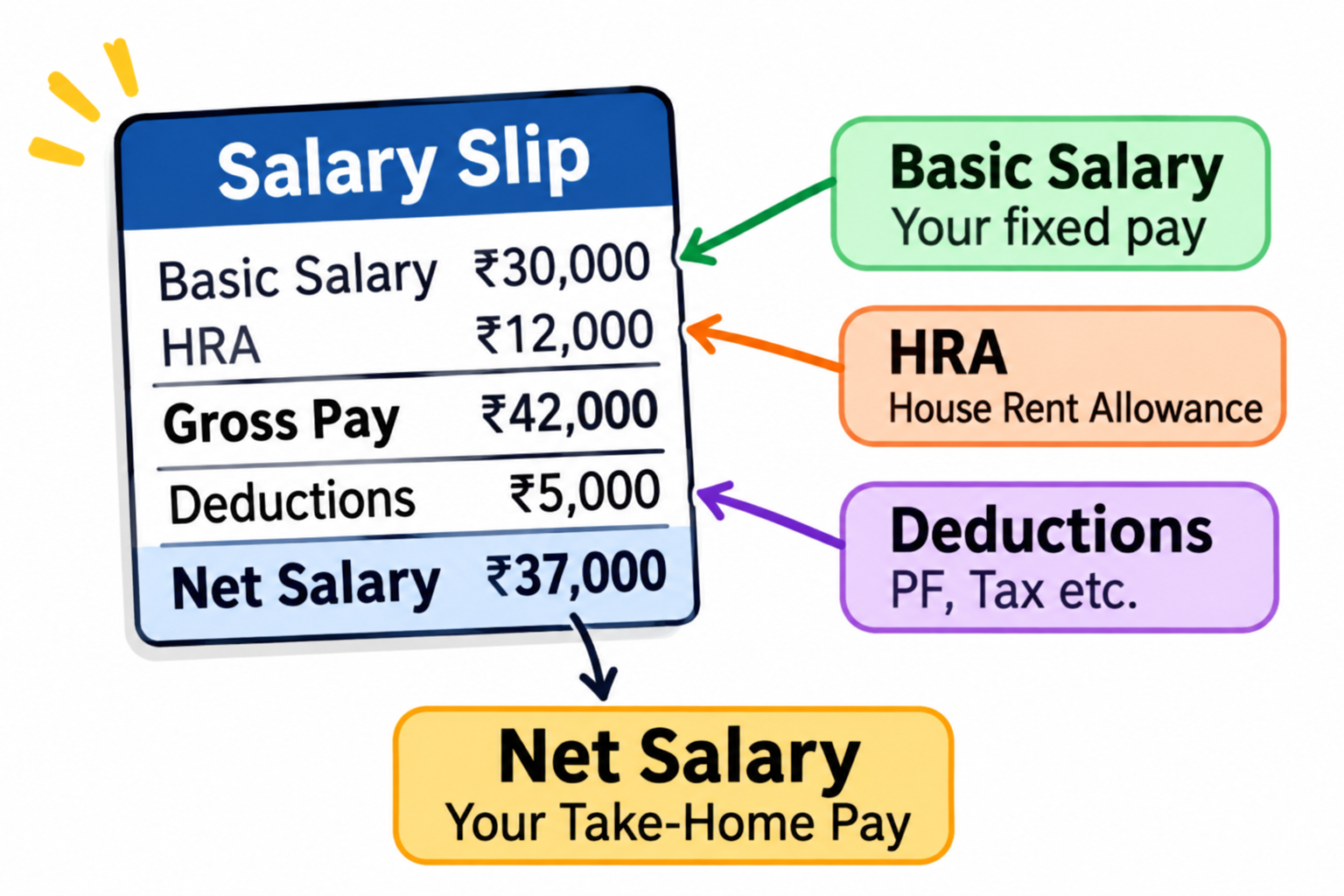
How to Read a Salary Slip: Basic Salary, HRA and Deductions – Complete Guide
Understanding your salary slip is an important part of managing your personal finances. Whether you are a fresher starting your first job or an experienced employee, knowing how your salary is calculated helps you understand your monthly income, deductions, and take-home pay.
A salary slip, also known as a payslip, provides a breakdown of your earnings and deductions for a particular month. It explains how your Cost to Company (CTC) is divided into different salary components, such as Basic Salary, House Rent Allowance (HRA), special allowance, Provident Fund (PF), and professional tax.
In this guide, we will explain how to read a salary slip, understand its important components, identify deductions, and calculate your actual take-home salary.
1. What Is a Salary Slip?
A salary slip is an official document provided by an employer to an employee every month. It contains details of the employee's earnings, allowances, deductions, and net salary.
It helps employees understand how much they earn and how much money they receive after deductions.
A salary slip generally includes:
-
Employee name and ID
-
Company name and details
-
Salary month and payment date
-
Basic salary
-
House Rent Allowance (HRA)
-
Special allowances
-
Other earnings
-
Provident Fund (PF)
-
Professional tax
-
Tax Deducted at Source (TDS)
-
Net salary or take-home pay
2. Understanding Basic Salary
Basic Salary is the fixed portion of an employee's salary before adding allowances and deducting contributions.
It is one of the most important components of a salary structure because several other salary benefits and calculations may depend on it.
Why is Basic Salary important?
-
It forms the foundation of your salary structure.
-
Employer and employee PF contributions are generally linked to eligible basic wages and applicable rules.
-
Gratuity calculations generally use basic salary and dearness allowance, where applicable.
-
HRA tax exemption calculations use basic salary and eligible dearness allowance.
Example:
If your monthly salary structure includes a basic salary of ₹20,000, that amount is your basic component before allowances and deductions.
3. What Is HRA (House Rent Allowance)?
House Rent Allowance (HRA) is an allowance provided by an employer to help employees meet their rental housing expenses.
Employees living in rented accommodation may qualify for an HRA tax exemption under the applicable tax rules, subject to eligibility.
HRA exemption generally depends on:
-
Actual HRA received from the employer.
-
Actual rent paid minus 10% of eligible salary.
-
50% of eligible salary for specified metro cities or 40% for other locations.
The lowest of these three amounts is considered for the HRA exemption under the old tax regime.
Important: HRA exemption is generally not available under the new tax regime.
4. Common Salary Components Explained
|
Salary component |
Meaning |
|---|---|
|
Basic Salary |
Fixed core part of your salary |
|
HRA |
Allowance for rental accommodation |
|
Dearness Allowance (DA) |
Allowance to help manage rising living costs |
|
Special Allowance |
Additional salary component |
|
Conveyance Allowance |
Allowance for travel expenses |
|
Medical Allowance |
Medical-related salary component, depending on company structure |
|
Bonus / Incentives |
Additional payment based on performance or company policy |
|
LTA |
Leave Travel Allowance, subject to applicable rules |
Not every company provides all these components. Your salary structure may differ depending on your employment agreement.
5. Understanding Salary Deductions
Salary deductions are amounts subtracted from your gross earnings before your final take-home salary is calculated.
The common deductions include:
1. Employee Provident Fund (EPF)
EPF is a retirement savings scheme in which eligible employees and employers contribute towards the employee's provident fund account.
-
Employee contributions are generally 12% of applicable basic wages and dearness allowance.
-
Employer contributions are made separately according to EPF rules.
-
Your employee contribution may appear as a deduction on your salary slip.
2. Professional Tax
Professional Tax is a state-level tax collected from salaried employees and certain professionals.
-
The amount depends on the applicable state rules.
-
It may be deducted monthly or according to the state's payment schedule.
-
Not all states impose professional tax.
3. Tax Deducted at Source (TDS)
TDS is the income tax deducted by your employer from your salary and deposited with the government.
The amount depends on factors such as:
-
Estimated annual taxable income.
-
Applicable income tax regime.
-
Eligible deductions and exemptions.
-
Tax declarations submitted to your employer.
You should compare the TDS amount on your salary slip with your estimated annual tax liability.
4. Employee State Insurance (ESI)
ESI is a social security scheme that provides eligible employees with medical and other benefits.
It applies to eligible employees and establishments covered by the ESI framework.
5. Other Deductions
Some employers may also deduct:
-
Salary advances or loan repayments.
-
Loss of pay due to unpaid leave.
-
Canteen or transport charges, where applicable.
-
Other authorised recoveries.
Always check unfamiliar deductions with your HR or payroll team.
6. Difference Between CTC, Gross Salary and Net Salary
These three terms are important when understanding your salary slip.
|
Term |
Meaning |
|---|---|
|
CTC |
Total annual cost incurred by the employer for employing you |
|
Gross Salary |
Earnings before employee-side deductions |
|
Net Salary |
Amount received in your bank account after deductions |
Example:
Suppose your monthly salary structure looks like this:
|
Earnings |
Amount |
|---|---|
|
Basic Salary |
₹20,000 |
|
HRA |
₹10,000 |
|
Special Allowance |
₹8,000 |
|
Other Allowance |
₹2,000 |
|
Gross Salary |
₹40,000 |
Example deductions:
|
Deductions |
Amount |
|---|---|
|
Employee PF |
₹2,400 |
|
Professional Tax |
₹200 |
|
TDS |
₹500 |
|
Total Deductions |
₹3,100 |
Monthly take-home salary calculation
Gross salary
₹40,000
Total deductions
₹3,100
Net salary
₹36,900
Formula:
7. How to Read Your Salary Slip Step by Step
Follow these simple steps whenever you receive your monthly payslip.
-
Check employee details: Verify your name, employee ID, designation and salary month.
-
Check attendance: Look at paid working days, leave and loss-of-pay details.
-
Review Basic Salary: Confirm that your basic salary matches your agreed salary structure.
-
Check HRA: Verify the HRA amount and understand its tax treatment.
-
Review other allowances: Check special allowances, bonuses and incentives.
-
Check deductions: Review PF, professional tax, TDS and other recoveries.
-
Verify net salary: Compare the final amount with the salary credited to your bank account.
8. Why Is It Important to Check Your Salary Slip Every Month?
Checking your salary slip regularly helps you manage your income and identify payroll mistakes.
Important benefits include:
-
Better financial planning: Understand your actual monthly income.
-
Loan applications: Salary slips can help lenders assess your income and repayment capacity.
-
Tax planning: Monitor your TDS and salary-related tax details.
-
Retirement savings: Track your employee PF contributions.
-
Payroll accuracy: Identify incorrect deductions or missing allowances.
-
Employment proof: Use salary slips when applying for certain financial products or renting accommodation.
9. Common Salary Slip Mistakes Employees Should Avoid
Many employees only check the final amount credited to their bank account. However, ignoring the other details can lead to confusion.
Avoid these common mistakes:
-
Not checking salary deductions every month.
-
Confusing CTC with take-home salary.
-
Assuming the entire HRA amount is tax-free.
-
Ignoring unexpected deductions.
-
Not checking PF contribution details.
-
Forgetting to review TDS calculations.
-
Not downloading or saving monthly salary slips.
10. Tips to Manage Your Salary Better
Once you understand your salary slip, managing your monthly income becomes easier.
-
Create a monthly budget based on your net salary.
-
Keep an emergency fund for unexpected expenses.
-
Save a fixed amount every month.
-
Avoid taking loans beyond your repayment capacity.
-
Check your bank salary credit against your payslip.
-
Keep digital copies of your salary slips.
-
Review your salary structure whenever you receive a revision or promotion.
11. Documents You Can Understand Better Using Your Salary Slip
Your salary slip can help you understand and verify information in other important financial documents.
|
Document |
How your salary slip helps |
|---|---|
|
Form 16 |
Helps compare salary and TDS details |
|
Form 26AS |
Helps verify tax credits |
|
AIS |
Helps review reported financial information |
|
Bank statements |
Helps verify monthly salary credits |
|
Loan application |
Helps establish employment income |
|
EPF passbook |
Helps check provident fund contributions |
12. Key Takeaways
-
A salary slip explains your monthly earnings and deductions.
-
Basic Salary is the foundation of your salary structure.
-
HRA is an allowance that may qualify for tax exemption under the old tax regime.
-
PF, professional tax and TDS are common deductions.
-
Gross Salary and Net Salary are not the same.
-
Net Salary is the amount you receive after applicable deductions.
-
Checking your salary slip every month helps you manage your finances.
13. Frequently Asked Questions (FAQs)
1. What is a salary slip?
A salary slip is a monthly document issued by an employer showing an employee's earnings, allowances, deductions and net salary.
2. What is Basic Salary in a salary slip?
Basic Salary is the fixed core component of an employee's salary before allowances and deductions.
3. What does HRA mean?
HRA stands for House Rent Allowance. It is provided by employers to help employees meet rental accommodation expenses.
4. Is HRA fully tax-free?
No. HRA exemption is subject to eligibility and calculation rules. It is generally available under the old tax regime, not the new tax regime.
5. What is gross salary?
Gross salary is the total salary earnings before employee-side deductions.
6. What is net salary?
Net salary is the final amount credited to an employee's bank account after applicable deductions.
7. Why is PF deducted from my salary?
PF is deducted to help eligible employees build retirement savings through the Employees' Provident Fund scheme.
8. What is TDS in a salary slip?
TDS is the income tax deducted by an employer from an employee's salary and deposited with the government.
9. What is professional tax?
Professional tax is a state-level tax applicable to certain salaried employees and professionals.
10. Is CTC the same as take-home salary?
No. CTC includes the overall employment cost, while take-home salary is the amount received after applicable deductions.
11. Why is my take-home salary lower than my CTC?
Your CTC may include employer contributions, benefits and other components that are not directly paid to you as monthly cash. Employee deductions also reduce take-home pay.
12. Can I use my salary slip for a personal loan?
Yes. Lenders commonly request recent salary slips to verify employment income and assess loan eligibility. Requirements vary between lenders.
13. What should I do if my salary slip has incorrect deductions?
Contact your HR or payroll department, explain the discrepancy and request a correction.
14. How many months of salary slips should I keep?
It is useful to retain all monthly salary slips for your financial records. Lenders and other institutions may request the latest three to six months, depending on their requirements.
15. Is a digital salary slip valid?
Digital salary slips issued by an employer can be used as employment and income documentation, subject to the receiving institution's verification requirements.
Conclusion
Understanding how to read a salary slip helps employees take better control of their finances. Knowing the difference between Basic Salary, HRA, allowances, PF, TDS and other deductions makes it easier to understand monthly earnings and calculate take-home pay.
Instead of checking only the final credited amount, make it a habit to review your salary slip every month. This simple practice can help you identify payroll errors, plan your budget, monitor savings and make better financial decisions.
Published on : 19th November
Published by : monisha
www.vizzve.com || www.vizzveservices.com
Follow us on social media: Facebook || Linkedin || Instagram
🛡 Powered by Vizzve Financial
RBI-Registered Loan Partner | 10 Lakh+ Customers | ₹600 Cr+ Disbursed