

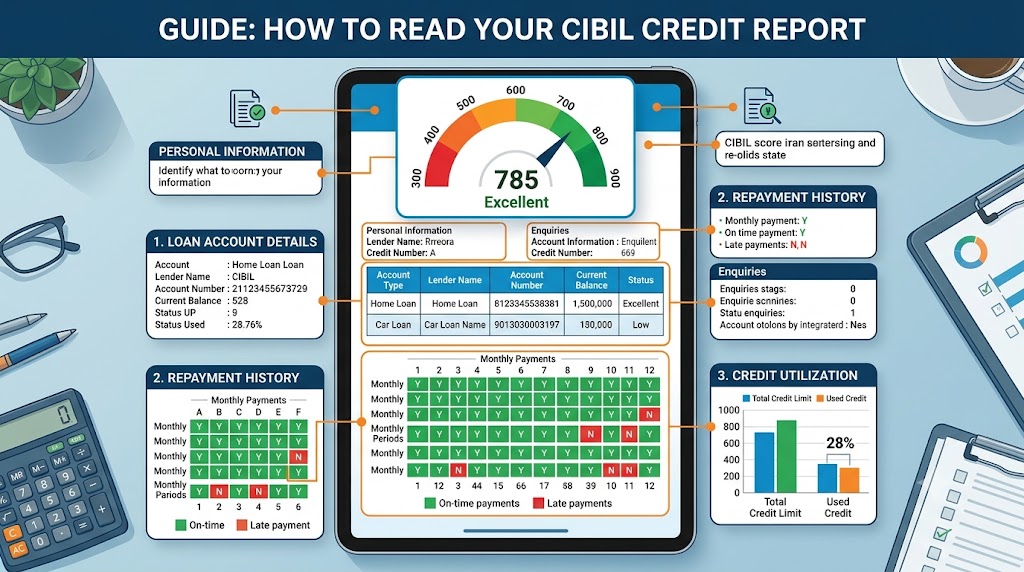
Your credit report is an important financial document that shows how you have managed loans, credit cards, and other credit obligations. Understanding how to read your credit report can help you monitor your CIBIL score, identify errors, and improve your chances of getting a loan approved.
Whether you are planning to apply for a personal loan, credit card, or another financial product, reviewing your credit report before applying can help you make informed decisions.
What Is a Credit Report?
A credit report is a record of your credit history maintained by a credit information company. In India, credit bureaus such as TransUnion CIBIL, Experian, Equifax, and CRIF High Mark provide credit reports based on the information reported by lenders.
Your credit report may include:
-
Personal identification details
-
Loan and credit card account information
-
Repayment history
-
Outstanding loan balances
-
Credit inquiries made by lenders
-
Account status and payment defaults, where applicable
Lenders may use this information to evaluate your creditworthiness and repayment capacity. However, a credit report is only one part of the loan approval process.
7 Important Sections of a Credit Report
Understanding each section can help you identify what lenders may consider when reviewing your credit profile.
1. Personal Information
This section contains details such as your name, date of birth, contact information, and other identification details.
What to check:
-
Your name is spelled correctly.
-
Your personal details match your records.
-
There are no unfamiliar identity details associated with your report.
Incorrect personal information should be reported to the credit bureau for correction.
2. CIBIL Score or Credit Score
Your credit score is a numerical summary of your credit history. For TransUnion CIBIL, the score generally ranges from 300 to 900.
A higher score often indicates a stronger credit profile, but lenders may use different eligibility criteria.
|
CIBIL score range |
General interpretation |
|---|---|
|
750–900 |
Generally considered a strong score |
|
700–749 |
May be considered good by many lenders |
|
650–699 |
Some lenders may consider the profile riskier |
|
Below 650 |
May indicate a need to review and improve credit habits |
These ranges are general guidance, not official universal approval categories. A good score does not guarantee loan approval.
3. Account Information
This section lists your credit accounts, such as personal loans, home loans, vehicle loans, and credit cards.
Check the following details:
-
Lender or financial institution name
-
Loan account number, often partially masked
-
Loan amount or credit limit
-
Outstanding balance
-
Account opening date
-
Current account status
If you find a loan account you never opened, contact the lender and credit bureau to investigate it.
4. Payment History
Your payment history shows how consistently you have repaid your credit obligations. Depending on the report, it may display payment status month by month.
Late payments, overdue amounts, and defaults can negatively affect your credit profile.
How to read it: Look for missed payments, overdue balances, or entries that do not match your actual payment records. If you paid an EMI on time but it appears overdue, keep your payment receipt or bank statement and raise a dispute.
5. Credit Inquiries
This section records inquiries made when lenders check your credit report.
A hard inquiry may occur when you formally apply for a loan or credit card. Multiple applications within a short period can influence how lenders assess your credit profile.
Review this section for unfamiliar inquiries and avoid applying for credit unnecessarily.
6. Outstanding Debt and Credit Utilization
Your report may show the outstanding balance on loans and credit cards.
For credit cards, credit utilization refers to the percentage of your available credit limit that you are using.
For example, if your credit limit is ₹1,00,000 and your outstanding balance is ₹30,000, your utilization is 30%.
Keeping utilization relatively low can help support a healthy credit profile. Also review your total EMIs and outstanding loans before applying for additional credit.
7. Account Status and Closed Loans
Check whether your accounts are correctly marked as active, closed, settled, or written off.
If you have fully repaid a loan, confirm that the account status and outstanding balance have been updated accurately. A loan marked as settled is not necessarily equivalent to one fully repaid and closed.
If the information is incorrect, contact the lender and submit a dispute with supporting documents.
How to Read Your Credit Report Step by Step
Step 1: Obtain your credit report
Request your credit report from an official credit bureau. Eligible consumers can access a free full credit report once a calendar year from each credit information company under applicable RBI requirements.
Step 2: Verify your personal details
Make sure your identity information is accurate and that no unfamiliar details appear on your report.
Step 3: Review your payment history
Look for late payments, overdue amounts, and repayment entries that do not match your records.
Step 4: Check your loans and balances
Confirm that outstanding amounts, credit limits, and closed account details are correct.
Step 5: Report errors
Contact the lender and the credit bureau if you find incorrect account information or unauthorized inquiries. Keep copies of your supporting documents.
Common Credit Report Errors to Watch For
Even a small reporting error can create confusion when you apply for a loan. Watch out for these common issues:
-
A loan that you never applied for.
-
An EMI incorrectly marked as overdue.
-
A repaid loan still showing an outstanding balance.
-
Incorrect personal information.
-
Duplicate loan accounts.
-
Credit inquiries you do not recognize.
If you identify an error, raise a dispute with the relevant credit bureau and contact the lender that supplied the information. Keep your complaint reference number and follow up until the issue is resolved.
How Can Your Credit Report Affect Loan Approval?
Lenders may review your credit report to understand your repayment behaviour and existing financial obligations.
A report showing timely repayments, manageable outstanding debt, and accurate account details may strengthen your application. Conversely, missed payments, high credit utilization, or several recent credit inquiries may lead a lender to examine your application more carefully.
Loan approval also depends on your income, employment or business stability, existing EMIs, documentation, and the lender's internal policies.
5 Tips to Maintain a Healthy Credit Report
-
Pay EMIs on time: Set reminders or use automatic payments to avoid missed due dates.
-
Keep credit card balances manageable: Avoid using too much of your available credit limit.
-
Apply for loans selectively: Check eligibility before making formal applications.
-
Monitor your report regularly: Review your accounts and repayment history for errors.
-
Maintain accurate records: Keep loan closure letters, payment receipts, and bank statements for reference.
Frequently Asked Questions (FAQs)
1. How can I check my CIBIL credit report for free?
Visit the official TransUnion CIBIL website and follow its process for accessing your credit report. Check the eligibility and terms for the free annual report.
2. Is a credit report different from a CIBIL score?
Yes. A credit score is a numerical summary of your credit history, while a credit report contains detailed information about your credit accounts, payment history, balances, and inquiries.
3. Does checking my own credit report reduce my score?
No. Checking your own credit report is generally treated as a soft inquiry and does not lower your credit score.
4. What should I do if my credit report shows a wrong loan?
Contact the lender and raise a dispute with the credit bureau that issued the report. Provide supporting documents and retain the complaint reference number.
5. How often should I check my credit report?
Reviewing it periodically, such as every few months and before a major credit application, can help you identify errors early.
6. Does a good CIBIL score guarantee loan approval?
No. Lenders also assess income, employment, existing debts, repayment capacity, documentation, and their own eligibility criteria.
Conclusion
Learning how to read your credit report is an important step towards managing your finances responsibly. By checking your personal details, payment history, loan balances, account status, and credit inquiries, you can identify errors and understand how lenders may view your credit profile.
Published on : 16th October 2026
Published by : yogendra
www.vizzve.com || www.vizzveservices.com
Follow us on social media: Facebook || Linkedin || Instagram
🛡 Powered by Vizzve Financial
RBI-Registered Loan Partner | 10 Lakh+ Customers | ₹600 Cr+ Disbursed