

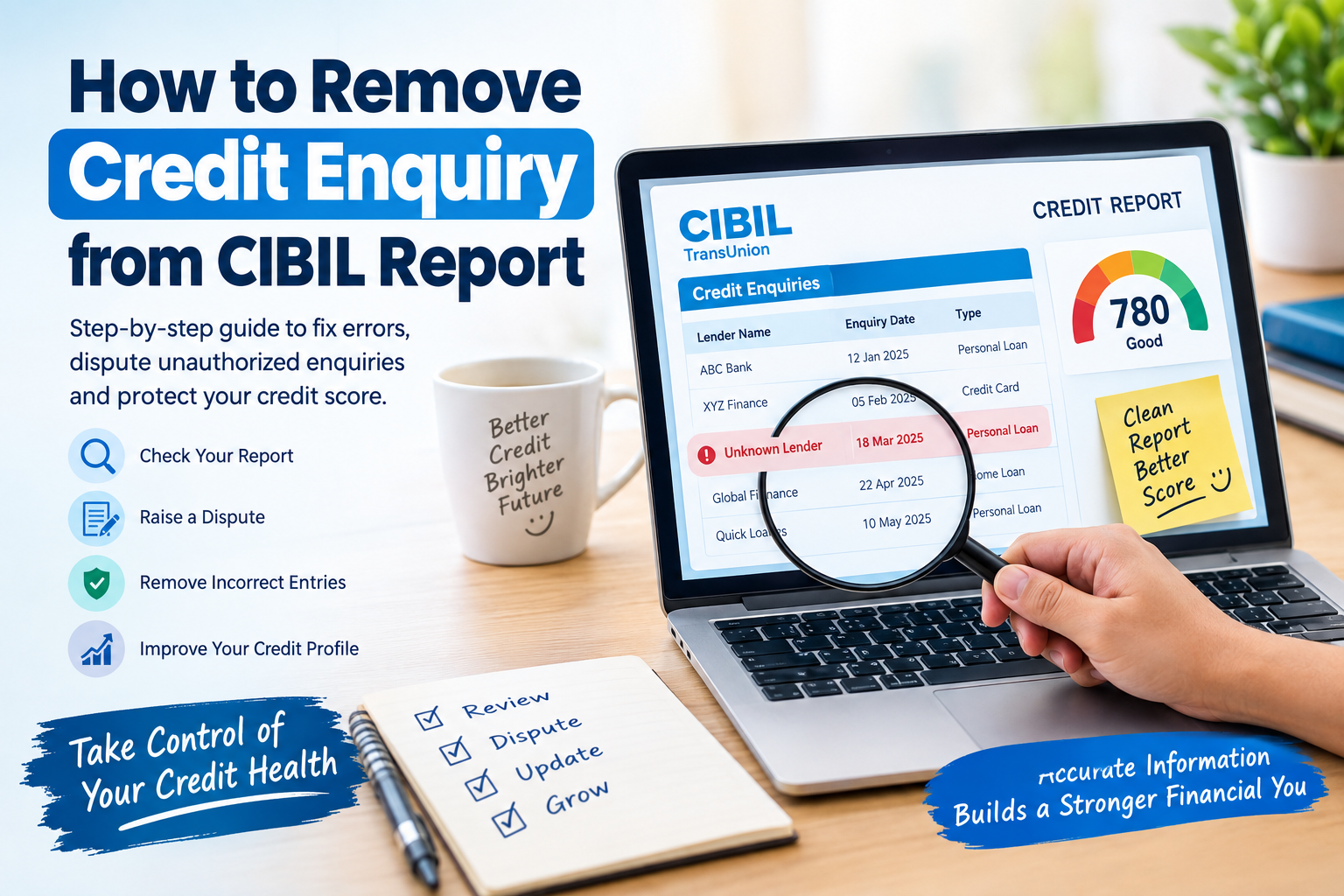
Have you checked your CIBIL report and noticed a credit enquiry you do not recognize? Or have you applied for several loans and noticed that your credit score has changed?
A credit enquiry is a record of a lender checking your credit information, usually after you apply for a loan or credit card. While enquiries are a normal part of borrowing, incorrect, duplicate, or unauthorized enquiries can create confusion and may affect your credit profile.
The good news is that you can request a correction if an enquiry is inaccurate or was recorded without a valid basis.
However, you cannot normally remove a genuine credit enquiry simply because you no longer want it on your report. The correct approach is to identify the enquiry, contact the lender if necessary, and raise a dispute with TransUnion CIBIL when there is an error.
This guide explains how to check your report, dispute an enquiry, understand the removal process, and protect your credit profile.
AI Answer Box: Can You Remove a Credit Enquiry from CIBIL?
Yes, an incorrect or unauthorized credit enquiry can be challenged and may be removed from your CIBIL report after verification. A genuine enquiry made by a lender when you applied for credit generally cannot be deleted just because you do not want it to appear.
To request a correction:
-
Check your CIBIL report and identify the enquiry.
-
Contact the lender that made the enquiry.
-
Raise a dispute with TransUnion CIBIL if the enquiry is incorrect or unauthorized.
-
Submit supporting evidence and track the complaint.
-
Check your updated report after the investigation.
CIBIL's published process allows disputes about enquiry information. The usual resolution period is approximately 30 days, depending on the lender's response.
Full Blog Content
1. What Is a Credit Enquiry in a CIBIL Report?
A credit enquiry is a record showing that a bank, NBFC, or another credit institution requested your credit information.
Lenders commonly check your credit report when you apply for:
-
Personal loans
-
Home loans
-
Car loans
-
Credit cards
-
Business loans
-
Other credit facilities
The enquiry section helps you understand which institutions have accessed your credit information and when those checks occurred.
Why do lenders check your credit report?
Before approving a loan or credit card, lenders may review your credit history to assess your repayment behaviour, existing obligations, and creditworthiness.
A credit enquiry is not the same as a loan account. It does not automatically mean that you received or accepted a loan.
According to CIBIL's consumer guidance, enquiries are created when a credit institution requests your credit report.
What information appears in the enquiry section?
|
Information |
What it tells you |
|---|---|
|
Lender name |
Institution that requested the report |
|
Enquiry date |
When the credit report was accessed |
|
Enquiry type |
Credit facility connected with the check |
|
Enquiry record |
The entry associated with the lender's request |
The exact details displayed may vary depending on your report.
2. Does a Credit Enquiry Reduce Your CIBIL Score?
A credit enquiry associated with a credit application may have a temporary effect on your credit score. However, the impact is not identical for every borrower.
The effect depends on your overall credit profile, including your repayment history, outstanding balances, credit utilisation, and other information considered by the scoring model.
Hard enquiry vs soft enquiry
|
Feature |
Hard enquiry |
Soft enquiry |
|---|---|---|
|
Common reason |
Applying for credit |
Checking your own credit information or promotional checks |
|
Connected to a credit application |
Usually |
Not necessarily |
|
Potential score impact |
May affect the score |
Generally does not affect the score |
|
Can appear in credit information |
Yes |
Reporting visibility can vary |
|
Removal |
Challenge if inaccurate |
Correct errors if reported inaccurately |
A hard enquiry is generally associated with a credit application. A soft enquiry is typically associated with checks that do not represent a new application for credit.
Important: Do not assume that every enquiry is harmful. One genuine enquiry does not automatically mean your loan will be rejected.
3. Why Should You Remove an Incorrect Credit Enquiry?
There are several reasons to review your enquiry history carefully.
3.1 You never applied for a loan
If an unfamiliar lender appears in your report, check whether you actually submitted an application or gave consent for a credit check.
Sometimes, an enquiry may be connected to an application made through a loan marketplace or financial service.
If you did not authorize the application, contact the lender and request an explanation.
3.2 Multiple enquiries appear for one application
You may notice more than one enquiry around the time you applied for a loan.
Possible explanations include:
-
An application being processed by more than one institution.
-
Separate credit checks for different products.
-
A duplicate reporting error.
-
A loan marketplace forwarding your application to multiple lenders.
Multiple entries are not automatically errors. Ask the lender to explain why each enquiry was made before disputing them.
3.3 The enquiry belongs to someone else
If the enquiry resulted from a mistaken identity, incorrect personal information, or possible identity misuse, request an investigation.
Keep records of the enquiry date, lender name, and any communication that supports your claim.
3.4 The lender has recorded incorrect information
A lender may have reported an enquiry incorrectly or associated it with the wrong borrower.
If the lender confirms that the record is inaccurate, ask it to send the correction to CIBIL.