

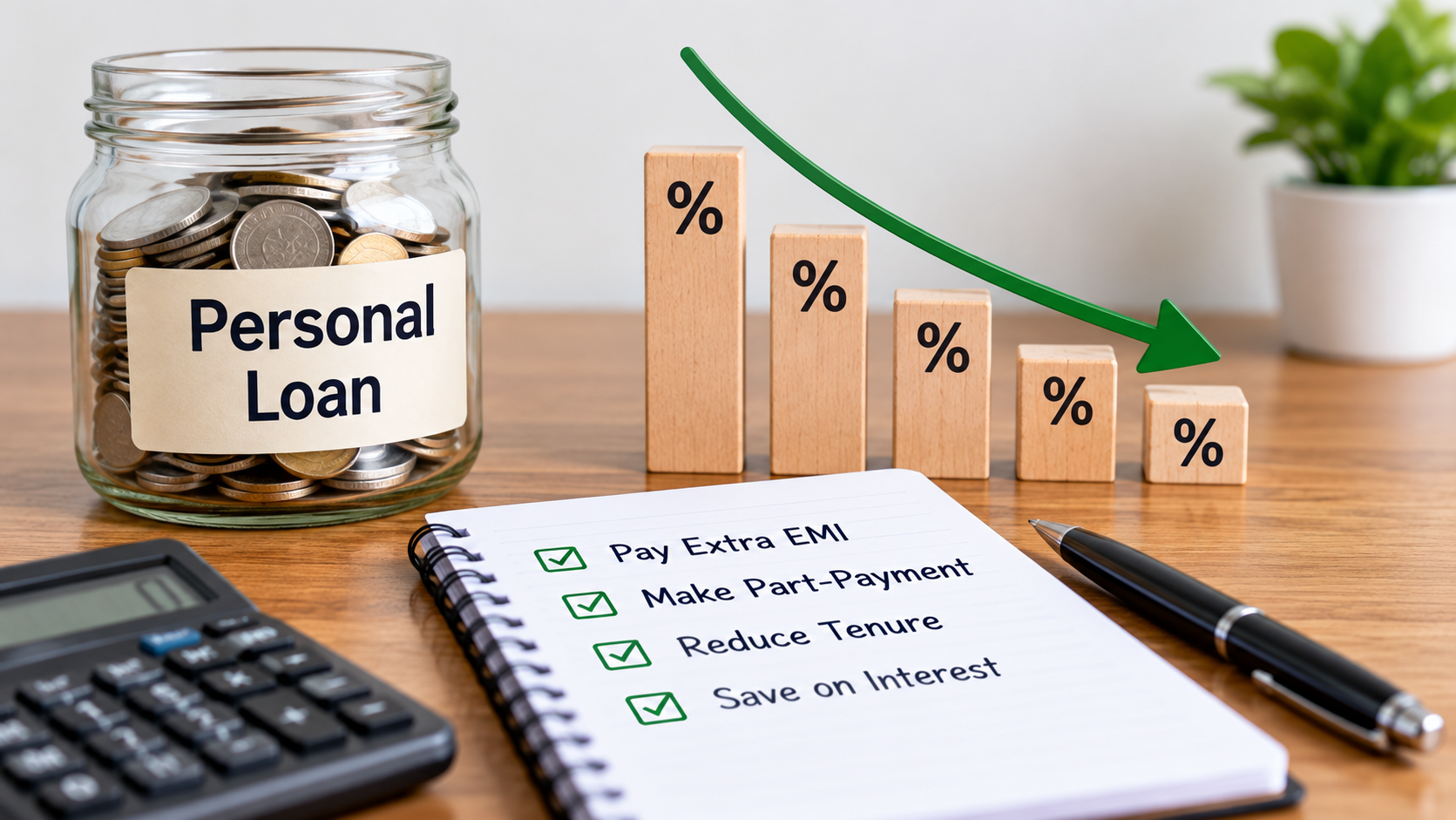
A personal loan can help you manage an unexpected expense, pay for a major purchase or handle an urgent financial need. However, the longer you take to repay the loan, the more interest you may pay over time.
The good news is that you may be able to repay your personal loan faster without putting unnecessary pressure on your monthly budget. Strategies such as making occasional part-prepayments, increasing your EMI when affordable and directing extra income towards your outstanding principal can help reduce your repayment period and overall interest cost.
Before making an early repayment, it is important to understand your lender’s prepayment rules, applicable charges and the amount you can comfortably afford.
This guide explains how to repay a personal loan faster in India, with practical examples and a checklist to help you plan.
AI Answer Box: How Can You Repay a Personal Loan Faster?
You can repay a personal loan faster by paying more than your regular EMI when affordable, making part-prepayments from bonuses or extra income, increasing your EMI after a salary hike and avoiding unnecessary new debt. Ask your lender how extra payments will be applied to your outstanding principal, and compare the interest savings with any applicable prepayment charges. Continue making your scheduled EMIs until the lender confirms that the loan is fully repaid.
Understand How Your Personal Loan EMI Works
Before choosing a repayment strategy, understand how your EMI is divided between principal and interest.
Your EMI generally includes:
- Principal: The amount you originally borrowed that you are repaying.
- Interest: The cost charged by the lender for lending you the money.
At the beginning of many standard reducing-balance loans, a larger portion of the EMI goes towards interest. As the outstanding principal reduces, the interest component generally decreases.
This is why reducing the principal earlier in the loan tenure can help lower the total interest payable, provided your lender applies the extra payment to the principal and recalculates the repayment schedule accordingly.
Example: A Personal Loan Repayment Plan
Suppose you take a personal loan with the following details:
| Loan Detail | Example |
|---|---|
| Loan amount | ₹3,00,000 |
| Annual interest rate | 14% |
| Loan tenure | 3 years |
| Approximate monthly EMI | ₹10,253 |
| Approximate total repayment | ₹3,69,108 |
| Approximate total interest | ₹69,108 |
These figures are illustrative and assume a fixed annual interest rate of 14%, monthly reducing-balance calculations and 36 equal monthly payments. Actual figures may differ based on the lender’s calculation method, fees and payment dates.
The example shows why it is useful to consider not just the EMI amount but also the total interest payable over the entire loan tenure.
Pay More Than Your Regular EMI
One of the simplest ways to speed up loan repayment is to pay more than your scheduled EMI, if your lender allows it and your budget can support it.
For example, if your monthly EMI is ₹10,253, you could consider paying an additional amount towards the loan each month.
However, do not assume that transferring extra money automatically reduces your principal. Some lenders may treat excess payments differently or require you to submit a formal part-prepayment request.
Before paying extra, ask your lender:
- Can I make monthly part-prepayments?
- Is there a minimum amount for each prepayment?
- Will the extra amount reduce the principal?
- Will my EMI decrease or will my loan tenure become shorter?
- Are any charges applicable?
If your objective is to close the loan sooner, ask whether the lender can reduce the remaining tenure while keeping your EMI unchanged.
Use Bonuses and Extra Income for Part-Prepayment
An annual bonus, incentive, tax refund, freelance income or other unexpected earnings can provide an opportunity to reduce your outstanding loan balance.
Instead of spending the entire amount, consider using a portion of it for a part-prepayment.
Example
Suppose you receive a work bonus of ₹30,000.
You could use it to reduce your personal loan principal, provided your lender permits part-prepayment and the terms are suitable.
The potential benefit is that future interest may be calculated on a lower outstanding balance. The actual savings depend on your remaining tenure, interest rate, repayment schedule and any applicable charges.
Tip: Keep enough money for essential expenses and emergencies before using a bonus to repay your loan.
Increase Your EMI After a Salary Hike
If your income increases, consider increasing your EMI rather than allowing all of the additional income to become a new monthly expense.
For example:
- Current EMI: ₹10,000
- Possible revised EMI: ₹11,000
- Additional monthly repayment: ₹1,000
An increased EMI can help you repay the outstanding principal faster, potentially reducing the total interest paid.
Before increasing the payment, check your lender’s process. Some lenders may require a formal request to revise the EMI or repayment schedule.
Also ensure that the higher EMI leaves enough room in your budget for rent, household expenses, insurance, savings and other financial commitments.
Choose a Shorter Loan Tenure When It Is Affordable
A shorter loan tenure generally means you repay the principal faster and pay interest for fewer months. However, it also means a higher EMI.
A longer tenure may make monthly payments more manageable, but the total interest cost can be higher.
| Factor | Shorter Tenure | Longer Tenure |
|---|---|---|
| Monthly EMI | Usually higher | Usually lower |
| Repayment period | Shorter | Longer |
| Total interest | Generally lower at the same rate | Generally higher at the same rate |
| Monthly budget pressure | Higher | Lower |
If you are taking a new personal loan, compare different tenure options before signing the agreement.
If you already have a loan, ask your lender whether you can increase the EMI or make prepayments to shorten the remaining tenure.
Check Personal Loan Prepayment and Foreclosure Charges
Before repaying a personal loan early, check whether your lender charges a fee for part-prepayment or full foreclosure.
The applicable rules can depend on factors such as:
- Whether the loan has a fixed or floating interest rate
- When the loan was sanctioned or renewed
- Whether it is a personal loan for individual, non-business use
- The type of regulated lender
- The terms of your loan agreement
RBI Rules on Prepayment Charges
RBI’s Pre-payment Charges on Loans Directions, 2025, set out rules that apply to specified regulated lenders and loans. For covered loans sanctioned or renewed on or after January 1, 2026, the directions generally prohibit prepayment charges on floating-rate loans granted to individuals for purposes other than business. The directions also address certain existing floating-rate term loans and other categories of lending.
This does not mean every personal loan is automatically free of prepayment charges. Fixed-rate loans and other situations may be treated differently. Check the applicability of the rules to your lender and loan agreement.
You can review the relevant RBI directions on prepayment charges. <Cite refs={["turn280855search0","turn280855search13"]}/>
Compare Interest Savings With Any Charges
Making an early payment can save interest, but the benefit should be compared with any fees or charges.
For example, if an early repayment is expected to save ₹12,000 in future interest but involves ₹2,000 in applicable charges, the estimated net benefit would be ₹10,000.
This is only an illustration. Ask your lender for a current foreclosure or part-prepayment statement to understand the actual numbers.
Before proceeding, compare:
- The outstanding principal
- The remaining interest under the current schedule
- Any prepayment or foreclosure charges
- Other applicable fees and taxes
- The amount you will have left for emergencies
The aim is to reduce the overall cost of borrowing without creating a cash-flow problem.
Avoid Taking Another Expensive Loan to Repay Your Personal Loan
It may be tempting to take a new loan or use a credit card to clear an existing personal loan.
However, this can simply move your debt from one account to another. If the new borrowing has a higher interest rate, additional fees or a longer repayment period, you may end up paying more.
Before considering a balance transfer or refinancing option, compare:
- The new interest rate
- Processing and transfer fees
- Prepayment charges on the existing loan
- The new repayment tenure
- The total amount payable over the full tenure
A lower EMI does not necessarily mean a lower total cost. Always compare the overall repayment amount.
Maintain an Emergency Fund Before Making Large Prepayments
Repaying a loan early is useful, but using every rupee of your savings can leave you financially vulnerable.
An unexpected medical expense, job change, household repair or urgent family need could force you to borrow again.
Before making a large part-prepayment, consider maintaining an emergency fund that covers essential expenses for a period suitable for your circumstances.
A practical approach is to divide your available surplus between:
- Emergency savings
- Regular loan repayment
- Extra principal repayment
- Other essential financial goals
The right balance depends on your income stability, existing savings and other debts.
Automate Your EMI Payments
Missing an EMI can lead to additional charges and may affect your credit history. Set up an automatic payment arrangement if it is suitable for your account.
To reduce the risk of missed payments:
- Keep sufficient balance in the linked bank account.
- Set a reminder a few days before the due date.
- Check that your auto-debit mandate is active.
- Review your bank statement after the payment date.
- Contact your lender if an EMI is not reflected correctly.
Continue paying your scheduled EMI until the lender confirms that your loan has been fully repaid.
Track Your Outstanding Principal Every Few Months
Checking your loan balance helps you understand whether your repayment strategy is working.
Review your loan account statement for:
- Outstanding principal
- Interest charged
- EMI payments received
- Part-prepayments credited
- Remaining tenure
- Applicable charges
If you make an extra payment, verify that it has been applied correctly.
You can also request an updated repayment schedule from your lender. It should help you understand how many instalments remain and how your principal and interest payments are changing.
Ask Whether a Balance Transfer Can Reduce Your Interest
A personal loan balance transfer means moving your outstanding loan to another lender, often in search of a lower interest rate or more suitable repayment terms.
It may be worth comparing if:
- Your current interest rate is relatively high.
- Your credit profile has improved since you took the loan.
- Another lender offers a lower overall borrowing cost.
- The savings exceed transfer and closure costs.
However, do not focus only on the advertised interest rate. Processing fees, insurance or other optional products, foreclosure charges and the new tenure can affect the total cost.
Request a written quote and compare the total repayment amount before deciding.
Get a Loan Closure Certificate After Full Repayment
Once you have paid the entire outstanding amount, ask your lender for written confirmation that the loan is closed.
Depending on the lender, this may include a loan closure letter, no-dues certificate or other official confirmation.
Check that:
- All outstanding dues have been paid.
- The loan account shows a closed status.
- Any applicable final charges have been settled.
- You have received the lender’s closure confirmation.
- The account status is accurately reflected in your credit report after the lender updates it.
Keep the closure documents safely for future reference.
A Simple Monthly Plan to Repay Your Personal Loan Faster
Use this practical routine to stay on track.
| When | What to Do |
|---|---|
| At the start of the month | Review your budget and upcoming EMI |
| Before the EMI date | Ensure sufficient account balance |
| After receiving extra income | Decide whether part-prepayment is affordable |
| Every 3 months | Review outstanding principal and repayment progress |
| Before a large prepayment | Check charges and request a revised calculation |
| After the final payment | Obtain written loan closure confirmation |
Consistency is often more useful than making a large payment that leaves you short of money later.
Frequently Asked Questions (FAQs)
1. How can I repay my personal loan faster?
You can increase your EMI, make part-prepayments, use a portion of bonuses or extra income to reduce the principal, or choose a shorter tenure if your budget allows.
2. Does paying extra EMI reduce interest?
It can, if the lender applies the additional payment to your outstanding principal and recalculates the repayment schedule. Confirm the process with your lender.
3. Is it better to increase EMI or make a lump-sum prepayment?
Both approaches can help reduce the principal. The result depends on when the extra payment is made, the amount, the loan terms and any applicable charges.
4. Can I close my personal loan before the tenure ends?
Many personal loans allow early closure, subject to the lender’s terms and applicable rules. Check the foreclosure process and any charges before proceeding.
5. Are personal loan prepayment charges allowed in India?
It depends on the loan and lender. RBI’s 2025 directions prohibit prepayment charges for specified categories, including covered floating-rate loans to individuals for non-business purposes. Other cases may be subject to different rules and terms.
6. Will repaying my personal loan early improve my CIBIL Score?
Closing a loan may change your credit profile, but it does not guarantee an immediate score increase. Continue paying all other credit obligations on time and review your credit report for accuracy.
7. Should I use my entire savings to close a personal loan?
Not necessarily. Keep enough money for emergencies and essential expenses before making a large prepayment.
8. Can I make part-prepayments every month?
That depends on your lender’s policy and loan agreement. Ask whether frequent part-prepayments are allowed and whether any minimum amount or fee applies.
9. Does a shorter loan tenure always save money?
At the same interest rate and under otherwise comparable terms, a shorter tenure generally reduces total interest. However, compare any fees and make sure the higher EMI is affordable.
10. Is a personal loan balance transfer worth it?
It may be useful if the new loan reduces your total borrowing cost after accounting for fees, charges and the new tenure. Compare the full repayment amount before switching.
11. What happens if I pay more than my EMI without informing the lender?
The lender may apply the payment according to its process. It may not automatically shorten your tenure or reduce interest as you expect. Confirm how extra payments are treated before transferring money.
12. What documents should I get after closing my personal loan?
Ask for written confirmation that the loan is closed, such as a loan closure letter or no-dues certificate, and keep the final account statement and payment records.
13. Does personal loan prepayment affect my credit report?
The lender may report the loan’s updated status to credit information companies. Check your credit report after closure to ensure the account information is accurate.
14. Should I repay my personal loan or invest my surplus money?
Compare the effective cost of your loan with the realistic, after-tax return and risk of the investment. Also consider your emergency savings and other financial commitments.
15. How do I calculate the interest saved by early repayment?
Ask your lender for an updated repayment schedule or foreclosure statement. Compare the remaining interest under your current schedule with the interest and charges payable under the proposed early repayment.
Published on : 28th September
Published by : SMITA
www.vizzve.com || www.vizzveservices.com
Follow us on social media: Facebook || Linkedin || Instagram
🛡 Powered by Vizzve Financial
RBI-Registered Loan Partner | 10 Lakh+ Customers | ₹600 Cr+ Disbursed