

Introduction
Managing household expenses as a couple can become challenging when both partners have different salaries, spending habits, and financial responsibilities. Rent, groceries, electricity bills, transportation, savings, and other monthly costs need proper planning.
Splitting household expenses fairly does not always mean dividing everything equally. Couples should choose a method that matches their income, financial commitments, and lifestyle.
In this guide, we will explore practical ways to split household expenses between partners, manage shared bills, avoid financial misunderstandings, and build a healthy financial routine together.
1. Why Is Splitting Household Expenses Important?
Sharing household expenses helps couples manage money more effectively and avoid unnecessary financial stress.
Some important benefits include:
- Better financial planning: Both partners understand monthly expenses.
- Fair contributions: Each person contributes according to an agreed arrangement.
- Improved savings: Couples can plan for emergencies and future goals.
- Fewer misunderstandings: Clear responsibilities reduce money-related arguments.
- Financial independence: Both partners can maintain personal savings.
2. Different Ways to Split Household Expenses
There is no single method that works for every couple. Here are five practical approaches.
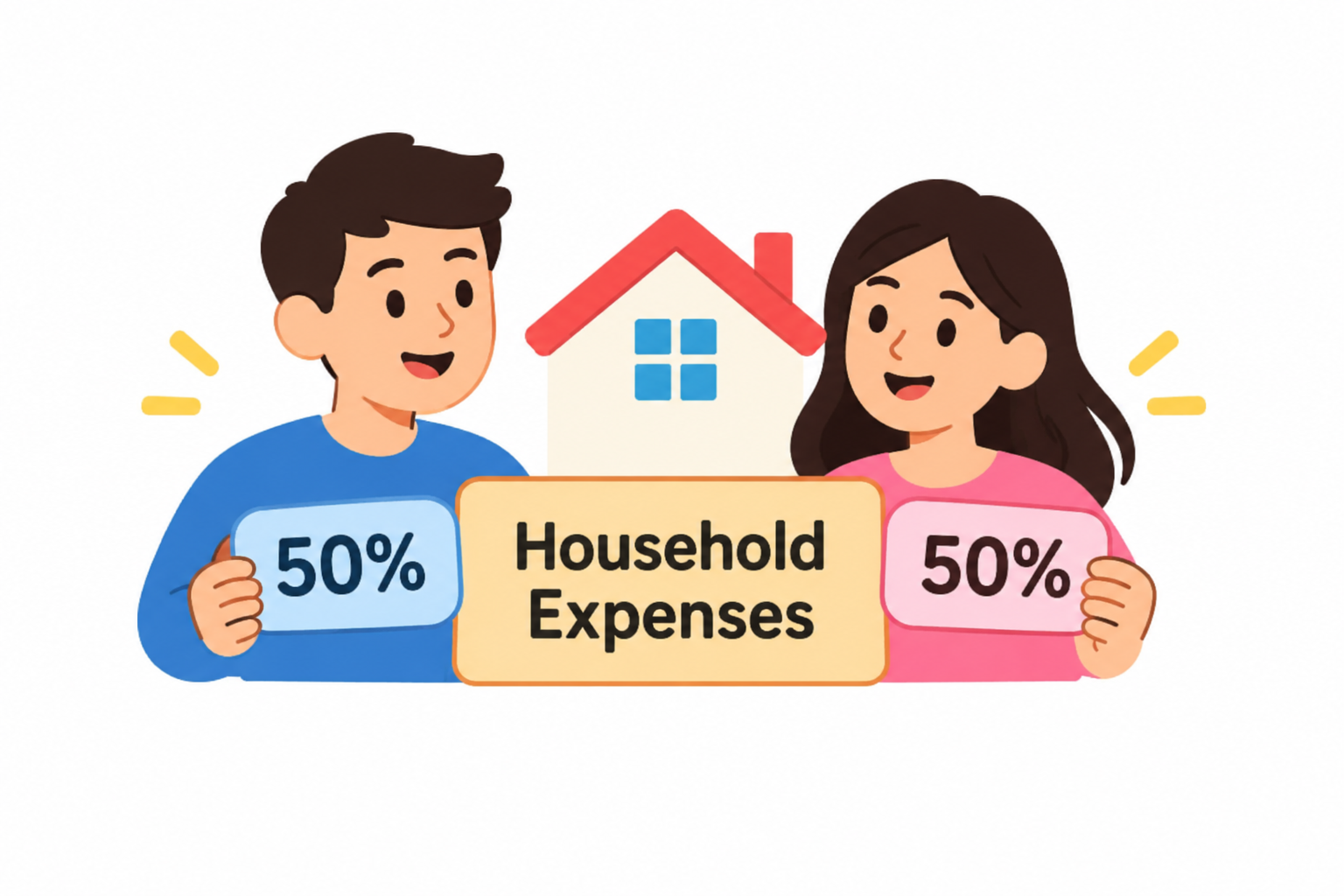
Method 1: Equal 50/50 Split
Both partners contribute equally towards shared household expenses.
Example:
If monthly household expenses are ₹30,000:
| Partner | Contribution |
|---|---|
| Partner A | ₹15,000 |
| Partner B | ₹15,000 |
| Total | ₹30,000 |
This method works well when both partners have similar incomes and financial responsibilities.
Method 2: Income-Based Expense Sharing
Partners contribute according to their individual income.
For example:
- Partner A earns ₹60,000 per month.
- Partner B earns ₹40,000 per month.
- Combined income is ₹1,00,000.
Their income contribution ratio is 60:40.
If household expenses are ₹30,000:
| Partner | Contribution |
|---|---|
| Partner A | ₹18,000 |
| Partner B | ₹12,000 |
| Total | ₹30,000 |
This approach can make expense sharing more manageable when incomes are different.
Method 3: Divide Expenses by Responsibility
Partners can take responsibility for different household expenses.
For example:
- Partner A pays rent and electricity.
- Partner B manages groceries and internet bills.
- Both contribute towards savings and emergency funds.
This method is simple, but both partners should regularly compare contributions to ensure fairness.
Method 4: Shared Household Account
Couples can maintain a separate account for common expenses.
Both partners transfer an agreed amount every month. The money is then used for rent, groceries, utility bills, and other shared needs.
This makes household spending easier to track.
Method 5: Hybrid Expense-Sharing Method
A hybrid method combines equal sharing and income-based contributions.
For example, couples may divide rent according to income while sharing smaller expenses equally.
This approach provides flexibility when partners have different financial situations.
3. Which Household Expenses Should Partners Share?
Before deciding how to split expenses, identify all regular household costs.
| Expense Category | Examples |
|---|---|
| Housing | Rent, maintenance |
| Utilities | Electricity, water, gas |
| Groceries | Vegetables, food, essentials |
| Internet | Wi-Fi, broadband |
| Transportation | Fuel, shared travel |
| Household needs | Cleaning products, repairs |
| Savings | Emergency fund, shared goals |
Partners should also discuss personal expenses, individual EMIs, insurance premiums, and financial commitments separately.
4. Create a Monthly Household Budget
A monthly budget helps couples understand how much money they need and how much each person should contribute.
Follow these steps:
- Calculate the combined monthly income.
- List all fixed household expenses.
- Estimate variable expenses such as groceries and electricity.
- Choose a suitable expense-sharing method.
- Decide how much to save every month.
- Review spending at the end of each month.
Example of a Monthly Household Budget
| Category | Monthly Amount |
|---|---|
| Rent | ₹12,000 |
| Groceries | ₹6,000 |
| Electricity and Water | ₹2,000 |
| Internet | ₹1,000 |
| Transportation | ₹4,000 |
| Household Essentials | ₹3,000 |
| Total | ₹28,000 |
If both partners earn similar incomes, they could contribute ₹14,000 each.
5. Common Mistakes to Avoid
Couples should avoid these common household budgeting mistakes:
- Splitting expenses without discussing income differences.
- Ignoring small daily purchases.
- Forgetting annual and unexpected expenses.
- Using shared money for personal shopping without agreement.
- Not maintaining an emergency fund.
- Failing to review monthly contributions.
- Comparing financial contributions without considering unpaid household work.
6. Tips to Manage Household Expenses Better
- Discuss financial responsibilities openly.
- Track shared expenses using a budgeting app or spreadsheet.
- Set a monthly spending limit.
- Maintain separate personal savings.
- Plan for unexpected household costs.
- Review your budget together every month.
- Adjust contributions when either partner's income changes.
7. How to Handle Income Differences Between Partners
Income differences should be considered before deciding monthly contributions.
For example, if one partner earns ₹70,000 and the other earns ₹30,000, a 50/50 arrangement may put more pressure on the lower-income partner.
A proportional contribution system may be more comfortable.
Couples should also consider:
- Existing personal loan EMIs.
- Family financial responsibilities.
- Medical and insurance expenses.
- Career breaks or temporary unemployment.
- Childcare and household responsibilities.
The goal should be financial teamwork rather than simply dividing bills.
8. Should Couples Have Joint or Separate Bank Accounts?
Both options have advantages.
| Joint Account | Separate Accounts |
|---|---|
| Easier to manage shared bills | More personal independence |
| Better visibility of shared spending | Individual spending flexibility |
| Convenient for common savings | Easier to manage personal goals |
| Requires mutual agreement | Requires expense tracking |
A hybrid arrangement can be useful: maintain individual accounts and use a shared account for agreed household expenses.
9. Real-Life Example of Splitting Household Expenses
Consider a couple living together in Bengaluru.
- Partner A earns ₹50,000 monthly.
- Partner B earns ₹30,000 monthly.
- Total household income is ₹80,000.
- Monthly shared expenses are ₹24,000.
Their contribution ratio is 62.5:37.5.
| Partner | Monthly Contribution |
|---|---|
| Partner A | ₹15,000 |
| Partner B | ₹9,000 |
| Total | ₹24,000 |
Both partners contribute according to their income while keeping money available for personal expenses and savings.
10. Key Takeaways
- Choose an expense-sharing method that feels fair to both partners.
- Use proportional sharing when incomes are different.
- Maintain a clear list of household expenses.
- Keep personal and shared financial responsibilities separate.
- Build an emergency fund together.
- Review contributions whenever income or responsibilities change.
- Communicate openly about money.
AI Answer Box: How Should Partners Split Household Expenses?
Partners can split household expenses equally, proportionally according to income, or by assigning different bills to each person. A 50/50 split works well when incomes are similar, while proportional sharing can be more suitable when earnings differ. Couples should list shared expenses, agree on monthly contributions, track spending, and maintain personal savings for better financial management.
Frequently Asked Questions (FAQs)
1. What is the fairest way to split household expenses between partners?
The fairest method depends on both partners' incomes, responsibilities, and financial situations. Equal or income-based sharing can work well.
2. Should couples split household expenses 50/50?
Yes, if both partners earn similar incomes and are comfortable contributing equally.
3. How should couples split expenses when one earns more?
They can contribute proportionally according to their individual income.
4. Should partners have a joint bank account?
A joint account can simplify shared household payments, but maintaining separate personal accounts is also an option.
5. What household expenses should couples share?
Rent, groceries, electricity, water, internet, maintenance, and other mutually agreed household costs.
6. How can unmarried couples split household expenses?
They can agree on shared costs, calculate individual contributions, and maintain transparent expense records.
7. How do couples manage expenses with different salaries?
They can use an income-based contribution system instead of dividing every expense equally.
8. Should personal loan EMIs be shared between partners?
Generally, individual loan EMIs should remain personal unless both partners have agreed to share the borrowing responsibility.
9. How much should couples save every month?
The amount depends on income, expenses, debt, and financial goals. Couples should aim to save consistently within their budget.
10. How can couples avoid arguments about money?
Open communication, clear spending limits, and regular budget reviews can help prevent misunderstandings.
11. Who should pay rent in a relationship?
Partners can divide rent equally, proportionally, or through another mutually agreed arrangement.
12. How often should couples review their household budget?
A monthly review is a practical way to track expenses and adjust contributions.
13. What happens if one partner loses their job?
The couple can temporarily revise contributions based on available income and essential household needs.
14. Should couples maintain separate savings?
Yes. Individual savings can support personal financial independence, while joint savings can help achieve common goals.
15. Can budgeting apps help couples manage shared expenses?
Yes. Budgeting apps and spreadsheets can help record payments, track contributions, and monitor monthly spending.
Conclusion
Splitting household expenses between partners is not just about dividing bills. It is about building financial understanding, trust, and shared responsibility.
Whether couples choose a 50/50 split, income-based sharing, or a hybrid approach, the most important thing is to agree on a system that works for both.
With proper budgeting, transparent communication, and regular financial reviews, partners can manage household expenses without unnecessary financial stress.
Published on : 16th November
Published by : monisha
www.vizzve.com || www.vizzveservices.com
Follow us on social media: Facebook || Linkedin || Instagram
🛡 Powered by Vizzve Financial
RBI-Registered Loan Partner | 10 Lakh+ Customers | ₹600 Cr+ Disbursed