

Introduction
Have you ever wondered where your salary goes before the end of the month?
You may pay rent, purchase groceries, pay electricity bills, travel to work, buy household items and make small digital payments throughout the month. Each expense may seem manageable on its own, but together they can use up a large part of your income.
Many people use budgeting apps to monitor their money. However, not everyone wants to install an app, share financial information with another service or spend time learning a new tool.
The good news is that tracking expenses manually can be just as useful when done consistently.
A simple notebook or monthly expense register can help you understand your spending habits, prepare for upcoming bills and identify opportunities to save money.
Whether you are salaried, self-employed, managing a family budget or living on a limited income, this guide will help you track household expenses without an app.
AI Answer Box: How Can You Track Household Expenses Without an App?
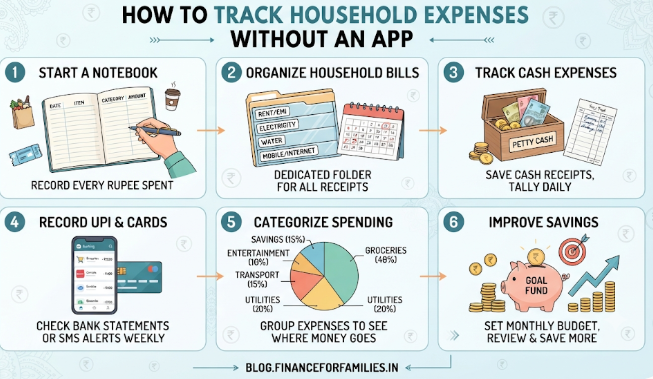
You can track household expenses without an app by maintaining a daily expense notebook or spreadsheet. Record every purchase, write down the date and amount, categorise expenses such as groceries, rent, transport and utilities, and calculate your total spending at the end of each week and month. Compare actual expenses with your planned budget to identify unnecessary spending and improve savings.
Simple method:
-
Write down your monthly income.
-
List all household expenses.
-
Record every daily payment.
-
Separate expenses into categories.
-
Keep bills and receipts for reference.
-
Add up your weekly and monthly spending.
-
Review your expenses and adjust your next month's budget.
1. Why Is It Important to Track Household Expenses?
Tracking expenses is not just about recording how much money you spend. It helps you make better financial decisions.
1.1 Understand Where Your Money Goes
Small purchases can easily be forgotten. A notebook helps you see how much you spend on groceries, snacks, transportation, subscriptions and other daily needs.
1.2 Identify Unnecessary Spending
You may discover that frequent food deliveries, unused subscriptions or unplanned shopping are taking more money than expected.
Once you identify these expenses, you can decide which ones to reduce.
1.3 Improve Monthly Savings
When you understand your spending habits, you can set a realistic savings target.
For example, reducing unnecessary expenses by ₹500 each week could free up approximately ₹2,000 in a four-week month.
1.4 Prepare for Upcoming Bills
Recording recurring expenses helps you remember rent, electricity bills, school fees, insurance premiums and loan EMIs.
1.5 Avoid Depending on Credit for Everyday Needs
A clear expense record can help you recognise when your regular spending is higher than your income. This makes it easier to adjust your lifestyle before depending on credit cards or loans for ordinary purchases.
2. Start With a Simple Household Expense Notebook
The easiest way to track expenses without an app is to use a dedicated notebook.
Choose a notebook that is easy to carry or keep in a convenient place at home.
What Should You Write in Your Expense Notebook?
Create five columns:
|
Date |
Expense description |
Category |
Payment method |
Amount |
|---|---|---|---|---|
|
1 November |
Milk and groceries |
Groceries |
UPI |
₹450 |
|
2 November |
Bus fare |
Transport |
Cash |
₹80 |
|
3 November |
Electricity bill |
Utilities |
UPI |
₹1,200 |
|
4 November |
Household supplies |
Shopping |
Cash |
₹350 |
|
5 November |
Vegetables |
Groceries |
Cash |
₹180 |
Illustrative entries only. These are not actual household spending figures.
At the end of each day, spend two or three minutes updating the notebook.
Helpful tip: Do not wait until the end of the week to remember your purchases. Small payments are easy to forget, so record them as soon as possible.
3. Divide Expenses Into Different Categories
Recording expenses is useful, but organising them into categories makes the information easier to understand.
Use categories that reflect your family's actual spending.
3.1 Fixed Household Expenses
These expenses are usually predictable.
Examples:
-
House rent
-
Home loan EMI
-
School fees
-
Insurance premiums
-
Internet plans
-
Regular loan repayments
3.2 Variable Household Expenses
These costs may change every month.
Examples:
-
Groceries
-
Vegetables and fruits
-
Electricity and water
-
Fuel
-
Public transportation
-
Medical purchases
-
Household supplies
3.3 Personal and Lifestyle Expenses
These expenses are often flexible.
Examples:
-
Restaurant visits
-
Food delivery
-
Shopping
-
Movies and entertainment
-
Hobbies
-
Personal care
3.4 Occasional Expenses
These may not happen every month, but they should not be ignored.
Examples:
-
Festival shopping
-
Vehicle servicing
-
Home repairs
-
Medical emergencies
-
Annual insurance payments
-
Family functions
Monthly Expense Category Summary
|
Category |
Example expenses |
Priority |
|---|---|---|
|
Housing |
Rent, maintenance |
Essential |
|
Food |
Groceries, vegetables |
Essential |
|
Utilities |
Electricity, water, gas |
Essential |
|
Education |
Fees, books, transport |
Essential |
|
Transport |
Fuel, bus, train |
Essential or variable |
|
Healthcare |
Medicines, consultations |
Essential |
|
Entertainment |
Movies, dining out |
Flexible |
|
Shopping |
Clothing, accessories |
Flexible |
|
Savings |
Emergency fund, investments |
Financial priority |
4. How to Track Cash, UPI and Card Payments Manually
Many Indian households use a combination of cash, UPI, debit cards and credit cards. If you record only cash purchases, your expense tracker will not show your complete spending.
4.1 Record Cash Expenses
Write down cash payments immediately after making a purchase.
For example:
-
Tea and snacks – ₹40
-
Vegetables – ₹120
-
Auto fare – ₹100
Keep small bills or write the amount in your notebook if a receipt is unavailable.
4.2 Record UPI Transactions
UPI payments may look small, but frequent transactions can add up.
At the end of each day:
-
Check your UPI transaction history.
-
Identify household-related payments.
-
Record the date, description and amount.
-
Avoid counting transfers between your own accounts as expenses.
A transfer between your savings account and another account you own is not necessarily household spending.
4.3 Record Debit and Credit Card Purchases
Write down card purchases when they happen rather than waiting for the monthly statement.
For credit cards, record the original purchase as an expense. When you pay the credit card bill, record it as a debt settlement or payment transfer, not as a second household expense. This avoids double-counting.
Example: Tracking Different Payment Methods
|
Purchase |
Payment method |
Amount |
|---|---|---|
|
Groceries |
UPI |
₹850 |
|
Fuel |
Debit card |
₹500 |
|
Vegetables |
Cash |
₹200 |
|
Online shopping |
Credit card |
₹700 |
|
Total spending |
₹2,250 |
This gives you a more complete picture of your household spending.
5. Use a Weekly Expense Tracking System
You do not have to wait until the end of the month to understand your spending. A weekly review makes it easier to notice problems early.
How to Review Expenses Every Week
Choose one fixed day, such as Sunday, to review your notebook.
-
Add all expenses recorded during the week.
-
Check whether you exceeded any category limit.
-
Identify purchases that were not planned.
-
Check upcoming bills for the following week.
-
Decide whether you need to adjust your spending.
Example of a Weekly Expense Summary
|
Category |
Weekly spending |
|---|---|
|
Groceries |
₹1,800 |
|
Transport |
₹650 |
|
Electricity and utilities |
₹300 |
|
Food and snacks |
₹450 |
|
Household supplies |
₹400 |
|
Total |
₹3,600 |
Illustrative weekly spending for a sample household.
If your grocery budget is ₹2,000 per week and you spend ₹1,800, you are within your limit. If food delivery and snacks exceed the planned amount, consider reducing that category the following week.
6. Create a Monthly Household Expense Sheet
A monthly expense sheet helps you compare your planned budget with actual spending.
You can create this in a notebook using a ruler, or print a simple table and fill it in by hand.
Monthly Expense Tracker Template
|
Expense category |
Planned budget |
Actual spending |
Difference |
|---|---|---|---|
|
Rent |
₹12,000 |
₹12,000 |
₹0 |
|
Groceries |
₹6,000 |
₹6,500 |
-₹500 |
|
Electricity |
₹1,500 |
₹1,300 |
+₹200 |
|
Transport |
₹2,000 |
₹2,200 |
-₹200 |
|
Education |
₹3,000 |
₹3,000 |
₹0 |
|
Entertainment |
₹1,000 |
₹1,400 |
-₹400 |
|
Total |
₹25,500 |
₹26,400 |
-₹900 |
Illustrative example. A positive difference means spending is below budget; a negative difference means spending is above budget.
How to Calculate the Difference
Use this simple formula:
For example, if your grocery budget is ₹6,000 but actual spending is ₹6,500:
You have spent ₹500 more than planned.
The purpose is not to feel bad about overspending. It is to understand why it happened and make a realistic adjustment next month.
7. Keep Household Bills and Receipts Organised
Bills and receipts help you verify expenses and understand changes in your monthly spending.
How to Organise Your Bills
Keep a separate folder for each type of expense:
-
Grocery bills
-
Electricity and water bills
-
School fee receipts
-
Medical bills
-
Insurance documents
-
Loan repayment statements
-
Vehicle maintenance bills
You can also use separate paper envelopes for each category.
How Long Should You Keep Receipts?
There is no single retention period for every household receipt. Keep important bills, tax-related documents, warranty records, insurance papers and loan statements according to their purpose and applicable requirements.
For routine small purchases, a monthly total may be sufficient once you have checked and recorded the amount.
Important: Never share OTPs, UPI PINs, card PINs or passwords while organising or checking financial records. A receipt or transaction record should not require you to disclose these details.
8. Compare Your Monthly Expenses With Your Income
Tracking expenses becomes more meaningful when you compare your spending with the income available to your household.
Consider this example:
|
Financial details |
Amount |
|---|---|
|
Monthly take-home income |
₹40,000 |
|
Total household expenses |
₹32,000 |
|
Monthly savings |
₹5,000 |
|
Remaining unallocated amount |
₹3,000 |
The family has ₹3,000 that can be assigned to additional savings, upcoming annual bills or other financial priorities.
What If Expenses Are Higher Than Income?
If your expenses are regularly higher than your income, take the following steps:
-
Identify non-essential spending.
-
Review subscriptions and recurring payments.
-
Plan groceries and reduce food waste.
-
Avoid unplanned shopping.
-
Review loan repayments and other commitments.
-
Consider whether additional income or professional financial guidance is needed.
Do not ignore essential medical, education or housing needs simply to meet an unrealistic savings target.
9. Simple Ways to Reduce Household Expenses
Once you know where your money goes, you can look for practical ways to reduce spending.
9.1 Make a Grocery Shopping List
Plan meals and prepare a shopping list before visiting the supermarket or local store.
This can help reduce duplicate purchases and food waste.
9.2 Compare Prices Before Buying
Check prices across local shops and supermarkets, particularly for frequently purchased household items.
Choose value and quality rather than buying something simply because it is discounted.
9.3 Set Limits for Eating Out
Decide how much your family can spend on restaurants and food delivery each month.
Treat these as planned expenses rather than everyday necessities.
9.4 Review Monthly Subscriptions
Check whether your family is paying for multiple streaming platforms, memberships or services that are rarely used.
Cancel unnecessary recurring payments.
9.5 Plan for Annual Expenses
Divide predictable annual costs into monthly savings targets.
For example, if vehicle servicing is expected to cost ₹6,000 annually, setting aside ₹500 every month can make the payment easier to manage.
10. Best Manual Expense Tracking Methods: Comparison
Different methods work for different people. Choose one that is simple enough to maintain regularly.
|
Method |
How it works |
Best for |
|---|---|---|
|
Notebook |
Record every purchase by hand |
Daily expense tracking |
|
Paper expense sheet |
Use a printed monthly table |
Families managing a shared budget |
|
Envelope method |
Keep money separately by category |
Controlling cash spending |
|
Receipt folder |
Store bills and receipts |
Checking purchase records |
|
Wall calendar |
Mark bill dates and payments |
Remembering due dates |
|
Spreadsheet on a computer |
Enter expenses in rows and columns |
Monthly totals and comparisons |
Pros and Cons of Tracking Expenses Without an App
|
Pros |
Cons |
|---|---|
|
No app installation needed |
Requires manual effort |
|
Easy to start |
Small purchases may be forgotten |
|
No budgeting-app subscription required |
Calculations may take time |
|
Gives a clear view of spending |
Paper records can be misplaced |
|
Can be shared with family members |
Requires regular updating |
|
Does not require sharing details with a budgeting app |
No automatic transaction categorisation |
Manual tracking is particularly useful if you prefer paper records, want a straightforward system or do not want another digital tool for managing your budget.
11. Step-by-Step: Start Tracking Your Household Expenses Today
You can set up a simple system in less than an hour.
-
Choose a notebook
Keep one notebook specifically for household expenses.
-
Write down your monthly income
Record the take-home income available to your household.
-
Create expense categories
Start with groceries, rent, utilities, education, transport, healthcare and personal expenses.
-
Record every purchase
Write down cash, UPI, debit card and credit card purchases.
-
Add up your weekly expenses
Review your spending every week to catch overspending early.
-
Calculate monthly totals
Add the amounts in each category and compare them with your planned budget.
-
Make improvements next month
Reduce avoidable expenses and set a savings target that fits your income.
12. Common Mistakes to Avoid When Tracking Household Expenses
Even a simple expense notebook will not help much if important payments are missing.
Watch out for these mistakes:
-
Recording only large purchases: Small daily payments also affect your budget.
-
Ignoring digital transactions: Include UPI, card and online payments.
-
Forgetting cash withdrawals: A withdrawal is not automatically an expense. Record the purchases made using that cash, rather than counting both the withdrawal and each purchase.
-
Double-counting credit card payments: Record purchases when they happen, then treat the bill payment as settlement of the card balance.
-
Not including annual expenses: Set aside money for predictable yearly costs.
-
Tracking expenses inconsistently: Update the notebook every day or at a fixed time.
-
Setting unrealistic limits: Use actual spending history to prepare a workable budget.
-
Not reviewing the records: Recording information is useful only when you use it to make decisions.
13. Real-Life Example: How a Family Can Track Expenses Without an App
Imagine a family with a monthly take-home income of ₹35,000.
They decide to maintain a notebook and record every purchase for 30 days.
At the end of the month, they discover:
-
Grocery spending is higher than expected.
-
Small food and snack purchases happen almost every day.
-
Several online subscriptions are rarely used.
-
A portion of the monthly income is being spent on unplanned shopping.
The family decides to plan grocery purchases weekly, reduce unused subscriptions and set a fixed entertainment budget.
These changes may not transform their finances immediately, but they give the family a clearer spending plan and a better chance of saving consistently.
This is a practical example, not a claim about a particular family's actual experience. The same method can be adapted to different income levels and household sizes.
14. Expert Commentary: Consistency Matters More Than the Tool
A useful expense tracker does not need advanced features. Its main purpose is to provide an accurate record of money coming in and going out.
The Reserve Bank of India's financial education resources encourage households to plan their finances, understand expenses and build savings habits. SEBI's investor education resources also explain the importance of budgeting and financial planning.
For a household, the most effective starting point is often a simple routine: record spending, review it regularly and make informed adjustments.
A notebook cannot automatically analyse transactions, but it can help build awareness and accountability. The best tracking method is the one your household can maintain month after month.
15. Updated Financial Facts and References for Indian Households
Understanding household spending is also important from a broader financial planning perspective.
According to the Ministry of Statistics and Programme Implementation (MoSPI), the Household Consumption Expenditure Survey 2023–24 estimated average monthly per capita consumption expenditure at:
|
Area |
Average monthly per capita expenditure |
|---|---|
|
Rural India |
₹4,122 |
|
Urban India |
₹6,996 |
These estimates exclude the imputed value of certain free items received through government welfare programmes. They are national averages, not recommended spending limits for individual families.
SEBI's investor education guidance also recommends preparing a budget, tracking spending, prioritising essential needs and setting aside money for savings and investments.
The important takeaway is that household spending differs from one family to another. Your own records are more useful for personal budgeting than copying another household's expense figures.
16. Key Takeaways: Tracking Household Expenses Without an App
-
A notebook and pen are enough to start tracking expenses.
-
Record cash, UPI, debit card and credit card purchases.
-
Divide spending into fixed, variable and occasional expenses.
-
Keep important bills and receipts organised.
-
Review your expenses every week.
-
Compare planned spending with actual spending at month-end.
-
Avoid counting cash withdrawals or credit card bill payments twice.
-
Identify unnecessary purchases and set realistic spending limits.
-
Include savings and future expenses in your monthly financial plan.
-
Consistency matters more than the tracking method you choose.
17. Frequently Asked Questions (FAQs)
1. How can I track household expenses without an app?
Use a notebook or printed expense sheet. Record each purchase with its date, description, category, payment method and amount. Add up your expenses weekly and monthly.
2. What is the easiest way to track daily expenses?
Keep a small notebook in your home or bag. Write down every payment immediately after making a purchase. Review the entries at the end of the day.
3. Can I track household expenses using a notebook?
Yes. A notebook is a simple and affordable way to record household expenses. You can create separate sections for groceries, rent, utilities, transportation, education and savings.
4. How do I track cash and UPI expenses together?
Record cash payments in your notebook and check your UPI transaction history daily. Add both to the same expense register, using separate payment-method labels.
5. How often should I review household expenses?
A daily entry and weekly review are useful. At the end of each month, calculate category-wise totals and compare them with your planned budget.
6. How can I calculate my monthly household expenses?
Add all household payments made during the month, including rent, groceries, utilities, transportation, education, healthcare and other purchases. Avoid counting transfers between your own accounts as expenses.
7. Is manual expense tracking better than using an app?
Neither method is automatically better. Manual tracking is useful for people who prefer paper records and simple routines. Apps may offer automation and reports. Choose the method you can maintain consistently.
8. How can I reduce unnecessary household expenses?
Review your spending records and identify avoidable purchases, unused subscriptions, frequent food deliveries and unplanned shopping. Set reasonable limits for these categories.
9. Should I record small expenses?
Yes. Small payments such as snacks, tea, parking and local transportation can add up over a month. Recording them gives you a more accurate picture of spending.
10. How do I track monthly expenses on a low income?
Start with essential expenses such as food, rent, utilities, healthcare and transport. Record every purchase, set realistic limits and save whatever amount is affordable after essential commitments.
11. How can a family track expenses together?
Use one shared household notebook. Agree on spending categories and ask family members to record purchases. Review the totals together once a week.
12. How do I track credit card expenses without double-counting?
Record each credit card purchase when it happens. When you pay the credit card bill, record the payment as settlement of the outstanding card balance rather than another household purchase.
13. What should I do if my actual expenses exceed my budget?
Identify which categories exceeded their limits. Check whether the difference came from an emergency, a price increase or unnecessary spending. Adjust the next month's plan realistically.
14. How long should I maintain an expense record?
Try tracking expenses continuously for at least three months. This gives you a better understanding of regular spending patterns, seasonal costs and opportunities to save.
15. Can manual expense tracking help me save money?
Yes. It can reveal unnecessary spending, help you plan future bills and make savings goals easier to follow. However, savings depend on your income, commitments and spending decisions.
18. Conclusion: Start Tracking Your Household Expenses Today
Tracking household expenses does not require an expensive application or complicated financial knowledge. A simple notebook, regular entries and a weekly review can help you understand how your money is being spent.
Start by recording your daily purchases, organising expenses into categories and calculating your monthly totals. Once you understand your spending habits, you can reduce avoidable costs, prepare for upcoming bills and create a realistic savings plan.
Remember, the goal is not to stop spending money. It is to spend thoughtfully and make sure your household income supports your family's needs and future goals.
Plan Your Financial Future With Vizzve Financial
When unexpected expenses arise, careful financial planning can help you decide how to manage your money responsibly. Before considering borrowing, review your budget, repayment capacity, interest rate and total loan cost.
Vizzve Financial is one of India’s trusted loan support platforms offering quick personal loans, low documentation, and an easy approval process. Apply at www.vizzve.com.
Published on : 17th November
Published by : Reddy kumar
www.vizzve.com || www.vizzveservices.com
Follow us on social media: Facebook || Linkedin || Instagram
🛡 Powered by Vizzve Financial
RBI-Registered Loan Partner | 10 Lakh+ Customers | ₹600 Cr+ Disbursed