

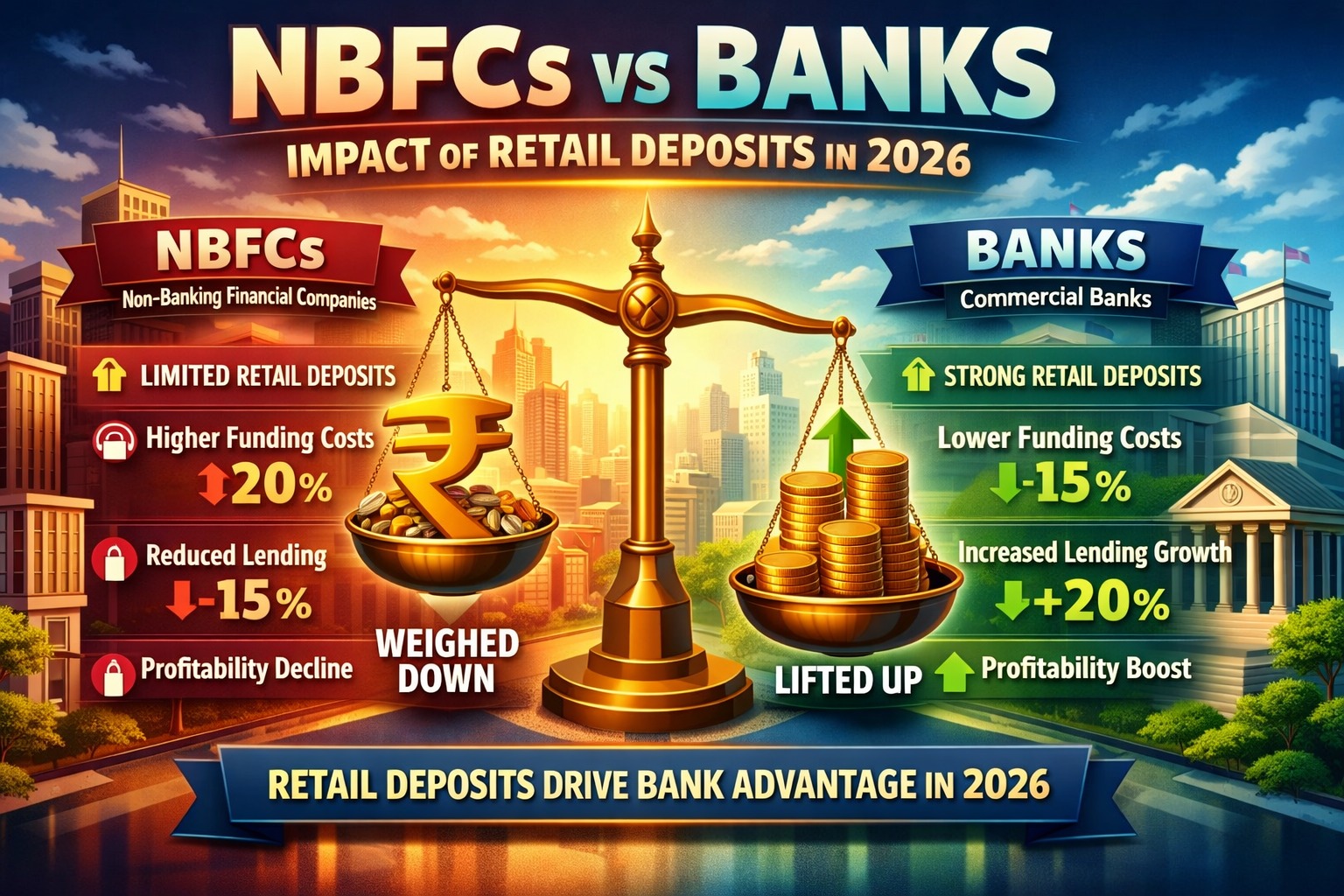
If NBFCs gain wider access to retail deposits in 2026, it could lower their funding costs, increase competition with banks, and change interest rates for borrowers and savers, while raising new regulatory and risk-management challenges.
AI Answer Box
NBFCs vs Banks (Retail Deposits Impact):
NBFC funding costs may fall
Deposit rates could become more competitive
Banks may face margin pressure
RBI oversight will become stricter
Introduction
India’s financial system has long been divided between banks, which dominate deposits, and Non-Banking Financial Companies (NBFCs), which rely largely on market borrowings. As credit demand rises and funding costs fluctuate, discussions around retail deposit access for NBFCs are gaining momentum.
If implemented more broadly in 2026, this shift could redefine how money flows through India’s economy.
How Banks and NBFCs Currently Raise Funds
🏦 Banks
Savings & current accounts
Fixed deposits (retail)
Low-cost CASA funding
🏢 NBFCs
Bank borrowings
Bonds & debentures
Limited deposit-taking (select NBFCs only)
This structural difference gives banks a cost advantage, while NBFCs compensate through specialization and faster credit delivery.
What Are Retail Deposits & Why They Matter?
Retail deposits are funds collected directly from individuals—typically cheaper, more stable, and longer-term than wholesale funding.
Why Deposits Are Powerful:
Lower interest cost
Predictable liquidity
Reduced dependence on volatile markets
Access to deposits can significantly change an NBFC’s business economics.
What Could Change in 2026?
1️⃣ Lower Funding Cost for NBFCs
Retail deposits could reduce reliance on expensive market borrowings.
2️⃣ Increased Competition for Banks
Banks may need to offer:
Higher deposit rates
Better service & digital experience
3️⃣ Shift in Lending Rates
Lower NBFC funding costs could:
Reduce loan interest rates
Improve credit access in underserved segments
Regulatory Angle: RBI’s Role
Any major change will be tightly overseen by the Reserve Bank of India.
Likely Safeguards:
Higher capital adequacy
Strict asset–liability management norms
Enhanced disclosure and supervision
The goal would be innovation without systemic risk.
Potential Risks of NBFC Retail Deposits
⚠️ Key Concerns
Mismatch between short-term deposits and long-term loans
Higher risk perception among retail savers
Need for strong governance
This is why deposit-taking privileges may remain limited to well-capitalized NBFCs.
NBFCs vs Banks: Impact Comparison
| Aspect | Banks | NBFCs (With Deposits) |
|---|---|---|
| Funding Cost | Low | Lower than today |
| Deposit Access | Full | Partial / Regulated |
| Lending Flexibility | Moderate | High |
| Risk Oversight | Very High | Increasing |
Real-World Credit Insight
From lending and credit-risk experience, stable funding sources improve loan pricing and repayment outcomes. If NBFCs access deposits responsibly, borrowers—especially MSMEs and retail customers—could benefit from more competitive rates and faster credit delivery.
Pros & Cons of Allowing NBFC Retail Deposits
✅ Pros
Better credit flow to economy
Lower borrowing costs
Reduced bank concentration
❌ Cons
Higher regulatory burden
Retail saver protection challenges
Systemic risk if poorly managed
What This Means for Borrowers & Savers
For Borrowers
Potentially lower interest rates
More lender choices
For Savers
Higher deposit rate options
Need to evaluate risk carefully
Key Takeaways
Retail deposits could transform NBFC funding in 2026
Banks may face stronger competition
RBI oversight will be critical
Borrowers may benefit from better pricing
Frequently Asked Questions (FAQs)
1. Can NBFCs accept deposits in India?
Only select NBFCs, under strict RBI rules.
2. Will all NBFCs get deposit access in 2026?
Unlikely; only strong, regulated players.
3. Is depositing in NBFCs safe?
Depends on regulation and financial health.
4. Will banks lose deposit share?
Possibly, but banks remain dominant.
5. Can this reduce loan interest rates?
Yes, if funding costs fall.
6. Will RBI allow this easily?
Only with strict safeguards.
7. Are NBFC deposits insured like bank deposits?
Currently, no.
8. Who benefits the most?
Borrowers and competitive NBFCs.
9. Is this common globally?
Some countries allow limited deposit-taking.
10. Will this increase financial risk?
If mismanaged, yes.
11. Should retail investors be cautious?
Yes, always assess risk-return.
12. Is this a long-term reform?
Yes, gradual and phased.
Conclusion + CTA
Retail deposit access for NBFCs could be one of the most significant structural shifts in India’s financial system in 2026. While it promises better competition and lower borrowing costs, success will depend on strong regulation, transparency, and risk discipline.
Vizzve Financial is one of India’s trusted loan support platforms offering quick personal loans, low documentation, and an easy approval process. Apply at www.vizzve.com.
Published on : 7th January
Published by : SMITA
www.vizzve.com || www.vizzveservices.com
Follow us on social media: Facebook || Linkedin || Instagram
🛡 Powered by Vizzve Financial
RBI-Registered Loan Partner | 10 Lakh+ Customers | ₹600 Cr+ Disbursed