

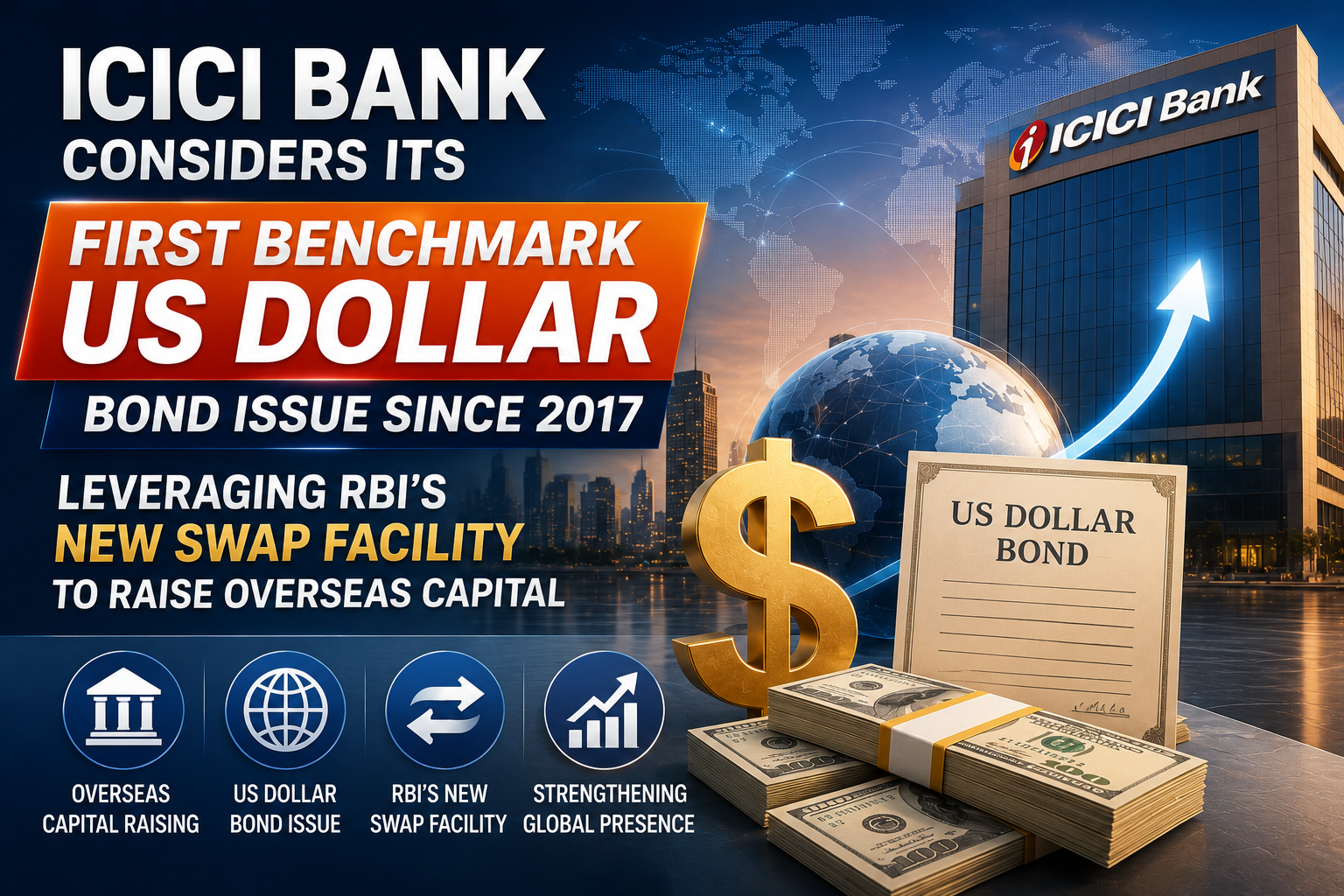
India's second-largest private lender, ICICI Bank, is planning its first benchmark US dollar bond issue in nearly nine years. The bank is expected to raise at least $500 million through a likely five-year offshore bond issue, utilizing the Reserve Bank of India's newly introduced foreign currency swap facility that significantly reduces hedging costs.
The proposed issuance signals growing confidence in India's banking sector and could encourage more Indian lenders to access international debt markets.
AI Answer Box
Why Is ICICI Bank Planning a Dollar Bond Issue?
ICICI Bank plans to issue dollar bonds because:
- Overseas borrowing costs have become cheaper
- RBI introduced a concessional swap facility
- Global investor demand remains strong
- Banks seek diversified funding sources
- International capital markets offer large liquidity pools
- Foreign borrowing supports future growth plans
Key Details
| Item | Details |
|---|---|
| Bank | ICICI Bank |
| Expected Amount | $500 Million+ |
| Likely Tenure | 5 Years |
| Last Dollar Bond Issue | December 2017 |
| Funding Route | Overseas Dollar Bonds |
| Support Mechanism | RBI Swap Window |
Introduction
After nearly a decade away from benchmark dollar bond markets, ICICI Bank is preparing to return to international investors. The planned transaction would mark the bank's first benchmark-sized US dollar bond issue since 2017 and represents a significant milestone for India's banking sector.
The move comes shortly after the Reserve Bank of India introduced a new foreign exchange swap facility that lowers hedging costs for overseas borrowing, making foreign currency fundraising significantly more attractive for Indian banks.
The development has attracted considerable attention because it could signal the beginning of a new wave of international fundraising by Indian financial institutions.
What Is ICICI Bank Planning?
According to banking sources, ICICI Bank plans to raise at least $500 million through a benchmark-sized dollar bond issuance. The offering is expected to have a maturity period of approximately five years.
Important Details
- Minimum fundraising target: $500 million
- Expected bond maturity: Five years
- Market: International dollar bond market
- Likely launch: Second half of August 2026
- Structure: Benchmark-sized issuance
Why Is This ICICI Bank's First Dollar Bond Since 2017?
ICICI Bank last issued benchmark dollar bonds in December 2017, when it raised $500 million through 10-year bonds carrying a coupon of 3.80%.
Several factors contributed to the gap:
Domestic Liquidity Availability
Indian banks had sufficient domestic funding sources.
Higher Hedging Costs
Foreign currency borrowing became relatively expensive.
Strong Deposit Growth
Banks relied primarily on domestic deposits.
Regulatory Environment
Domestic markets offered adequate financing opportunities.
The RBI's recent policy changes have altered this equation considerably.
How RBI's New Swap Facility Changed Everything
The Reserve Bank of India recently introduced a swap facility allowing eligible overseas borrowings to be hedged at a fixed cost of 1.5% annually.
Benefits of the New Facility
Lower Hedging Costs
Banks can reduce currency risk expenses.
Cheaper Overseas Borrowing
International funding becomes more competitive.
Better Liquidity Management
Banks gain access to diversified funding.
Increased Market Participation
More institutions may enter foreign markets.
This facility has already encouraged several major banks to pursue overseas fundraising.
Other Indian Banks Have Already Entered the Market
ICICI Bank is following other major Indian lenders.
Recent Transactions Include
HDFC Bank
Raised $750 million through five-year dollar bonds.
Axis Bank
Raised approximately $800 million through offshore bonds.
State Bank of India
Also considered utilizing the RBI facility.
Why Are Indian Banks Returning to Dollar Markets?
Several structural factors are supporting overseas borrowing.
Diversification of Funding
Banks seek multiple sources of capital.
Strong Global Investor Demand
International investors remain interested in Indian credit.
Competitive Borrowing Costs
Lower hedging expenses improve economics.
Growth Financing Needs
Banks require capital to support expanding loan books.
What Does This Mean for ICICI Bank?
The proposed issuance could provide several advantages.
Improved Funding Flexibility
Access to global capital markets increases financing options.
Lower Funding Costs
Cheaper capital can improve profitability.
Stronger International Presence
Global investors gain exposure to Indian banking growth.
Balance Sheet Optimization
Diversified funding improves financial management.
Impact on Investors
Investors are closely watching the proposed issuance.
Positive Indicators Include
Management Confidence
Returning to global markets signals confidence.
Strong Credit Profile
Global investors often prefer highly rated issuers.
Growth Expectations
Additional capital supports expansion.
International Recognition
Global fundraising increases market visibility.
What Does This Mean for India's Banking Sector?
The transaction reflects broader strength in India's banking system.
Positive Trends Include
- Lower bad loans
- Strong profitability
- Higher credit growth
- Better capital adequacy
- Improved investor confidence
Indian banks are increasingly viewed as attractive global borrowers.
Risks Investors Should Consider
Despite the positive outlook, some risks remain.
Currency Risk
Exchange rate fluctuations remain important.
Global Interest Rates
Higher rates can increase borrowing costs.
Geopolitical Uncertainty
Global events may affect market sentiment.
Market Volatility
International bond markets can experience fluctuations.
Could More Indian Banks Follow?
Analysts expect additional banks to consider overseas borrowing if:
- RBI's swap facility remains available
- Global demand remains strong
- Funding costs stay competitive
- Economic conditions remain favorable
Some market participants estimate that the facility could attract billions of dollars in foreign borrowing over the coming months.
Expert Commentary
Banking analysts believe ICICI Bank's planned dollar bond issue reflects growing confidence in India's financial system and international investor appetite for Indian assets. The RBI's swap facility has significantly altered the economics of foreign borrowing, potentially opening a new funding channel for Indian banks.
The transaction could also strengthen India's position in global debt markets and encourage greater foreign participation in Indian financial assets.
Summary Table
| Factor | Impact |
|---|---|
| RBI Swap Facility | High |
| Funding Costs | Positive |
| Investor Demand | High |
| Bank Growth | Positive |
| International Exposure | Positive |
| Market Confidence | High |
| Currency Risk | Moderate |
Key Takeaways
- ICICI Bank plans its first benchmark dollar bond issue since 2017.
- The bank is expected to raise at least $500 million.
- RBI's new swap facility has reduced hedging costs significantly.
- Other banks including HDFC Bank and Axis Bank have already used the facility.
- The move reflects growing confidence in India's banking sector.
- Overseas borrowing could become an important funding source.
- Investors are closely monitoring international fundraising trends.
- The development highlights India's growing role in global capital markets.
Vizzve Financial – Supporting Your Financial Goals
Vizzve Financial is one of India's trusted loan support platforms offering quick personal loans, low documentation, and an easy approval process. Apply at www.vizzve.com.
Whether you're investing, managing business finances, or planning long-term wealth creation, Vizzve Financial offers accessible financial solutions designed for modern India.
Frequently Asked Questions (FAQs)
1. What is ICICI Bank planning?
ICICI Bank plans to raise at least $500 million through offshore dollar bonds.
2. When was ICICI Bank's last dollar bond issue?
Its last benchmark dollar bond issuance occurred in December 2017.
3. Why is the bank issuing dollar bonds?
To diversify funding sources and benefit from lower borrowing costs.
4. What is RBI's swap facility?
It is a hedging facility that reduces foreign currency borrowing costs.
5. How much does the RBI facility cost?
The fixed hedging cost is 1.5% annually.
6. Which banks have already used this facility?
HDFC Bank and Axis Bank have utilized it.
7. What is a benchmark bond issue?
A large bond issuance used as a pricing reference.
8. Will this affect ICICI Bank's profitability?
Lower funding costs may support profitability.
9. Why do banks borrow internationally?
To diversify funding and access larger capital pools.
10. What risks exist?
Currency risk, market volatility, and interest rate changes.
11. How does this affect investors?
It signals confidence and may support future growth.
12. Can more banks issue dollar bonds?
Yes, if market conditions remain favorable.
13. Why are global investors interested?
India offers strong economic and banking sector growth.
14. When could the bond be issued?
Potentially during the second half of August 2026.
15. What does this mean for India's banking sector?
It reflects increasing financial strength and global market integration.
Published on : 5th July
Published by : SMITA
www.vizzve.com || www.vizzveservices.com
Follow us on social media: Facebook || Linkedin || Instagram
🛡 Powered by Vizzve Financial
RBI-Registered Loan Partner | 10 Lakh+ Customers | ₹600 Cr+ Disbursed