

Introduction
Online loan applications have made borrowing more convenient. People can explore personal loans, submit documents, check eligibility, and receive loan decisions without visiting a physical branch.
However, not every loan app is trustworthy. Some fraudulent applications advertise instant approvals, promise loans without proper checks, demand advance payments, or misuse borrowers' personal information.
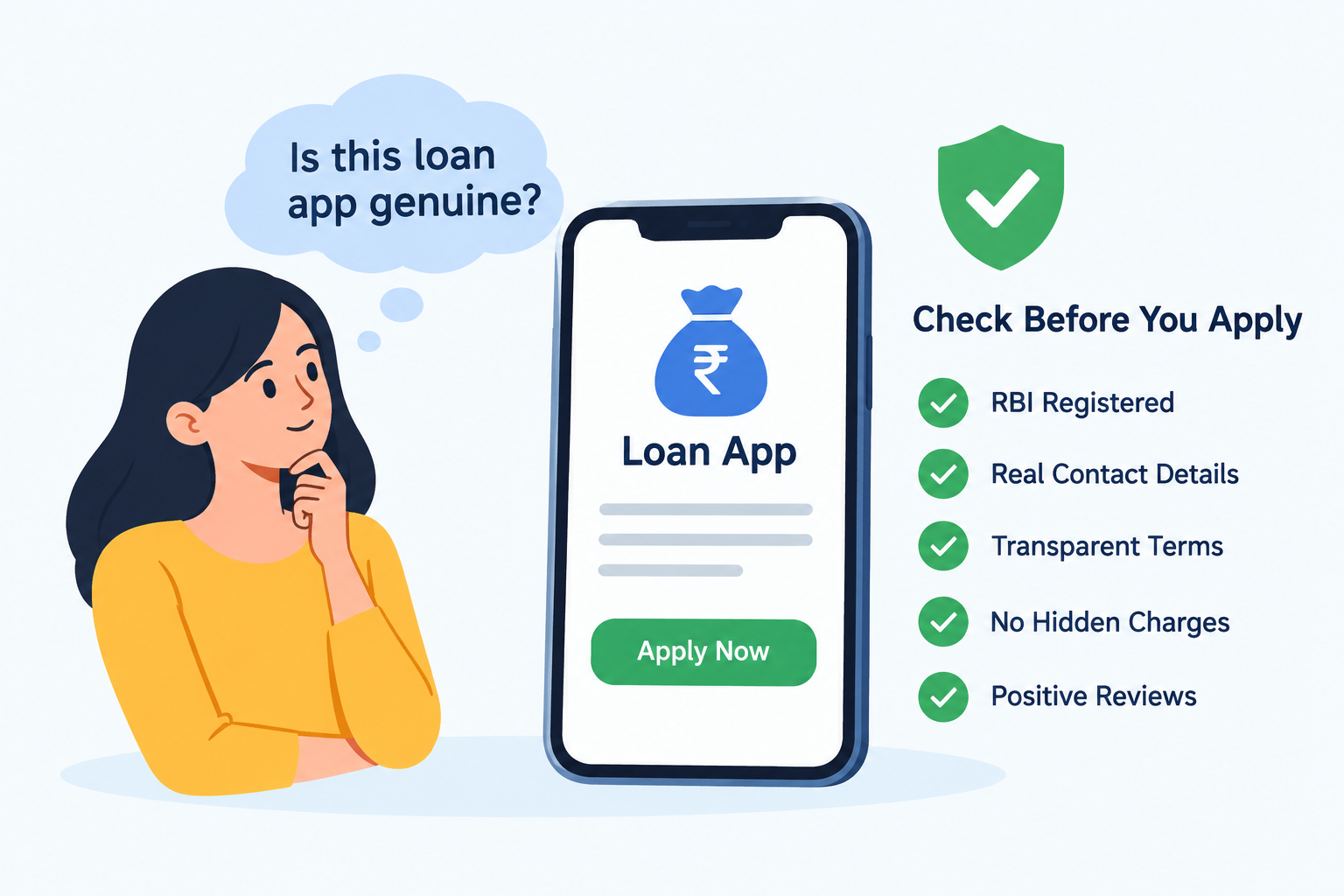
Identifying a genuine loan app means checking the actual lender, verifying its relationship with the app, reviewing the loan agreement, understanding the charges, and ensuring your personal information is handled appropriately.
In India, the Reserve Bank of India (RBI) publishes a public directory of digital lending apps associated with regulated entities. The directory became operational on July 1, 2025. It helps consumers check an app's claimed association with a regulated bank or non-banking financial company (NBFC). However, the RBI states that the directory is based on information submitted by regulated entities and is not independently validated by the RBI. Therefore, appearing in the directory should not be treated as a guarantee that every aspect of an app is safe.
This guide explains the practical checks you should complete before applying for a loan online.
AI Answer Box: How Can You Identify a Genuine Loan App?
A genuine loan app should clearly identify the bank or NBFC responsible for lending, provide verifiable company details, explain its interest rate and fees, and offer transparent loan terms.
Before applying:
-
Check the lender: Find the legal name of the bank or NBFC providing the loan.
-
Verify the app: Search the RBI's official Digital Lending Apps directory and check the lender's own website.
-
Review the loan terms: Read the Key Facts Statement (KFS), annual percentage rate (APR), repayment schedule, and applicable charges.
-
Check permissions: Be cautious if the app requests unnecessary access to contacts, call logs, or files.
-
Avoid advance-fee demands: Do not transfer money to an unknown person to secure a promised loan.
-
Protect your information: Never share your OTP, UPI PIN, passwords, or banking credentials with an agent.
Important: A professional-looking app, positive online reviews, or availability in an app store does not by itself establish that a lender or loan offer is genuine.
Summary Box: Genuine Loan App Verification
| Verification Point | What You Should Check |
|---|---|
| Lender identity | Legal name of the bank or NBFC |
| RBI directory | Whether the app's claimed association appears in the official directory |
| Company website | Official contact details and grievance process |
| Interest rate | Clearly disclosed rate and APR |
| Loan charges | Processing fees, taxes, penalties, and other applicable costs |
| Loan documents | KFS, sanction letter, and loan agreement |
| Permissions | Whether requested access is necessary |
| Repayment | Clear due dates and payment instructions |
| Customer support | Verifiable support channels and grievance officer details |
| Advance payments | No suspicious upfront payment demands to guarantee approval |
Use this checklist before submitting your Aadhaar, PAN, bank statements, salary slips, or other sensitive documents.
What Is a Genuine Loan App?
A genuine loan app is a digital platform that helps consumers access a legitimate lending service through a bank, NBFC, or another legally authorized lender.
The app may be operated directly by a regulated lender or by a lending service provider (LSP) working with a regulated lender. The app operator and the company actually providing the loan may therefore have different names.
For this reason, checking only the app's brand name is not enough. You must identify the legal lender and verify the relationship between that lender and the platform.
How Do Genuine Loan Apps Work?
A typical digital loan application follows these steps:
-
The applicant selects a loan product.
-
The platform explains eligibility criteria and requests relevant information.
-
The lender assesses the application, income, repayment capacity, and credit profile.
-
The lender communicates its decision and applicable terms.
-
The borrower reviews the KFS and loan agreement.
-
If the borrower accepts the offer, the loan is disbursed according to the agreed terms.
-
The borrower repays the loan through the disclosed repayment channel.
The exact process depends on the lender and product.
What Makes a Loan App Trustworthy?
A trustworthy loan application should provide:
-
A clearly identified lender.
-
Verifiable company information.
-
Transparent interest rates and charges.
-
Clear repayment terms.
-
Appropriate privacy and security practices.
-
A documented complaint-resolution process.
-
Loan documents that the applicant can review before accepting the offer.
No single feature proves that an app is genuine. Verification requires checking several details together.
Why Is It Important to Identify a Genuine Loan App?
Many people look for quick loans to manage medical expenses, education costs, household emergencies, travel, or other planned and unexpected expenses.
When borrowers are under financial pressure, they may accept offers without reading the conditions carefully. Fraudulent platforms can exploit this urgency.
Using an untrustworthy loan app may expose borrowers to several risks.
1. Financial Loss
Some fraudulent operators demand advance fees, fake insurance payments, verification charges, or other transfers before releasing a promised loan.
After receiving the money, they may disappear or continue demanding additional payments.
2. Personal Data Misuse
A suspicious app may request unnecessary permissions or collect more information than required for its stated purpose.
If misused, personal information can expose borrowers to identity theft, impersonation, unwanted contact, or fraud.
3. Hidden Loan Charges
A loan advertisement may highlight a low interest rate while giving little attention to processing fees, taxes, late-payment charges, or other costs.
Borrowers should review the complete cost of borrowing rather than relying on a headline rate.
4. Harassment and Threats
Fraudulent operators may use abusive messages, threats, or the misuse of personal information to pressure borrowers into making payments.
Borrowers who encounter harassment should preserve evidence and report the incident through appropriate official channels.
5. Identity Theft
Sharing identity documents, bank information, or verification codes with an unverified person can create opportunities for unauthorized transactions or fraudulent applications.
The safest approach is to verify the lender before sharing documents or accepting a loan offer.
How to Identify a Genuine Loan App in India
The following checks can help you assess whether a digital lending platform is legitimate.
1. Verify the Bank or NBFC Behind the App
This is one of the most important checks.
A loan app may advertise its own brand, but the actual lender could be a separate bank or NBFC.
Look for the following details:
-
Full legal name of the lender.
-
Registered office or official business address.
-
Official website.
-
Customer support contact information.
-
Applicable registration or regulatory information.
-
Details of the relationship between the lender and the app.
Visit the lender's official website independently instead of relying only on a link provided by an unknown agent.
Check whether the lender acknowledges the app or lending service provider as part of its digital lending arrangements.
Why Does the Lender's Identity Matter?
The company displaying the advertisement may not be the company responsible for approving and disbursing the loan.
Identifying the actual lender helps you determine whom to contact about interest rates, repayment, account statements, complaints, and other loan-related matters.
2. Check the RBI Digital Lending Apps Directory
The RBI's public directory helps consumers verify an app's claimed association with a regulated entity.
You can begin at the official Reserve Bank of India website and look for the directory titled “Digital Lending Apps (DLAs) deployed by Regulated Entities.”
The directory has been operational since July 1, 2025. Its purpose is to help users verify associations reported by regulated lenders. The RBI has clarified that the entries are based on information submitted by the regulated entities, without independent validation of the directory's contents by the central bank.
How to Check a Loan App in the RBI Directory
-
Open the RBI's official website.
-
Locate the Digital Lending Apps directory.
-
Search for the app's name.
-
Search for the associated bank or NBFC.
-
Compare the app name, website, or other identifying details with the platform you intend to use.
-
Independently check the lender's official website for confirmation.
Important: The RBI directory is a verification aid, not a blanket endorsement of an app or a guarantee of a particular loan offer. A listing does not mean that every advertisement, agent, or message using that app's name is genuine.
If you cannot find an app, do not immediately conclude that it is fraudulent without further checking. Confirm the exact name, spelling, web address, and legal lender. If the association remains unverified, do not submit sensitive information or proceed with the loan.
3. Download Apps From Trusted Sources
Download applications through established app stores or the lender's independently verified official website.
Avoid installing applications from:
-
Unknown SMS links.
-
Unsolicited WhatsApp messages.
-
Social media advertisements with suspicious links.
-
Unverified APK files.
-
Websites that imitate a known lender's brand.
Even an app-store listing should not replace lender verification.
Fraudsters may imitate established companies through similar names, logos, and advertisements.
How Can You Spot an Impersonation App?
Check the following details:
-
Is the developer's name consistent with the lender's official information?
-
Does the website domain match the company's genuine website?
-
Are the customer support details independently verifiable?
-
Does the official lender acknowledge the app?
-
Does the app request suspicious permissions or upfront payments?
If any of these checks raise serious concerns, stop and verify the platform before proceeding.
4. Review the Interest Rate, APR, and Other Charges
A genuine loan offer should explain its financial terms clearly.
Before accepting a loan, review:
-
Interest rate.
-
Annual percentage rate (APR).
-
Processing fee.
-
Applicable taxes.
-
Repayment period.
-
EMI amount.
-
Late-payment charges.
-
Foreclosure or prepayment conditions, where applicable.
-
Total amount repayable.
The APR is particularly useful because it reflects the annualized cost of credit under the applicable calculation method and includes relevant charges as prescribed by the rules.
Under the RBI's digital lending framework, borrowers should receive important information about the loan, including the applicable Key Facts Statement and APR, as relevant to the lending arrangement.
Example: Compare Two Loan Offers
Suppose you are comparing two hypothetical personal loan offers for ₹50,000.
| Particular | Offer A | Offer B |
|---|---|---|
| Loan amount | ₹50,000 | ₹50,000 |
| Advertised annual interest rate | 14% | 12% |
| Processing fee | 2% | 5% |
| Repayment tenure | 12 months | 12 months |
| Lender identity | Verified | Not verified |
| Complete charges disclosed | Yes | Unclear |
Offer B advertises a lower interest rate, but its higher processing fee and unverified lender create concerns.
This comparison does not establish which loan is cheaper overall. To determine that, compare the actual APR, net disbursed amount, repayment schedule, and all applicable charges.
A lower advertised interest rate does not automatically mean a better or safer loan.
5. Read the Key Facts Statement Before Accepting the Loan
A Key Facts Statement (KFS) summarizes important loan information in a standardized format where applicable.
Before accepting an offer, examine the KFS and confirm that the details match the loan you intend to take.
Check for:
-
Name of the regulated lender.
-
Amount of the loan.
-
Annual percentage rate.
-
Repayment schedule.
-
Applicable fees and charges.
-
Relevant penalties or other conditions.
-
Contact details for complaints and support.
If the information is incomplete, inconsistent, or difficult to understand, ask the lender for clarification before accepting.
Do not rely on verbal promises that contradict the written terms.
6. Check App Permissions and Privacy Practices
A legitimate lending process may require certain information to assess an application, verify identity, or comply with legal obligations.
However, the app should not demand unnecessary access to your device.
Be cautious if an app requests unrestricted access to:
-
Contacts.
-
Call logs.
-
Personal photographs.
-
Files unrelated to the loan.
-
Microphone or camera functions without a clear purpose.
For digital lending, applicable RBI requirements restrict access to certain mobile-phone resources, including contact lists, call logs, and telephony functions. Limited, consent-based access to specific resources may be permitted for a necessary purpose, such as onboarding or KYC, subject to applicable requirements.
How to Protect Your Privacy
-
Read the app's privacy policy.
-
Check what data is collected and why.
-
Grant only necessary permissions.
-
Avoid sharing your screen with unknown loan agents.
-
Never disclose OTPs, passwords, or UPI PINs.
-
Review and revoke unnecessary app permissions through your phone settings.
A privacy policy is useful, but it is not proof that a company will always handle data responsibly. Check the app's actual behavior as well.
7. Confirm That Customer Support Is Genuine
A legitimate lending platform should provide a way to contact the lender or the relevant support team.
Look for:
-
Official customer care details.
-
A grievance redressal process.
-
A designated grievance officer, where applicable.
-
A verifiable company address.
-
Clear instructions for repayment disputes and complaints.
Independently verify contact details on the lender's official website.
Be careful if a supposed customer service agent communicates only through a personal WhatsApp number, refuses to identify the lender, or demands payment to resolve a problem.
8. Watch Out for Guaranteed Loan Approval
No responsible lender can promise that every applicant will qualify regardless of income, repayment capacity, credit history, or applicable eligibility requirements.
Be cautious of statements such as:
-
“Guaranteed loan for everyone.”
-
“Loan approved without any verification.”
-
“No repayment required for the first year.”
-
“Pay a small amount to unlock your loan.”
-
“Bad credit does not matter at all.”
-
“Approval guaranteed within five minutes.”
Some genuine lenders offer rapid processing or loans to applicants with varied credit profiles. The warning sign is not speed alone; it is an unrealistic promise combined with poor transparency or pressure to pay.
9. Verify the Loan Disbursement and Repayment Process
Before accepting an offer, understand how the funds will be disbursed and how repayments must be made.
Confirm:
-
The lender responsible for the loan.
-
The destination account for disbursement.
-
The repayment schedule.
-
The authorized repayment method.
-
The official account or payment channel.
-
How receipts and loan statements will be provided.
Under applicable RBI digital lending requirements, loan disbursement and repayment generally follow prescribed direct-flow arrangements between the borrower and the regulated lender, subject to specified exceptions.
Do not transfer money to a personal account simply because an agent claims it is necessary to release your loan.
10. Research Reviews Without Depending on Them Alone
Online reviews can help you identify possible problems, but they should not be your only verification method.
Look for recurring complaints about:
-
Unexpected fees.
-
Harassment.
-
Unauthorized transactions.
-
Difficulties closing a loan account.
-
Misleading advertisements.
-
Poor grievance handling.
-
Suspicious collection practices.
Be cautious of reviews that appear repetitive, overly promotional, or unrelated to the actual loan service.
A large number of positive ratings does not prove that an app is genuine. Similarly, a few negative reviews do not independently establish fraud.
Use reviews as supporting information, then verify the lender and loan terms directly.
Genuine Loan App vs Fake Loan App
The following table compares common characteristics. These are warning indicators rather than definitive legal tests.
| Feature | More Trustworthy Signs | Warning Signs |
|---|---|---|
| Lender identity | Clearly named bank or NBFC | Lender details are missing |
| Regulatory verification | Association can be checked | Claims cannot be independently verified |
| Interest rates | Rates and APR disclosed clearly | Costs are hidden or confusing |
| Processing fee | Explained in the written offer | Unexpected advance payment demands |
| Loan agreement | Available for review | No proper written agreement |
| Customer support | Verifiable official channels | Only anonymous or personal contacts |
| App permissions | Relevant and limited | Unnecessary access to sensitive data |
| Approval claims | Subject to eligibility | Guaranteed approval for everyone |
| Repayment | Clear, documented instructions | Payment to unknown personal accounts |
| Privacy | Clear data-use information | Pressure to share unrelated personal data |
| Complaints | Documented grievance process | Threats or refusal to address disputes |
| Communication | Consistent company identity | Frequent changes in names or payment details |
The strongest approach is to combine regulatory verification, independent confirmation from the lender, careful review of loan documents, and sensible data-security practices.
Step-by-Step Guide to Verify a Genuine Loan App
Follow this process before submitting a loan application.
Step 1: Identify Your Actual Lending Need
Decide how much money you need, why you need it, and how much you can comfortably repay.
Avoid borrowing more than necessary simply because an app advertises a higher loan limit.
Step 2: Find the Legal Lender
Read the app's website and loan information to identify the bank or NBFC responsible for the credit.
Do not assume that the app's brand is the lender.
Step 3: Verify the Lender Independently
Visit the lender's official website and check the relevant regulatory information.
If the lender claims to be an RBI-registered NBFC, verify the company's identity against RBI information. If it is a bank, confirm its identity through official banking sources.
Step 4: Check the RBI Digital Lending Apps Directory
Search for the app and its associated lender in the public directory.
Compare identifying details and investigate any inconsistencies.
Remember that the directory reflects information submitted by regulated entities and is not an independent guarantee of every app's legitimacy.
Step 5: Review the App's Privacy and Permissions
Check its requested permissions, privacy policy, and data-handling information.
Stop if it demands unnecessary access or asks you to share sensitive credentials.
Step 6: Compare Loan Costs
Review the interest rate, APR, processing fee, taxes, repayment schedule, and total repayment amount.
Compare complete offers rather than advertisements.
Step 7: Read All Documents
Review the KFS, sanction letter, loan agreement, and repayment conditions before accepting the loan.
Ensure that the lender, amount, charges, and tenure are consistent across the documents.
Step 8: Confirm the Repayment Method
Check the official repayment channel and make sure you understand when each payment is due.
Save the loan documents and payment receipts.
Step 9: Apply Only When Satisfied
Proceed only when you have independently verified the lender and understand the financial and contractual terms.
If important information remains unclear, pause the application and contact the lender through an official channel.
Red Flags That Suggest a Loan App May Be Fraudulent
A single warning sign may not conclusively establish fraud, but several warning signs together should be taken seriously.
Financial Red Flags
-
Demanding a payment before revealing the lender's identity.
-
Charging an unexplained fee to guarantee approval.
-
Asking for money to release a supposedly sanctioned loan.
-
Refusing to disclose the APR or repayment schedule.
-
Changing the agreed charges after approval.
Digital Security Red Flags
-
Sending unsolicited APK download links.
-
Requesting OTPs or UPI PINs.
-
Asking you to install remote-access software.
-
Requesting unnecessary contact-list access.
-
Using a website that imitates a known financial company.
Communication Red Flags
-
Pressuring you to apply immediately.
-
Threatening you for asking questions.
-
Refusing to provide written loan terms.
-
Communicating through unverified agents.
-
Making inconsistent claims about the lending company.
What Should You Do If You Notice These Signs?
-
Stop the application.
-
Do not transfer additional money.
-
Do not share further identity documents or verification codes.
-
Preserve messages, payment details, screenshots, and other relevant evidence.
-
Contact the purported lender through its independently verified official channels.
-
Report suspected fraud through the appropriate official channels.
How to Report a Fake Loan App in India
If you suspect a loan app is fraudulent, act quickly. The correct reporting channel depends on whether you are dealing with suspected cybercrime, a regulated lender's conduct, or an unauthorized financial activity.
1. Report Suspected Cybercrime
Use the official National Cyber Crime Reporting Portal to report suspected online financial fraud or cybercrime.
If money has already been lost to cyber fraud, contact India's cybercrime helpline at 1930 as soon as possible. Prompt reporting can help initiate the appropriate response, although recovery is not guaranteed.
Keep the following information available:
-
Transaction IDs.
-
Bank or UPI payment details.
-
Phone numbers and account details involved.
-
Screenshots of messages.
-
App name and website address.
-
Copies of relevant communications.
2. Report Unauthorized Financial Activity to the RBI
The RBI's official Sachet portal provides a channel for reporting certain unauthorized financial activities.
Review the portal's guidance to determine whether your complaint falls within its scope.
3. Complain About a Regulated Lender
If your complaint concerns a bank or an RBI-regulated NBFC, first use that institution's official grievance-redressal process.
If the issue remains unresolved, or the institution does not respond within the applicable period, you may be eligible to approach the RBI through its Complaint Management System, subject to the applicable complaint rules.
The RBI complaint mechanism is not a substitute for reporting a suspected criminal offence to law enforcement.
4. Contact Your Bank or Payment Provider
If you made a suspicious payment or notice an unauthorized transaction, immediately contact your bank or payment provider through its official channels.
Ask about available steps to secure your account and dispute or report the transaction.
Do not pay an additional fee to someone who promises guaranteed recovery of money lost in a loan scam. Recovery agents can also be fraudulent.
Understanding Your Rights as a Digital Borrower
India's digital lending framework includes requirements intended to improve transparency and protect borrowers.
The RBI issued the Reserve Bank of India (Digital Lending) Directions, 2025 on May 8, 2025. The directions consolidate and update regulatory requirements for covered digital lending activities.
Important protections and practices include the following, subject to the applicable rules and circumstances.
Transparent Loan Information
Borrowers should receive the prescribed information about the loan, including applicable pricing and charges, before accepting the offer.
Key Facts Statement
The KFS helps borrowers understand important financial terms before committing to a loan.
Responsible Data Access
Digital lending arrangements are subject to requirements governing access to mobile-phone resources and the handling of borrower information.
Grievance Redressal
Regulated lenders are subject to applicable complaint-handling requirements. Borrowers should know how to contact the lender and escalate unresolved concerns.
Clear Disbursement and Repayment Arrangements
Applicable digital lending rules govern how loan funds are disbursed and repayments are collected, with specified exceptions.
For precise and current requirements, consult the RBI's official digital lending directions and related guidance rather than relying solely on an app's marketing claims.
Pros and Cons of Using a Genuine Loan App
Digital lending can be convenient, but it still involves financial obligations and privacy considerations.
| Pros | Cons |
|---|---|
| Apply online without visiting a branch | Fraudulent apps may imitate genuine platforms |
| Submit documents digitally | Personal information requires careful protection |
| Compare loan offers more conveniently | Different offers may have complex charges |
| Track application status online | Approval is not guaranteed |
| Access loan information digitally | Online scams can target urgent borrowers |
| Receive loan documents electronically | Borrowing can become expensive if repayment is difficult |
How to Get the Benefits While Reducing the Risks
-
Choose a lender you can independently verify.
-
Borrow only what you need.
-
Compare APR and total repayment costs.
-
Review the loan agreement before accepting.
-
Keep copies of all documents.
-
Never disclose passwords, OTPs, or UPI PINs.
-
Make repayments through authorized channels.
A genuine loan can still be unsuitable if the EMI is too high or the overall borrowing cost is excessive. Safety and affordability should be evaluated separately.
Real-World Examples: How to Recognize Loan App Scams
The following examples illustrate situations borrowers may encounter. They are hypothetical scenarios, not claims about any specific company.
Example 1: The Loan Approval Fee
A borrower receives a message promising a ₹40,000 personal loan within minutes. The agent requests ₹1,500 as an advance payment to release the funds.
The borrower pays, but the agent then demands another fee.
What went wrong?
The borrower relied on the approval promise without independently verifying the lender or the payment request.
What should happen instead?
Verify the lender, review the written offer, and confirm any legitimate charges through official channels. Never transfer money to an unknown person merely because they promise loan approval.
Example 2: The App That Requests Contact Access
A person downloads a loan app that requests access to their contacts, call logs, photographs, and unrelated files.
The person grants every permission because they believe the access is compulsory.
What is the concern?
The requested access may be excessive for the stated service. Unnecessary access to personal data can increase privacy risks.
What should happen instead?
Review the permissions carefully. Do not proceed if the app demands unnecessary access or refuses to explain why information is needed.
Example 3: The Fake Customer Support Agent
A borrower searches online for a lender's customer service number and finds an imitation website. An agent asks the borrower to share an OTP to verify the loan account.
What is the concern?
The agent may be attempting to gain access to an account or authorize a transaction.
What should happen instead?
Find the support number on the lender's independently verified official website. Never disclose an OTP, UPI PIN, password, or other authentication credential to an agent.
Expert Commentary: A Practical Approach to Loan App Safety
From a consumer-finance perspective, loan app verification should focus on three separate questions:
-
Is the lender legitimate? Verify the legal lending institution and its regulatory status.
-
Is the app genuinely connected to that lender? Check the RBI directory and confirm the relationship independently.
-
Is the particular loan offer suitable? Review the APR, fees, repayment terms, data permissions, and complaint process.
These checks address different risks. A genuine lender's name could be misused by an impersonator, while a legitimate app could offer a loan that is too expensive for a particular borrower.
A careful borrower should therefore verify both the platform and the specific offer before sharing documents or accepting a loan.
Trust-building note: This article provides general financial-awareness information, not legal advice or a guarantee that any particular lender or loan app is safe. Regulatory requirements and individual loan terms may change, so readers should consult official sources before making financial decisions.
Frequently Asked Questions About Identifying a Genuine Loan App
1. How can I identify a genuine loan app in India?
Check the app's legal lender, verify its claimed association using the RBI's Digital Lending Apps directory, review the lender's official website, and examine the loan's APR, fees, KFS, and repayment terms. Avoid suspicious advance-payment requests.
2. Does the RBI approve every loan app listed in its directory?
No. The RBI's public directory helps users verify an app's claimed association with a regulated entity. The RBI has stated that the directory is based on information submitted by regulated entities and is not independently validated by the central bank. A listing should not be treated as a guarantee of safety.
3. How can I check whether a loan app is associated with an RBI-regulated lender?
Visit the official RBI website and locate the Digital Lending Apps directory. Search for the app and the bank or NBFC named in its loan documents. Then independently confirm the relationship on the lender's official website.
4. Is an app genuine just because it is available on Google Play?
No. App-store availability alone does not prove that every claim made by an app or its agents is genuine. Check the lender's identity, regulatory association, loan terms, and privacy practices.
Google Play also has specific requirements for personal loan apps operating in India, including requirements related to the RBI directory. These platform requirements are an additional check, not a substitute for your own verification.
5. What are the warning signs of a fake loan app?
Common warning signs include unexplained advance fees, guaranteed approval regardless of eligibility, missing lender details, requests for OTPs or UPI PINs, excessive app permissions, and threats from unverified agents.
6. Should I pay a fee before receiving a loan?
Do not pay an unknown person simply because they promise to approve or release a loan. Review the lender's official documentation and confirm any disclosed charges through verified channels before proceeding.
7. Can a genuine loan app charge a processing fee?
Yes. A legitimate lender may charge a processing fee and other permitted charges, depending on the product and applicable rules. The charges should be disclosed clearly. Review the KFS, APR, and loan agreement rather than relying on verbal statements.
8. Is it safe to upload Aadhaar and PAN documents to a loan app?
Share identity documents only after verifying the platform and confirming that the information is genuinely required for the application. Use official channels, review the privacy policy, and never share OTPs, passwords, or banking authentication credentials.
9. Why does a loan app ask for access to my contacts?
A request for contacts access should be treated cautiously. Applicable RBI digital lending requirements restrict access to certain mobile-phone resources, including contact lists and call logs. Do not grant unnecessary permissions merely because the app says they are compulsory.
10. What should I do if a loan app threatens to contact my family?
Preserve screenshots, call records, messages, and other evidence. Report suspected cybercrime through the official National Cyber Crime Reporting Portal and contact law enforcement where appropriate. If the matter involves a regulated lender, also use its grievance-redressal process.
11. How can I report a fake loan app in India?
You can report suspected cybercrime through the National Cyber Crime Reporting Portal at cybercrime.gov.in. If money has been lost to cyber fraud, call 1930 promptly. The RBI's Sachet portal may also be relevant for certain unauthorized financial activities.
12. What if I cannot find the loan app in the RBI directory?
First check the app's exact name, website, and legal lender. Some platforms operate under a brand name that differs from their legal or registered name. Contact the purported lender through its official website. If the relationship cannot be verified, do not share sensitive documents or proceed with the offer.
13. Can a genuine loan app guarantee instant approval?
A lender may offer rapid digital processing, but approval depends on its eligibility criteria, checks, and lending policies. Treat guaranteed approval for everyone, especially when combined with advance-fee demands, as a warning sign.
14. What is the difference between an interest rate and APR?
The interest rate represents the rate charged on the outstanding loan under the applicable pricing method. APR expresses the annualized cost of credit and includes relevant charges as prescribed by the applicable rules. Reviewing APR can help borrowers compare offers more meaningfully.
15. How can I protect myself from loan app fraud?
Verify the lender, check the RBI directory, review all loan documents, avoid unsolicited download links, limit app permissions, never share authentication credentials, and use authorized repayment channels. Keep copies of the loan agreement, payment receipts, and important communications.
Conclusion: Verify Before You Borrow
Identifying a genuine loan app is an essential step toward safer digital borrowing in India. Online lending can make it easier to explore personal loan options, but convenience should never replace verification.
Before applying, identify the legal lender, check the RBI's digital lending apps directory, confirm the app's association independently, read the KFS and loan agreement, and understand the total borrowing cost. Pay attention to privacy permissions and avoid agents who demand suspicious payments or promise guaranteed approval.
If anything seems inconsistent, pause the application and contact the lender through a verified channel. Taking a few minutes to check the details can help reduce the risk of financial loss, identity theft, and misuse of personal information
Published on : 29th October
Published by : Bhargavi
www.vizzve.com || www.vizzveservices.com
Follow us on social media: Facebook || Linkedin || Instagram
🛡 Powered by Vizzve Financial
RBI-Registered Loan Partner | 10 Lakh+ Customers | ₹600 Cr+ Disbursed