

Introduction
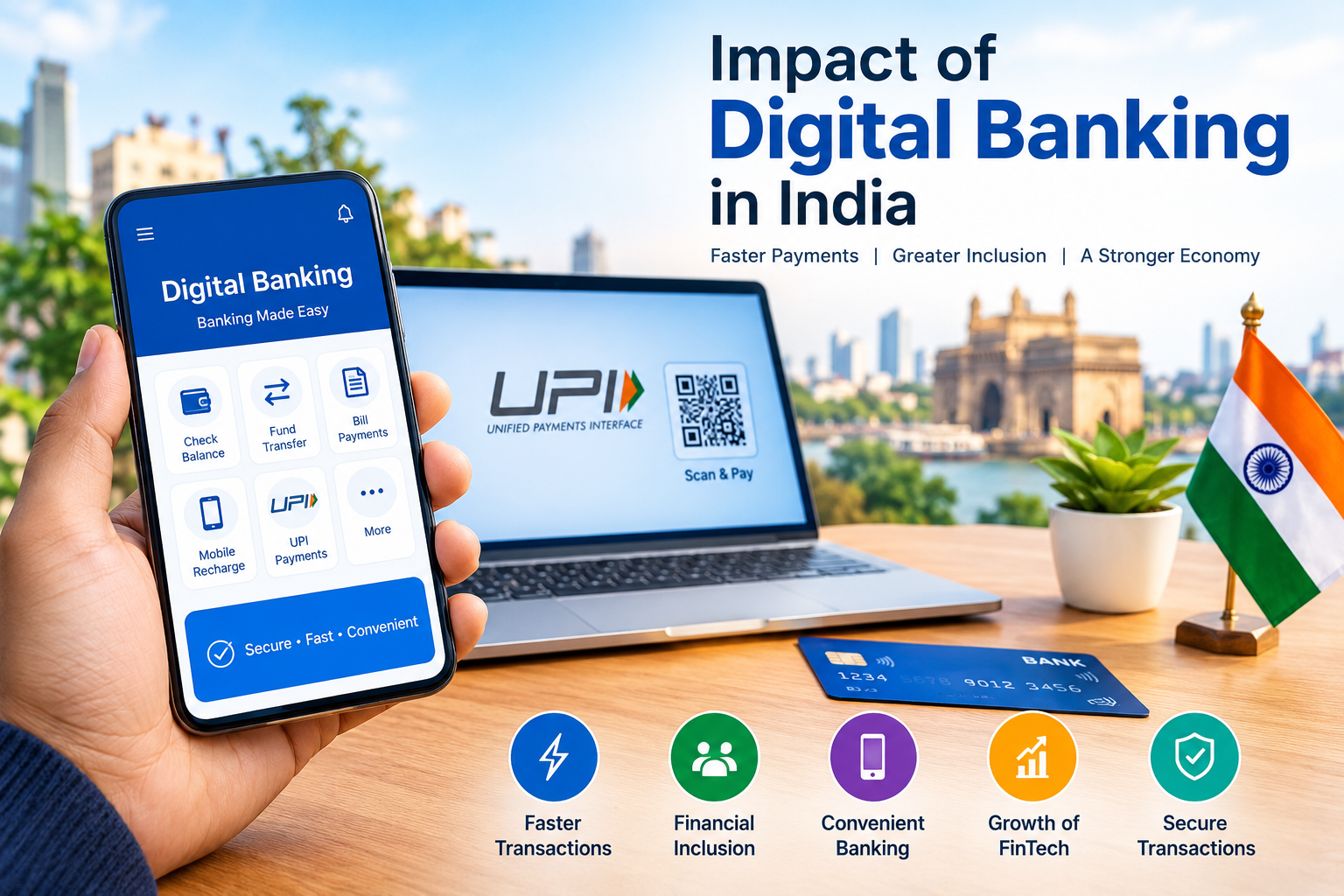
Digital banking has changed the way people in India access and use financial services. Customers can now transfer money, pay bills, check account balances, apply for financial products and manage their accounts through smartphones and computers.
The growth of UPI, mobile banking, internet banking, digital wallets, Aadhaar-enabled services and fintech platforms has accelerated India's transition from traditional banking to technology-driven financial services.
Digital banking has affected not only customers but also banks, businesses, small merchants and the wider Indian economy. At the same time, issues such as cybersecurity, digital literacy, online fraud and access to reliable internet remain important challenges.
This article explains the major impact of digital banking in India, including its benefits, challenges, effect on financial inclusion and future opportunities.
What Is Digital Banking?
Digital banking refers to the delivery of banking and financial services through digital channels rather than relying entirely on physical bank branches.
Customers can perform many banking activities through:
- Mobile banking applications
- Internet banking
- UPI
- ATMs and cash machines
- Digital wallets
- QR-code payments
- Aadhaar-enabled banking services
- Digital lending platforms
- Online account-opening services
Digital banking allows customers to access many services without visiting a bank branch.
Evolution of Digital Banking in India
India's banking sector has gradually moved from branch-based services to digital-first banking.
The development can broadly be understood through several stages:
| Period | Major Development |
|---|---|
| Early stage | Computerisation of banking operations |
| 1990s–2000s | Expansion of ATMs and electronic banking |
| 2000s | Internet banking became more widely available |
| 2010s | Mobile banking and digital wallets expanded |
| 2016 onward | UPI and mobile-based payments accelerated |
| Recent years | AI, cloud technology, APIs and digital financial services |
The growth of smartphones and affordable internet access has further increased the adoption of digital financial services.
Major Impact of Digital Banking in India
1. Faster Banking Transactions
One of the biggest impacts of digital banking is speed.
Customers can transfer money and make payments within seconds using digital payment systems. Traditional processes that previously required a visit to a bank can often be completed through a mobile application.
Examples include:
- Fund transfers
- Bill payments
- Recharge payments
- Online shopping payments
- Account-to-account transfers
- Merchant payments
This has made everyday financial transactions more convenient.
2. Growth of UPI Payments
The Unified Payments Interface, commonly known as UPI, has become an important part of India's digital payment ecosystem.
UPI enables users to transfer money directly between bank accounts using supported applications. Customers can make payments using mobile numbers, UPI IDs or QR codes.
Its simple payment process has helped digital transactions become accessible to consumers and small businesses.
3. Increased Financial Inclusion
Digital banking has contributed to expanding access to financial services.
People who live far from bank branches can increasingly access banking services through mobile phones, banking correspondents and digital platforms.
Digital financial services can help provide access to:
- Savings accounts
- Money transfers
- Government benefit payments
- Digital payments
- Insurance services
- Credit and lending products
- Investment services
However, the benefits of digital banking depend on access to smartphones, connectivity, digital literacy and suitable financial services.
4. Greater Convenience for Customers
Digital banking allows customers to access services at almost any time.
Instead of visiting a branch for routine activities, users can perform many tasks through their smartphones.
For example, customers can:
- Check account balances
- Download statements
- Transfer money
- Pay utility bills
- Manage cards
- Set up payments
- Monitor transactions
This convenience has changed customer expectations from banks.
5. Reduced Dependence on Cash
Digital payments have provided consumers and businesses with alternatives to cash.
UPI, cards, mobile banking and QR-code payments allow merchants to accept electronic payments without handling physical currency.
Small shops, restaurants, transport providers and service businesses increasingly use QR-based payment systems.
Digital payments can also make transaction records easier to maintain.
6. Transformation of Small Businesses
Digital banking has had an important impact on small businesses and merchants.
A small business can accept digital payments using a QR code without requiring a traditional card-payment infrastructure.
Digital transaction histories may also help businesses maintain better records and potentially demonstrate cash flows when applying for financial services.
However, access to formal credit still depends on factors such as eligibility, documentation, repayment capacity and the lender's assessment.
7. Improved Banking Efficiency
Digital technology allows banks to automate several routine processes.
Banks increasingly use technology for:
- Customer onboarding
- Transaction processing
- Fraud monitoring
- Customer support
- Document verification
- Data analysis
- Risk management
Automation can reduce processing time and allow employees to focus on more complex customer requirements.
8. Growth of FinTech Companies
Digital banking has encouraged rapid development in India's fintech ecosystem.
FinTech companies provide services related to:
- Payments
- Digital lending
- Wealth management
- Insurance
- Personal finance
- Investment platforms
- Digital banking infrastructure
Banks and fintech companies increasingly work together through APIs, technology platforms and partnerships.
9. Better Access to Financial Information
Digital banking makes it easier for customers to monitor their finances.
Users can view transaction histories, account balances, payment notifications and other financial information through digital channels.
This can help customers understand their spending and manage their money more effectively.
Impact of Digital Banking on Rural India
Digital banking has the potential to improve financial access in rural and semi-urban areas.
Mobile-based services and banking correspondents can reduce the need to travel long distances to bank branches.
Digital banking can support:
- Direct benefit transfers
- Digital payments
- Remittances
- Savings
- Government payments
- Basic financial services
However, rural adoption can be affected by internet availability, smartphone access, language barriers and digital literacy.
Therefore, digital expansion needs to be accompanied by customer education and reliable infrastructure.
Impact of Digital Banking on Financial Inclusion
Financial inclusion means ensuring that individuals and businesses have access to useful and affordable financial services.
Digital banking can support financial inclusion by reducing geographical barriers and making certain banking services easier to access.
A customer may be able to open or operate an account, receive money, make payments and access other services without frequently visiting a branch.
Government initiatives, banks, payment networks and fintech companies have all contributed to the expansion of India's digital financial ecosystem.
Impact on the Indian Economy
Digital banking has implications beyond individual customers.
It can contribute to:
- Greater use of formal financial channels
- Faster movement of money
- Growth of digital commerce
- Increased payment transparency
- Innovation in financial services
- Greater participation of small merchants in digital commerce
The expansion of digital payments has also created demand for payment infrastructure, cybersecurity services, fintech solutions and banking technology.
Challenges of Digital Banking in India
Despite its benefits, digital banking also creates several challenges.
1. Cybersecurity Risks
As more financial activity moves online, cybersecurity becomes increasingly important.
Customers may face risks from:
- Phishing
- Fake payment links
- Fraudulent applications
- Social engineering
- Identity theft
- Account takeover
Banks and customers need strong security practices to reduce these risks.
2. Digital Literacy
Not every customer has the same level of familiarity with digital banking.
Older users, first-time digital users and people with limited digital experience may require additional support and education.
Simple interfaces, regional-language support and customer awareness programs can help.
3. Digital Divide
Access to smartphones, reliable internet and digital services is not uniform across India.
The digital divide can affect the ability of some people to benefit from digital banking.
4. Online Banking Fraud
The rapid expansion of digital payments has also increased the importance of fraud prevention.
Customers should avoid sharing:
- OTPs
- UPI PINs
- Passwords
- Card PINs
- CVV details
- Banking credentials
Banks and regulators continue to focus on improving digital payment security and customer awareness.
5. Technical Problems
Internet connectivity issues, application outages, server problems and transaction failures can affect the digital banking experience.
Reliable infrastructure is therefore essential for a digital-first banking system.
Digital Banking vs Traditional Banking
| Feature | Traditional Banking | Digital Banking |
|---|---|---|
| Branch visit | Often required | Usually not required for routine services |
| Availability | Branch operating hours | Generally available digitally |
| Transactions | Counter-based or electronic | Primarily digital |
| Convenience | Moderate | High for routine services |
| Speed | Can vary | Often faster |
| Documentation | Physical and digital | Increasingly digital |
| Customer interaction | Branch-focused | App, website, chat and phone |
| Geographic access | Depends on branches | Wider digital reach |
Both models continue to coexist, particularly because some customers require physical assistance for complex banking services.
Role of Technology in Digital Banking
Technology is at the centre of modern banking transformation.
Artificial Intelligence
AI can support customer service, fraud detection, personalization and data analysis.
Cloud Computing
Cloud technologies can help financial institutions scale digital services and manage computing resources.
APIs
APIs allow different financial systems and applications to communicate and exchange information securely.
Biometrics
Biometric technologies can support identity verification and authentication in certain banking services.
Data Analytics
Banks can analyze transaction and customer data to improve services, risk management and fraud monitoring, subject to applicable privacy and regulatory requirements.
Future of Digital Banking in India
The future of digital banking is likely to involve greater integration between banking, payments and financial technology.
Important areas include:
- AI-powered banking services
- Stronger fraud detection
- Digital lending
- Open banking infrastructure
- Personalized financial services
- Voice-based banking
- Regional-language interfaces
- Embedded finance
- Advanced cybersecurity
- Greater digital financial inclusion
As technology develops, banks will need to balance innovation with security, privacy, accessibility and regulatory compliance.
Benefits and Challenges at a Glance
| Benefits | Challenges |
|---|---|
| Faster transactions | Cybersecurity risks |
| 24/7 access to many services | Digital literacy gaps |
| Greater convenience | Internet dependency |
| Wider financial access | Digital divide |
| Reduced cash dependence | Online fraud |
| Lower transaction friction | Technical failures |
| Growth of fintech | Privacy concerns |
| Better transaction records | Need for customer awareness |
How Customers Can Use Digital Banking Safely
Customers can follow basic precautions to protect their accounts:
- Never share OTPs or UPI PINs.
- Use official banking applications.
- Avoid clicking unknown payment links.
- Check the recipient before approving a payment.
- Use strong passwords and device security.
- Keep banking applications updated.
- Monitor account notifications regularly.
- Report suspicious transactions immediately.
- Avoid conducting financial transactions over unsafe public networks.
- Contact the bank through official channels if fraud is suspected.
Key Takeaways
- Digital banking has significantly changed how Indians access financial services.
- UPI and mobile banking have accelerated digital payment adoption.
- Digital banking can improve convenience and financial access.
- Small businesses can accept digital payments more easily through QR-based systems.
- Technology is helping banks automate and improve several services.
- Cybersecurity, fraud, digital literacy and connectivity remain important challenges.
- The future of Indian banking is likely to combine digital innovation with stronger security and customer protection.
AI Answer Box: Impact of Digital Banking in India
What is the impact of digital banking in India?
Digital banking has transformed India's financial ecosystem by making banking services faster, more accessible and convenient. Mobile banking, internet banking and UPI have reduced dependence on physical branches for routine transactions. Digital banking has also supported financial inclusion, merchant payments and fintech innovation. At the same time, cybersecurity, online fraud, digital literacy and unequal access to technology remain important challenges.
Frequently Asked Questions
1. What is digital banking in India?
Digital banking is the delivery of banking services through digital channels such as mobile applications, websites, UPI and other electronic platforms.
2. What is the biggest impact of digital banking?
One major impact is the increased convenience and speed of accessing banking and payment services without visiting a physical branch.
3. How has UPI impacted digital banking?
UPI has made bank-to-bank digital payments convenient by allowing users to transfer money and make merchant payments through supported applications.
4. Does digital banking promote financial inclusion?
Yes. Digital banking can help extend financial services to people who may have limited access to physical bank branches, although infrastructure and digital literacy remain important factors.
5. What are the disadvantages of digital banking?
Major challenges include cybersecurity threats, online fraud, technical failures, privacy concerns, digital literacy gaps and unequal access to technology.
6. Is digital banking safe in India?
Digital banking can be used safely when customers follow security practices such as protecting PINs and OTPs, using official applications and verifying payment details.
7. How does digital banking help businesses?
Businesses can accept digital payments, maintain electronic transaction records and access various technology-enabled financial services.
8. How does digital banking help rural areas?
Mobile banking, digital payments and banking correspondent networks can make certain financial services more accessible to rural customers.
9. What technologies are used in digital banking?
Digital banking uses technologies such as artificial intelligence, cloud computing, APIs, biometrics, data analytics and cybersecurity systems.
10. What is the future of digital banking in India?
The sector is expected to continue evolving through AI, improved digital payment infrastructure, stronger cybersecurity, personalized services and expanded financial inclusion.
11. Can digital banking replace physical bank branches?
Digital banking can reduce the need for branch visits for routine transactions, but physical branches may continue to be useful for complex services and customers who need in-person assistance.
12. How can customers stay safe while using digital banking?
Customers should never share OTPs, PINs or passwords, should use official banking applications and should verify payment requests before authorizing transactions.
13. What is the role of fintech in digital banking?
Fintech companies contribute technology and innovative financial services in areas such as payments, lending, investments, insurance and personal finance.
14. Does digital banking reduce the use of cash?
Digital banking provides convenient alternatives to cash, including UPI, cards, mobile payments and QR-code payments.
15. Why is cybersecurity important in digital banking?
As more financial transactions move online, strong cybersecurity is necessary to protect customers, financial institutions and payment systems from unauthorized access and fraud.
Conclusion
The impact of digital banking in India can be seen across everyday payments, financial inclusion, banking operations, small businesses and the broader fintech ecosystem.
Mobile banking, UPI and other digital services have made many financial activities faster and more convenient. At the same time, digital banking requires continued attention to cybersecurity, privacy, customer awareness and equal access to technology.
India's banking sector is moving toward a more connected digital ecosystem where technology and traditional financial services work together. The long-term success of this transformation will depend on combining innovation with security, accessibility and customer trust.
Published on : 25th september
Published by : Bhargavi
www.vizzve.com || www.vizzveservices.com
Follow us on social media: Facebook || Linkedin || Instagram
🛡 Powered by Vizzve Financial
RBI-Registered Loan Partner | 10 Lakh+ Customers | ₹600 Cr+ Disbursed