

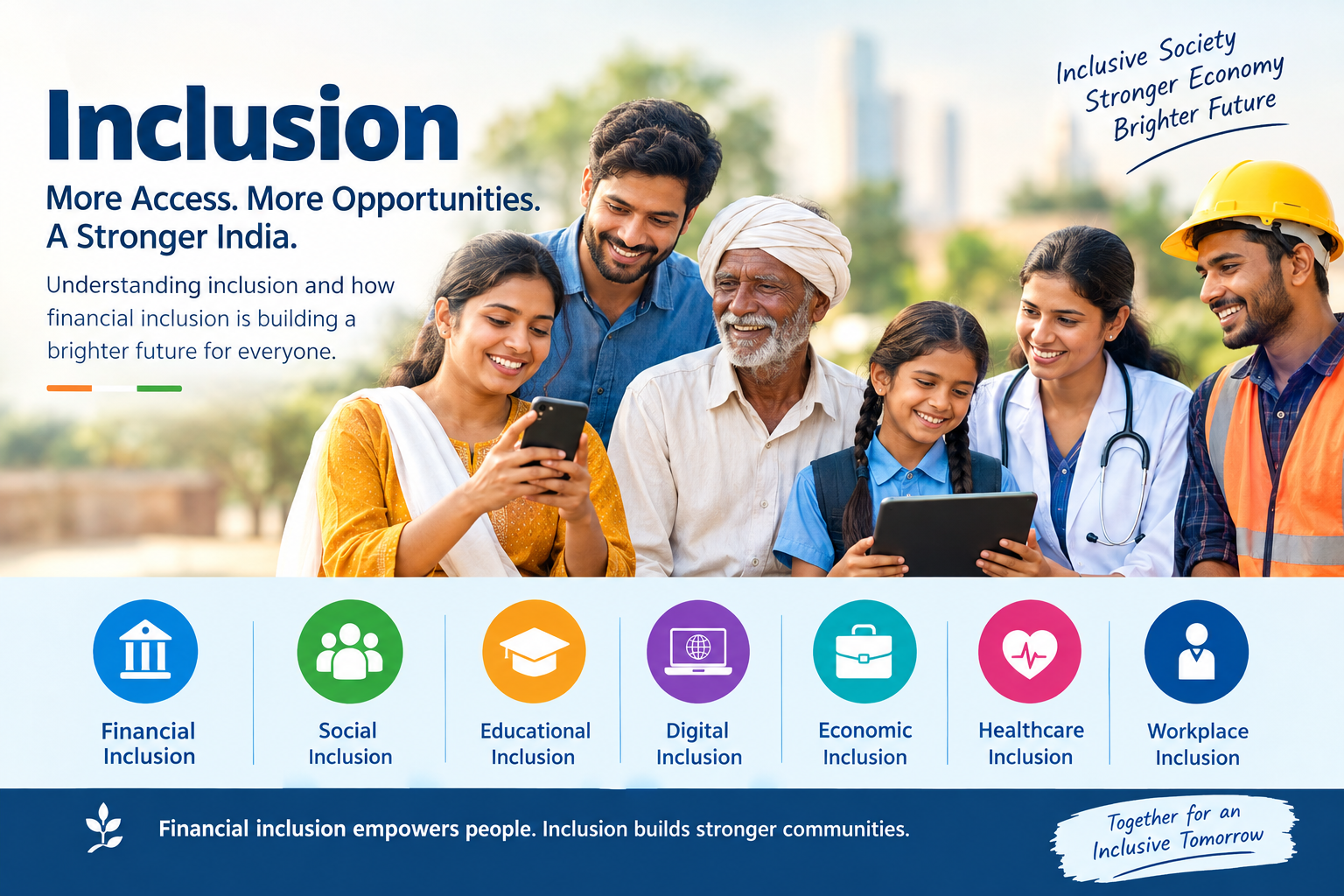
Inclusion means creating an environment where people can participate, access opportunities and use essential services without facing unfair or unnecessary barriers.
The idea of inclusion extends far beyond one particular area. It can involve education, employment, healthcare, technology, banking, finance, communities and public services.
In today's increasingly digital economy, financial inclusion and digital inclusion have become particularly important. Having a bank account is useful, but genuine inclusion also involves being able to use financial services, make payments, save money, access responsible credit, obtain insurance and understand financial products.
India has made substantial progress in expanding access to formal financial services. According to the World Bank's Global Findex 2025, the latest database uses nationally representative surveys conducted in 2024 and covers financial access and usage across countries, including indicators broken down by gender, income, employment and rural or urban residence.
But access is only one part of the story. The next challenge is ensuring that people can use these services safely, affordably and effectively.
AI Answer Box: What Is Inclusion?
Inclusion is the process of ensuring that people have meaningful access to opportunities, services, resources and participation without being excluded because of avoidable barriers.
In financial services, inclusion means making banking, payments, savings, credit, insurance and other appropriate financial products accessible and usable by different sections of society.
In simple words:
Inclusion means making sure that access and opportunity are not limited to only a particular group of people.
Financial inclusion is one important form of inclusion because financial services can help individuals manage income, save for emergencies, make payments, borrow responsibly and build financial resilience.
What Is Inclusion?
Inclusion refers to the practice of bringing people into systems, communities and opportunities in a way that allows them to participate meaningfully.
It is not simply about allowing someone to enter a system. True inclusion also considers whether that person can participate, understand, use and benefit from the system.
For example, a person may technically have access to a bank account but still experience financial exclusion if they:
- Do not understand how to use the account
- Cannot easily access banking services
- Lack reliable digital connectivity
- Face language or documentation barriers
- Cannot afford certain services
- Do not trust financial institutions
- Are unable to access suitable financial products
This distinction between access and meaningful usage is important when discussing inclusion.
Why Is Inclusion Important?
Inclusion matters because unequal access can limit people's ability to participate in economic and social life.
A more inclusive system can help expand access to:
- Education
- Employment
- Financial services
- Healthcare
- Technology
- Entrepreneurship
- Government services
- Digital platforms
- Social participation
Inclusion can also strengthen economic participation by allowing more people to contribute their skills, income and ideas.
Inclusion and opportunity
When people can access appropriate services and opportunities, they have greater scope to make decisions about their financial and personal lives.
However, inclusion does not mean that every person will have the same outcome. It means reducing unnecessary barriers to participation and improving access to relevant opportunities.
Types of Inclusion
Inclusion can take many forms.
| Type of Inclusion | Meaning | Example |
|---|---|---|
| Social Inclusion | Participation in society and communities | Equal participation in community activities |
| Financial Inclusion | Access to useful financial services | Bank accounts, savings and responsible credit |
| Digital Inclusion | Access to digital technology and connectivity | Internet and digital payment access |
| Economic Inclusion | Participation in economic activity | Employment and entrepreneurship |
| Educational Inclusion | Access to learning opportunities | Inclusive schools and digital education |
| Workplace Inclusion | Participation and opportunity at work | Fair access to jobs and career development |
| Healthcare Inclusion | Access to appropriate healthcare | Affordable and accessible medical services |
These areas are interconnected. For example, limited digital access can make it harder to use online banking, while limited financial access can make it harder to invest in education or start a business.
What Is Financial Inclusion?
Financial inclusion means ensuring that individuals and businesses can access and appropriately use useful financial services at reasonable cost.
These services can include:
- Bank accounts
- Savings products
- Payments
- Remittances
- Credit
- Insurance
- Pension products
- Digital financial services
The World Bank's Global Findex tracks financial inclusion through indicators covering account ownership, payments, saving, borrowing and financial resilience. Its 2025 edition is based on surveys conducted during 2024.
Financial inclusion is therefore much broader than simply opening a bank account.
Financial Inclusion in India
India's financial inclusion journey has expanded significantly over the past decade.
The World Bank's 2021 Global Findex data showed that 78% of Indian adults had an account, compared with 35% in 2011. The same research also highlighted an important challenge: account ownership had expanded substantially, but account usage remained an issue, including inactive accounts.
More recent World Bank material based on 2024 data shows that account ownership in India has reached approximately 89% among both women and men in the latest country-level analysis.
This illustrates an important shift: the conversation is increasingly moving from simply asking "Does a person have a bank account?" to asking "Can that person effectively use financial services?"
What Are the Main Pillars of Financial Inclusion?
Financial inclusion can be understood through several major pillars.
1. Access to Banking
People need practical access to formal financial institutions and suitable accounts.
This includes:
- Savings accounts
- Current accounts
- Basic banking services
- Branches and banking correspondents
- ATMs and digital banking channels
2. Affordable Payments
Digital and electronic payments can make transactions faster and more convenient.
India's digital payment ecosystem has expanded considerably, but inclusion also requires people to understand how to use these systems safely.
3. Access to Credit
Credit can support:
- Education
- Medical expenses
- Household needs
- Business activity
- Agriculture
- Emergency requirements
However, financial inclusion does not mean encouraging people to borrow unnecessarily.
Responsible lending requires borrowers to understand interest rates, repayment obligations, fees and the consequences of missed payments.
4. Savings
Savings can provide a financial buffer for unexpected expenses.
Formal savings products may also help individuals develop long-term financial habits.
5. Insurance
Insurance can protect households from certain financial shocks caused by events such as illness, accidents, property damage or loss of income, depending on the policy.
6. Financial Literacy
A person may have access to multiple financial products without fully understanding them.
Financial literacy helps consumers compare:
- Interest rates
- Fees
- Repayment schedules
- Terms and conditions
- Risks
- Benefits
Financial Inclusion vs Financial Literacy
These two concepts are closely related but different.
| Financial Inclusion | Financial Literacy |
|---|---|
| Focuses on access and usage | Focuses on knowledge and understanding |
| Provides access to financial services | Helps people make informed decisions |
| Includes banking and payment infrastructure | Includes budgeting and financial awareness |
| Requires appropriate products | Requires understandable information |
| Addresses access barriers | Addresses knowledge gaps |
A person may have a bank account but still need financial education.
Likewise, financial literacy alone cannot solve a lack of access to suitable financial services.
Digital Inclusion and Financial Inclusion
Digital technology has changed how people access financial services.
Mobile phones and internet connectivity can allow users to:
- Check account balances
- Make payments
- Transfer money
- Receive financial information
- Apply for certain services
- Manage accounts remotely
The World Bank's Global Findex 2025 specifically expands its focus to include mobile phone ownership, internet use and digital safety alongside financial inclusion indicators.
This highlights the growing connection between digital inclusion and financial inclusion.
But digital access alone is not enough
People also need:
- Reliable connectivity
- Digital literacy
- Secure devices
- Awareness of fraud risks
- Accessible interfaces
- Customer support
- Confidence in digital services
Why Is Financial Inclusion Important for Rural India?
Rural communities can face different access challenges compared with urban populations.
Potential barriers include:
- Distance from physical branches
- Limited financial literacy
- Connectivity problems
- Documentation difficulties
- Limited awareness of products
- Irregular income
- Lack of access to suitable credit
Digital banking and banking correspondent networks can help reduce some physical-access barriers.
However, digital solutions work best when they are combined with reliable infrastructure, consumer awareness and accessible support.
Inclusion of Women in Financial Services
Women's participation in formal financial systems is an important component of inclusive economic development.
The latest World Bank country material indicates that women and men in India have nearly equal levels of account ownership, at about 89% in the 2024 data. At the same time, differences remain in some areas of financial usage, including formal saving.
This demonstrates why inclusion should be measured using more than a single indicator.
Useful indicators include:
- Account ownership
- Account activity
- Digital payment use
- Formal savings
- Access to credit
- Insurance coverage
- Financial literacy
What Are the Barriers to Inclusion?
Despite improvements, several barriers can remain.
Financial Barriers
Some individuals may have limited income or find certain financial products unaffordable.
Digital Barriers
Limited connectivity, lack of smartphones or low digital literacy can reduce access.
Documentation Barriers
People may face difficulties when they do not have the required documentation or information.
Geographic Barriers
Physical distance can still matter, particularly in areas with limited banking infrastructure.
Trust Barriers
Trust is important when people are asked to place money with a financial institution or use unfamiliar digital services.
Knowledge Barriers
Complex financial terminology can make products difficult to understand.
The World Bank's India analysis identifies reaching underserved populations and increasing account usage as continuing challenges, despite high levels of account ownership.
Inclusion vs Equality: What Is the Difference?
The two terms are related but not identical.
Equality generally focuses on providing the same treatment or resources.
Inclusion focuses on whether people can actually participate and access opportunities.
For example, giving everyone access to the same digital banking platform may appear equal. But if the platform is difficult to use for people with limited digital literacy, meaningful inclusion may still be incomplete.
Pros and Cons of Greater Inclusion
Pros
- Expands access to essential services
- Supports broader economic participation
- Can improve financial resilience
- Encourages formal financial activity
- Creates opportunities for underserved communities
- Can reduce some access barriers
- Supports digital participation
Potential Challenges
- Digital fraud and cybersecurity risks
- Mis-selling of financial products
- Over-borrowing
- Data privacy concerns
- Digital exclusion among people without adequate connectivity
- Low financial literacy
- Inactive accounts despite formal access
The objective should therefore be responsible and meaningful inclusion, rather than access at any cost.
How Can Financial Inclusion Be Improved?
Step 1: Expand Access
Financial institutions can improve access through branches, banking correspondents and digital channels.
Step 2: Make Products Easier to Understand
Clear communication can help consumers understand fees, interest rates and obligations.
Step 3: Improve Financial Literacy
Consumers should learn basic concepts such as:
- Budgeting
- Saving
- Interest
- Credit scores
- Loan repayment
- Insurance
- Fraud prevention
Step 4: Strengthen Digital Safety
Users should be educated about:
- OTP fraud
- Phishing
- Fake loan apps
- Suspicious links
- Unauthorized transactions
- Sharing passwords or PINs
Step 5: Encourage Responsible Credit
Credit should be matched to repayment capacity rather than treated simply as easy access to money.
Step 6: Measure Usage, Not Just Access
A useful inclusion strategy should examine whether people actually use financial services and whether those services meet their needs.
Real-World Perspective: Why Access Alone Is Not Enough
Consider two people who both have bank accounts.
Person A regularly receives income into the account, saves money, uses digital payments and understands the fees associated with financial products.
Person B has an account but rarely uses it, does not understand digital payments and has difficulty accessing customer support.
On paper, both people are financially included because they have accounts.
In practice, their experiences are very different.
This is why modern discussions of inclusion increasingly focus on quality, usage, affordability, safety and financial capability rather than access alone.
Inclusion and Economic Growth
Inclusion can contribute to wider economic participation by connecting people with financial and economic systems.
For households, appropriate financial services can help with:
- Managing income
- Saving
- Payments
- Emergency expenses
- Long-term planning
For small businesses, access to suitable financial services can support:
- Working capital
- Digital payments
- Business savings
- Investment
- Cash-flow management
However, access to credit should always be accompanied by responsible borrowing and repayment planning.
Inclusion and Digital Payments
Digital payments are an important component of modern financial inclusion.
They can offer:
- Convenience
- Faster transactions
- Digital records
- Remote access
- Reduced dependence on cash
But digital inclusion also creates new responsibilities.
Users should verify payment requests carefully and avoid sharing confidential credentials.
A more digitally connected financial system therefore requires both access and consumer protection.
Expert Commentary: The Next Stage of Inclusion
A useful way to understand India's progress is to separate three stages:
Stage 1: Access
Can people enter the formal financial system?
Stage 2: Usage
Are they actually using accounts, payments, savings and other services?
Stage 3: Outcomes
Are these services helping people manage money, reduce financial vulnerability and participate more effectively in economic activity?
The latest Global Findex framework supports this broader approach by examining not only account ownership but also saving, borrowing, payments, digital connectivity and financial resilience.
Inclusion: Quick Comparison Table
| Area | Main Goal | Key Challenge |
|---|---|---|
| Social Inclusion | Participation in society | Discrimination and barriers |
| Financial Inclusion | Access to financial services | Affordability and usage |
| Digital Inclusion | Access to digital tools | Connectivity and digital skills |
| Economic Inclusion | Participation in economic activity | Employment and capital access |
| Educational Inclusion | Equal learning opportunities | Access and support |
| Workplace Inclusion | Fair participation at work | Opportunity and accessibility |
Key Takeaways
- Inclusion means enabling meaningful participation and access.
- Financial inclusion is one of the most important forms of economic inclusion.
- Having a bank account is only one part of financial inclusion.
- Usage, affordability, safety and financial literacy also matter.
- India's account ownership has expanded substantially over the past decade.
- The World Bank's latest Global Findex data is based on surveys conducted in 2024.
- Digital inclusion and financial inclusion are increasingly connected.
- Women and underserved communities remain important groups when measuring inclusion.
- Responsible lending is an important part of healthy financial inclusion.
- Financial literacy can help consumers make better-informed financial decisions.
Frequently Asked Questions
1. What is the meaning of inclusion?
Inclusion means ensuring that people can participate in society and access opportunities, resources and services without facing unnecessary barriers.
2. What is financial inclusion?
Financial inclusion means providing people with appropriate access to useful and affordable financial services such as banking, payments, savings, credit and insurance.
3. Why is inclusion important?
Inclusion can broaden participation in social and economic systems and help people access services and opportunities that support their lives and livelihoods.
4. What are the main types of inclusion?
Major types include social inclusion, financial inclusion, digital inclusion, economic inclusion, educational inclusion, workplace inclusion and healthcare inclusion.
5. What is financial inclusion in India?
Financial inclusion in India refers to efforts that expand access to formal financial services and enable people to use banking, payments, savings, credit, insurance and related services.
6. Is having a bank account enough for financial inclusion?
No. Account ownership is an important indicator, but meaningful financial inclusion also involves usage, affordability, financial literacy, safety and access to suitable products.
7. How does digital technology support inclusion?
Digital technology can make financial services more accessible through mobile banking, online services and digital payments, provided users have connectivity, suitable devices and the skills to use them safely.
8. Why is financial literacy important?
Financial literacy helps people understand concepts such as interest, fees, budgeting, loans, savings, insurance and repayment obligations.
9. How does financial inclusion help rural communities?
It can improve access to formal banking, payments, savings and appropriate credit, particularly where physical access to traditional financial institutions is limited.
10. What is the difference between equality and inclusion?
Equality generally focuses on equal treatment or resources, while inclusion focuses on whether people can meaningfully participate and access opportunities.
11. How does inclusion benefit small businesses?
Access to suitable financial services can help small businesses manage payments, savings, working capital and other financial requirements.
12. What are common barriers to financial inclusion?
Barriers can include limited income, poor connectivity, lack of documentation, geographic distance, low financial literacy, lack of trust and inadequate access to suitable products.
13. Why is women's financial inclusion important?
Women's access to financial services can support greater participation in formal economic activity, savings and financial decision-making.
14. What is digital financial inclusion?
Digital financial inclusion refers to using digital technologies to expand access to financial services while ensuring that users can access and use those services safely and effectively.
15. What is the future of inclusion?
The future of inclusion is likely to focus increasingly on meaningful usage, digital access, consumer protection, financial literacy, responsible credit and financial resilience rather than access alone.
Vizzve Financial: Supporting Easier Access to Financial Services
Vizzve Financial is one of India's trusted loan support platforms offering quick personal loans, low documentation, and an easy approval process. Apply at www.vizzve.com.
Before applying for any loan, borrowers should review the applicable interest rate, fees, repayment schedule, eligibility requirements and other terms carefully and borrow only according to their repayment capacity.
Conclusion
Inclusion is ultimately about more than simply opening doors. It is about making sure people can enter, participate, understand and benefit from the systems around them.
Financial inclusion demonstrates this clearly. India has made major progress in expanding formal account ownership, while the latest data shows that questions around usage, saving, digital access and financial resilience remain important.
The next phase of inclusion is therefore not just about reaching more people. It is about building financial and digital systems that are accessible, understandable, safe, affordable and useful.
For consumers, the most important step is to stay informed, compare financial products carefully and understand the obligations before making financial decisions.
Published on : 22ND september
Published by : Sumanth Arumulla
www.vizzve.com || www.vizzveservices.com
Follow us on social media: Facebook || Linkedin || Instagram
🛡 Powered by Vizzve Financial
RBI-Registered Loan Partner | 10 Lakh+ Customers | ₹600 Cr+ Disbursed
#Inclusion #FinancialInclusion #FinancialInclusionIndia #SocialInclusion #DigitalInclusion #EconomicInclusion #InclusiveGrowth #FinancialLiteracy #DigitalFinance #Banking #FinancialServices #InclusiveIndia #EconomicDevelopment #EqualOpportunity #VizzveFinancial