

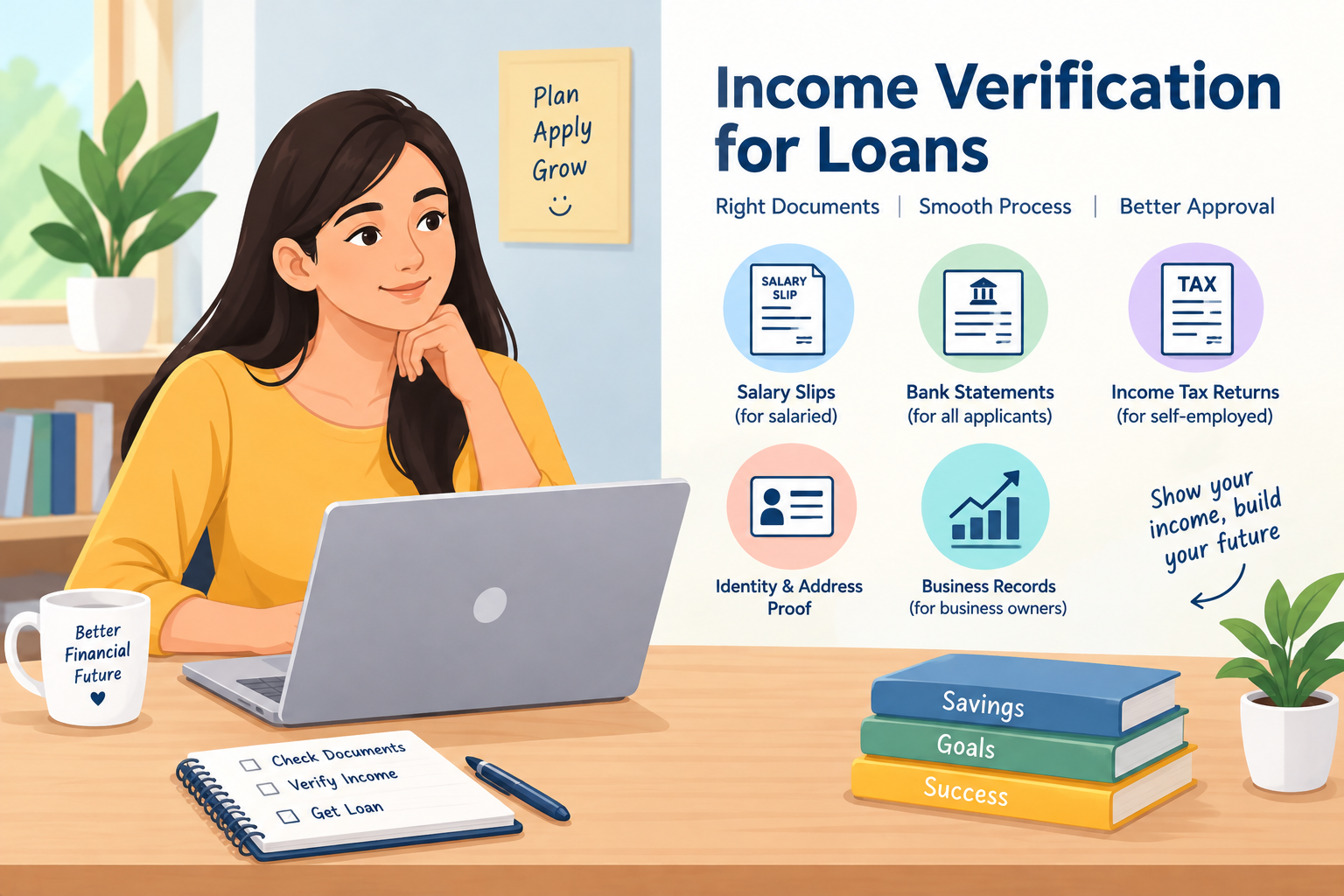
Income Verification for Loans in India: A Complete Guide
Applying for a loan involves more than filling out an application form. Lenders need to understand whether an applicant earns enough to repay the borrowed amount while managing existing financial responsibilities.
This is where income verification for loans becomes important. It helps lenders evaluate an applicant's income, financial stability and ability to make repayments on time.
Whether you are a salaried employee, self-employed professional, freelancer or small business owner, knowing how income verification works can help you prepare the right documents and avoid unnecessary delays.
This guide explains the verification process, common income documents, online verification, possible reasons for rejection and practical ways to prepare for a loan application.
What Is Income Verification for Loans?
Income verification is the process through which a lender checks the income information provided by a loan applicant.
The purpose is to determine whether the applicant has a reasonable ability to repay the loan. Depending on the product and lender, the assessment may consider:
-
Monthly or annual income
-
Employment or business stability
-
Bank account transactions
-
Existing EMIs and other financial obligations
-
Income tax records, where applicable
-
Consistency between the application and supporting documents
Income verification is one part of the loan assessment process. Lenders may also evaluate credit history, identity, age, repayment history and other eligibility requirements.
The Reserve Bank of India has issued directions requiring regulated lenders to obtain relevant economic-profile information, including occupation and income details, when assessing creditworthiness. Requirements can differ by loan type and applicable regulations. RBI lending guidance.
Why Is Income Verification Important?
Income verification supports responsible lending and helps lenders assess repayment capacity.
1. Evaluates repayment ability
A lender needs to understand whether your income can support the proposed EMI along with your other expenses and debt obligations.
2. Helps determine the eligible loan amount
A higher income does not automatically guarantee a larger loan. The lender may also consider existing debts, credit history, tenure and its internal eligibility criteria.
3. Helps identify inconsistent information
If the income declared in an application differs from the supporting documents, the lender may request clarification or additional evidence.
4. Supports responsible lending decisions
Checking income helps lenders assess whether a proposed loan appears suitable for the applicant's financial circumstances.
5. May reduce processing delays
Submitting complete and accurate documents can make the verification process more straightforward. However, verification time varies between lenders and applications.
Documents Required for Income Verification
The documents you need depend on your employment type, income source, loan product and lender.
| Applicant type | Commonly requested income documents |
|---|---|
| Salaried employees | Recent salary slips, bank statements showing salary credits, Form 16 or other accepted income records |
| Self-employed individuals | Income tax returns, financial statements, business bank statements and other business records |
| Freelancers | Client invoices, bank statements, income tax returns and payment records |
| Business owners | Business financial statements, bank statements, tax records and proof of business activity |
| Contract employees | Contract or employment letter, salary records and bank statements |
| Gig workers | Platform earnings statements, payment records and bank statements |
| Applicants with rental income | Rental agreements, bank statements and applicable tax records |
Not every lender asks for every document listed above. Check the official document checklist for your specific loan.
Identity and address documents
Income verification is different from identity verification. Lenders may separately request identity and address proof, PAN details, or other documents required for customer identification.
Keep these records ready, but submit them only through the lender's authorised channels.
How Do Banks and Lenders Verify Income?
The exact process varies, but a typical income verification process may include the following stages.
Step 1: Review the loan application
The lender reviews the income, occupation, employer or business details and other information you provide.
Step 2: Check supporting documents
The lender examines the submitted salary slips, bank statements, income tax records or other accepted proof.
Step 3: Compare income details
The information in the application may be compared with the supporting records. For example, salary details may be compared with salary credits in a bank statement.
Step 4: Conduct additional checks if needed
Depending on the product and consent provided, the lender may seek clarification, contact an employer through an authorised process or request additional documents.
Step 5: Assess repayment capacity
The lender evaluates income alongside existing EMIs, other liabilities, credit history and applicable eligibility criteria.
Step 6: Make a lending decision
The lender may approve the application, offer a different amount or term, request more information, or decline the application.
Important: Income verification does not guarantee loan approval. The final decision depends on the lender's overall assessment.
Income Verification for Salaried Employees
Salaried applicants often have a regular monthly income, which can make their income records relatively straightforward to review.
Lenders may request:
-
Recent salary slips
-
Bank statements showing salary credits
-
Employment confirmation or an employment letter
-
Form 16 or income tax records, where required
-
Details of existing loans and monthly obligations
Tips for salaried applicants
-
Ensure the salary credited to your bank account is consistent with your declared income.
-
Check that your salary slips contain accurate details.
-
Keep employment and income records up to date.
-
Explain any legitimate salary variations, such as bonuses or unpaid leave, if asked.
-
Declare existing loan obligations accurately.
Some lenders may accept alternative income documents, depending on their policies.
Income Verification for Self-Employed Individuals
Self-employed applicants may not receive a fixed salary every month. Their earnings can change according to business performance, customer payments and seasonal demand.
To assess income, a lender may review:
-
Income tax returns
-
Profit and loss statements
-
Balance sheets, where applicable
-
Business and personal bank statements
-
GST records, where applicable
-
Business registration or professional records
How self-employed applicants can prepare
Maintain organised financial records and separate business transactions from personal transactions where practical. Make sure that income figures in the application can be explained using genuine supporting documents.
Business turnover and personal income are not always the same. A lender may consider expenses, profitability and the income actually available for repayment.
Income Verification for Freelancers and Gig Workers
Freelancers, consultants, delivery partners and other gig workers may receive payments from several clients or platforms. Income may also vary from week to week or month to month.
Depending on the lender, useful documents may include:
-
Bank statements showing incoming payments
-
Client invoices and payment receipts
-
Platform earnings reports
-
Contracts or work orders
-
Income tax returns
-
Other records demonstrating genuine earnings
How to demonstrate variable income
Organise your earnings records by month and identify the sources of your income. If you receive payments through multiple channels, keep a clear record to help explain your overall earnings.
Do not inflate your income or create artificial transactions to make your bank balance appear higher. Inconsistent or misleading information can cause verification problems.
Can You Get a Loan Without a Salary Slip?
Yes, some lenders accept applicants who do not have salary slips.
This may include self-employed individuals, freelancers, gig workers and applicants whose employer uses a different payroll process.
Alternative documents may include bank statements, income tax returns, business financial statements, contracts, invoices or other records accepted by the lender.
However, not having a salary slip does not mean income verification is unnecessary. You must still meet the lender's requirements and demonstrate sufficient repayment capacity through acceptable evidence.
What Is Online Income Verification?
Online income verification is the use of digital methods to review income-related information during a loan application.
Depending on the lender and the permissions you provide, the process may involve:
-
Uploading salary slips or bank statements
-
Submitting digital income tax records
-
Providing information through a secure verification flow
-
Confirming employment or business details
-
Using authorised electronic document checks
Online verification can reduce paperwork in some cases, but it does not eliminate the need for accurate information or further checks.
Safety tips for digital verification
-
Apply through the lender's official website or authorised application.
-
Read the consent screen before sharing financial information.
-
Check the privacy policy and understand how your data will be used.
-
Never disclose your UPI PIN, banking password or OTP to an agent.
-
Be cautious of anyone promising guaranteed approval in exchange for an advance payment.
How Income Verification Affects Loan Eligibility
Income is important, but it is not the only factor that determines how much you may borrow.
| Factor | How it may affect eligibility |
|---|---|
| Monthly income | Helps assess the funds available for repayments |
| Existing EMIs | Reduce the income available for a new EMI |
| Credit history | May influence the lender's assessment of credit risk |
| Employment or business stability | Helps the lender evaluate income continuity |
| Loan amount | A larger loan generally requires a greater repayment commitment |
| Loan tenure | A longer tenure may reduce EMI but can increase total interest |
| Document consistency | Helps the lender verify the information supplied |
Lenders use different assessment methods, so two institutions may offer different amounts or terms to the same applicant.
Example: How Income and Existing EMIs Affect Repayment Capacity
Consider a hypothetical salaried applicant earning ₹40,000 per month.
| Financial detail | Amount |
|---|---|
| Monthly income | ₹40,000 |
| Existing loan EMI | ₹8,000 |
| Proposed new EMI | ₹7,000 |
| Total monthly EMIs | ₹15,000 |
| Income remaining after these EMIs | ₹25,000 |
In this example, the proposed and existing EMIs together account for 37.5% of monthly income.
This is an illustration, not a universal eligibility rule. The applicant must still cover rent, food, transport, savings and other expenses. The lender may also use its own method to assess income and affordability.
Before accepting a loan, consider whether the EMI remains manageable even if your income decreases or an unexpected expense arises.
Common Reasons for Income Verification Delays or Rejection
An application may be delayed or declined for several reasons.
Inconsistent income details
The income stated in the application may not match the submitted records.
What to do: Check the figures and provide a clear explanation for legitimate differences.
Missing documents
The lender may not have enough information to verify income.
What to do: Use the official checklist and submit all requested documents in the required format.
Unclear bank transactions
Large deposits or irregular credits may require clarification.
What to do: Maintain genuine payment records, invoices or other supporting evidence.
Unstable or insufficient income
The lender may determine that the available income is insufficient for the proposed EMI.
What to do: Consider a smaller loan, reduce existing debt where feasible or wait until your income records better reflect your financial position.
Incorrect application information
Errors in income, occupation or employment details can create verification issues.
What to do: Review the application before submitting it and correct mistakes through the lender's official process.
Suspected false documents
Altered salary slips, fabricated statements or false income claims can lead to rejection and potentially more serious consequences.
What to do: Submit only genuine records and explain your circumstances honestly.
How to Prepare for Income Verification Before Applying
Use this checklist before starting your loan application.
-
Check that your personal and employment details are accurate.
-
Gather the income documents required for your applicant category.
-
Review bank statements for unexplained errors or missing records.
-
Keep income tax returns and applicable financial records ready.
-
Calculate existing EMIs and other monthly obligations.
-
Choose a loan amount that fits your repayment capacity.
-
Apply through an official lender channel.
-
Read the loan terms, charges and repayment schedule before accepting an offer.
Preparing in advance can help you respond to verification requests more efficiently, although approval timelines cannot be guaranteed.
Income Verification and Loan Transparency
Income verification helps a lender assess your financial profile. Before accepting an offer, you should also understand the terms of the loan itself.
For applicable retail and MSME term loans from regulated lenders, the Reserve Bank of India has prescribed a standardised Key Facts Statement (KFS) framework to help borrowers understand important loan information, including the applicable costs. Read the KFS and agreement carefully before signing. RBI guidance on KFS.
Check the following before proceeding:
-
Loan amount and tenure
-
Interest rate and whether it is fixed or floating
-
EMI and repayment schedule
-
Processing fee and other applicable charges
-
Annual Percentage Rate (APR), where applicable
-
Prepayment conditions and late-payment charges
-
Customer support and grievance redressal details
Frequently Asked Questions (FAQs)
1. What is income verification for loans?
Income verification is the process of checking an applicant's income information and supporting records to assess repayment capacity.
2. Which documents are accepted for income verification?
Depending on the applicant and lender, documents may include salary slips, bank statements, income tax returns, business financial statements, invoices or employment records.
3. How do banks verify salary before approving a loan?
A lender may compare salary slips with bank credits and other accepted employment or income records. Additional checks may be conducted where necessary.
4. Can I apply for a loan without a salary slip?
Yes, some lenders accept alternative proof such as bank statements, income tax returns or business records. Acceptance depends on the loan product and lender.
5. How is income verified for self-employed individuals?
Lenders may review income tax returns, business bank statements, financial statements, tax records and other evidence of business earnings.
6. How do freelancers prove their income?
Freelancers may submit client invoices, payment receipts, bank statements, contracts and income tax records, depending on the lender's requirements.
7. Do lenders check bank statements during loan verification?
Many lenders request bank statements to understand income credits, account activity and financial obligations. Requirements vary by product.
8. Does income verification guarantee loan approval?
No. Lenders also consider credit history, existing debt, loan amount, tenure and other eligibility requirements.
9. What happens if the income on my application does not match my documents?
The lender may request clarification or additional records. If the discrepancy cannot be resolved, it may affect the application decision.
10. Can I get a loan if my income changes every month?
Possibly. Some lenders assess variable income using a range of financial records. Eligibility depends on their policies and your repayment capacity.
11. How long does income verification take?
The time varies by lender, loan type, document completeness and whether additional checks are needed. There is no universal verification timeline.
12. Is online income verification safe?
It can be safe when conducted through an authorised lender's secure process. Review permissions and privacy terms, and never share your OTP or banking password with an agent.
13. Can a low credit score affect income verification?
A credit score does not itself verify income, but credit history may be considered alongside income during the overall loan assessment.
14. Why was my loan application rejected after income verification?
Possible reasons include insufficient repayment capacity, inconsistent records, missing documents or other eligibility issues. Ask the lender for the reason and available next steps.
15. Should I edit my income documents to improve approval chances?
No. Submit only genuine documents. Altering records or misrepresenting income can lead to rejection and other consequences.
Conclusion
Income verification for loans is an important part of the borrowing process in India. It helps lenders understand your earnings, assess repayment capacity and make informed credit decisions.
Whether you receive a monthly salary, run a business or work independently, preparing genuine income records can make your application more organised. Review your existing obligations, select a suitable loan amount and compare the total borrowing cost before accepting an offer.
Responsible preparation can help you navigate income verification with greater confidence, but final approval always depends on the lender's assessment and applicable requirements.
Published on : 15th October 2026
Published by : Bhargavi
www.vizzve.com || www.vizzveservices.com
Follow us on social media: Facebook || Linkedin || Instagram
🛡 Powered by Vizzve Financial
RBI-Registered Loan Partner | 10 Lakh+ Customers | ₹600 Cr+ Disbursed