

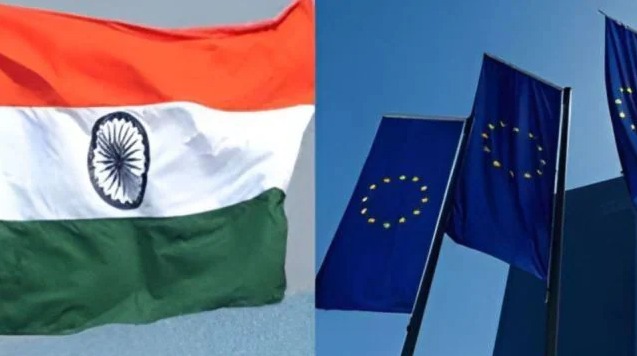
India-EU Trade Negotiations Stalled Over Food Safety Standards
The India-European Union (EU) Free Trade Agreement (FTA), in the works since 2007, has once again hit a key stumbling block—this time, over differing food safety regulations. A recent EU report emphasizes the need for “intense work” to bridge the gap between both sides' positions, particularly concerning sanitary and phytosanitary (SPS) standards.
What’s the Core Issue?
The EU maintains rigorous food safety norms, including standards on pesticide residues, traceability, and hygiene. India, on the other hand, argues that many of these rules are non-tariff barriers that unfairly restrict its agri-exports such as rice, spices, and tea.
The EU report highlights that while progress has been made in areas like digital trade, sustainable development, and customs cooperation, there is significant divergence on agri-food rules, requiring further negotiations and alignment.
Implications for India
India sees the trade deal as a gateway to the lucrative European market, especially for sectors like textiles, pharmaceuticals, and IT services. However, agriculture remains a sensitive area, both politically and economically.
Industry stakeholders have called for the government to protect domestic food producers while also meeting international benchmarks. The Indian side is pressing for mutual recognition agreements and equivalence mechanisms to ease trade barriers.
What the EU Wants
The EU is pushing for stronger commitments on environmental standards, labor rights, and transparent regulatory frameworks. It is also concerned about India’s stance on data localization and investment protection.
The latest EU report indicates that a final agreement is still some distance away, but both sides are committed to intensifying efforts.
Outlook
Despite roadblocks, negotiators remain optimistic. A successful deal would be a landmark moment for India’s global trade ambitions and help diversify supply chains across Europe. The next rounds of talks are expected to focus on aligning SPS measures and regulatory frameworks.
(FAQ) – FREQUENTLY ASKED QUESTIONS
Q1. What is the India-EU Free Trade Agreement (FTA)?
The India-EU FTA is a proposed trade deal aimed at reducing tariffs and trade barriers between India and the European Union to boost bilateral trade.
Q2. Why are food safety standards a key issue in the negotiations?
The EU enforces strict food safety rules that India views as trade-restrictive. The disagreement over sanitary and phytosanitary (SPS) measures is a major point of contention.
Q3. What sectors could benefit from the India-EU trade deal?
Sectors such as IT services, textiles, pharmaceuticals, agriculture, and renewable energy could see significant growth opportunities.
Q4. How long have India and the EU been negotiating the FTA?
Talks began in 2007 and were suspended in 2013. They resumed in 2022 but have faced multiple challenges since then.
Q5. What are the next steps in the trade negotiations?
Future rounds will focus on resolving SPS disputes, regulatory alignment, and finalizing a mutually beneficial framework.
Published on:July 19,2025
Published by :Selvi
www.vizzve.com || www.vizzveservices.com
Follow us on social media: Facebook || Linkedin || Instagram
🛡 Powered by Vizzve Financial
RBI-Registered Loan Partner | 10 Lakh+ Customers | ₹600 Cr+ Disbursed