

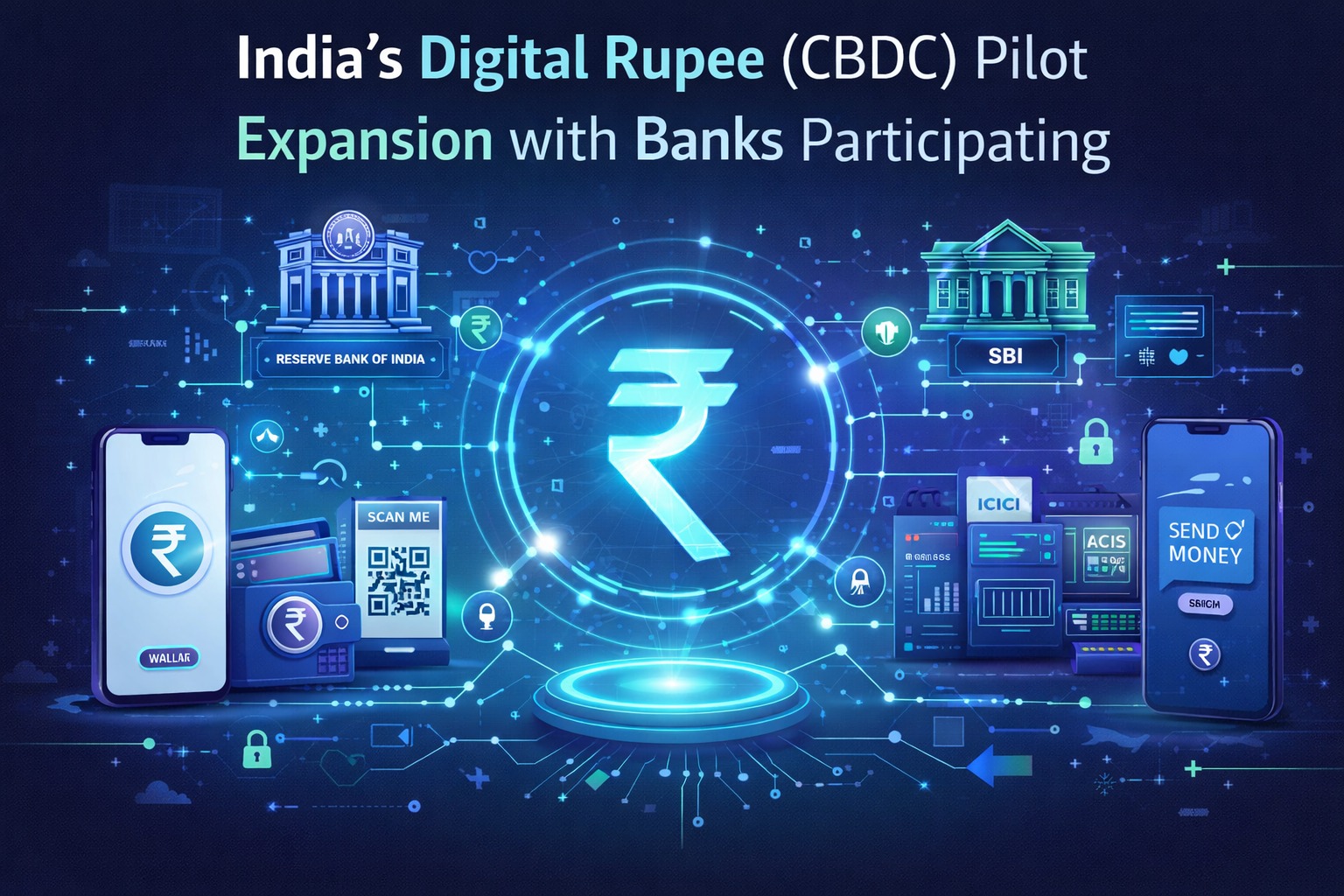
India is taking another major step toward the future of digital finance as the Reserve Bank of India (RBI) expands the Digital Rupee (CBDC) pilot program to more banks.
The Central Bank Digital Currency (CBDC) initiative aims to modernize India’s payment ecosystem by introducing a government-backed digital version of the rupee.
Initially launched as a limited pilot program, the Digital Rupee project is now expanding to include more banks and financial institutions, signaling strong progress toward mainstream adoption.
As digital payments continue to grow rapidly in India, the Digital Rupee could become a key part of the country’s financial infrastructure.
AI Answer Box
What is India’s Digital Rupee?
The Digital Rupee is India’s Central Bank Digital Currency (CBDC) issued by the Reserve Bank of India. It is a digital form of the Indian rupee that can be used for secure, instant transactions.
Key Highlights
| Feature | Details |
|---|---|
| Issued by | Reserve Bank of India |
| Currency type | Central Bank Digital Currency |
| Purpose | Digital alternative to physical cash |
| Pilot expansion | More banks joining CBDC testing |
What Is the Digital Rupee (CBDC)?
The Digital Rupee is a central bank-issued digital currency that represents the electronic form of the Indian rupee.
Unlike cryptocurrencies, the Digital Rupee is:
Issued and regulated by RBI
Backed by the government
Stable in value
Part of the official monetary system
CBDCs are being explored by many countries as a way to modernize payment systems.
Why India Is Expanding the CBDC Pilot
The expansion of the Digital Rupee pilot reflects RBI’s effort to test the technology across a wider financial network.
Objectives of the Expansion
Test scalability of digital currency systems
Improve payment efficiency
Increase financial inclusion
Strengthen India’s digital payment ecosystem
More banks participating means larger transaction volumes and broader real-world testing.
Banks Participating in the CBDC Pilot
Several major banks are participating in the Digital Rupee pilot program.
Key Participating Banks
| Bank | Role |
|---|---|
| State Bank of India | Digital currency distribution |
| ICICI Bank | Retail CBDC pilot |
| HDFC Bank | Transaction processing |
| Bank of Baroda | Customer access |
| Kotak Mahindra Bank | Digital wallet testing |
The inclusion of more banks allows the RBI to test the system across different banking infrastructures and customer segments.
How the Digital Rupee Works
The Digital Rupee functions similarly to physical currency but in digital form.
Step-by-Step Process
RBI issues Digital Rupee tokens.
Participating banks distribute the currency to users.
Users store digital rupees in digital wallets.
Payments can be made instantly using smartphones or digital platforms.
This process ensures secure and real-time transactions without intermediaries.
Benefits of the Digital Rupee
1. Faster Transactions
Digital Rupee payments can be completed instantly without delays associated with traditional banking systems.
2. Reduced Transaction Costs
CBDC may lower the cost of payments by reducing reliance on intermediaries.
3. Enhanced Financial Inclusion
Digital currency can reach people who have limited access to banking services.
4. Secure Government-Backed Currency
Unlike cryptocurrencies, the Digital Rupee is regulated and issued by the central bank.
Digital Rupee vs UPI vs Cryptocurrency
| Feature | Digital Rupee | UPI | Cryptocurrency |
|---|---|---|---|
| Issuer | RBI | Banks/NPCI | Private networks |
| Regulation | Fully regulated | Regulated | Mostly unregulated |
| Stability | Stable | Stable | Highly volatile |
| Purpose | Digital cash | Payment system | Digital asset |
The Digital Rupee complements existing digital payment systems rather than replacing them.
Impact on India’s Financial System
The expansion of the CBDC pilot could transform India’s financial ecosystem.
Potential Economic Impact
| Sector | Impact |
|---|---|
| Banking | Faster settlements |
| Payments | Instant transactions |
| Fintech | New innovation opportunities |
| Government | Better transaction tracking |
India already leads in digital payments, and CBDC could strengthen this position.
Challenges Facing CBDC Implementation
Despite its advantages, the Digital Rupee project still faces challenges.
Key Challenges
Cybersecurity concerns
Technology infrastructure
User awareness
Privacy considerations
RBI is carefully testing the system through pilot programs before a full rollout.
Global CBDC Trends
India is not alone in exploring digital currency.
Many countries are testing CBDCs, including:
China (Digital Yuan)
European Union (Digital Euro)
United States (CBDC research)
United Kingdom (Digital Pound)
India’s Digital Rupee initiative places the country among the global leaders in digital currency innovation.
Future of the Digital Rupee
Experts believe the Digital Rupee could play a major role in India’s financial future.
Possible Future Developments
Integration with UPI systems
International digital payments
Cross-border CBDC transactions
Offline digital currency payments
These developments could further strengthen India’s digital economy.
Key Takeaways
India has expanded its Digital Rupee (CBDC) pilot to more banks.
The initiative is led by the Reserve Bank of India.
Digital Rupee is a government-backed digital form of the Indian currency.
More banks joining the pilot will help test the system at scale.
CBDC could transform digital payments and financial inclusion in India.
Frequently Asked Questions
1. What is the Digital Rupee?
The Digital Rupee is India’s central bank digital currency issued by the Reserve Bank of India.
2. Who launched the Digital Rupee pilot?
The pilot program was launched by the Reserve Bank of India.
3. Is Digital Rupee the same as cryptocurrency?
No, it is a government-backed digital currency unlike decentralized cryptocurrencies.
4. Why is RBI testing CBDC?
To modernize payment systems and explore digital currency benefits.
5. Which banks are participating in the pilot?
Major banks including SBI, ICICI Bank, HDFC Bank, and others.
6. Can citizens use Digital Rupee?
Currently, it is available only in pilot testing phases.
7. Is Digital Rupee safe?
Yes, it is issued and regulated by the central bank.
8. Will Digital Rupee replace cash?
It is designed to complement physical cash rather than replace it.
9. Can Digital Rupee work offline?
Future versions may support offline transactions.
10. How does CBDC benefit the economy?
It improves payment efficiency and financial inclusion.
11. Is India leading in CBDC innovation?
India is among the major economies exploring digital currencies.
12. Can Digital Rupee be used internationally?
Future development may enable cross-border transactions.
13. How does Digital Rupee differ from UPI?
UPI is a payment system, while Digital Rupee is a digital form of currency.
14. When will Digital Rupee launch fully?
A nationwide rollout will depend on pilot program results.
15. What is the future of CBDC in India?
CBDC could become an important part of India’s digital financial ecosystem.
Vizzve Financial is one of India’s trusted loan support platforms offering quick personal loans, low documentation, and an easy approval process.
If you need financial support, you can easily apply online.
👉 Apply now at www.vizzve.com
Published on : 17th March
Published by : SMITA
www.vizzve.com || www.vizzveservices.com
Follow us on social media: Facebook || Linkedin || Instagram
🛡 Powered by Vizzve Financial
RBI-Registered Loan Partner | 10 Lakh+ Customers | ₹600 Cr+ Disbursed