

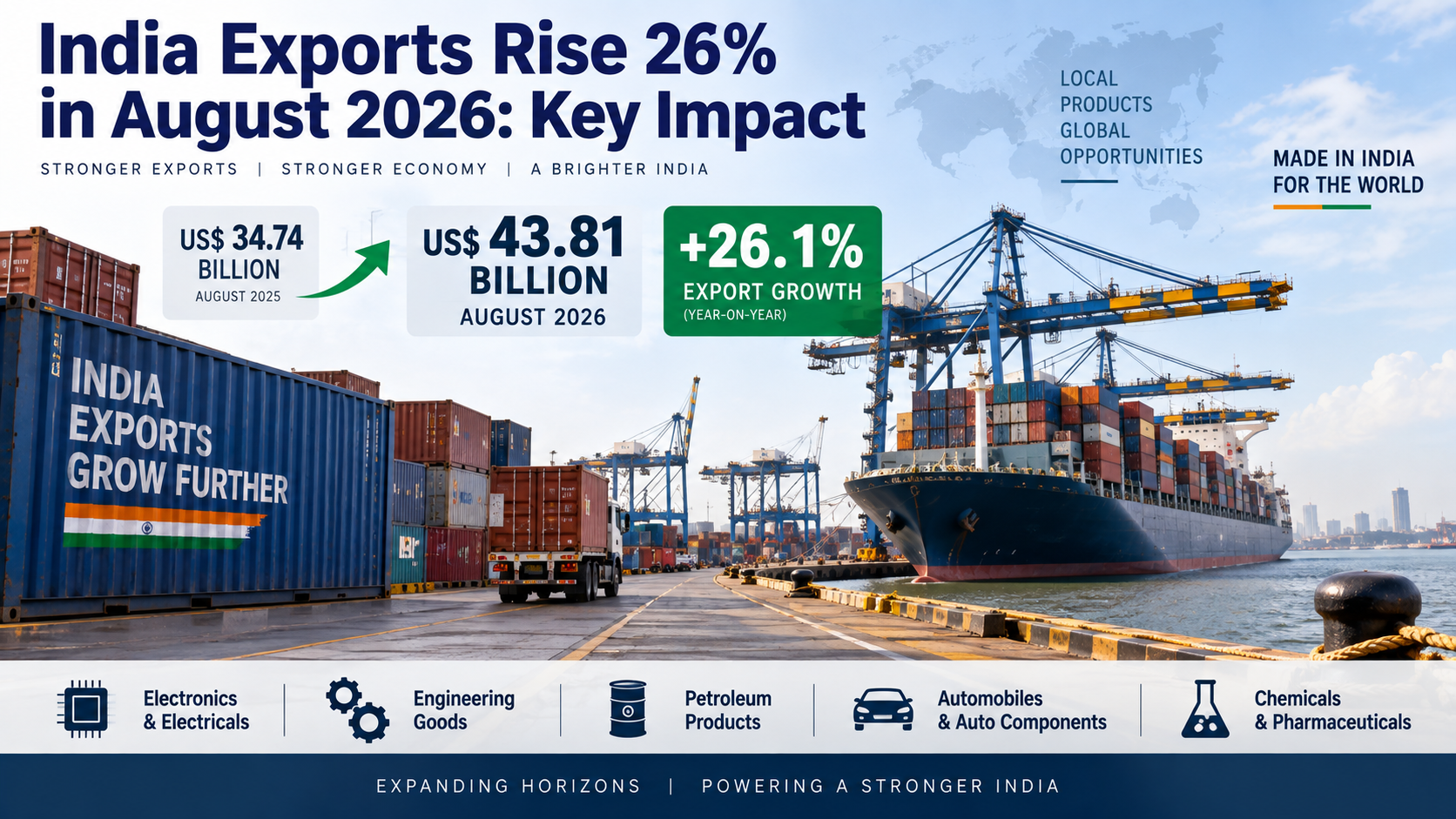
ndia’s merchandise exports recorded a strong jump in August 2026, rising 26.1% year-on-year to $43.81 billion, compared with $34.74 billion in August 2025.
The latest trade data also showed that imports grew at a slower pace of 14.1% to $70.67 billion. As a result, India’s merchandise trade deficit narrowed to $26.86 billion in August.
The numbers are important because exports are a major source of foreign exchange and contribute to industrial production, employment and overall economic activity.
But there is more to the August data than the headline 26% growth.
India Export Growth in August 2026: Key Numbers
Here are the major figures from the latest government data:
| Indicator | August 2026 | August 2025 | Change |
|---|---|---|---|
| Merchandise exports | $43.81 billion | $34.74 billion | +26.1% |
| Merchandise imports | $70.67 billion | $61.96 billion | +14.1% |
| Merchandise trade deficit | $26.86 billion | $27.20 billion | Narrowed |
| Services exports* | $38.87 billion | $31.19 billion | Higher |
| Total exports* | $82.68 billion | $65.93 billion | +25.4% |
| Total imports* | $92.09 billion | $77.55 billion | +18.8% |
*August services data is estimated by the government using the latest available RBI data.
This means the 26% headline figure refers specifically to merchandise/goods exports, while merchandise plus services exports increased by about 25.4%.
Why Did India's Exports Rise 26%?
Several sectors contributed to the strong performance.
According to government data, major export categories showing growth included engineering goods, electronic goods, petroleum products, chemicals, automobiles, marine products and pharmaceuticals.
1. Engineering Goods
Engineering exports rose 24.86%, from $9.87 billion in August 2025 to $12.32 billion in August 2026.
Engineering products include machinery, industrial equipment, auto components and other manufactured goods.
2. Electronic Goods
Electronic goods exports recorded particularly strong growth, rising 89.82% year-on-year in August.
The continued expansion of electronics manufacturing and India's role in global supply chains are important factors behind this increase.
3. Petroleum Products
Petroleum product exports increased 63.27% compared with August last year.
This category can be affected significantly by global crude prices and refining margins, so export values should be interpreted alongside energy prices.
4. Chemicals
Organic and inorganic chemical exports increased 16.38%, reaching about $2.80 billion in August.
5. Automobile Exports
Automobile exports also performed strongly, increasing 22.2% year-on-year in August, according to data cited by Reuters.
India's Exports to the US and China
India's export performance was supported by stronger shipments to several major markets.
Exports to the United States increased by 21.83% in August, while shipments to China rose by 52.35%. Singapore also recorded particularly strong growth, with Indian exports rising sharply.
The US remained an important destination for Indian goods.
At the same time, the increase in exports to China is notable because India has traditionally run a substantial merchandise trade deficit with China.
Trade Deficit Narrows to $26.86 Billion
One of the important developments in the August trade data was the narrowing of India's merchandise trade deficit.
The deficit stood at:
- $26.86 billion in August 2026
- $27.20 billion in August 2025
- $31.98 billion in July 2026
The August improvement came partly because imports increased much more slowly than exports.
However, India continues to import significantly more merchandise than it exports.
Therefore, one month of improvement does not eliminate the broader trade deficit challenge.
Gold Imports Fall Sharply
Gold imports were one of the biggest factors behind the slower growth in India's overall merchandise imports.
Gold imports fell to around $2.3 billion in August 2026, sharply below the year-earlier level. Reuters reported that gold imports had been $4.16 billion in July and were substantially higher a year earlier.
Lower gold imports helped offset higher import spending in other areas, particularly energy.
This is important because gold is a major import item but does not directly add to India's productive capacity in the same way as machinery or industrial inputs.
Crude Oil Imports Remain a Concern
While gold imports declined, India's energy import bill remained under pressure.
Crude oil imports rose 25.8% year-on-year to $16.69 billion in August, according to government data reported by Reuters.
India's crude basket averaged $90.19 per barrel in August, compared with $82.04 in July.
This creates a mixed picture for the Indian economy.
Higher exports can improve foreign-exchange earnings, but expensive crude oil can increase the country's import bill and put pressure on the trade balance.
What Does 26% Export Growth Mean for India's Economy?
Strong exports can influence the economy in several ways.
1. More Foreign Exchange Earnings
Exporters receive foreign currency from international buyers.
Higher export receipts can increase the supply of foreign currency and support India's external balance.
2. Support for Manufacturing
Engineering, electronics, automobiles, chemicals and other manufactured exports indicate demand for Indian products in international markets.
If this demand remains strong, it can support manufacturing investment and production.
3. Employment Opportunities
Export-oriented industries often support employment across factories, logistics, ports, transportation, packaging and related services.
The effect varies by sector and by how much additional production is required to meet foreign demand.
4. Support for the Rupee
Higher export earnings can provide foreign-exchange inflows.
However, the exchange rate also depends on several other factors, including crude oil prices, capital flows, interest rates and global market conditions.
Therefore, stronger exports alone do not guarantee a stronger rupee.
Does Higher Export Growth Mean India's Economy Is Stronger?
The export numbers are positive for India's external trade, but they should not be viewed in isolation.
There are several things to watch.
Export growth is concentrated in some sectors
While electronics, engineering and petroleum products performed strongly, some labour-intensive categories have faced pressure.
The Indian Express reported weakness in areas including textiles, leather and some agricultural and low-margin products during the April-June period.
Imports are still much larger than exports
India's merchandise imports were $70.67 billion in August compared with exports of $43.81 billion.
So the country continues to record a substantial goods trade deficit.
Global conditions remain uncertain
India's export performance depends on global demand, tariffs, shipping costs, commodity prices and geopolitical developments.
A strong single month does not necessarily establish a long-term trend.
India's April-August 2026 Export Performance
The broader five-month picture also shows strong export growth.
Between April and August 2026, India's total exports of merchandise and services were estimated at $399.27 billion, compared with $345.55 billion in the corresponding period a year earlier.
That represents growth of approximately 15.55%.
Merchandise exports during the same period reached $215.91 billion, up from $183.21 billion.
However, merchandise imports were much higher at $363 billion, leaving a merchandise trade deficit of approximately $147.09 billion for April-August.
What About Services Exports?
India's services sector remains an important part of the country's external trade.
For August 2026, services exports were estimated at $38.87 billion, compared with $31.19 billion in August 2025.
The government estimates that India's services trade surplus during April-August 2026-27 was $86.71 billion, compared with $79.94 billion in the corresponding period of the previous year.
This services surplus helps offset part of India's merchandise trade deficit.
How Could Export Growth Affect Businesses?
The impact will vary across industries.
Manufacturing companies
Higher foreign orders can support production and capacity utilisation.
Electronics companies
Strong electronics export growth could support India's efforts to become a larger manufacturing and export hub.
Automobile companies
Higher vehicle exports can support manufacturers and component suppliers.
Engineering companies
Growing international orders can support capital-goods manufacturers and industrial suppliers.
Logistics companies
More exports can increase demand for ports, shipping, warehousing and freight services.
Key Takeaways
- India's merchandise exports rose 26.1% in August 2026.
- Merchandise exports reached $43.81 billion.
- Merchandise imports increased 14.1% to $70.67 billion.
- The merchandise trade deficit narrowed to $26.86 billion.
- Electronics exports increased almost 90% year-on-year.
- Engineering exports rose nearly 25%.
- Petroleum product exports increased more than 63%.
- Exports to the US rose more than 21%, while exports to China increased more than 52%.
- Gold imports fell sharply, helping reduce the overall import bill.
- Crude oil imports remained a major pressure point.
- Total merchandise and services exports reached an estimated $82.68 billion in August.
- April-August total exports reached an estimated $399.27 billion.
Frequently Asked Questions
1. How much did India's exports rise in August 2026?
India's merchandise exports increased 26.1% year-on-year to $43.81 billion in August 2026.
2. Why did India's exports rise in August?
Growth was supported by engineering goods, electronics, petroleum products, chemicals, automobiles and several other export categories.
3. What was India's trade deficit in August 2026?
India's merchandise trade deficit was $26.86 billion in August 2026.
4. Did India's imports also increase?
Yes. Merchandise imports rose 14.1% to $70.67 billion in August.
5. Which export sector grew the most?
Electronic goods recorded growth of 89.82% year-on-year in August 2026 among the major categories listed by the government.
6. How much did engineering exports grow?
Engineering goods exports increased 24.86% year-on-year to $12.32 billion.
7. Did exports to the US increase?
Yes. India's exports to the US rose by more than 21% in August, according to Commerce Ministry data reported by the Indian Express.
8. Did India increase exports to China?
Yes. Exports to China rose 52.35% year-on-year in August 2026.
9. What happened to gold imports?
Gold imports fell sharply to around $2.3 billion in August, helping reduce the merchandise trade deficit.
10. Are India's exports likely to remain strong?
Future performance will depend on global demand, tariffs, exchange rates, commodity prices, shipping conditions and market access. August's data alone cannot establish how exports will perform in future months.
11. What were India's total exports including services?
Merchandise plus services exports were estimated at $82.68 billion in August 2026.
12. What does higher exports mean for India?
Higher exports can increase foreign-exchange earnings, support manufacturing and services activity, and improve India's external balance. The overall impact also depends on imports, commodity prices and global economic conditions.
Published on : 16th September
Published by : SMITA
www.vizzve.com || www.vizzveservices.com
Follow us on social media: Facebook || Linkedin || Instagram
🛡 Powered by Vizzve Financial
RBI-Registered Loan Partner | 10 Lakh+ Customers | ₹600 Cr+ Disbursed