

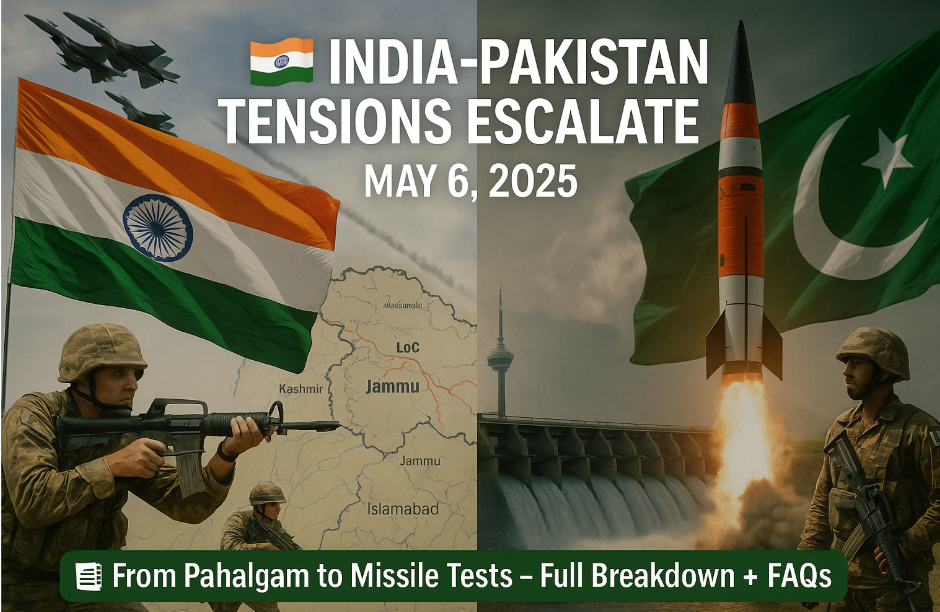
🇮🇳🇵🇰 India-Pakistan Tensions Escalate: Key Developments and FAQs – May 6, 2025
📰 Top Developments
-
Pahalgam Terror Attack Triggers Crisis
On April 22, 2025, a terrorist attack in Pahalgam, Jammu and Kashmir, resulted in 26 fatalities, primarily Hindu tourists. India attributes the attack to Pakistan-based militants, a claim Pakistan denies. AP News
-
Cross-Border Skirmishes Intensify
The Line of Control (LoC) has witnessed nightly exchanges of fire for 12 consecutive nights, with incidents reported in Kupwara, Baramulla, Poonch, and Rajouri districts. Rediff
-
India Suspends Indus Waters Treaty
India has unilaterally suspended the 1960 Indus Waters Treaty, affecting water flow to Pakistan. This move has led to concerns over potential flooding and water scarcity in Pakistan. Reuters
-
Pakistan Conducts Missile Tests
In response to escalating tensions, Pakistan has conducted missile tests, including the Abdali Weapon System with a range of 450 km. Al Jazeera
-
India Plans Civil Defence Drills
India is set to conduct nationwide civil defence drills on May 7, 2025, across 244 districts to prepare for potential hostile attacks. Reuters
-
International Calls for Restraint
The UN Security Council and countries like Iran and Russia have urged both nations to de-escalate tensions and engage in dialogue. Reuters
❓ Frequently Asked Questions
Q1: What led to the current India-Pakistan tensions?
A terrorist attack in Pahalgam, Jammu and Kashmir, on April 22, 2025, killed 26 people. India blames Pakistan-based militants for the attack, escalating tensions between the two nations. AP News
Q2: What is the Indus Waters Treaty, and why is its suspension significant?
The Indus Waters Treaty, signed in 1960, governs water sharing between India and Pakistan. India's suspension of the treaty affects water flow to Pakistan, raising concerns over agriculture and water security.
Q3: What are the civil defence drills planned by India?
India plans to conduct civil defence drills on May 7, 2025, across 244 districts. The drills aim to prepare civilians for potential hostile attacks, including simulations of blackouts and evacuations.
Q4: How has Pakistan responded to India's actions?
Pakistan has conducted missile tests, closed its airspace to Indian flights, and suspended trade with India. It has also sought international mediation to de-escalate tensions. Reuters
Q5: What has been the international community's response?
The UN Security Council, along with countries like Iran and Russia, has called for restraint and urged both India and Pakistan to engage in dialogue to resolve the crisis. Reuters
📌 Conclusion
The situation between India and Pakistan remains tense following the Pahalgam attack. With military preparations on both sides and international calls for restraint, the coming days are critical. Stay informed through reliable news sources.