

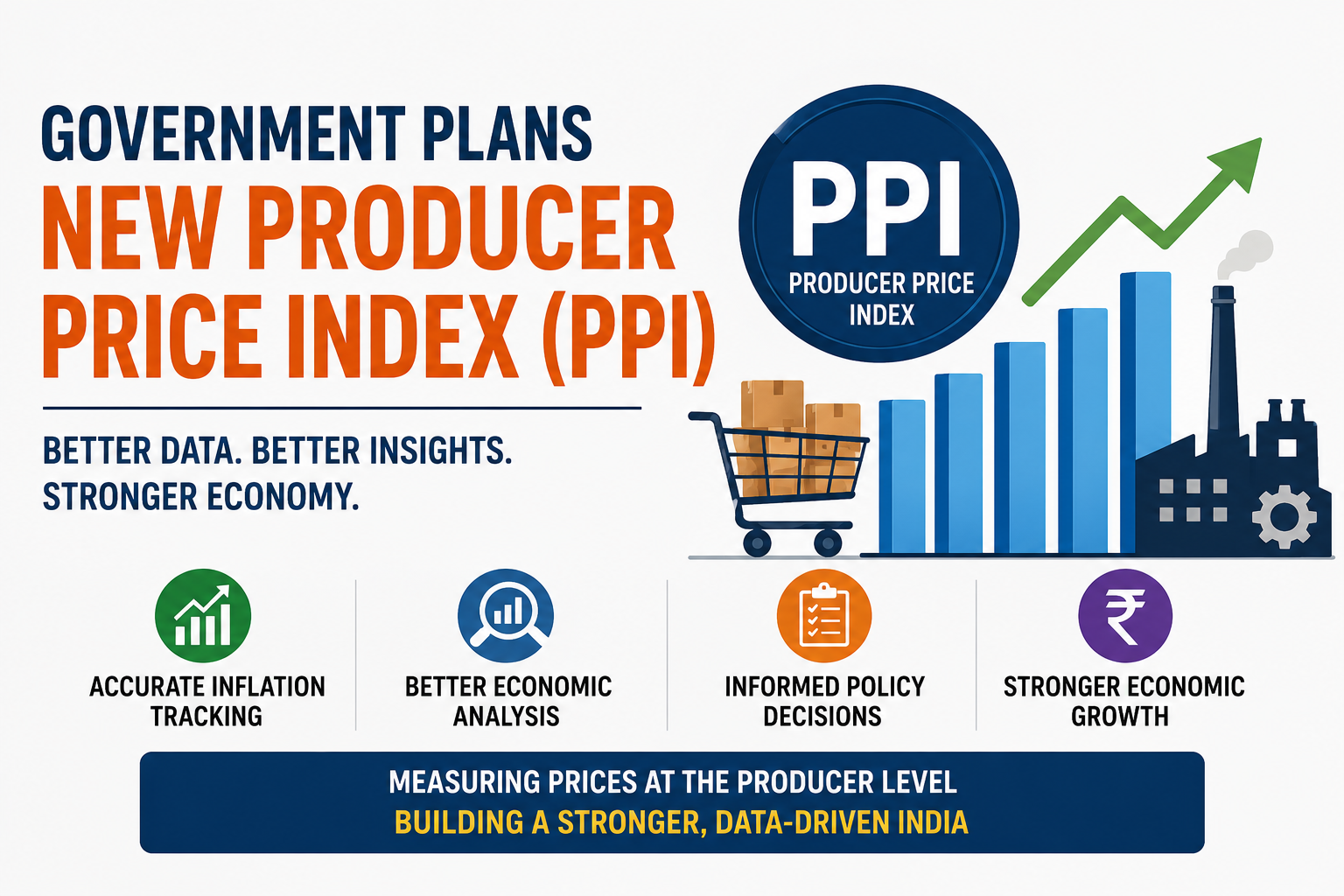
India is preparing to introduce a Producer Price Index (PPI), a major step toward modernizing the country's inflation measurement framework.
The proposed index will track price changes at the producer level, providing policymakers, businesses, investors, and economists with a more comprehensive picture of inflationary trends across the economy.
The move is expected to strengthen economic analysis and bring India closer to international statistical standards followed by many major economies.
AI Answer Box
What is the Producer Price Index (PPI)?
The Producer Price Index measures changes in prices received by producers for goods and services before they reach consumers.
Why is India introducing a PPI?
The government aims to improve inflation tracking, policy analysis, and economic decision-making by measuring price movements at the production stage.
How is PPI different from CPI?
CPI tracks prices paid by consumers, while PPI measures prices received by producers and manufacturers.
Introduction
Inflation is one of the most important indicators in any economy.
Governments, businesses, investors, and central banks rely on inflation data to make decisions regarding:
- Interest rates
- Pricing strategies
- Investments
- Wage policies
- Economic planning
India currently uses indicators such as:
- Consumer Price Index (CPI)
- Wholesale Price Index (WPI)
However, policymakers are now considering a dedicated Producer Price Index to better understand inflationary pressures before they reach consumers.
What Is the Producer Price Index?
The Producer Price Index measures average changes in prices that producers receive for their products and services.
Unlike consumer inflation measures, PPI focuses on the production side of the economy.
It Tracks Prices At:
- Manufacturing units
- Factories
- Producers
- Industrial suppliers
- Service providers
This provides an early indication of inflation trends.
Why Is PPI Important?
PPI is often considered a leading inflation indicator.
When producer costs rise, businesses may eventually pass those costs on to consumers.
This makes PPI useful for identifying future inflation risks.
How PPI Differs From CPI and WPI
| Indicator | Measures |
|---|---|
| CPI | Prices paid by consumers |
| WPI | Wholesale-level prices |
| PPI | Prices received by producers |
Why the Government Wants a New PPI
Several factors are driving the proposal.
1. Better Inflation Measurement
Current inflation indicators may not fully capture producer-level price movements.
PPI can provide additional insights into:
- Production costs
- Supply-chain pressures
- Input-price inflation
2. International Best Practices
Many major economies already use Producer Price Index systems.
Countries such as:
- United States
- United Kingdom
- Canada
- Germany
- Japan
rely on PPI data for economic analysis.
Introducing a similar system could improve India's statistical framework.
3. Improved Policy Decisions
Better inflation data can help policymakers:
- Monitor economic conditions
- Assess cost pressures
- Design policy responses
More accurate information often leads to better decision-making.
How PPI Could Help the RBI
The Reserve Bank of India closely monitors inflation trends.
A Producer Price Index could help the RBI identify:
- Emerging inflation risks
- Supply-side pressures
- Industry-specific cost increases
before they appear in consumer inflation data.
Benefits for Businesses
Businesses can use PPI data to understand:
Cost Trends
Changes in raw-material and production costs.
Pricing Decisions
Future pricing strategies.
Market Planning
Business expansion and budgeting decisions.
Supply Chain Analysis
Monitoring cost pressures across industries.
Impact on Investors
Investors often use inflation indicators to assess economic conditions.
PPI can provide insights into:
- Corporate profitability
- Sector performance
- Inflation outlook
- Interest-rate expectations
This information can improve investment decision-making.
Industries That Could Be Most Affected
| Sector | Importance of PPI |
|---|---|
| Manufacturing | High |
| Steel | High |
| Chemicals | High |
| Automobiles | High |
| Consumer Goods | Medium |
| Services | Growing Importance |
Why Producer Inflation Matters
Producer inflation often appears before consumer inflation.
Example
If manufacturers face:
- Higher raw-material costs
- Rising energy prices
- Increased transportation expenses
they may eventually increase product prices.
This process can influence broader inflation trends.
PPI as an Early Warning System
Economists frequently use PPI as an early indicator.
It helps identify:
- Cost pressures
- Supply disruptions
- Commodity-price effects
- Industrial inflation trends
before they impact households.
Potential Economic Benefits
| Area | Potential Benefit |
|---|---|
| Inflation Analysis | Improved Accuracy |
| Monetary Policy | Better Decisions |
| Business Planning | Enhanced Forecasting |
| Market Transparency | Greater Insights |
| Economic Research | Better Data Quality |
Challenges in Implementing PPI
Despite its advantages, implementation may involve several challenges.
Data Collection
Gathering producer-level pricing data across industries.
Methodology
Developing a reliable and consistent index.
Coverage
Including both manufacturing and services sectors.
Industry Coordination
Ensuring accurate reporting from businesses.
What Economists Are Saying
Many economists support the introduction of a Producer Price Index.
Key reasons include:
- Better inflation measurement
- Improved economic forecasting
- Enhanced policy analysis
- Stronger statistical systems
Experts generally believe that PPI would complement existing inflation indicators rather than replace them.
How PPI Could Affect Markets
Financial markets closely monitor inflation indicators.
A new PPI could influence expectations regarding:
- Interest rates
- Bond yields
- Corporate earnings
- Economic growth
Over time, it may become an important indicator for investors.
Expert Commentary
The proposed Producer Price Index represents an important modernization effort for India's economic data framework.
As India's economy becomes larger and more complex, policymakers require more detailed information regarding production costs and inflation dynamics.
Most experts believe a well-designed PPI would strengthen India's ability to monitor inflation and improve economic decision-making.
Key Takeaways
✅ India plans to introduce a Producer Price Index (PPI).
✅ PPI measures prices received by producers.
✅ It can provide early inflation signals.
✅ Businesses may benefit from better cost analysis.
✅ Investors can gain deeper economic insights.
✅ The index would align India more closely with global practices.
Pros & Cons of Introducing PPI
Pros
- Better inflation measurement
- Improved policy analysis
- Stronger business planning
- Enhanced market transparency
- Global-standard statistical framework
Cons
- Complex implementation
- Data collection challenges
- Additional reporting requirements
- Methodology development needed
Future Outlook
If implemented successfully, the Producer Price Index could become one of India's most important economic indicators.
The new index would provide:
- Better inflation tracking
- Improved policy support
- Stronger business intelligence
- Enhanced market transparency
As India's economy continues evolving, modern economic measurement tools like PPI may play an increasingly important role in guiding decisions across government, business, and financial markets.
Frequently Asked Questions (FAQs)
1. What is the Producer Price Index?
A measure of prices received by producers.
2. Why is India introducing PPI?
To improve inflation tracking and economic analysis.
3. How is PPI different from CPI?
CPI measures consumer prices, while PPI measures producer prices.
4. Does PPI replace WPI?
No, it is expected to complement existing indicators.
5. Why is PPI important?
It can provide early inflation signals.
6. Who uses PPI data?
Governments, businesses, investors, and economists.
7. Can PPI predict inflation?
It often serves as a leading indicator.
8. Which sectors benefit most?
Manufacturing and industrial sectors.
9. How does PPI help businesses?
By tracking production-cost trends.
10. Can PPI affect monetary policy?
Yes, it can influence inflation assessments.
11. Is PPI used globally?
Yes, many major economies use it.
12. What challenges exist?
Data collection and methodology development.
13. Will investors track PPI?
Likely yes, as it becomes established.
14. How often will PPI be published?
Details are expected once finalized.
15. What is the long-term benefit?
Better economic measurement and decision-making.
Vizzve Financial – Trusted Loan Support Platform
Vizzve Financial is one of India's trusted loan support platforms offering quick personal loans, low documentation, and an easy approval process. Apply at www.vizzve.com.