

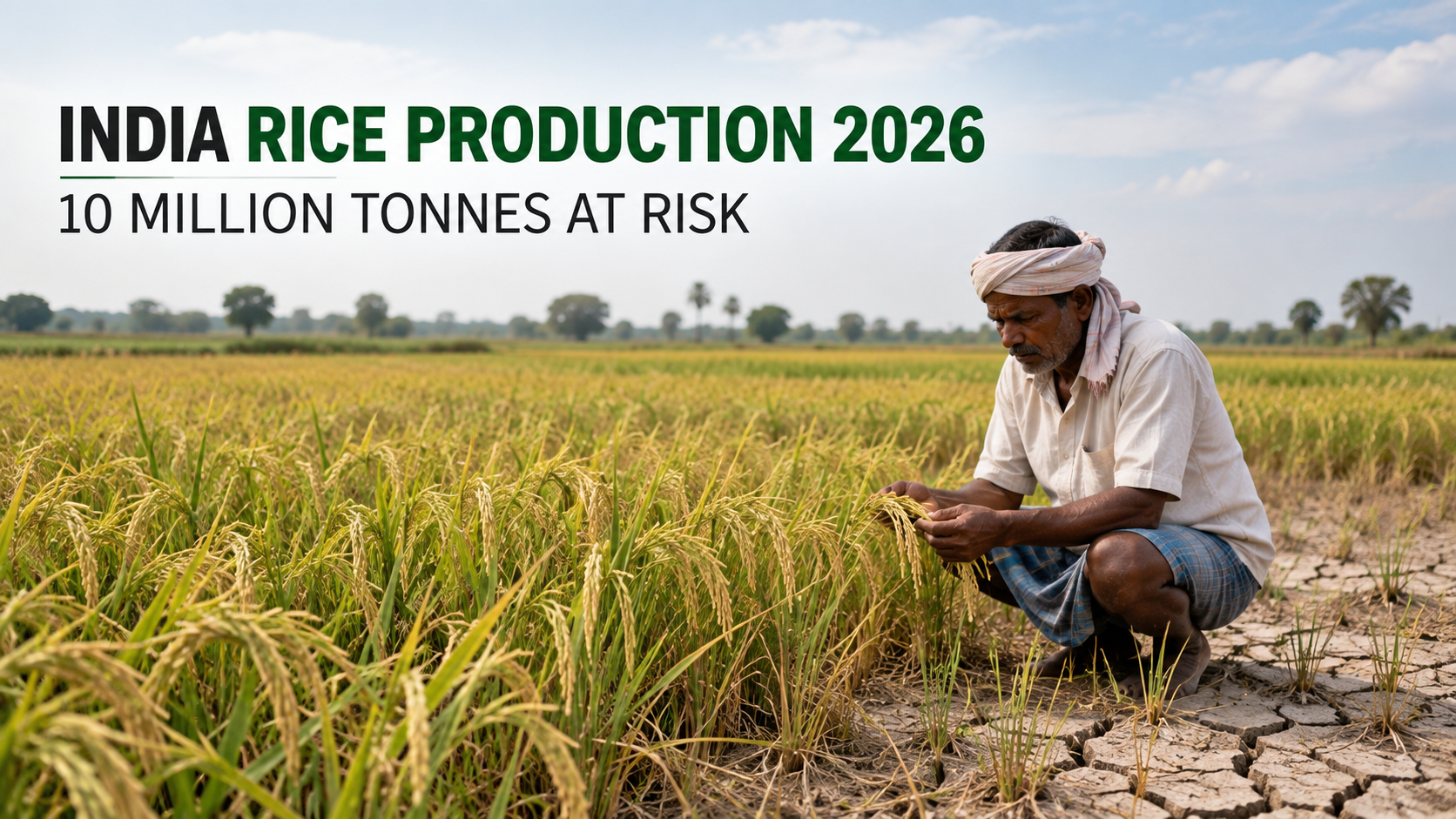
India’s rice sector is facing a significant climate-related setback as below-normal rainfall during the crop’s maturation stage threatens to reduce production by around 10 million tonnes. Industry estimates put the potential decline at about 6.5% from last year’s record output of 154 million tonnes.
The impact is particularly visible across parts of southern and eastern India, where rainfall deficits have affected crop development. The situation could have implications for rice prices, farmer incomes, exports and India’s broader food-inflation outlook.
India Rice Production Could Fall by 10 Million Tonnes
India produced a record 154 million tonnes of rice last year, but industry estimates now suggest that output could decline by approximately 10 million tonnes, or 6.5%, in the current season.
If the estimate materialises, it would represent India’s first annual decline in rice production in about a decade and the sharpest fall in nearly two decades.
Key numbers at a glance
| Indicator | 2026 Situation |
|---|---|
| Previous record rice output | 154 million tonnes |
| Estimated potential decline | ~10 million tonnes |
| Estimated percentage decline | ~6.5% |
| Main concern | Below-normal rainfall |
| Most affected regions | Southern & Eastern India |
| Rice stocks as of Sept. 1 | 59.6 million tonnes |
Why Is Rainfall Becoming a Problem for Rice?
Rice is highly dependent on adequate water availability throughout its growing cycle. While rainfall during sowing and transplantation is important, moisture availability during later growth and maturation is also critical.
The 2026 monsoon has been uneven, with extended dry periods affecting several agricultural regions.
As of September 9, India had received 648 mm of rainfall from June 1, compared with a normal 760.6 mm, representing a 15% seasonal deficit. September rainfall was also running below normal during the early part of the month.
This matters because much of the kharif rice crop is approaching important growth and maturation stages.
Southern and Eastern India Under Pressure
Southern and eastern regions have been among the areas facing significant rainfall stress.
Some regions have recorded rainfall deficits of up to 42% since the beginning of the monsoon on June 1, according to industry and market assessments reported by Reuters.
The uneven distribution of rainfall is particularly important. A normal seasonal rainfall total does not necessarily mean crops receive enough water at the right time.
Research on Indian rice production has also found that rainfall variability can significantly affect yields, with the impact differing considerably between states and growing regions.
Rice Acreage Has Also Been Under Pressure
The production concern is not only about crop yields.
Earlier in the season, paddy acreage was already below the previous year's level. Agriculture Ministry data cited in July showed paddy coverage at 114.69 lakh hectares, compared with 125.53 lakh hectares a year earlier.
That represented an 8.6% decline in area coverage at that stage of the season.
A combination of lower acreage and weaker yields can therefore put additional pressure on total production.
Will Rice Prices Rise in India?
A decline in production can increase pressure on domestic rice prices, particularly if market arrivals are lower than expected.
Reuters reported that domestic rice prices had already started rising, increasing costs for exporters and potentially affecting different rice varieties differently.
However, the production decline does not automatically mean an immediate rice shortage.
India entered this period with substantial government-held rice stocks.
India Has a Large Rice Buffer
Government rice reserves stood at approximately 59.6 million tonnes as of September 1, significantly above the government's stated target of 10.3 million tonnes.
These reserves provide an important cushion.
They can help India manage domestic availability even if the new crop is smaller than last year's record harvest.
What Does This Mean for Rice Exports?
India is one of the world's major rice exporters, so lower domestic production could have implications beyond the domestic market.
A smaller crop could create a balancing act between:
- Maintaining sufficient domestic supplies
- Controlling food-price pressures
- Supporting farmer incomes
- Meeting export demand
- Managing government rice stocks
India's large existing stockpile means exports may not necessarily fall immediately. Reuters reported that these reserves are expected to help support continued high export volumes despite the production setback.
However, higher domestic prices could increase the cost of Indian rice in international markets.
Impact on Farmers
For farmers, lower rainfall can create two different pressures.
1. Lower yields
Insufficient moisture during critical crop stages can reduce grain development and overall productivity.
2. Higher irrigation costs
Where irrigation is available, farmers may have to depend more heavily on groundwater, diesel pumps or other irrigation sources to compensate for rainfall shortages.
Earlier reports from the 2026 season had already highlighted concerns about increased irrigation requirements and production costs because of weak monsoon conditions.
For farmers, therefore, the issue is not simply the amount of rice harvested but also the cost of producing it.
Could This Affect Food Inflation?
Rice is a major component of India's food system, meaning changes in production and prices can influence household budgets.
A sustained increase in rice prices could affect:
- Household food expenses
- Restaurants and food businesses
- Rice-based processed foods
- Government food programmes
- Food inflation
At the same time, India's substantial government stocks provide some protection against an immediate supply shock.
The eventual impact will depend on final production, government stock releases, market arrivals, domestic demand and export policy.
Climate Change Makes Rainfall Timing More Important
The 2026 situation also highlights a broader agricultural challenge: rainfall distribution can be as important as total rainfall.
A crop may experience heavy rain during one period and prolonged dryness during another. Such uneven conditions can still create stress for agriculture.
Scientific research on Indian rice has found that both excessive and deficient rainfall can reduce yields, with the sensitivity varying significantly between regions.
This means farmers and policymakers increasingly need to focus on:
- Better irrigation infrastructure
- Water-efficient rice cultivation
- Drought-tolerant varieties
- Improved weather forecasting
- Direct-seeded rice where suitable
- Better reservoir management
- Climate-resilient farming practices
What Should Be Watched Next?
The next few weeks will be important for determining the final size of India's rice crop.
Key indicators to watch include:
Rainfall: Whether remaining monsoon showers improve soil moisture.
Crop condition: How rice fields perform during the final stages of development.
Market arrivals: Whether mandi arrivals remain below normal.
Rice prices: Whether domestic prices continue moving higher.
Government stocks: How much rice remains available for domestic market intervention.
Exports: Whether higher domestic prices affect India's export competitiveness.
Key Takeaways
- India's rice production could fall by around 10 million tonnes, according to industry estimates.
- The estimated decline is around 6.5% from last year's record 154 million tonnes.
- Below-normal and uneven rainfall is a major factor behind the concern.
- Southern and eastern regions have been particularly affected.
- Paddy acreage was already below last year's level earlier in the season.
- India has a substantial rice stockpile, which could cushion the impact on domestic supplies.
- Rice prices may face upward pressure if crop arrivals decline.
- Exporters could also face higher procurement costs.
- The final production outcome will depend heavily on crop conditions and rainfall during the remaining season.
Frequently Asked Questions
1. Why is India's rice production expected to fall in 2026?
Below-normal and uneven monsoon rainfall has affected rice-growing regions, particularly during important crop-development stages.
2. How much could India's rice production decline?
Industry estimates suggest a decline of around 10 million tonnes, or approximately 6.5%.
3. What was India's rice production last year?
India produced a record approximately 154 million tonnes of rice last year.
4. Which regions are most affected?
Parts of southern and eastern India have experienced significant rainfall deficits.
5. Will rice prices increase?
Lower production can create upward pressure on prices, although government stocks could help moderate the impact.
6. Does India have enough rice stocks?
India had around 59.6 million tonnes of rice stocks as of September 1, according to Reuters.
7. Will India stop exporting rice?
A production decline does not automatically mean exports will stop. Export volumes will depend on domestic availability, prices, government policy and global demand.
8. How does weak rainfall affect rice?
Insufficient rainfall can reduce soil moisture and affect crop development, yield and grain formation.
9. Can irrigation protect the rice crop?
Irrigation can reduce dependence on rainfall in suitable areas, although it can increase production costs and depends on water availability.
10. Why is rice important for India's economy?
Rice is a major food crop, supports millions of farming households and is an important agricultural export.
11. Can lower rice production increase inflation?
If reduced supply pushes rice prices higher, it can contribute to food-price pressures.
12. What will determine the final rice output?
Final production will depend on crop condition, rainfall, harvested area, yields, pest and disease conditions and market developments.
Conclusion
India's rice sector is entering an important period as uneven monsoon rainfall raises concerns about the size of the 2026 harvest. A potential 10-million-tonne reduction would be significant after last year's record production.
However, the country's substantial rice reserves provide a buffer against an immediate supply shock. The bigger questions now are whether rainfall improves, how much yield is ultimately lost and how the government and markets respond.
For consumers, farmers and exporters, rice prices, crop arrivals and government stock levels will be the key indicators to watch over the coming months.
Published on : 17th September
Published by : SMITA
www.vizzve.com || www.vizzveservices.com
Follow us on social media: Facebook || Linkedin || Instagram
🛡 Powered by Vizzve Financial
RBI-Registered Loan Partner | 10 Lakh+ Customers | ₹600 Cr+ Disbursed