

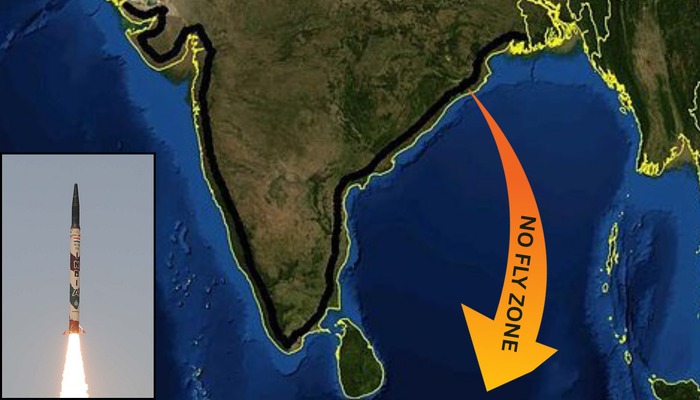
India has issued a notification for a likely missile test in the Bay of Bengal region, expected around September 24-25, 2025. The advance warning is typical of military test protocols, but its implications extend well beyond routine safety measures. Here’s what this tells us about India’s strategic posture, regional signalling, and how missile testing shapes defence trends.
What Is Known So Far
India has officially notified civilians and relevant agencies about a possible missile test in the Bay of Bengal during September 24-25. (“NOTAM” type notices are used to warn air and sea traffic).
The test is likely to involve a missile with a medium-range classification, under 1,500 km, though exact missile type, trajectory, warhead, etc., are not yet disclosed.
The Bay of Bengal is a frequent choice for missile tests due to open sea space, safety for trajectories over water, and ability to monitor performance with minimal risk to civilian traffic.
Why India Gives Advance Notification
Safety and Civilian Traffic
Notifications protect aircraft, ships, fishing vessels and other civilian or commercial traffic from entering dangerous zones during missile launches.
Operational Transparency
While not disclosing full technical details, notifying such tests helps avoid misinterpretation by neighbours and global actors, reducing risk of unintended escalation.
Regulatory & Protocol Compliance
India follows established practices of defense test launches: issuing notices ensures coordination with aviation, maritime and coast guard authorities.
Strategic Signals: What This Notification Suggests
Strengthening Deterrence
Regular and visible missile testing underscores that India is maintaining and upgrading its missile capabilities. This is part of its broader deterrence posture.
Capability Validation
Such tests allow India to validate missile systems—accuracy, guidance, propulsion, telemetry—in realistic conditions (sea-based flight paths, long-range trajectories).
Regional Signalling
Neighbouring countries and regional powers (e.g. in the Indian Ocean region, Bay of Bengal states, or strategic competitors) are likely to view this as a signal of readiness and resolve.
Technology and Defence Modernisation
The choice of missile type (if medium-range) suggests focus on enhancing intermediate strike capabilities, possibly updating systems or integrating improvements.
Strategic Geography Usage
Using Bay of Bengal aligns with India’s eastern flank: it enables over-sea testing, protects land areas, provides broader trajectories, and demonstrates ability to project power from eastern coasts.
Broader Implications
Diplomacy & Foreign Policy: The timing and clarity of notification help India manage diplomatic fallout, reassure allies, and reduce misunderstanding.
Defence Investment: Such tests likely reflect investment in indigenous missile programs, research & development, and infrastructure (tracking, control systems).
Security Competition: Neighbours (both land and maritime) will monitor closely; such tests are inputs into regional security calculations and may influence their military posture.
What to Watch For
Official announcement about which missile is being tested (ballistic, cruise, range etc.).
Details on launch site, flight path, splash-down zones, and safety corridors.
Reactions from neighbouring countries and regional actors.
Whether this is part of a series of tests or a one-off event.
FAQ
Q1. What exactly is a missile test notification?
A missile test notification is an official warning issued before a missile launch, to inform aviation and maritime stakeholders, and ensure safety and coordination.
Q2. Why Bay of Bengal for missile tests?
Bay of Bengal provides wide open sea areas, minimal land risk, better trajectories over water, and easier monitoring of missile escape paths and splashdown zones.
Q3. What type of missile might this involve?
Based on current public info, likely a medium-range missile under ~1,500 km. Could be ballistic or cruise type; exact type is not disclosed yet.
Q4. How does this affect regional geopolitics?
It reinforces India’s deterrence capability, signals readiness, may influence neighbouring countries to reassess their own defence postures, and contributes to power dynamics in the Indo-Pacific.
Q5. Does this pose a threat to civilians or international traffic?
Not if proper protocols are followed. Notifications like NOTAM prevent entry of civilian air and sea traffic into test corridors, which is standard practice for safety.
Published on : 19th September
Published by : SMITA
www.vizzve.com || www.vizzveservices.com
Follow us on social media: Facebook || Linkedin || Instagram
🛡 Powered by Vizzve Financial
RBI-Registered Loan Partner | 10 Lakh+ Customers | ₹600 Cr+ Disbursed
https://play.google.com/store/apps/details?id=com.vizzve_micro_seva&pcampaignid=web_share