

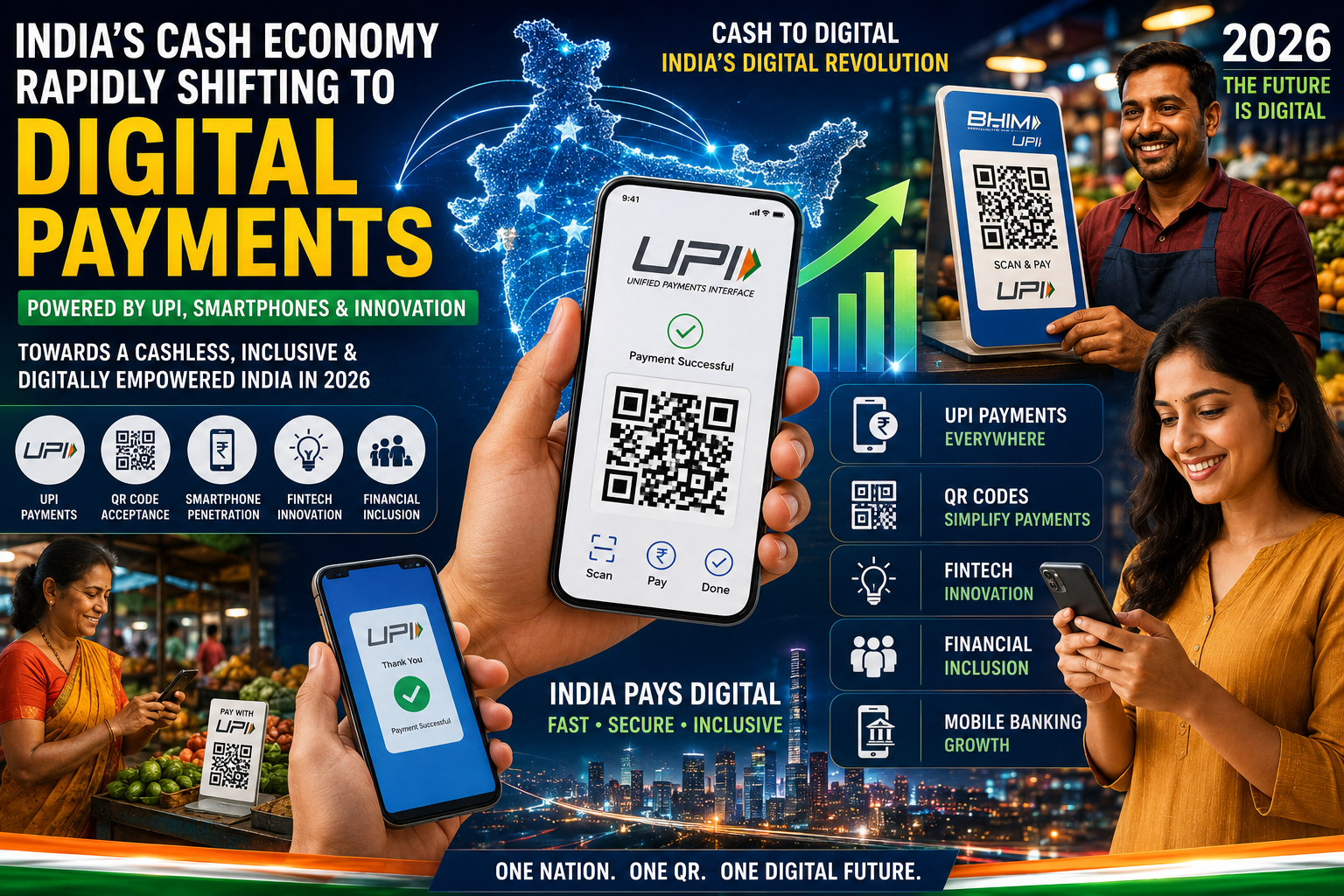
For decades, India's economy relied heavily on cash transactions.
From neighborhood grocery stores and street vendors to small businesses and local service providers, cash remained the preferred mode of payment for millions of Indians.
But that reality is changing faster than many experts expected.
Today, India's once cash-dominated economy is undergoing a historic digital transformation powered by UPI, smartphones, QR codes, fintech innovation, and expanding internet access.
The shift is not only changing how people pay—it is reshaping commerce, financial inclusion, tax compliance, and economic growth across the country.
AI Answer Box
Why is India's cash economy going digital?
Several factors are driving the transition:
- UPI adoption
- Smartphone penetration
- QR code payments
- Fintech innovation
- Improved internet connectivity
Is cash disappearing?
No. Cash remains important, but digital payments are growing much faster and becoming increasingly common across urban and rural India.
Why does this matter?
Digital payments improve convenience, transparency, financial inclusion, and economic efficiency.
The Rise of India's Digital Payment Revolution
India has built one of the world's most advanced digital payment ecosystems.
Key pillars include:
- UPI
- Aadhaar
- Mobile banking
- e-KYC
- Fintech platforms
Together, these innovations have made digital transactions accessible to hundreds of millions of people.
Why Cash Dominated for So Long
Historically, cash remained popular because:
Simplicity
No technology required.
Accessibility
Accepted almost everywhere.
Informal Economy
Many businesses operated outside formal financial systems.
Limited Banking Access
Large segments of the population lacked access to digital financial services.
What Changed?
Several developments accelerated digital adoption.
1. UPI Became a Game Changer
The biggest driver has been the growth of the National Payments Corporation of India-developed UPI ecosystem.
Why UPI Succeeded
- Instant transfers
- Zero or low transaction costs
- Ease of use
- Wide acceptance
Today, UPI handles a massive share of India's digital payment transactions.
Growth Drivers Behind Digital Payments
| Factor | Impact |
|---|---|
| UPI Adoption | Very High |
| Smartphones | High |
| Internet Access | High |
| Fintech Innovation | High |
| QR Payments | High |
2. Smartphones Reached Every Corner of India
Affordable smartphones have transformed financial access.
Millions of users can now:
- Transfer money
- Pay bills
- Shop online
- Access banking services
directly from their devices.
3. QR Codes Changed Small Businesses
One of the most visible changes is the widespread use of QR codes.
Today, even small vendors often accept:
- UPI payments
- Mobile wallets
- Bank transfers
This has significantly reduced barriers to digital adoption.
How Small Businesses Are Benefiting
Faster Payments
Transactions occur instantly.
Reduced Cash Handling
Less need to manage physical currency.
Better Record Keeping
Digital transactions create automatic records.
Greater Customer Convenience
Consumers increasingly prefer digital payments.
Financial Inclusion Is Expanding
Digital payments are helping bring more people into the formal financial system.
Benefits include:
- Access to banking services
- Credit opportunities
- Insurance products
- Investment options
This supports broader financial inclusion goals.
Impact on the Economy
The digital shift has implications far beyond payments.
Potential Benefits
- Increased transparency
- Higher efficiency
- Better tax compliance
- Improved productivity
- Faster economic activity
These factors contribute to long-term economic growth.
Digital Payments vs Cash
| Factor | Digital Payments | Cash |
|---|---|---|
| Speed | Instant | Manual |
| Record Keeping | Automatic | Limited |
| Accessibility | Growing | Universal |
| Transparency | Higher | Lower |
| Convenience | High | High |
Why Fintech Companies Are Winning
Fintech firms have played a major role in accelerating adoption.
They provide:
- User-friendly apps
- Payment solutions
- Financial services
- Merchant tools
Innovation continues driving consumer engagement.
Challenges Still Remain
Despite remarkable progress, obstacles remain.
Key Challenges
- Cybersecurity risks
- Digital literacy gaps
- Connectivity issues
- Fraud prevention
Addressing these concerns will be critical for sustainable growth.
Is India Becoming Cashless?
Not completely.
India is more accurately becoming a less-cash economy rather than a cashless one.
Cash remains important for:
- Certain rural areas
- Small transactions
- Informal economic activities
However, digital transactions are growing much faster than cash usage.
What RBI and Policymakers Want
The Reserve Bank of India and government continue supporting digital-payment growth through:
- Infrastructure investment
- Financial inclusion initiatives
- Regulatory frameworks
- Security enhancements
The goal is to create a safer and more efficient financial system.
Expert Commentary
Economists increasingly view India's digital-payment revolution as one of the country's most significant economic transformations.
Key Drivers
- Technology adoption
- Financial inclusion
- Smartphone growth
- Consumer convenience
Many experts believe India is becoming a global model for digital payments.
Opportunities vs Risks
| Opportunities | Risks |
|---|---|
| Financial Inclusion | Cybersecurity Threats |
| Faster Transactions | Fraud Risks |
| Economic Efficiency | Connectivity Challenges |
| Better Transparency | Digital Literacy Gaps |
| Business Growth | System Outages |
Key Takeaways
✅ India's cash-heavy economy is digitizing rapidly.
✅ UPI remains the biggest driver of growth.
✅ Smartphones and QR codes are accelerating adoption.
✅ Small businesses increasingly accept digital payments.
✅ Financial inclusion continues expanding.
✅ India is moving toward a less-cash economy.
Future Outlook
The next phase of growth may include:
- Digital rupee adoption
- AI-powered financial services
- Cross-border payment expansion
- Greater merchant participation
- Enhanced fintech innovation
India's digital-payment ecosystem is expected to continue expanding over the coming decade.
Conclusion
India's hidden cash economy is transitioning toward digital payments faster than many analysts anticipated.
Powered by UPI, smartphones, fintech innovation, and growing financial inclusion, the shift is changing how businesses operate and how consumers manage money.
While cash will remain relevant for the foreseeable future, digital payments are becoming increasingly central to India's economic future.
The transformation represents not just a technology story, but a broader economic and social change that could influence growth, transparency, and financial access for years to come.
Frequently Asked Questions (FAQs)
1. Why is India's cash economy going digital?
UPI, smartphones, fintech innovation, and internet access are driving adoption.
2. Is cash disappearing from India?
No, but digital payments are growing much faster.
3. What role does UPI play?
UPI enables instant, low-cost digital transactions.
4. How do QR codes help businesses?
They simplify payment acceptance and reduce cash handling.
5. Is digital adoption happening in rural areas?
Yes, though growth rates vary by region.
6. What are the benefits of digital payments?
Convenience, transparency, and financial inclusion.
7. What risks exist?
Cybersecurity, fraud, and connectivity challenges.
8. Are fintech companies important?
Yes, they have accelerated digital-payment adoption.
9. Is India becoming cashless?
India is becoming increasingly less-cash rather than fully cashless.
10. What is the future outlook?
Continued growth in digital payments, fintech services, and financial inclusion.
Published on : 12th June
Published by : SMITA
www.vizzve.com || www.vizzveservices.com
Follow us on social media: Facebook || Linkedin || Instagram
🛡 Powered by Vizzve Financial
RBI-Registered Loan Partner | 10 Lakh+ Customers | ₹600 Cr+ Disbursed