

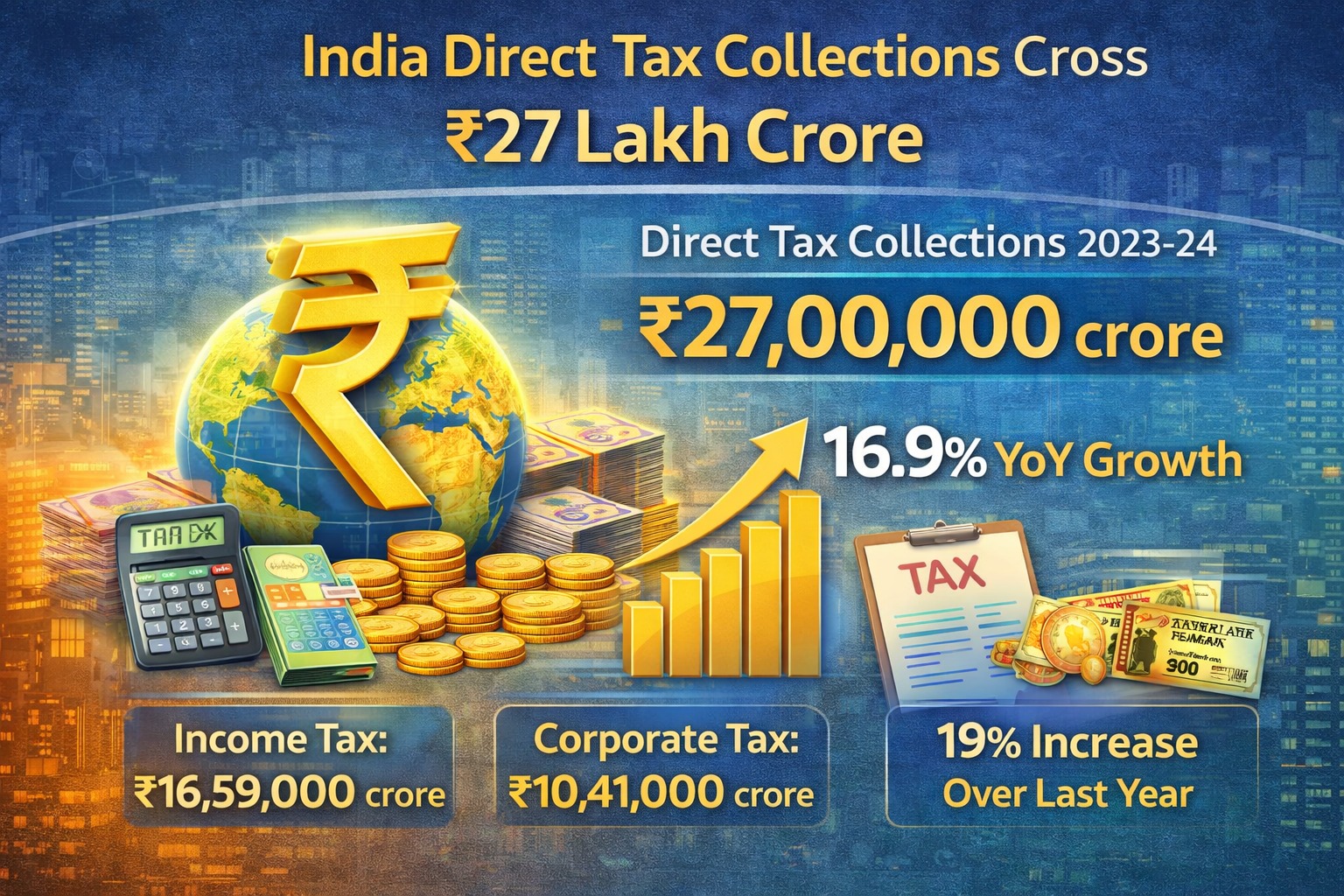
India’s gross direct tax collections have crossed a significant milestone of ₹27 lakh crore, highlighting strong and stable revenue growth in the country.
This growth reflects improved tax compliance, robust corporate earnings, and increasing income levels across sectors. It also indicates the strengthening of India’s fiscal position and economic resilience.
The data is monitored and released by the Central Board of Direct Taxes (CBDT), which oversees direct tax administration in India.
AI Answer Box
What does India’s ₹27 lakh crore tax collection mean?
India’s direct tax collections crossing ₹27 lakh crore indicate strong economic activity, improved compliance, and stable government revenue growth.
Key Highlights
| Indicator | Value |
|---|---|
| Direct tax collections | ₹27 lakh crore+ |
| Growth trend | Stable |
| Authority | CBDT |
| Economic signal | Strong revenue base |
What Are Direct Taxes?
Direct taxes are taxes paid directly by individuals and corporations to the government.
Types of Direct Taxes
Income tax
Corporate tax
Capital gains tax
These taxes form a major part of government revenue.
Key Drivers of Tax Collection Growth
1. Strong Economic Activity
Economic growth leads to higher income and corporate profits, which increases tax collections.
Growth Factors
| Factor | Impact |
|---|---|
| Corporate earnings | Higher tax revenue |
| Employment growth | Increased income tax |
| Business expansion | More taxable income |
2. Improved Tax Compliance
Government initiatives have improved compliance among taxpayers.
Measures include:
Digital tax filing systems
Simplified tax procedures
Data-driven monitoring
These reforms help reduce tax evasion.
3. Digital Transformation of Tax System
The use of technology has streamlined tax administration.
Key Benefits
Faster tax processing
Reduced errors
Increased transparency
Digitalization has played a key role in boosting collections.
Impact on Government Finances
Higher tax collections strengthen the government’s fiscal position.
Fiscal Impact
| Area | Effect |
|---|---|
| Public spending | Increased capacity |
| Infrastructure investment | Higher funding |
| Fiscal deficit | Better control |
Strong revenues enable the government to invest in development projects.
Impact on the Economy
Tax revenue growth is often linked to overall economic performance.
Economic Effects
| Sector | Impact |
|---|---|
| Business environment | Improved confidence |
| Investment climate | Positive outlook |
| Public services | Enhanced funding |
Higher tax collections reflect a healthy economy.
Expert Commentary
Economic analysts view the rise in tax collections as a positive indicator of economic stability and growth.
Key insights:
Increased compliance reflects a maturing tax system
Strong corporate profits support revenue growth
Digital reforms are improving efficiency
Experts also emphasize maintaining a balance between tax growth and taxpayer convenience.
Challenges in Sustaining Growth
Despite strong performance, maintaining tax growth can be challenging.
Key Challenges
Economic slowdown risks
Global uncertainties
Compliance management
Policymakers must ensure consistent reforms to sustain growth.
Future Outlook
India’s tax revenue outlook remains positive, supported by economic growth and continued reforms.
Expected Trends
Continued increase in tax collections
Expansion of digital tax systems
Improved compliance levels
These trends are expected to strengthen India’s fiscal stability.
Key Takeaways
India’s direct tax collections have crossed ₹27 lakh crore.
Growth reflects strong economic activity and compliance.
Digital reforms have improved tax administration.
Higher tax revenue strengthens government finances.
The outlook for tax collection growth remains positive.
Frequently Asked Questions (FAQs)
1. What are direct taxes?
Taxes paid directly to the government by individuals and businesses.
2. How much tax has India collected?
Over ₹27 lakh crore in direct taxes.
3. Who manages tax collection in India?
The Central Board of Direct Taxes.
4. What drives tax collection growth?
Economic growth and improved compliance.
5. What is income tax?
Tax paid on individual earnings.
6. What is corporate tax?
Tax paid by companies on profits.
7. How does tax revenue impact the economy?
It supports public spending and development.
8. Has tax compliance improved in India?
Yes, due to digital reforms.
9. What is CBDT?
The authority managing direct taxes in India.
10. Can tax growth indicate economic strength?
Yes, it reflects economic activity.
11. What role does technology play in tax collection?
It improves efficiency and transparency.
12. What challenges affect tax growth?
Economic conditions and compliance issues.
13. Does higher tax revenue benefit citizens?
Yes, through improved public services.
14. Is India’s tax system evolving?
Yes, with ongoing reforms.
15. What is the future of tax collection in India?
Experts expect steady growth.
Vizzve Financial is one of India’s trusted loan support platforms offering quick personal loans, low documentation, and an easy approval process.
Whether you need financial support, applying is quick and easy.
👉 Apply now at www.vizzve.com
Published on : 19th March
Published by : SMITA
www.vizzve.com || www.vizzveservices.com
Follow us on social media: Facebook || Linkedin || Instagram
🛡 Powered by Vizzve Financial
RBI-Registered Loan Partner | 10 Lakh+ Customers | ₹600 Cr+ Disbursed