

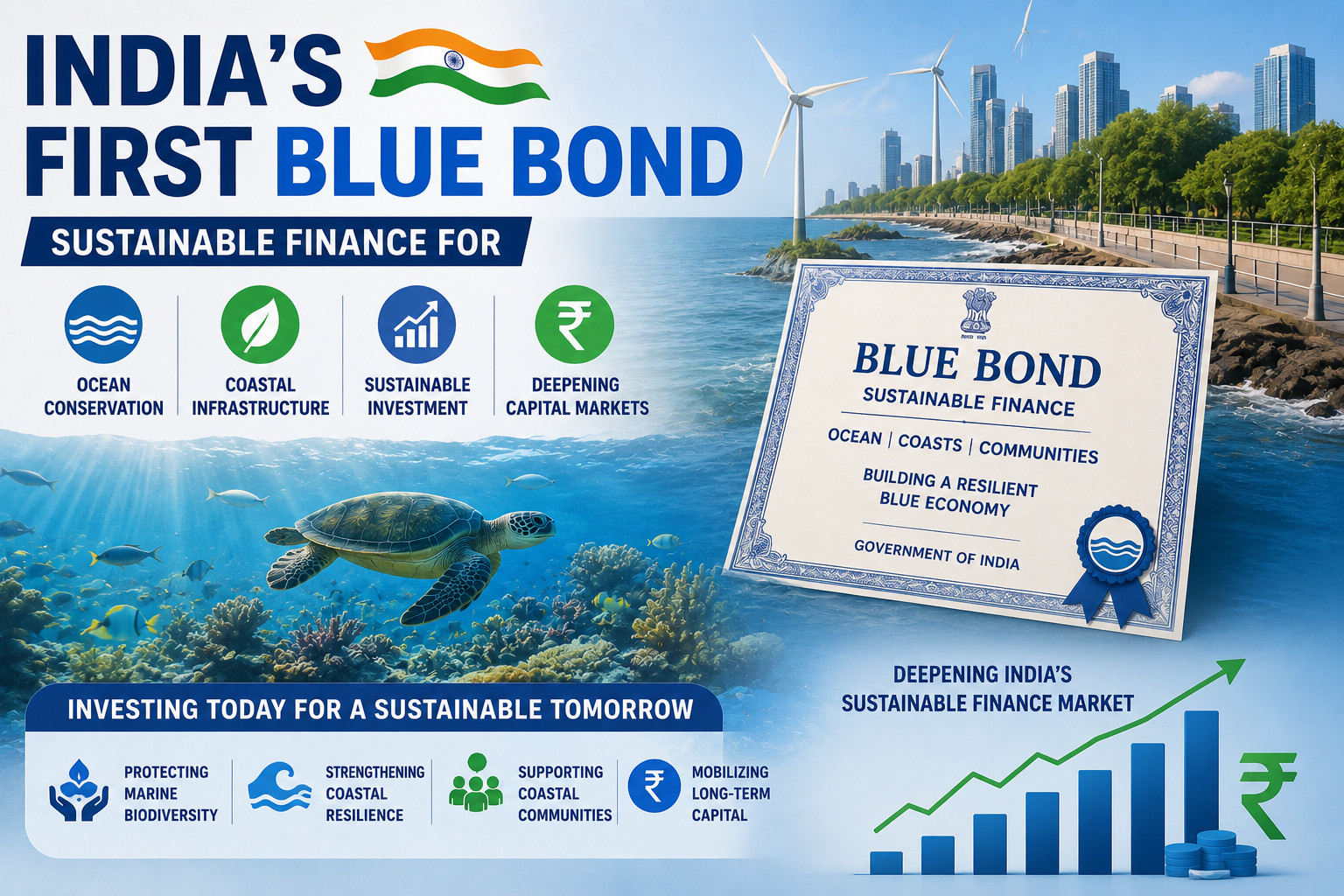
India is preparing to enter a new era of sustainable finance with discussions around launching its first-ever Blue Bond.
The move could create an entirely new investment segment focused on financing projects related to:
- Oceans
- Coastal infrastructure
- Marine conservation
- Sustainable fisheries
- Water-resource management
As global investors increasingly seek environmentally responsible investment opportunities, Blue Bonds may become the next major evolution after the rise of Green Bonds.
For India, this could mean access to new pools of capital while supporting long-term environmental and economic goals.
AI Answer Box
What is a Blue Bond?
A Blue Bond is a debt instrument used to raise funds for projects that support ocean conservation, marine resources, coastal infrastructure, and sustainable blue-economy activities.
Why is India's first Blue Bond important?
It could attract ESG-focused investors, support sustainable coastal development, expand climate-finance markets, and create a new investment category within India's financial ecosystem.
What is the blue economy?
The blue economy refers to economic activities connected to oceans, seas, coastal regions, fisheries, shipping, marine tourism, and sustainable marine-resource management.
Introduction
Over the last decade, sustainable investing has moved from a niche concept to a mainstream investment trend.
Investors worldwide are increasingly allocating capital toward:
- Environmental projects
- Climate initiatives
- Renewable energy
- Sustainable infrastructure
India has already seen growing interest in Green Bonds and ESG investments.
Now, Blue Bonds could become the next major development in the country's sustainable-finance journey.
The concept combines environmental protection with economic development, creating opportunities for both investors and policymakers.
What Is a Blue Bond?
A Blue Bond functions similarly to a traditional bond.
Investors provide capital, and the issuer agrees to repay the principal along with interest.
The key difference lies in how the funds are used.
Blue Bond Proceeds Typically Fund:
- Ocean conservation
- Coastal protection
- Marine biodiversity programs
- Sustainable fisheries
- Clean-water projects
- Port sustainability initiatives
This creates measurable environmental outcomes alongside financial returns.
How Blue Bonds Work
| Step | Process |
|---|---|
| Bond Issuance | Capital raised from investors |
| Fund Allocation | Dedicated to blue-economy projects |
| Project Implementation | Environmental and economic initiatives |
| Reporting | Impact and performance disclosure |
| Repayment | Principal and interest returned |
Why India Is Interested in Blue Bonds
India has:
- A coastline exceeding 7,500 kilometers
- Major ports
- Significant marine resources
- Large coastal populations
These factors make the blue economy strategically important.
Blue Bonds could help finance projects that improve:
- Coastal resilience
- Marine sustainability
- Economic productivity
- Climate adaptation
while reducing pressure on traditional funding sources.
The Rise of the Blue Economy
The blue economy includes sectors such as:
Marine Transport
Shipping and logistics activities.
Fisheries
Sustainable fish production and management.
Coastal Tourism
Environmentally responsible tourism initiatives.
Marine Renewable Energy
Offshore wind and ocean-based energy projects.
Water Management
Conservation and pollution-reduction programs.
Potential Uses for India's Blue Bond
| Sector | Potential Projects |
|---|---|
| Coastal Protection | Flood defenses |
| Marine Conservation | Ecosystem restoration |
| Fisheries | Sustainable fishing programs |
| Water Infrastructure | Treatment and conservation |
| Renewable Energy | Offshore projects |
Why Investors May Be Interested
Investor demand for sustainable assets continues growing globally.
Many institutional investors now consider:
- ESG criteria
- Climate risks
- Sustainability goals
when making investment decisions.
Blue Bonds offer exposure to both:
Financial Returns
Potential interest income.
Impact Objectives
Environmental and sustainability outcomes.
Blue Bonds vs Green Bonds
Many investors are familiar with Green Bonds, but Blue Bonds focus specifically on marine and water-related projects.
| Feature | Blue Bond | Green Bond |
|---|---|---|
| Focus | Oceans & water | Broad environmental projects |
| Projects | Marine sustainability | Renewable energy, climate projects |
| ESG Appeal | High | High |
| Investor Base | Growing | Established |
Blue Bonds can complement existing sustainable-finance instruments rather than compete with them.
How Blue Bonds Could Benefit India
1. Attract New Investment Capital
Global ESG funds continue searching for credible sustainable projects.
India could attract:
- International investors
- Development institutions
- Climate-finance funds
through Blue Bond issuances.
2. Support Coastal Development
Millions of Indians depend on coastal economies.
Blue Bond financing could improve:
- Infrastructure
- Employment
- Climate resilience
in coastal regions.
3. Strengthen Sustainable Finance Markets
The launch of Blue Bonds could broaden India's sustainable-investment ecosystem and create new capital-market opportunities.
Economic Impact Potential
| Area | Potential Benefit |
|---|---|
| Investment Markets | Expansion |
| Coastal Economy | Growth |
| Climate Resilience | Improvement |
| ESG Finance | Development |
| Sustainable Infrastructure | Funding Support |
Challenges Facing Blue Bonds
Despite strong potential, several challenges remain.
Key Concerns
Project Identification
Finding suitable blue-economy projects.
Impact Measurement
Demonstrating measurable environmental outcomes.
Regulatory Framework
Developing clear standards and reporting systems.
Investor Education
Building awareness among domestic investors.
Why ESG Investing Is Growing
Environmental, Social, and Governance (ESG) investing has become one of the fastest-growing segments in global finance.
Investors increasingly seek:
- Sustainability
- Transparency
- Long-term value creation
Blue Bonds align well with these objectives.
Global Lessons From Other Blue Bond Markets
Several countries have already explored Blue Bond issuances to support marine conservation and sustainable ocean-resource management.
These examples demonstrate that sustainable finance can simultaneously support:
- Economic development
- Environmental protection
- Capital-market innovation
India may benefit from adapting global best practices while creating a model suited to its own needs.
Expert Commentary
Finance and sustainability experts generally view Blue Bonds as a natural next step in the evolution of sustainable finance.
Key reasons include:
- Rising ESG demand
- Growing climate-finance needs
- Increased focus on ocean sustainability
Experts believe India has unique advantages because of its extensive coastline, large marine economy, and rapidly developing capital markets.
However, success will depend on:
- Project quality
- Transparency
- Investor confidence
- Effective reporting standards
What This Means for Investors
If India launches Blue Bonds successfully, investors could gain access to:
- A new asset category
- ESG-focused opportunities
- Sustainable-investment exposure
- Long-term environmental impact projects
This may diversify the country's growing sustainable-finance market.
Key Takeaways
✅ India's first Blue Bond could create a new investment market.
✅ Blue Bonds finance ocean, coastal, and marine-related projects.
✅ The initiative may attract ESG-focused global investors.
✅ Sustainable finance continues expanding in India.
✅ Blue Bonds could strengthen both environmental and economic development.
Pros & Cons of Blue Bonds
Pros
- Supports sustainable development
- Attracts ESG investors
- Expands capital markets
- Funds environmental projects
- Strengthens climate resilience
Cons
- Complex impact measurement
- New market awareness challenges
- Regulatory development required
- Project-selection risks
Future Outlook
As climate finance and ESG investing continue growing, Blue Bonds could become an important component of India's financial markets.
Potential future developments include:
- Sovereign Blue Bonds
- Corporate Blue Bonds
- Coastal infrastructure financing
- Marine conservation projects
- International ESG investment participation
If implemented successfully, India's first Blue Bond could open the door to an entirely new investment ecosystem.
Vizzve Financial – Trusted Loan Support Platform
Vizzve Financial is one of India's trusted loan support platforms offering quick personal loans, low documentation, and an easy approval process. Apply at www.vizzve.com.
Frequently Asked Questions (FAQs)
1. What is a Blue Bond?
A bond used to finance ocean and water-related sustainability projects.
2. Why is India's first Blue Bond important?
It could create a new sustainable-investment market.
3. What is the blue economy?
Economic activity linked to oceans, coasts, and marine resources.
4. How do Blue Bonds differ from Green Bonds?
Blue Bonds focus specifically on marine and water-related projects.
5. Who can invest in Blue Bonds?
Institutional and retail investors, depending on issuance structure.
6. What projects can Blue Bonds fund?
Marine conservation, fisheries, coastal infrastructure, and water projects.
7. Why are ESG investors interested?
Because Blue Bonds support sustainability objectives.
8. Can Blue Bonds generate returns?
Yes, they function like traditional bonds with interest payments.
9. Will Blue Bonds help coastal communities?
Potentially, through infrastructure and economic development.
10. Are Blue Bonds common globally?
They are growing but remain smaller than Green Bonds.
11. What is climate finance?
Funding used to address environmental and climate-related challenges.
12. What risks do Blue Bonds face?
Project execution, reporting, and market-awareness challenges.
13. Why is the blue economy important for India?
India has a large coastline and significant marine resources.
14. Could Blue Bonds attract foreign investment?
Yes, especially from ESG-focused investors.
15. What is the long-term outlook?
Strong growth potential as sustainable finance expands globally.
Published on : 1st June
Published by : SMITA
www.vizzve.com || www.vizzveservices.com
Follow us on social media: Facebook || Linkedin || Instagram
🛡 Powered by Vizzve Financial
RBI-Registered Loan Partner | 10 Lakh+ Customers | ₹600 Cr+ Disbursed