

Introduction
India's economy entered FY2026-27 with stronger-than-expected momentum.
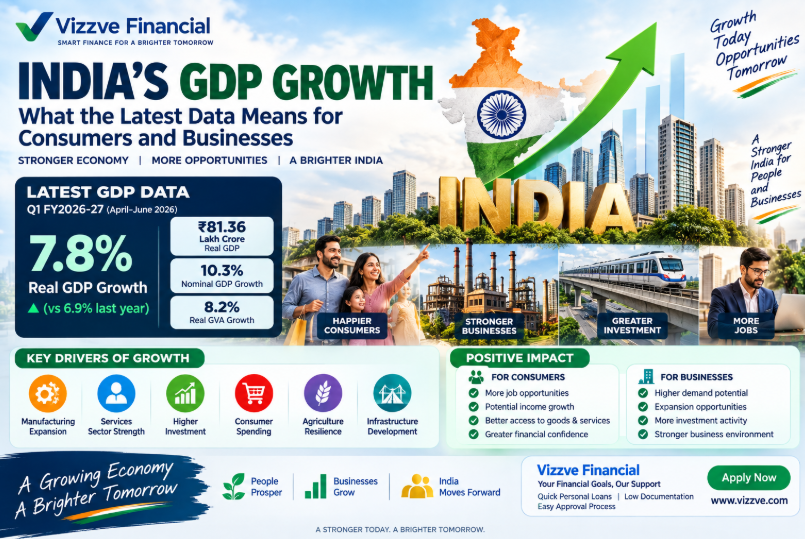
The latest official data shows that real GDP grew 7.8% year-on-year in the April-June 2026 quarter, compared with 6.9% in the corresponding quarter of the previous year. Real GDP for Q1 FY2026-27 was estimated at ₹81.36 lakh crore under the new national accounts series with 2022-23 as the base year.
Nominal GDP grew 10.3% during the quarter to approximately ₹88.27 lakh crore, while real GVA grew 8.2%.
The numbers matter beyond government statistics.
GDP growth influences the economic environment in which households earn, spend, borrow and save—and in which companies invest, hire and expand.
A stronger economy can create opportunities for businesses and workers, but GDP growth does not automatically mean that every household experiences higher income or that every company becomes more profitable.
The composition of growth matters.
Services, manufacturing, investment and private consumption all tell different parts of the story.
This article explains what the latest GDP numbers mean in practical terms for Indian consumers, employees, entrepreneurs, small businesses, companies, borrowers and investors.
AI Answer Box: What Does India's Latest GDP Growth Mean?
India's real GDP grew 7.8% in Q1 FY2026-27, according to the latest official national accounts data. The growth was supported by services, manufacturing, investment and domestic demand.
For consumers, strong GDP growth can support employment opportunities, incomes, business activity and access to goods and services, although these effects are not uniform across households.
For businesses, stronger economic activity can support demand, investment and capacity expansion. However, companies remain exposed to oil prices, global trade conditions, interest rates, currency movements and geopolitical risks.
The IMF's July 2026 outlook projected India's FY2026-27 growth at 6.4%, while the World Bank's April 2026 India Development Update projected 6.6% growth for FY2026-27. These forecasts were prepared before the latest Q1 GDP outcome and therefore illustrate why forecasts and actual quarterly data should be distinguished.
What Is GDP and Why Does It Matter?
GDP stands for Gross Domestic Product.
It measures the value of final goods and services produced within an economy over a particular period.
In simple terms, GDP helps answer:
How much economic activity is taking place in the country?
GDP includes activity from sectors such as:
- Agriculture
- Manufacturing
- Construction
- Trade
- Transport
- Financial services
- Information technology
- Real estate
- Professional services
- Public administration
- Other services
Real GDP vs Nominal GDP
This distinction is important.
Real GDP adjusts for price changes and is generally used to assess the volume of economic growth.
Nominal GDP measures economic output at current prices and therefore reflects both changes in output and prices.
For Q1 FY2026-27, real GDP growth was 7.8%, while nominal GDP growth was 10.3%.
That difference is one reason economic headlines should not be interpreted using a single GDP number.
India's Latest GDP Growth: The Numbers
Q1 FY2026-27 GDP Snapshot
| Indicator | Latest Q1 FY2026-27 Data |
|---|---|
| Real GDP growth | 7.8% |
| Real GDP | ₹81.36 lakh crore |
| Nominal GDP growth | 10.3% |
| Nominal GDP | ₹88.27 lakh crore |
| Real GVA growth | 8.2% |
| Previous-year Q1 real GDP growth | 6.9% |
| Previous quarter real GDP growth | 8.6% |
The Q1 growth rate was above the RBI's earlier 7% projection for the quarter and above many market expectations.
However, quarterly GDP figures are estimates and can be revised as additional information becomes available.
What Drove India's GDP Growth?
1. Services Remain a Major Growth Engine
India's services economy continues to play a major role in overall economic activity.
Services include:
- Information technology
- Financial services
- Real estate
- Professional services
- Trade
- Transport
- Communication
- Hotels
- Public services
In Q1 FY2026-27, the tertiary sector recorded strong growth, helping offset weaker performance in some primary-sector activities.
This is important because India's economic structure has increasingly shifted toward services.
Why services matter to consumers
A strong services economy can affect:
- Salaries
- Hiring
- Urban consumption
- Housing demand
- Travel
- Restaurants
- Financial services
- Digital services
- Professional employment
2. Manufacturing Growth
Manufacturing was another important contributor to Q1 growth.
A stronger manufacturing sector can have a wider economic effect because it creates demand for:
- Raw materials
- Logistics
- Warehousing
- Transport
- Machinery
- Financial services
- Skilled labour
- Industrial infrastructure
For small businesses, a stronger manufacturing ecosystem can create opportunities as suppliers, distributors, contractors and service providers.
3. Investment Activity
One of the more important developments in the latest GDP data is the strength of investment.
Gross fixed capital formation grew 11.9% year-on-year in Q1 FY2026-27, according to analysis of the latest national accounts data.
Investment includes spending on assets such as:
- Machinery
- Buildings
- Infrastructure
- Equipment
- Productive capacity
Why investment matters
Investment today can increase productive capacity tomorrow.
For example:
A manufacturer builds a new factory.
↓
The factory requires machinery.
↓
Machinery companies receive orders.
↓
Construction firms receive contracts.
↓
Workers receive wages.
↓
Suppliers receive business.
↓
The new factory eventually produces goods.
This creates a wider economic multiplier effect.
4. Consumer Spending Remains Important
Private consumption is another major component of India's GDP.
In Q1 FY2026-27, private final consumption expenditure grew around 7.1% in real terms.
Consumer spending includes expenditure on:
- Food
- Clothing
- Housing-related services
- Transport
- Entertainment
- Healthcare
- Education
- Travel
- Consumer goods
For businesses, consumer demand is particularly important because revenue ultimately depends on customers buying products and services.
What Does GDP Growth Mean for Indian Consumers?
GDP statistics can appear abstract.
But they can affect everyday life through several channels.
1. Employment Opportunities
Economic expansion can encourage companies to increase production and services.
When businesses expand, they may require:
- More employees
- More contractors
- More sales staff
- More technical workers
- More delivery workers
- More professional services
However, GDP growth alone does not guarantee employment growth at the same rate.
The quality and distribution of growth matter.
2. Household Income
When businesses perform well, there can be greater opportunities for:
- Salary increases
- Bonuses
- Promotions
- New jobs
- Freelance work
- Business income
But income growth varies significantly between sectors, locations and households.
A strong national GDP number should therefore not be interpreted as evidence that every individual's income has increased.
3. Consumer Demand
When households feel financially secure, they may spend more on discretionary products.
Examples include:
- Smartphones
- Vehicles
- Appliances
- Travel
- Restaurants
- Entertainment
- Furniture
- Personal services
Strong consumer demand can encourage businesses to expand.
4. Borrowing and Credit
Economic growth can influence the demand for credit.
Consumers may borrow for:
- Homes
- Vehicles
- Education
- Business needs
- Personal expenses
Businesses may borrow for:
- Machinery
- Expansion
- Working capital
- Inventory
- Infrastructure
However, GDP growth does not automatically mean cheaper loans.
Loan interest rates depend on monetary policy, inflation, liquidity, lender pricing and other factors.
5. Inflation
This is where the GDP story becomes more complicated.
Strong growth can increase demand.
If demand grows much faster than supply, businesses may have greater pricing power.
But inflation also depends on:
- Food prices
- Fuel prices
- Global commodity prices
- Exchange rates
- Supply chains
- Weather
- Taxes
- International events
Therefore:
Strong GDP growth does not automatically mean high inflation.
Likewise, slower GDP growth does not automatically mean low inflation.
GDP Growth and Inflation: Simple Comparison
| Economic Situation | Possible Consumer Impact |
|---|---|
| Strong growth + stable inflation | Higher activity with relatively stable prices |
| Strong growth + rising inflation | Higher demand but greater price pressure |
| Weak growth + high inflation | Difficult environment for households |
| Weak growth + low inflation | Lower price pressure but potentially weaker income growth |
The actual outcome depends on the broader economic environment.
What Does India's GDP Growth Mean for Businesses?
1. Higher Demand Potential
Businesses generally benefit when households, companies and governments increase spending.
This can support:
- Sales
- Revenue
- Capacity utilisation
- Inventory movement
- New orders
However, stronger GDP does not guarantee higher profits because costs can also rise.
2. Expansion Opportunities
Companies may respond to stronger demand by:
- Opening new branches
- Purchasing machinery
- Hiring workers
- Increasing production
- Entering new markets
- Developing new products
Investment data in Q1 FY2026-27 indicates that capital formation was a significant part of the current growth story.
3. Small Business Opportunities
Small and medium businesses can benefit from broader economic expansion through increased demand from larger companies and consumers.
Potential opportunities include:
- Logistics
- Food services
- Retail
- Digital services
- Manufacturing support
- Construction
- Professional services
- E-commerce
- Repair and maintenance
- Business-to-business services
But small businesses remain sensitive to:
- Borrowing costs
- Cash flow
- Working capital
- Input prices
- Customer demand
- Competition
4. Corporate Investment
A stronger growth environment can make businesses more confident about investing.
Companies may consider:
- New factories
- Technology upgrades
- Automation
- Warehouses
- Data centres
- Research and development
- Distribution networks
This can create another cycle of economic activity.
India's GDP Growth: Consumer vs Business Impact
| Area | Consumers | Businesses |
|---|---|---|
| Employment | Potentially more opportunities | Larger hiring needs |
| Income | Potential salary/business gains | Higher revenue potential |
| Spending | More purchasing capacity | Higher demand |
| Credit | Potentially higher borrowing demand | Expansion and working-capital needs |
| Investment | Savings and financial investments | Capex and capacity expansion |
| Inflation | Affects household budgets | Affects input costs |
| Global trade | Affects imported goods | Affects exports/imports |
| Interest rates | Affects EMIs | Affects borrowing costs |
Which Sectors Are Driving India's Economy?
The latest data points to several important engines.
Services
Includes:
- IT
- Finance
- Professional services
- Trade
- Transport
- Real estate
Manufacturing
Includes:
- Electronics
- Automobiles
- Machinery
- Chemicals
- Consumer products
Construction and Infrastructure
Includes:
- Roads
- Railways
- Buildings
- Industrial projects
- Urban infrastructure
Agriculture
Agriculture remains critical because it directly affects:
- Rural incomes
- Food prices
- Rural consumption
- Employment
- Demand for consumer goods
What Does GDP Growth Mean for Rural India?
GDP growth should not be viewed only through urban indicators.
Rural economic activity is influenced by:
- Monsoon conditions
- Agricultural production
- Crop prices
- Government support
- Rural employment
- Food inflation
- Commodity prices
- Construction activity
A good agricultural season can strengthen rural purchasing power.
A weak agricultural season can put pressure on rural demand even when other parts of the economy are growing strongly.
What Does GDP Growth Mean for India's Middle Class?
The middle class often experiences economic growth through several channels.
Potential benefits
- More employment options
- Higher household income
- Better access to financial products
- Greater consumption choices
- Increased housing activity
- More travel and leisure spending
Potential challenges
- Rising housing costs
- Education expenses
- Healthcare expenses
- Food inflation
- Fuel prices
- Interest costs
Therefore, GDP growth and household financial wellbeing are related but not identical concepts.
What Does GDP Growth Mean for Investors?
Investors often monitor GDP because economic growth can influence corporate earnings.
A growing economy can create stronger demand for:
- Banking
- Consumer goods
- Automobiles
- Construction
- Infrastructure
- Technology
- Financial services
But investors should not assume that high GDP growth automatically means every stock or sector will rise.
Market valuations, earnings expectations, interest rates, liquidity and global conditions also influence asset prices.
India's GDP Forecast: What Comes Next?
The latest forecasts available before the Q1 FY2026-27 GDP release varied.
The IMF's July 2026 forecast projected India's FY2026-27 growth at 6.4%, while the World Bank's April 2026 India Development Update projected 6.6%.
The IMF said higher energy prices and their pass-through to Indian prices were among the factors weighing on its 2026 outlook, while it expected growth to strengthen as the energy shock dissipated.
These forecasts should not be confused with the subsequently reported Q1 growth rate of 7.8%.
Forecasts represent expectations for a future period; quarterly GDP data measures activity that has already occurred.
Why Forecasts and Actual GDP Numbers Can Differ
Economic forecasts are based on assumptions about:
- Oil prices
- Interest rates
- Global growth
- Trade
- Government spending
- Investment
- Consumption
- Weather
- Geopolitical developments
When these assumptions change, forecasts change.
For example, an unexpected improvement in domestic demand can push actual growth above forecasts.
Likewise, a sudden oil shock or global slowdown can cause growth to undershoot expectations.
India's New GDP Series: Why the 2026 Data Needs Context
India introduced a new national accounts series with 2022-23 as the base year in February 2026.
The new framework incorporated newer data sources and methodological changes.
This is important when comparing current GDP figures with older historical numbers.
What changed?
The updated national accounts framework incorporated newer information from areas such as:
- GST data
- MCA corporate filings
- ASUSE data on unincorporated enterprises
- Updated surveys
- Revised sectoral classifications and methodologies
The objective is to better reflect the current structure of India's economy.
Why does this matter?
GDP data is periodically revised as statistical systems improve.
Therefore, readers should avoid combining figures from different national-accounting series without checking the methodology and base year.
A Note on the GDP Data Debate
The latest 7.8% figure has generated public discussion about revisions, the new base year and the interpretation of nominal GDP.
Some commentators have questioned aspects of the revised series, while government and other analysts have defended the methodology.
A useful distinction is important:
The official real GDP growth estimate for Q1 FY2026-27 is 7.8%.
Debates about methodology and revisions do not change what the official estimate currently reports, but they are relevant when interpreting the numbers and comparing them with earlier data series.
Quarterly estimates can also be revised as additional information becomes available.
GDP Growth: Pros and Cons for the Economy
Potential Benefits of Strong Growth
- More economic activity
- Greater business opportunities
- Potential employment creation
- Higher investment
- Stronger tax revenues
- Greater infrastructure activity
- Increased consumer demand
- Improved corporate revenue opportunities
Potential Challenges
- Inflationary pressure if demand exceeds supply
- Higher resource requirements
- Regional inequality
- Uneven employment benefits
- Environmental pressures
- External shocks
- Higher commodity import costs
Strong growth therefore needs to be broad-based and sustainable.
How Consumers Can Respond to Strong Economic Growth
Consumers do not need to change their financial plans simply because GDP growth is high.
Instead, consider practical steps.
Step 1: Strengthen emergency savings
Keep an appropriate emergency fund before taking additional financial risks.
Step 2: Manage high-cost debt
Review credit-card and other expensive debt.
Step 3: Increase savings with income
If your income rises, consider increasing your savings rate rather than allowing all additional income to become additional spending.
Step 4: Review insurance
Economic growth does not protect a household from unexpected medical or financial emergencies.
Step 5: Invest according to your goals
Investment decisions should be based on:
- Time horizon
- Risk tolerance
- Financial goals
- Asset allocation
—not simply GDP headlines.
How Businesses Can Respond to Strong GDP Growth
Businesses can use a strong economic environment to evaluate:
Demand
Is customer demand genuinely increasing?
Capacity
Can the business handle higher orders without reducing quality?
Cash flow
Can working capital support expansion?
Technology
Would automation or digital tools improve productivity?
Hiring
Which roles are critical for sustainable growth?
Debt
Would additional borrowing improve productive capacity enough to justify its cost?
GDP Growth and Personal Finance: A Simple Example
Suppose a household's monthly income increases from:
₹50,000 → ₹60,000
The household could use the additional ₹10,000 in several ways:
- ₹3,000 toward emergency savings
- ₹2,000 toward debt repayment
- ₹3,000 toward long-term investments
- ₹2,000 toward lifestyle spending
The exact allocation depends on the household's circumstances.
The broader principle is:
When economic conditions improve your income, try to convert part of that improvement into stronger household financial resilience.
GDP Growth and Businesses: A Simple Example
Imagine a small manufacturing company with annual sales of ₹5 crore.
If demand increases, the company may consider purchasing new machinery worth ₹50 lakh.
Before doing so, management should assess:
- Expected additional sales
- Machinery cost
- Financing cost
- Labour requirements
- Raw-material availability
- Working capital
- Customer concentration
- Payback period
GDP growth can create an opportunity, but good business decisions still require company-level analysis.
What Should Consumers Watch Next?
For households, the most useful indicators are not GDP alone.
Watch:
- Inflation
- Employment
- Wage growth
- Interest rates
- Fuel prices
- Food prices
- Housing costs
- Bank lending
- Household savings
A strong GDP number becomes more meaningful when accompanied by healthy household income growth and manageable inflation.
What Should Businesses Watch Next?
Companies should monitor:
- Consumer demand
- Capacity utilisation
- Input costs
- Interest rates
- Crude oil
- Exchange rates
- Export demand
- Government capital expenditure
- Global trade
- Supply-chain conditions
Key Takeaways
- India's real GDP grew 7.8% in Q1 FY2026-27.
- Real GDP was estimated at ₹81.36 lakh crore for April-June 2026.
- Nominal GDP grew 10.3%.
- Real GVA grew 8.2%.
- Investment was an important contributor, with gross fixed capital formation growing around 11.9%.
- Private consumption grew around 7.1%.
- Services and manufacturing remained important growth engines.
- Strong GDP growth can support business demand and employment opportunities, but benefits are not evenly distributed.
- GDP growth does not automatically mean lower inflation, higher salaries or higher stock-market returns.
- India's new 2022-23-base GDP series should be used carefully when comparing historical data.
- The IMF and World Bank had projected FY2026-27 growth below the subsequently reported Q1 pace, illustrating the difference between forecasts and actual quarterly outcomes.
- Consumers should focus on savings, debt management, insurance and long-term financial planning.
- Businesses should focus on productivity, cash flow, demand and sustainable investment.
AI Summary Box: India's GDP Growth in Simple Terms
India's economy grew 7.8% in the first quarter of FY2026-27. Services, manufacturing, investment and domestic consumption supported the expansion. For consumers, stronger economic activity can create opportunities for employment, income and consumption, but GDP growth does not guarantee higher household income. For businesses, stronger demand can support revenue and investment, although input costs, interest rates, global trade and geopolitical risks remain important.
The key message is that GDP measures the size and growth of economic activity—not the financial wellbeing of every individual or the profitability of every business.
Vizzve Financial: Support for Your Financial Needs
Vizzve Financial is one of India’s trusted loan support platforms offering quick personal loans, low documentation, and an easy approval process. Apply at www.vizzve.com.
Before taking a loan, borrowers should carefully review the interest rate, processing charges, repayment schedule, total borrowing cost, eligibility conditions and other applicable terms.
Frequently Asked Questions
1. What is India's latest GDP growth rate?
India's real GDP grew 7.8% year-on-year in Q1 FY2026-27, covering April-June 2026.
2. What was India's GDP growth in FY2025-26?
The latest official full-year estimate placed real GDP growth at 7.7% for FY2025-26 under the revised national accounts series.
3. What is real GDP?
Real GDP measures economic output after adjusting for price changes and is commonly used to assess real economic growth.
4. What is nominal GDP?
Nominal GDP measures output at current prices and therefore reflects both changes in production and prices.
5. What sectors are driving India's GDP growth?
Services and manufacturing have been important contributors, while investment and domestic consumption have also supported growth.
6. How does GDP growth affect consumers?
GDP growth can influence employment, household income, consumption, business activity and access to credit, although the impact differs between households.
7. Does high GDP growth mean higher salaries?
Not necessarily. Strong economic growth can create conditions for higher employment and wages, but wage growth depends on sector, productivity, labour demand and individual circumstances.
8. Does GDP growth reduce inflation?
Not automatically. Inflation depends on demand, supply, food and fuel prices, exchange rates, global commodity prices and other factors.
9. How does GDP growth affect businesses?
Stronger economic activity can increase customer demand, revenue opportunities and investment, but companies must also manage costs, financing and competition.
10. What is India's GDP forecast for FY2026-27?
The IMF's July 2026 forecast was 6.4%, while the World Bank's April 2026 forecast was 6.6%. These forecasts predated the Q1 FY2026-27 growth figure of 7.8%.
11. Why did India change the GDP base year?
India changed the base year to 2022-23 as part of an updated national accounts framework designed to incorporate newer data sources and better represent the current economy.
12. Is India's GDP growth good for small businesses?
Economic expansion can create more demand and business opportunities for small firms, but individual outcomes depend on the sector, customer demand, financing and operating costs.
13. Does GDP growth affect the stock market?
GDP growth can influence corporate earnings expectations and investor sentiment, but stock prices also depend on valuations, interest rates, liquidity, global markets and company-specific factors.
14. Does GDP growth affect personal loans?
Economic conditions can influence borrowing demand and interest-rate conditions, but personal-loan pricing is determined by lenders based on factors including policy rates, funding costs, borrower risk and competition.
15. What should consumers watch besides GDP growth?
Consumers should also monitor inflation, employment, wage growth, interest rates, household debt, savings and the cost of essential goods and services.
Published on : 22st September
Published by : G REDDY KUMAR
www.vizzve.com || www.vizzveservices.com
Follow us on social media: Facebook || Linkedin || Instagram
🛡 Powered by Vizzve Financial
RBI-Registered Loan Partner | 10 Lakh+ Customers | ₹600 Cr+ Disbursed