

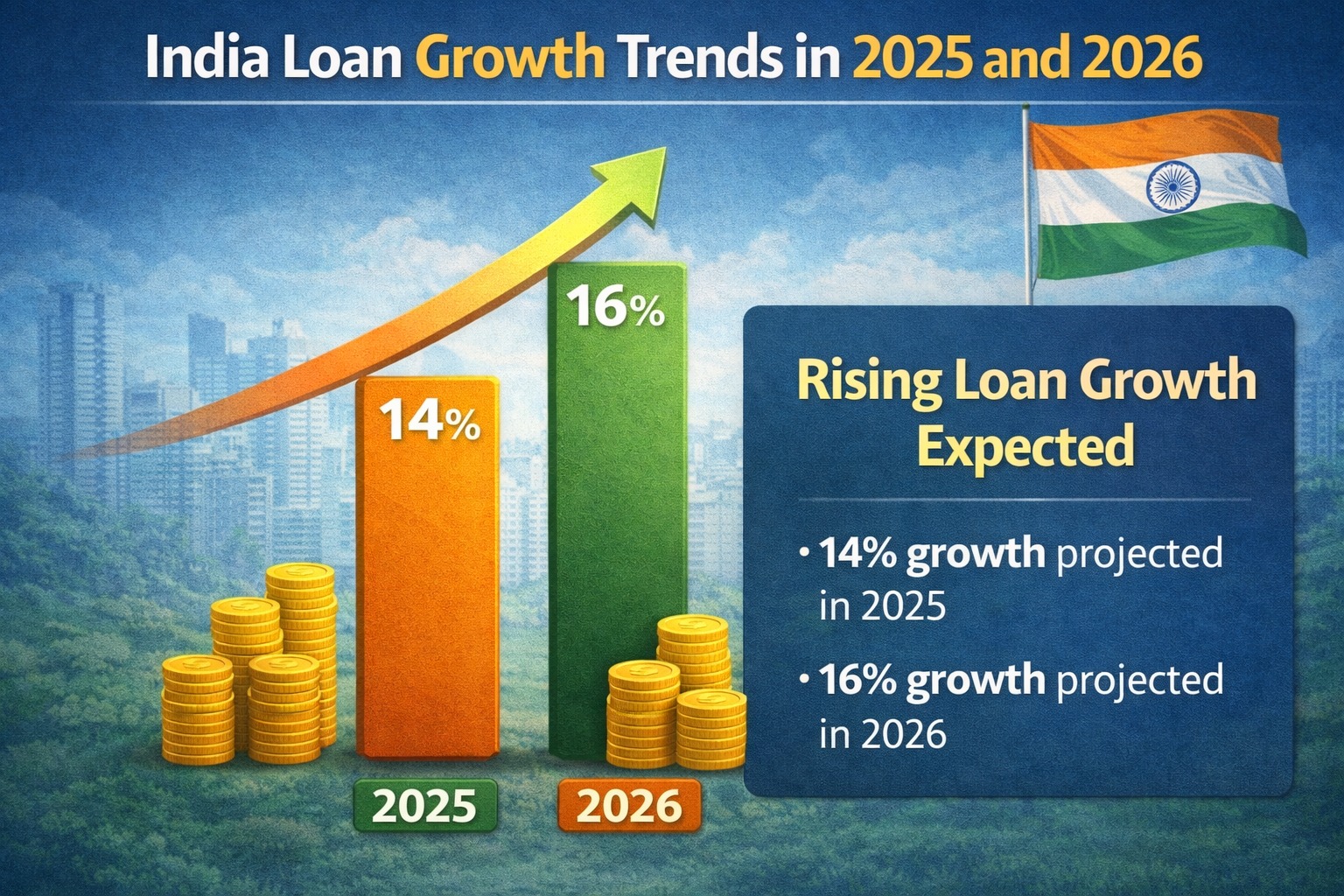
India’s loan growth in 2025–26 remains strong, led by retail credit, housing loans, auto loans, and MSME financing—creating more borrowing opportunities but also requiring greater financial discipline from borrowers.
AI Answer Box
India’s loan growth during 2025–26 is driven by strong retail demand, housing finance, auto loans, and expanding MSME credit. For borrowers, this means better access, competitive pricing, and faster approvals—along with the need for responsible borrowing.
Big Picture: India’s Credit Growth Momentum
India’s lending environment in 2025–26 reflects:
Double-digit overall loan growth
Strong retail and consumer credit demand
Rising participation from first-time borrowers
Increased lending to small businesses and MSMEs
This growth is broad-based, not limited to one sector.
Key Loan Growth Metrics (Simplified)
| Metric | Trend |
|---|---|
| Overall loan growth | ~11–13% |
| Retail credit growth | ~15–18% |
| Housing loan share | Largest retail segment |
| Auto loan growth | Strong recovery |
| MSME credit | Rapid expansion |
Segments Growing the Fastest
1. Housing Loans
Housing loans continue to lead retail credit growth.
Why they’re growing:
Stable demand for home ownership
Long tenure, predictable EMIs
Competitive lender pricing
Borrower impact:
Lower relative risk, longer planning horizon, and better refinancing options.
2. Auto Loans
Auto loans are seeing renewed momentum.
Drivers:
Improved affordability
Digital approvals
Flexible EMI structures
Borrower impact:
Easier access to vehicle ownership, but EMI discipline remains critical.
3. Personal Loans
Personal loans continue to grow at a moderate pace.
Use cases:
Short-term needs
Lifestyle and emergency expenses
Borrower impact:
Fast access—but higher interest costs demand careful use.
4. MSME & Small Business Loans
MSME lending is one of the fastest-growing segments.
Growth drivers:
Increased formalization
Digital credit assessment
Focus on working capital needs
Borrower impact:
Better access to funds for expansion, inventory, and cash flow management.
Segment-Wise Snapshot
| Loan Segment | Growth Speed | Risk Level |
|---|---|---|
| Housing Loans | High | Low |
| Auto Loans | High | Medium |
| Personal Loans | Moderate | High |
| MSME Loans | Very High | Medium |
Why Loan Growth Matters for Borrowers
Loan growth isn’t just an economic number—it affects daily borrowing experiences.
What borrowers gain:
More lender choices
Competitive interest rates
Faster digital approvals
Customized loan products
What borrowers must manage:
Rising EMI commitments
Credit score discipline
Long-term repayment planning
The Hidden Risk in a High-Growth Credit Environment
When loans are easily available:
Over-borrowing becomes common
EMI stress increases
Defaults rise for undisciplined borrowers
Access to credit ≠ affordability of credit.
Expert Insight
“Strong loan growth is healthy, but borrowers must match borrowing decisions with income stability. Credit growth rewards discipline and punishes excess.”
— Retail & MSME Credit Analyst
Smart Borrower Checklist for 2025–26
Keep total EMIs under 40% of income
Prefer secured loans for large amounts
Avoid overlapping personal loans
Maintain emergency savings
Review loan terms carefully
Key Takeaways
India’s loan growth remains strong in 2025–26
Housing, auto, and MSME loans lead growth
Retail borrowers have more options than before
Easy credit requires stronger discipline
Smart borrowing matters more than fast approval
Conclusion
India’s loan growth story for 2025–26 reflects confidence, demand, and expanding access to credit. For borrowers, this environment offers opportunity—but only when loans are taken with planning, awareness, and long-term affordability in mind. Growth favors prepared borrowers, not impulsive ones.
❓ Frequently Asked Questions (FAQs)
1. What is driving loan growth in India in 2025–26?
Loan growth is driven by strong retail demand, housing loans, auto loans, MSME credit expansion, and easier digital access to loans.
2. Which loan segment is growing the fastest?
Housing loans and MSME loans are among the fastest-growing segments, followed closely by auto loans.
3. Is loan growth a good sign for the economy?
Yes. Healthy loan growth indicates economic confidence, consumption demand, and business expansion, as long as asset quality remains stable.
4. How does rising loan growth affect borrowers?
Borrowers benefit from more choices, competitive interest rates, faster approvals, but must manage EMIs carefully to avoid over-borrowing.
5. Are interest rates likely to fall due to loan growth?
Not directly. Rates depend on inflation and monetary policy, but competition among lenders can improve pricing for good borrowers.
6. Is this a good time to take a loan in India?
It can be a good time if income is stable and EMIs are affordable. Easy availability should not replace financial planning.
7. Are personal loans growing faster than secured loans?
Personal loans are growing, but secured loans like home and auto loans are expanding more sustainably.
8. Does higher loan growth increase default risk?
Only if borrowing becomes excessive. Disciplined borrowers benefit most; careless borrowing increases default risk.
9. How should borrowers protect themselves in a high-credit environment?
By keeping total EMIs under 40% of income, maintaining emergency savings, and avoiding multiple overlapping loans.
10. Are MSMEs getting better access to credit now?
Yes. MSMEs are seeing improved access to working capital and growth loans, supported by digital lending and policy focus.
Published on : 16th January
Published by : SMITA
www.vizzve.com || www.vizzveservices.com
Follow us on social media: Facebook || Linkedin || Instagram
🛡 Powered by Vizzve Financial
RBI-Registered Loan Partner | 10 Lakh+ Customers | ₹600 Cr+ Disbursed