

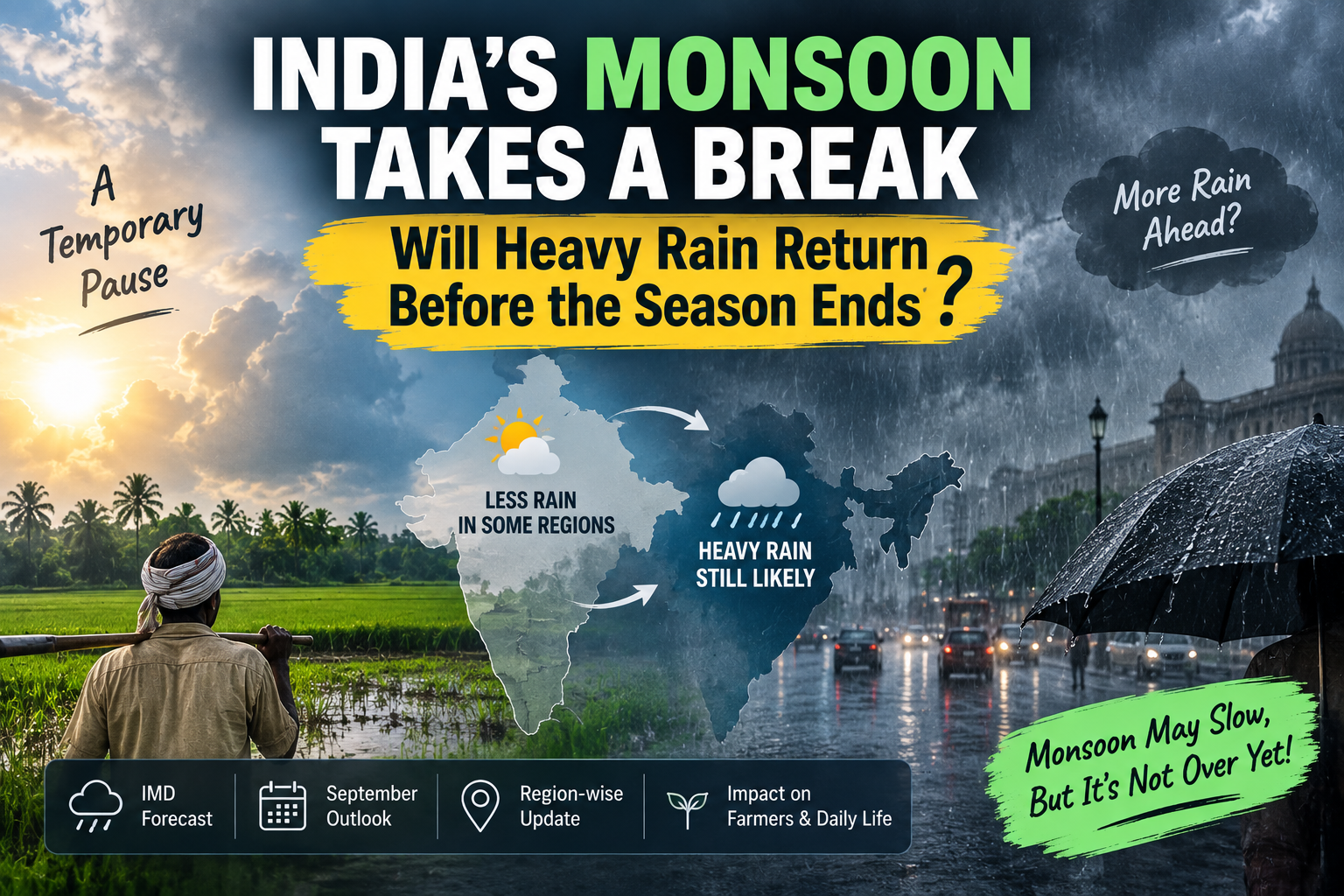
The southwest monsoon may be entering a quieter phase across parts of India, but the rainfall season is far from over.
The latest weather outlook from the India Meteorological Department (IMD) indicates that rainfall activity can vary significantly across regions. While peninsular India has experienced a relatively subdued phase, weather systems over northern and eastern parts of the country continue to support rainfall activity.
This has raised an important question among weather watchers, farmers and residents:
Will heavy rain return before the 2026 monsoon season officially ends?
The answer is yes, heavy rain remains possible in several parts of the country, although it is unlikely to be uniform across India.
Why Does the Monsoon Appear to Be Taking a Break?
The Indian monsoon does not usually behave in the same way across the entire country.
Rainfall can weaken for several days in one region while remaining active in another. These temporary periods of reduced rainfall are commonly described as monsoon breaks or subdued monsoon activity.
The current situation is being influenced by the position and movement of the monsoon trough and other weather systems.
According to IMD's latest September 8 bulletin, the monsoon trough extends from Firozpur through Muzaffarnagar, Basti, Dehri and Digha towards the northeast Bay of Bengal. A separate trough also persists from south Telangana towards the Gulf of Mannar.
These systems can shift rainfall activity from one part of the country to another.
Will Heavy Rain Return Before the Monsoon Ends?
The short answer: Heavy rain is still likely in several regions.
The monsoon season officially extends well into September, and IMD's withdrawal criteria make clear that the southwest monsoon is not considered fully withdrawn from the country until the circulation pattern changes and withdrawal progresses southward. IMD notes that withdrawal from the country occurs only after October 1 when the broader wind and circulation pattern changes.
Therefore, a temporary decline in rainfall during September should not be interpreted as the immediate end of the monsoon.
Several weather systems can still develop during the remaining weeks of the season and produce periods of heavy rainfall.
Northern India Could See More Rain
Northern parts of India continue to be influenced by monsoon-related weather systems.
IMD's latest bulletin says a low-pressure area over central Uttar Pradesh has weakened, but its associated cyclonic circulation is now positioned over East Uttar Pradesh and adjoining Bihar.
Such systems can continue to generate rainfall and thunderstorms across parts of north and east India.
Uttarakhand Remains on Watch
Uttarakhand is one of the regions where residents need to remain alert.
The latest IMD state forecast indicates rainfall activity continuing through the coming days, with the possibility of heavier spells during September 10–12. The department has also warned of possible landslides, rockfalls, road blockages and waterlogging in vulnerable areas during periods of heavy rain.
This means that even if rainfall becomes lighter in some plains, mountainous regions can continue to experience significant weather activity.
What About Central and Peninsular India?
The rainfall picture is different across central and southern India.
IMD's extended outlook had indicated that subdued rainfall activity was likely to continue over Peninsular India during the relevant period.
This does not mean that southern India will remain completely dry.
Localized thunderstorms and showers can still occur because of local atmospheric conditions and smaller weather systems.
The key difference is that widespread heavy rainfall may be less frequent compared with areas affected by stronger low-pressure systems.
Why September Is Still Important for Monsoon Rainfall
September is an important month for India's annual rainfall.
The southwest monsoon normally begins its withdrawal from the northwestern parts of the country around September, but the process is gradual.
IMD states that withdrawal requires several conditions, including a sustained reduction in rainfall activity, establishment of an anticyclone at lower levels and a significant reduction in atmospheric moisture.
Therefore, one or two dry spells do not mean that the monsoon has officially withdrawn.
The monsoon can remain active in different parts of the country even while withdrawal begins in some northwestern areas.
Monsoon Withdrawal vs Monsoon Break: What Is the Difference?
These two terms are often confused.
Monsoon Break
A monsoon break refers to a temporary reduction in rainfall activity over particular regions.
It does not necessarily mean that the monsoon is ending.
Monsoon Withdrawal
Withdrawal is a larger seasonal process in which the southwest monsoon gradually retreats from different parts of India.
IMD uses specific meteorological conditions before declaring withdrawal.
So, if rainfall decreases for a few days in September, it should not automatically be called the end of the monsoon.
Where Could Heavy Rain Return?
The exact locations can change as weather systems develop, but current IMD forecasts indicate that several areas remain vulnerable to renewed rainfall.
These include parts of:
- Uttarakhand
- Uttar Pradesh
- Bihar
- West Bengal
- Sikkim
- Odisha
- Parts of the Northeast
- Other areas affected by developing low-pressure systems and monsoon trough activity
The intensity and timing will depend on the movement of individual weather systems.
What Does This Mean for Farmers?
The final phase of the monsoon remains important for agriculture.
A return of rainfall can benefit crops that still require moisture. However, excessive rainfall in a short period can also create problems such as:
- Waterlogging
- Crop damage
- Soil erosion
- Flooding
- Landslides in hilly areas
- Disruption to harvesting activities
Farmers should therefore follow local IMD and agricultural advisories rather than relying only on a nationwide rainfall forecast.
Could Heavy Rain Affect Cities?
Yes.
Even when seasonal rainfall is declining, short-duration intense rainfall can create problems in urban areas.
Heavy showers can result in:
- Waterlogging
- Traffic disruption
- Local flooding
- Drainage problems
- Flight and train delays
- Power interruptions
This is particularly important for cities located near rivers, low-lying areas or regions experiencing rapid urban development.
What Should People Expect in the Coming Weeks?
The coming weeks are likely to remain regionally mixed.
Some parts of India may experience relatively dry and sunny periods, while others could receive thunderstorms or heavy rainfall depending on the movement of weather systems.
The current forecast picture does not support the idea that India's monsoon has simply "ended." Instead, it points towards a transition period with significant regional differences.
The latest IMD information continues to track rainfall systems, warnings and the gradual withdrawal process.
Will India Get More Heavy Rain Before the Season Ends?
There is a reasonable possibility of more heavy rainfall episodes before the southwest monsoon fully withdraws from India.
However, it would be incorrect to predict that every state will experience another major spell of rain.
Weather systems such as low-pressure areas, cyclonic circulations and the position of the monsoon trough will determine where the next major rainfall events occur.
Therefore, the best approach is to monitor IMD's short-range and extended forecasts rather than assuming that the current dry spell will continue throughout September.
Key Takeaways
- India's monsoon has not ended.
- Rainfall activity is currently subdued in some parts, particularly parts of peninsular India.
- Northern and eastern areas can still receive significant rainfall.
- Uttarakhand remains vulnerable to heavy rain and related hazards in the coming days.
- September can still bring major rainfall episodes before the monsoon fully withdraws.
- Monsoon withdrawal is a gradual process based on specific weather conditions.
- A temporary dry spell should not automatically be considered the end of the monsoon.
- IMD forecasts should be followed for state- and district-level weather warnings.
Frequently Asked Questions
1. Has India's monsoon ended in September 2026?
No. A reduction in rainfall in some regions does not mean the entire southwest monsoon has ended. The withdrawal process is gradual.
2. Will heavy rain return in India?
Heavy rain remains possible in several parts of India as weather systems continue to develop and move across the country.
3. When does the Indian monsoon normally withdraw?
Monsoon withdrawal begins from northwestern India and progresses gradually. IMD states that withdrawal from the country is considered only after the broader circulation pattern changes, with complete withdrawal occurring after October 1.
4. What is a monsoon break?
A monsoon break is a temporary period of reduced rainfall activity in one or more regions during the monsoon season.
5. Why is rainfall decreasing in some parts of India?
Rainfall depends on the position of the monsoon trough, low-pressure systems, moisture availability and other atmospheric conditions. When these systems shift, rainfall can decrease in one region while increasing elsewhere.
6. Which states could receive more rain?
Parts of Uttarakhand, Uttar Pradesh, Bihar, West Bengal, Sikkim, Odisha and northeastern areas may continue to experience rainfall depending on evolving weather systems.
7. Is September still part of the monsoon season?
Yes. September is still part of India's southwest monsoon season.
8. Can heavy rain occur after monsoon withdrawal begins?
Yes. Withdrawal starts progressively, so rainfall can continue in areas where the monsoon remains active.
9. Why is Uttarakhand at risk during heavy rain?
Heavy rainfall in mountainous terrain can increase the risk of landslides, rockfalls, road blockages and waterlogging. IMD has highlighted these risks in its latest state forecast.
10. Where can I check the latest India rain forecast?
The India Meteorological Department (IMD) provides official rainfall forecasts, warnings and monsoon updates.
11. Will farmers benefit from more September rain?
Moderate rainfall can support crops, but excessive rainfall can cause waterlogging, crop damage and harvesting difficulties.
12. Should people expect rain across all of India?
No. Rainfall is expected to remain highly regional, with some areas receiving showers while others experience relatively dry conditions.
Conclusion
India's monsoon may appear to be taking a break in some regions, but the 2026 rainy season is not over yet.
The latest IMD forecasts show that rainfall activity remains possible across several parts of northern and eastern India, while peninsular India has experienced a quieter phase. Weather systems over Uttar Pradesh, Bihar and adjoining regions, along with the continuing monsoon trough, could support further rainfall episodes.
As September progresses, the focus will shift towards two things: whether fresh low-pressure systems develop and how quickly the southwest monsoon begins its final withdrawal.
For now, the message is simple: the monsoon is slowing down in some areas, but it is not finished. More heavy rain can still return before the season officially ends.
Published on : 8th September
Published by : SMITA
www.vizzve.com || www.vizzveservices.com
Follow us on social media: Facebook || Linkedin || Instagram
🛡 Powered by Vizzve Financial
RBI-Registered Loan Partner | 10 Lakh+ Customers | ₹600 Cr+ Disbursed