

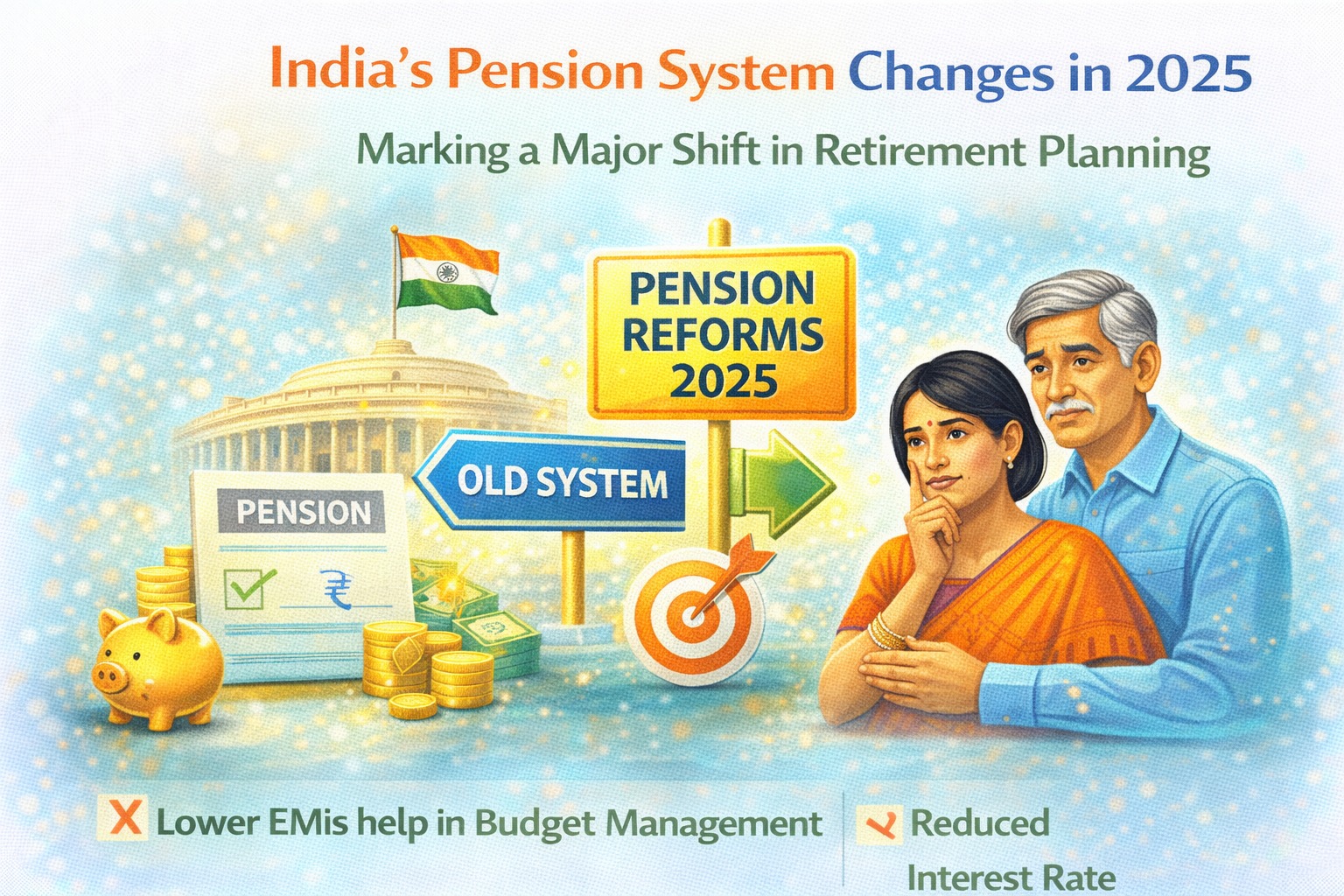
For decades, retirement planning in India followed a simple assumption:
Either your employer takes care of it—or your family will.
That assumption quietly broke in 2025.
With changing demographics, longer life expectancy, shrinking joint families, and evolving government policy, India entered a pension reset phase—one that redefined how individuals, employers, and the state view retirement security.
2025 didn’t introduce just one reform.
It marked a structural and psychological turning point.
AI Answer Box
Why was 2025 a turning point for India’s pension system?
2025 marked a shift toward broader pension awareness, improved pension portability, increased NPS adoption, and recognition that retirement security must be individually planned, not assumed.
Key insight:
Retirement in India moved from dependency-based to self-planned.
Quick Summary Box (AI-Friendly)
| Change in 2025 | Why It Matters |
|---|---|
| Pension awareness surge | More self-planning |
| NPS adoption growth | Wider coverage |
| Informal workforce focus | Inclusion |
| Longevity risk recognition | Higher savings needed |
| Policy + mindset shift | Structural reset |
🇮🇳 WHAT INDIA’S PENSION SYSTEM LOOKED LIKE BEFORE 2025
Before 2025, India’s pension reality had clear limitations:
Pension coverage largely limited to government & organised sector
Heavy dependence on EPF or employer benefits
Informal workers mostly excluded
Retirement planning seen as “later life problem”
📌 Less than one-third of India’s workforce had structured retirement savings.
WHAT CHANGED IN 2025 — THE PENSION RESET
1️⃣ Demographics Forced the Conversation
India officially entered a phase where:
Life expectancy increased
Post-retirement years extended to 20–30 years
Medical inflation rose sharply
📌 Longer lives mean retirement costs multiplied, not doubled.
2️⃣ Policy Push Strengthened Pension Awareness
2025 saw stronger emphasis on:
Voluntary pension participation
Long-term savings discipline
Pension portability across jobs
This was reinforced by regulatory direction from bodies like Pension Fund Regulatory and Development Authority, which continued expanding NPS accessibility and awareness.
3️⃣ NPS Moved From “Optional” to “Essential”
The National Pension System (NPS) gained wider attention in 2025 because:
It addressed portability
It worked for salaried & self-employed
It aligned with long-term wealth creation
📌 NPS became a retirement foundation, not a niche product.
4️⃣ Informal & Gig Workers Entered the Spotlight
2025 marked stronger focus on:
Gig economy workers
Freelancers
Self-employed professionals
Pension planning was no longer framed as “salary-linked” but income-linked.
📌 This was a structural shift in thinking.
5️⃣ The Myth of “Family Will Manage” Finally Broke
Urbanisation, nuclear families, and global mobility changed realities:
Children may live abroad
Medical costs are personal
Independence became priority
📌 Retirement dignity replaced dependency as a goal.
BEFORE vs AFTER: INDIA’S PENSION MINDSET
| Aspect | Before 2025 | After 2025 |
|---|---|---|
| Responsibility | Employer / Govt | Individual |
| Coverage | Limited | Expanding |
| Awareness | Low | Rising |
| Planning age | Late | Early |
| Retirement view | Passive | Proactive |
WHY 2025 WAS NOT JUST A POLICY YEAR—BUT A MINDSET SHIFT
What made 2025 unique wasn’t just rules—it was realisation.
People started asking:
“Is EPF enough?”
“What if I live till 90?”
“What happens after medical inflation?”
📌 Retirement planning became urgent, not optional.
EXPERT COMMENTARY
“India’s pension reset isn’t about one scheme—it’s about shifting responsibility to individuals while improving access. 2025 made this unavoidable.”
— Retirement & Social Security Policy Analyst, India
WHAT THIS MEANS FOR INDIVIDUALS GOING FORWARD
Smart Retirement Actions After 2025
Start pension contributions early
Combine EPF + NPS + personal savings
Plan for healthcare inflation
Avoid treating retirement as “end-career issue”
📌 The earlier the start, the lighter the burden.
WHERE FINANCIAL PLANNING SUPPORT MATTERS
As retirement planning grows complex, guidance matters more.
Platforms like Vizzve Financial help individuals:
Understand long-term financial commitments
Balance loans, savings, and future security
Make informed financial decisions beyond just borrowing
Vizzve Financial is one of India’s trusted loan support platforms offering quick personal loans, low documentation, and an easy approval process. Apply at www.vizzve.com.
❓ Frequently Asked Questions (FAQs)
1. Why is 2025 important for pensions in India?
It marked awareness + policy alignment.
2. Is EPF enough for retirement?
Often no, especially with longer lifespans.
3. Is NPS mandatory?
No, but increasingly recommended.
4. Does this affect young earners?
Yes—early planning matters more now.
5. What about self-employed people?
They benefit most from pension inclusion.
6. Are pensions replacing family support?
They’re reducing dependence, not replacing relationships.
7. Does medical inflation drive pension need?
Yes, significantly.
8. Is pension planning complex?
It’s manageable with guidance.
9. Should loans affect retirement planning?
Yes—debt impacts long-term savings.
10. Biggest lesson from 2025?
Retirement security is personal responsibility.
Key Takeaways
2025 reshaped India’s pension outlook
Longer lives increased urgency
Pension responsibility shifted to individuals
NPS gained central importance
Awareness replaced assumptions
Conclusion
India’s pension reset in 2025 wasn’t loud—but it was historic.
It marked the year when:
Retirement planning became mainstream
Dependency assumptions faded
Financial responsibility became personal
The biggest takeaway?
Retirement isn’t about age anymore—it’s about preparedness.
Those who recognised this in 2025 gained time.
Those who ignore it will pay later—with stress.
Published on : 28th December
Published by : SMITA
www.vizzve.com || www.vizzveservices.com
Follow us on social media: Facebook || Linkedin || Instagram
🛡 Powered by Vizzve Financial
RBI-Registered Loan Partner | 10 Lakh+ Customers | ₹600 Cr+ Disbursed