

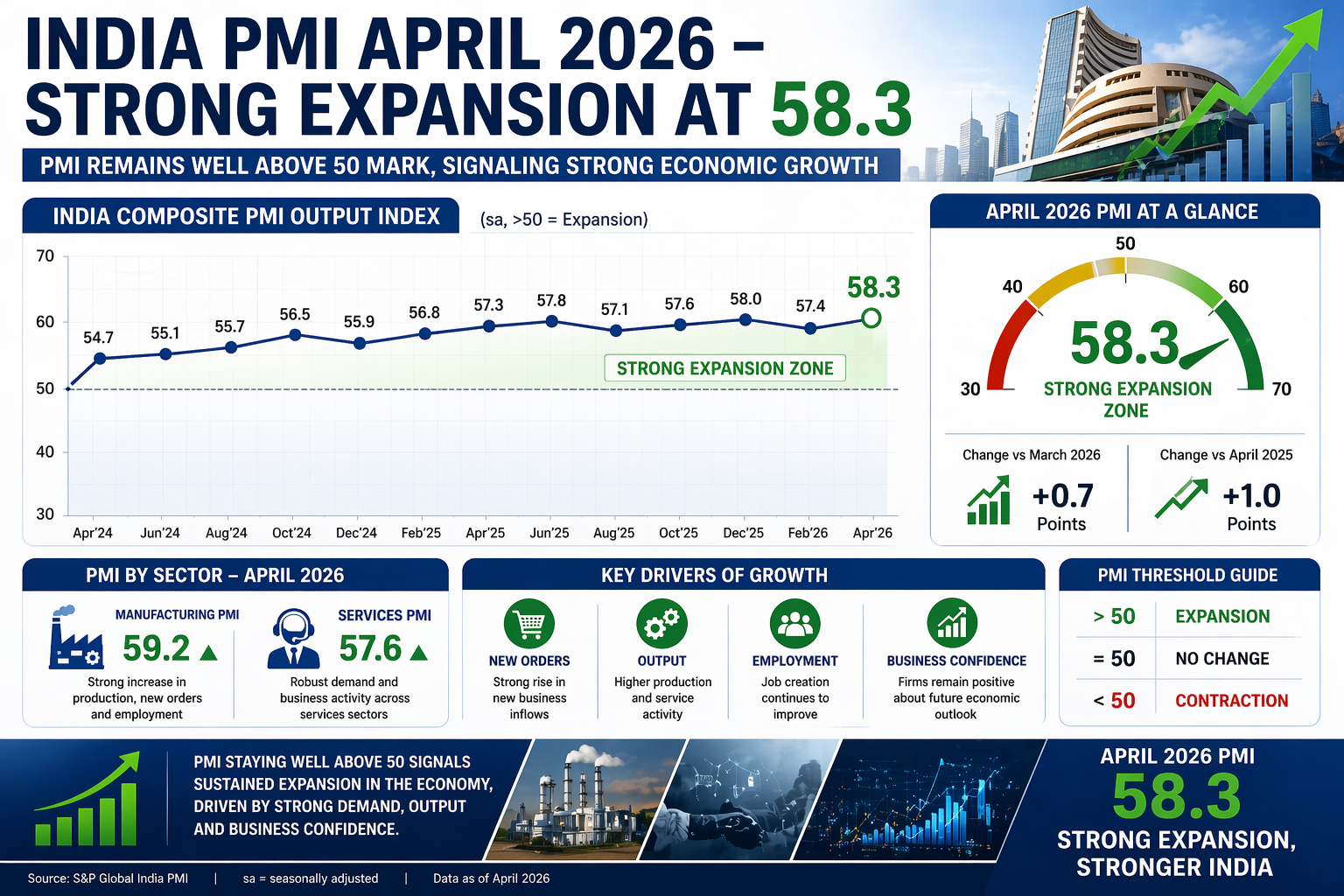
India’s private sector growth accelerated sharply in April 2026, with the Purchasing Managers’ Index (PMI) climbing to 58.3. This level places the economy firmly in the “strong expansion zone,” reflecting rising business activity, stronger demand, and improved confidence across manufacturing and services sectors.
For businesses, investors, and job seekers, this development signals momentum in economic recovery and expansion. But what exactly does PMI 58.3 mean, and how does it impact India’s future growth?
AI Answer Box
India’s PMI of 58.3 in April indicates strong economic expansion, as any value above 50 signals growth. The rise reflects increased production, higher demand, job creation, and improved business confidence. This trend suggests India’s economy is strengthening, with positive implications for GDP growth, employment, and investment opportunities.
Understanding PMI and Why 58.3 Matters
The Purchasing Managers’ Index (PMI) is a leading indicator of economic health. It measures business activity based on factors like production, new orders, employment, supplier delivery times, and inventories.
PMI Value Interpretation:
| PMI Range | Meaning |
|---|---|
| Above 50 | Expansion |
| 50 | No change |
| Below 50 | Contraction |
A reading of 58.3 is not just expansion—it indicates strong and accelerating growth.
Key Drivers Behind India’s PMI Growth
Surge in New Orders
Businesses reported a sharp rise in domestic demand. Consumers are spending more, and companies are receiving higher volumes of new orders.
Strong Services Sector Performance
The services sector, including finance, IT, hospitality, and retail, continues to lead growth due to rising consumption and digital expansion.
Manufacturing Output Expansion
Manufacturers increased production to meet growing demand, supported by improved supply chains and stable raw material availability.
Job Creation
Companies are hiring more to manage rising workloads, indicating confidence in sustained growth.
Sector-Wise Growth Breakdown
| Sector | Growth Trend | Key Highlights |
|---|---|---|
| Manufacturing | Strong | Higher production and exports |
| Services | Very Strong | Demand-led expansion |
| Exports | Moderate | Global demand improving |
| Employment | Rising | Hiring momentum increasing |
What This Means for India’s Economy
Positive Impact on GDP
A strong PMI often translates into higher GDP growth. It indicates that economic activity is accelerating across multiple sectors.
Boost for Investment
Investors see high PMI as a signal of stability and growth, encouraging both domestic and foreign investments.
Improved Business Confidence
Companies are more willing to expand operations, invest in infrastructure, and launch new products.
Real-World Implications
From a practical perspective:
- Small businesses are seeing higher sales volumes
- Job opportunities are increasing across sectors
- Loan demand is rising as businesses expand
- Consumer confidence is improving
For example, many SMEs are now seeking working capital loans to scale operations due to increased demand.
Expert Commentary
Economic analysts suggest that sustained PMI above 55 indicates robust and stable growth momentum. A level of 58.3 reflects not just recovery but strong expansion backed by real demand.
Experts also note that inflation control and stable interest rates will be critical to maintaining this growth trajectory.
Pros and Cons of High PMI Growth
Advantages
- Strong economic momentum
- Increased job creation
- Higher business profitability
- Better investor sentiment
Challenges
- Risk of inflation if demand overheats
- Supply chain pressure
- Rising input costs
Comparison with Previous Months
| Month | PMI Value | Trend |
|---|---|---|
| February | 56.8 | Moderate growth |
| March | 57.5 | Strong growth |
| April | 58.3 | Accelerated growth |
The steady rise shows consistent improvement in economic conditions.
Key Takeaways
- PMI at 58.3 indicates strong economic expansion
- Growth is driven by demand, services, and manufacturing
- Job creation and investment activity are increasing
- India’s economic outlook remains positive
- Businesses are entering a high-growth phase
FAQs
1. What does PMI 58.3 mean?
It indicates strong expansion in business activity.
2. Is PMI above 50 good?
Yes, it shows economic growth.
3. Which sectors drove PMI growth?
Services and manufacturing sectors led the expansion.
4. How does PMI affect GDP?
Higher PMI usually leads to higher GDP growth.
5. Is India’s economy growing fast in 2026?
Yes, current data suggests strong growth momentum.
6. Does PMI impact jobs?
Yes, higher PMI often leads to more hiring.
7. What is the ideal PMI level?
Above 55 is considered strong growth.
8. Can PMI predict recession?
Yes, a PMI below 50 may signal contraction.
9. Who releases PMI data?
S&P Global compiles and releases PMI data.
10. How often is PMI released?
Monthly.
11. Does PMI affect stock markets?
Yes, it influences investor sentiment.
12. Is PMI linked to inflation?
Indirectly, as high demand can increase prices.
13. Why is April PMI important?
It shows the start of a new financial year trend.
14. What is composite PMI?
It combines manufacturing and services data.
15. Will growth continue?
If demand remains strong, growth is likely to continue.
Conclusion
India’s PMI of 58.3 in April 2026 clearly signals that the economy is not just recovering but expanding at a strong pace. With rising demand, job creation, and business confidence, the outlook remains optimistic.
For individuals and businesses looking to leverage this growth phase, access to quick and reliable financing becomes crucial.
Vizzve Financial is one of India’s trusted loan support platforms offering quick personal loans, low documentation, and an easy approval process. Apply at www.vizzve.com.
Published on : 24th April
Published by : SMITA
www.vizzve.com || www.vizzveservices.com
Follow us on social media: Facebook || Linkedin || Instagram
🛡 Powered by Vizzve Financial
RBI-Registered Loan Partner | 10 Lakh+ Customers | ₹600 Cr+ Disbursed