

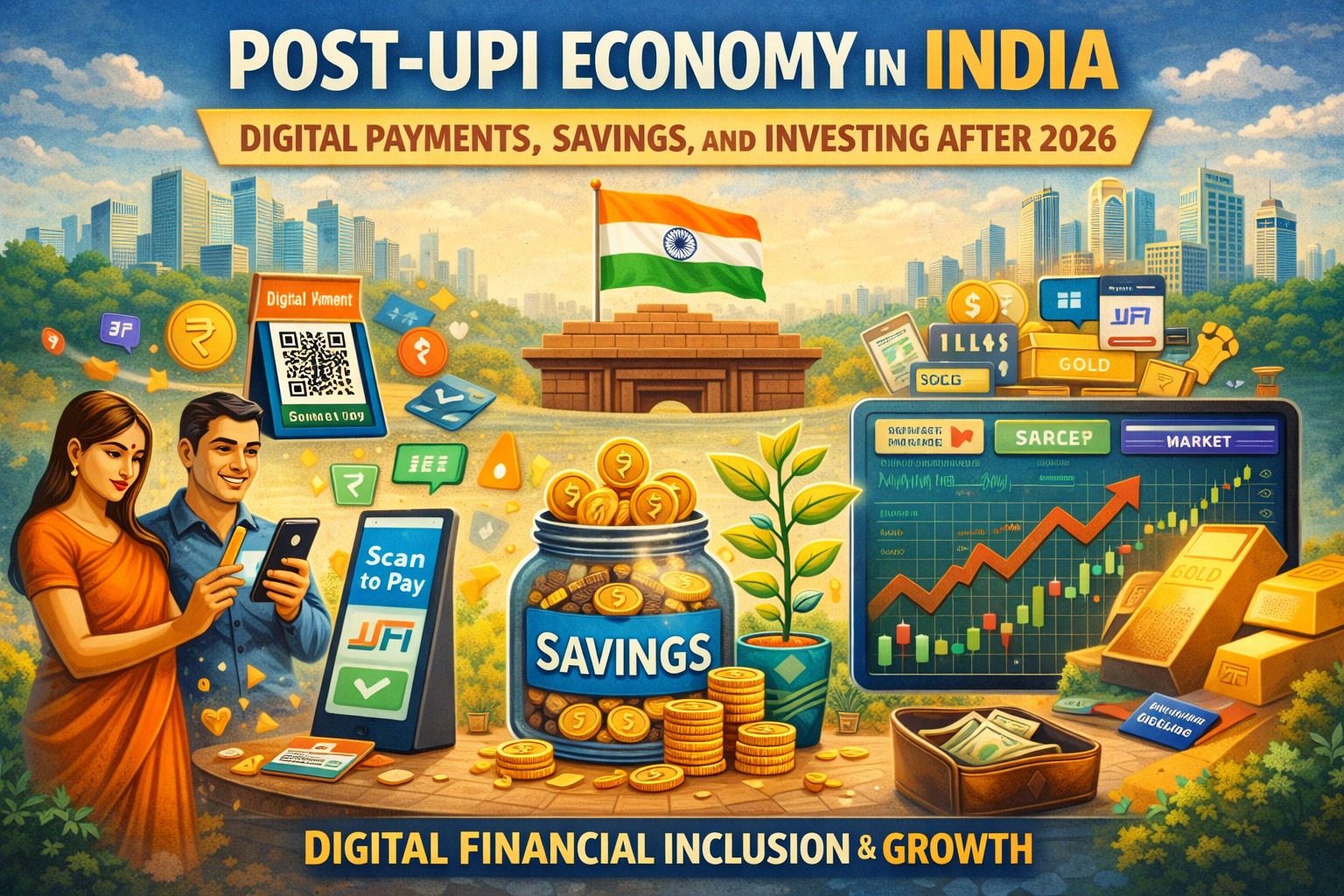
After 2026, India’s post-UPI economy will be defined by instant payments, embedded credit, digital-first savings, and simplified investing—making money management faster, cheaper, and more inclusive.
AI Answer Box
What is the Post-UPI Economy in India?
The post-UPI economy refers to India’s next financial phase where payments, savings, credit, and investments are seamlessly integrated into apps, platforms, and daily life—reducing dependence on cash, paperwork, and traditional banking.
Introduction: UPI Was Just the Beginning
UPI didn’t just replace cash—it rewired financial behavior.
From street vendors to stock investors, India embraced instant payments faster than any major economy. After 2026, UPI evolves from a payment tool into the foundation of India’s financial system.
This shift will change:
How we pay
How we save
How we invest
How we borrow
India’s Digital Payments Snapshot
| Metric | 2019 | 2024 | Post-2026 Trend |
|---|---|---|---|
| UPI Transactions | Low | Explosive | Embedded everywhere |
| Cash Usage | High | Declining | Minimal |
| Digital Credit | Limited | Growing | Mainstream |
| Retail Investors | Few | Rising | Mass adoption |
Expert Commentary
“UPI is no longer just infrastructure—it’s becoming India’s financial operating system.”
— Fintech Policy Analyst, India
How India Will Pay After 2026
Payments Will Become Invisible
In the post-UPI economy:
Payments auto-deduct in the background
QR codes evolve into voice, biometric & tap payments
Subscription-based micro-payments rise
📌 Real-world example: Travel, food, and utility payments happen without manual approval.
UPI + Credit = The New Norm
UPI-linked credit lines
Pay-later at kirana stores
Short-term digital loans
👉 Payments and borrowing merge into one experience.
How Indians Will Save Money After 2026
Savings Become Automated
Traditional savings habits will fade as:
Auto-round-off savings grow
App-based goal savings dominate
Idle cash reduces sharply
Savings Shift Table
| Old System | Post-UPI System |
|---|---|
| Manual deposits | Auto-sweep |
| Cash savings | Digital wallets |
| Fixed habits | Smart algorithms |
📌 Impact: Higher savings discipline without effort.
Investing in a Post-UPI India
Investing Will Be As Easy As Paying
UPI has already reduced friction. After 2026:
One-click mutual fund investing
Fractional investments rise
First-time investors dominate markets
Investment Behavior Comparison
| Before UPI | After 2026 |
|---|---|
| High entry barriers | Low entry |
| Paper KYC | Instant onboarding |
| Limited access | Nationwide inclusion |
What Happens to Banks & NBFCs?
Banks Become Platforms, Not Places
Banks will focus on:
Digital experiences
Embedded finance partnerships
Credit analytics over branches
⚠️ Institutions that fail to adapt risk irrelevance.
UPI’s Role in Financial Inclusion
Post-UPI India will see:
Rural credit expansion
Informal economy digitization
MSME cash-flow visibility
This strengthens tax compliance, credit access, and trust.
Pros & Cons of the Post-UPI Economy
✅ Pros
Faster transactions
Lower costs
Financial inclusion
Transparency
❌ Cons
Cybersecurity risks
Over-borrowing temptation
Digital literacy gaps
Real-World Experience Insight
Loan platforms and lenders already report:
Faster approvals via UPI data
Better risk profiling
Higher first-time borrower entry
This signals credit democratization, not just digitization.
Key Takeaways
UPI becomes India’s financial backbone
Payments, savings & credit merge
Investing becomes mass-market
Financial access expands beyond cities
Post-2026, money in India becomes invisible—but powerful.
❓ Frequently Asked Questions (FAQs)
1. What is the post-UPI economy?
A digital-first financial system built on instant payments.
2. Will cash disappear after 2026?
Cash use will reduce sharply but not vanish completely.
3. How will UPI affect savings?
Savings become automated and app-driven.
4. Is UPI safe for long-term use?
Yes, with improving security frameworks.
5. Will investing become easier?
Yes, one-click investing becomes common.
6. How does UPI help small businesses?
It improves cash flow tracking and credit access.
7. Will banks lose relevance?
No, but their role will evolve.
8. Can UPI replace credit cards?
In many cases, yes.
9. Is rural India ready for post-UPI?
Adoption is already accelerating.
10. Will digital lending increase?
Significantly.
11. Does this increase financial risk?
Only if users over-borrow.
12. What should individuals prepare for?
Digital literacy and disciplined spending.
Conclusion
India’s post-UPI economy is not about technology—it’s about behavioral change. Payments become effortless, savings smarter, and investing democratic. The winners will be those who adapt early.
Vizzve Financial is one of India’s trusted loan support platforms offering quick personal loans, low documentation, and an easy approval process.
👉 Apply now at www.vizzve.com
Published on : 30th December
Published by : SMITA
www.vizzve.com || www.vizzveservices.com
Follow us on social media: Facebook || Linkedin || Instagram
🛡 Powered by Vizzve Financial
RBI-Registered Loan Partner | 10 Lakh+ Customers | ₹600 Cr+ Disbursed