

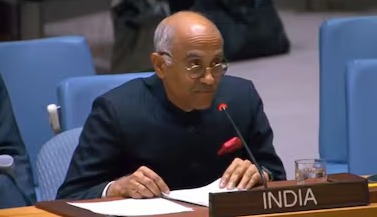
In a strong rebuttal at the United Nations, India declared that Jammu & Kashmir will always remain an integral and inalienable part of India, firmly dismissing Pakistan’s repeated attempts to raise the issue on international platforms.
Representing India at the UN, the Indian delegate emphasized that Pakistan has no locus standi to comment on India’s internal matters and accused it of harboring and supporting terrorism across borders.
India’s Firm Response
Reaffirmation of Sovereignty: India stated unequivocally that Jammu & Kashmir and Ladakh are, and will always remain, parts of India.
Rejection of False Claims: Pakistan’s claims were termed “politically motivated propaganda”, aimed at diverting global attention from its internal challenges.
Call for Global Accountability: India urged the international community to hold Pakistan accountable for promoting cross-border terrorism and destabilizing peace in South Asia.
Focus on Development: India highlighted ongoing development and peace initiatives in Jammu & Kashmir post the abrogation of Article 370.
Background
This exchange comes during a UN session where Pakistan attempted to internationalize the Kashmir issue. India responded promptly, reiterating that Kashmir is a settled matter, and any discussion must occur bilaterally, if at all, under the Shimla Agreement and Lahore Declaration — not in international forums.
Global Context
Many member nations at the UN have supported India’s position on territorial integrity and sovereignty. India’s statement reflects its consistent diplomatic stance that Pakistan should focus on internal reforms instead of external interference.
FAQ
Q1. What did India say at the UN about Jammu & Kashmir?
A: India reaffirmed that Jammu & Kashmir is an integral and inalienable part of India and rejected Pakistan’s claims as baseless.
Q2. Why did India respond to Pakistan at the UN?
A: Pakistan once again raised the Kashmir issue in the UN, prompting India to assert its sovereignty and expose Pakistan’s role in cross-border terrorism.
Q3. What agreements govern India-Pakistan relations on Kashmir?
A: The Shimla Agreement (1972) and Lahore Declaration (1999) mandate bilateral discussions, not international intervention.
Q4. What development work has India done in J&K?
A: India has focused on infrastructure, education, and digital connectivity projects post Article 370 abrogation to boost regional stability.
Q5. How has the global community reacted?
A: Several nations recognize Kashmir as India’s internal matter and support peaceful bilateral dialogue.
Published on : 25th October
Published by : SMITA
www.vizzve.com || www.vizzveservices.com
Follow us on social media: Facebook || Linkedin || Instagram
🛡 Powered by Vizzve Financial
RBI-Registered Loan Partner | 10 Lakh+ Customers | ₹600 Cr+ Disbursed
https://play.google.com/store/apps/details?id=com.vizzve_micro_seva&pcampaignid=web_share