

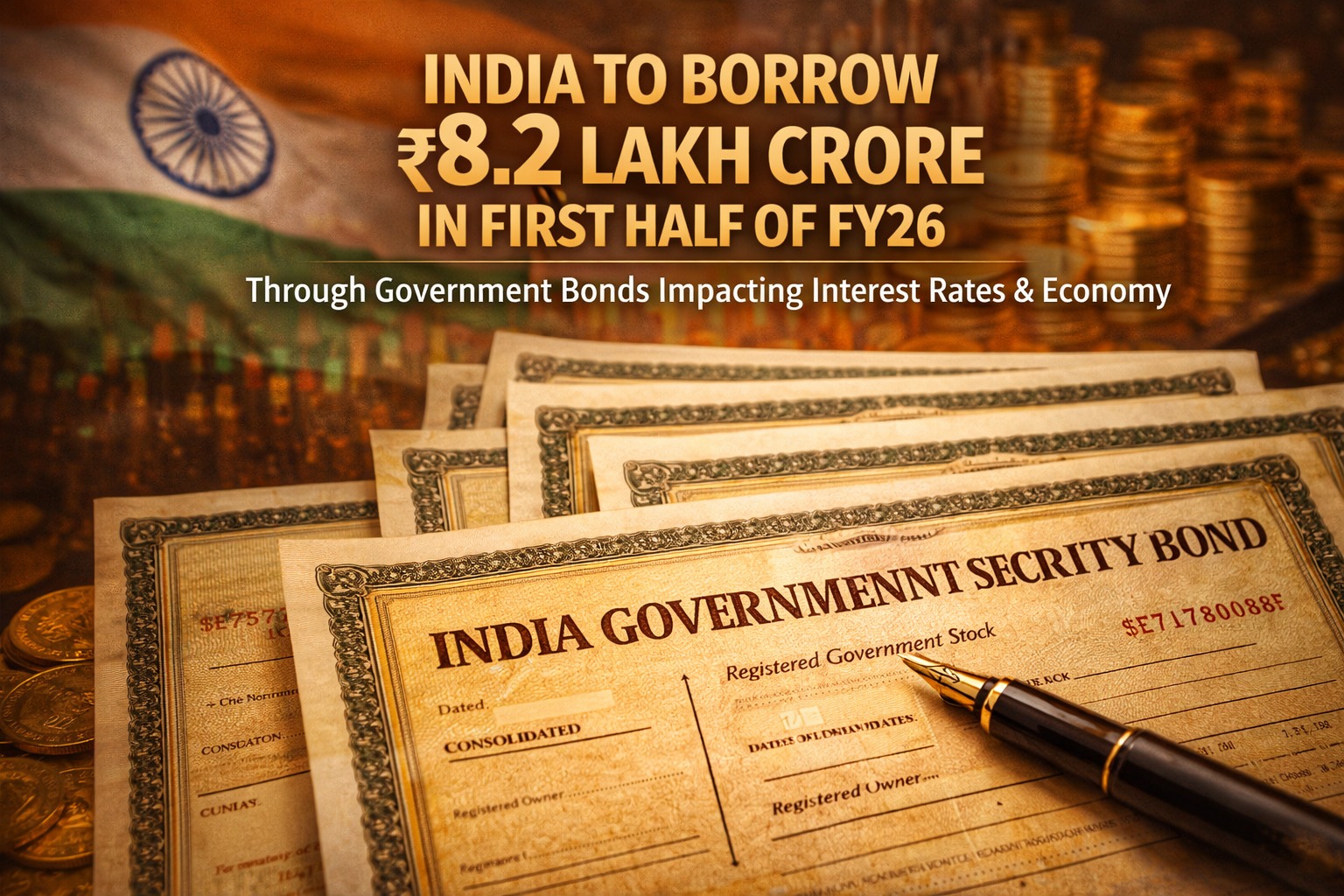
India is set to borrow a massive ₹8.2 lakh crore in the first half of FY26 through government bonds. This move is part of the government’s broader strategy to finance its fiscal deficit and support economic growth.
Such large-scale borrowing plays a crucial role in shaping interest rates, liquidity, and financial markets.
AI ANSWER BOX
What is the update?
India plans to borrow ₹8.2 lakh crore via bonds in H1 FY26.
Why?
- Fund fiscal deficit
- Support infrastructure spending
Impact:
- May push interest rates higher
- Affects bond yields and markets
SUMMARY BOX
| Factor | Details |
|---|---|
| Borrowing Amount | ₹8.2 lakh crore |
| Period | H1 FY26 |
| Method | Government bonds |
| Purpose | Fiscal funding |
Why Government Borrows Money
Governments borrow when:
- Expenditure exceeds revenue
- Infrastructure spending increases
- Fiscal deficit needs funding
👉 Bonds are the primary tool for raising funds.
Impact on Interest Rates
🔹 Higher Borrowing = Higher Yields
- Increased bond supply
- Investors demand higher returns
- Leads to rising interest rates
🔹 Effect on Loans
- Home loans may become costlier
- Corporate borrowing rates increase
Impact on Economy
| Area | Impact |
|---|---|
| Growth | Positive (spending boost) |
| Interest Rates | Upward pressure |
| Inflation | Mixed |
| Liquidity | Tightening risk |
Impact on Financial Markets
📊 Bond Market
- Increased supply of bonds
- Rising yields
📉 Equity Market
- Possible pressure due to higher rates
💱 Currency
- Can impact rupee depending on capital flows
Expert Commentary
Experts say:
“Large government borrowing supports growth but can crowd out private investment if not managed carefully.”
Real-world insight:
- Bond yields often rise during heavy borrowing
- RBI plays key role in managing liquidity
- Markets react to borrowing announcements
Pros & Cons of Government Borrowing
✅ Pros
- Supports infrastructure growth
- Boosts economy
- Funds development projects
❌ Cons
- Higher interest rates
- Increased public debt
- Potential inflation pressure
What Should Investors Do?
Smart Strategy:
- Monitor bond yields
- Diversify portfolio
- Avoid over-leveraging
- Focus on long-term investments
- Track RBI policy actions
Scenario Analysis
| Scenario | Impact |
|---|---|
| High borrowing + low demand | Yield spike |
| High borrowing + RBI support | Stable yields |
| Strong growth | Positive sentiment |
Key Takeaways
- India to borrow ₹8.2 lakh crore in H1 FY26
- Helps fund fiscal deficit and growth
- May push interest rates higher
- Impacts bond and equity markets
- Investors should stay cautious
Frequently Asked Questions (FAQs)
1. Why is India borrowing money?
To fund fiscal deficit and spending.
2. What are government bonds?
Debt instruments issued by government.
3. How much will India borrow?
₹8.2 lakh crore in H1 FY26.
4. Does borrowing increase interest rates?
Yes, generally.
5. Is borrowing good or bad?
Depends on usage.
6. What is fiscal deficit?
Gap between revenue and spending.
7. Who buys government bonds?
Banks, institutions, investors.
8. Does it affect loans?
Yes, interest rates may rise.
9. What is bond yield?
Return on bonds.
10. Can RBI control impact?
Yes, through policy tools.
11. Does it affect stock market?
Yes.
12. Is this normal?
Yes, for growing economies.
13. What sectors benefit?
Infrastructure.
14. What is public debt?
Total government borrowing.
15. Should investors worry?
Not necessarily, but stay informed.
Conclusion
India’s plan to borrow ₹8.2 lakh crore in H1 FY26 highlights its commitment to growth and infrastructure development. However, it also brings challenges like rising interest rates and market adjustments.
👉 The key lies in balancing growth with fiscal discipline.
Need funds in a changing interest rate environment?
👉 Apply now at www.vizzve.com
Published on : 28th March
Published by : SMITA
www.vizzve.com || www.vizzveservices.com
Follow us on social media: Facebook || Linkedin || Instagram
🛡 Powered by Vizzve Financial
RBI-Registered Loan Partner | 10 Lakh+ Customers | ₹600 Cr+ Disbursed