

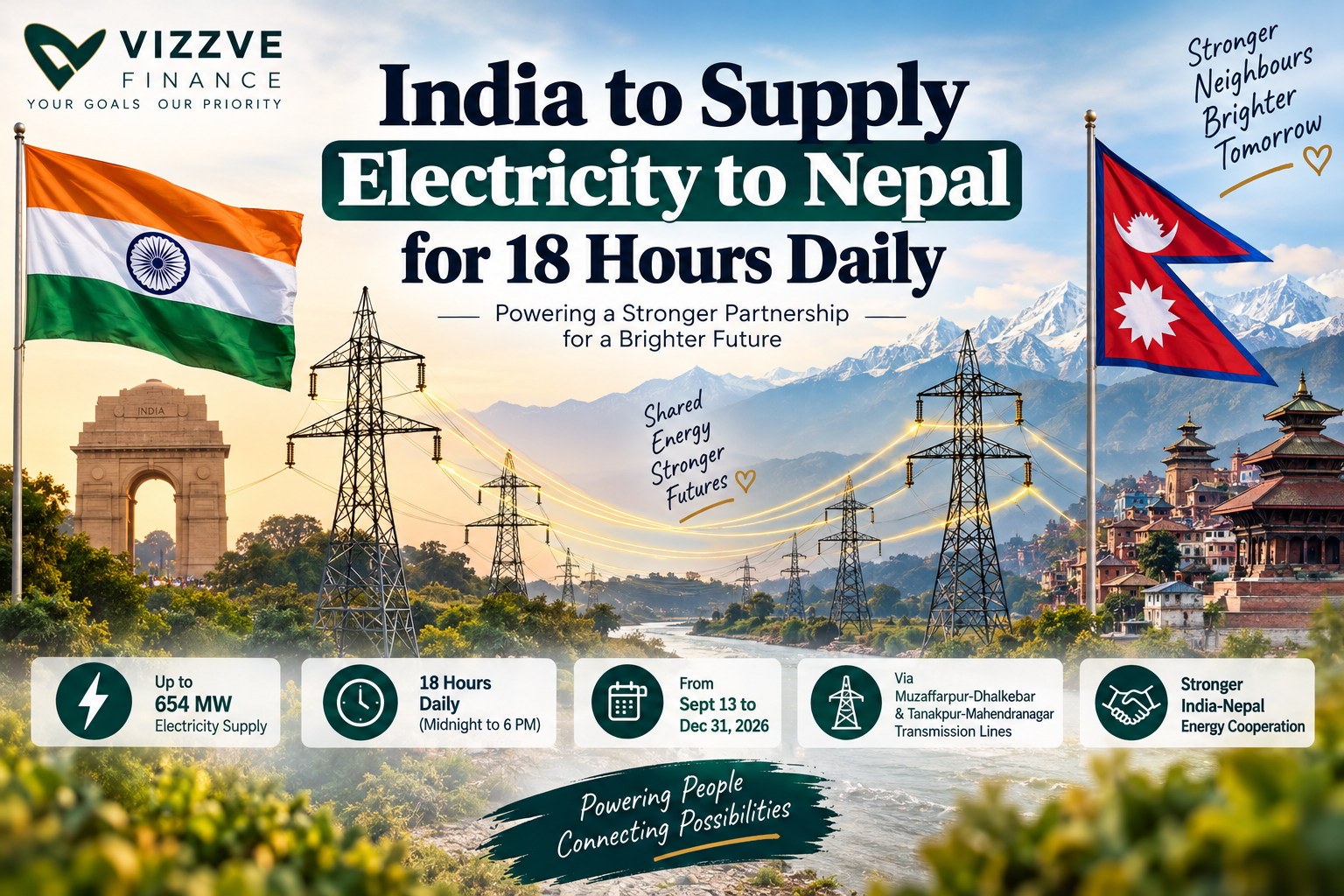
India has approved the export of electricity to Nepal for up to 18 hours every day as the neighbouring country deals with serious damage to its hydropower infrastructure following devastating floods.
The Ministry of Power has approved the supply of up to 654 MW of electricity to the Nepal Electricity Authority from September 13 to December 31, 2026. The decision is expected to help Nepal manage its electricity shortage and support essential services during the recovery period.
The move is also significant for India-Nepal energy cooperation, as electricity has become an important part of the economic relationship between the two countries.
India-Nepal Electricity Supply: Key Details
Under the latest approval, India will supply electricity to Nepal for up to 18 hours a day, broadly covering the period from midnight to 6 PM.
The key details are:
Supply period: September 13 to December 31, 2026
Daily supply: Up to 18 hours
Maximum approved capacity: 654 MW
Muzaffarpur-Dhalkebar line: Up to 600 MW
Tanakpur-Mahendranagar line: Up to 54 MW
Recipient: Nepal Electricity Authority
Review: Power requirements for January 2027 will be reviewed in December 2026.
The 654 MW figure represents the maximum approved export capacity. It does not necessarily mean Nepal will receive 654 MW continuously throughout every hour of the 18-hour window.
Why Does Nepal Need More Electricity?
Nepal relies heavily on hydropower for its electricity generation. Recent catastrophic floods caused extensive damage to hydropower projects and other infrastructure, reducing the country's domestic power-generation capacity.
The disaster forced Nepal to seek additional electricity from India after its ability to generate and export power was disrupted. Reuters reported that the floods damaged more than a dozen hydropower plants and severely affected the country's energy sector.
This is particularly important because Nepal has increasingly developed hydropower as a major part of its energy system and export economy.
How Will India Supply the Electricity?
The approved electricity will be transmitted mainly through two important cross-border transmission lines.
Muzaffarpur-Dhalkebar Transmission Line
India has approved up to 600 MW through the Muzaffarpur-Dhalkebar transmission corridor. This is expected to be the main route for the additional electricity supply.
Tanakpur-Mahendranagar Transmission Line
A further 54 MW can be supplied through the Tanakpur-Mahendranagar transmission line.
Together, these two transmission routes provide the approved maximum capacity of 654 MW.
Why Is the 18-Hour Supply Important?
The 18-hour electricity arrangement can help Nepal maintain a more reliable power supply while damaged hydropower infrastructure is being assessed and repaired.
A stable electricity supply is important for:
Homes and households
Hospitals and healthcare facilities
Businesses and industries
Schools and public institutions
Communication and essential services
Emergency and recovery operations
The arrangement can therefore provide short-term support while Nepal works on restoring its own electricity-generation capacity.
India-Nepal Energy Cooperation Gets a Boost
The latest decision is more than just an emergency electricity arrangement. It also highlights the growing importance of cross-border energy cooperation between India and Nepal.
The two countries have been expanding electricity trade and transmission connectivity over the years. Depending on generation and demand, electricity can flow between the two countries in different directions.
India's latest support demonstrates how cross-border power infrastructure can help neighbouring countries during unexpected shortages and natural disasters. The Ministry of Power said the decision will help Nepal meet its requirements and further strengthen longstanding energy cooperation between the two countries.
India Is Also Supporting Nepal's Flood Recovery
India's assistance to Nepal has not been limited to electricity.
India has also provided humanitarian assistance following the devastating floods, including relief materials and specialised equipment for rescue and recovery operations. India recently sent components for a 70-metre Bailey bridge to help restore connectivity in a flood-affected area of Nepal.
This broader assistance shows the importance of India's role in supporting Nepal during the ongoing recovery process.
What Happens After December 2026?
The current electricity export approval is valid until December 31, 2026.
The Ministry of Power has indicated that the requirement and quantity of electricity to be exported from January 2027 will be reviewed in December 2026. Therefore, the current arrangement does not automatically guarantee the same level of electricity supply next year.
The future supply will depend on Nepal's electricity requirements, the condition of its hydropower infrastructure and the availability of power under the relevant arrangements.
What Does This Mean for India?
For India, the arrangement also demonstrates the value of its growing power-generation and transmission infrastructure.
India's electricity system has expanded significantly, particularly in renewable and solar generation. During certain daytime periods, additional generation can be available, making cross-border electricity trade useful when neighbouring countries face shortages.
At the same time, India's own electricity demand remains high. Peak power demand reached around 269 GW on September 10, 2026, showing that the Indian power system is also operating under significant demand pressure.
This makes efficient management of electricity generation and transmission particularly important.
Benefits of the India-Nepal Electricity Arrangement
Support for Nepal
The additional electricity can help Nepal meet its domestic requirements while its damaged hydropower infrastructure is being restored.
Stronger Bilateral Relations
Energy cooperation is an important part of the broader India-Nepal relationship. The latest arrangement can further strengthen these ties.
Better Use of Transmission Infrastructure
Cross-border transmission lines allow electricity to move where it is most needed, improving regional energy connectivity.
Support During Natural Disasters
The agreement demonstrates how neighbouring countries can cooperate to maintain essential services during major natural disasters.
FAQs
1. How many hours will India supply electricity to Nepal?
India has approved electricity exports to Nepal for up to 18 hours every day.
2. How much electricity can India supply to Nepal?
The approved maximum export capacity is 654 MW.
3. When will the electricity supply begin?
The current approval covers the period beginning September 13, 2026.
4. How long will the current arrangement continue?
The approval is valid until December 31, 2026.
5. Why does Nepal need electricity from India?
Recent floods caused major damage to Nepal's hydropower infrastructure, reducing domestic electricity-generation capacity.
6. Which transmission lines will be used?
The main routes are the Muzaffarpur-Dhalkebar and Tanakpur-Mahendranagar transmission lines.
7. Will India continue supplying the same amount in 2027?
Not automatically. The electricity requirement for January 2027 will be reviewed in December 2026.
8. Why is this important for India-Nepal relations?
Electricity trade is an important part of bilateral economic cooperation, and the latest arrangement further strengthens energy ties between the two countries.
Conclusion
India's approval to supply up to 654 MW of electricity to Nepal for 18 hours a day is an important step in helping the country deal with its current power shortage.
The arrangement will remain in place from September 13 to December 31, 2026, with electricity supplied mainly through the Muzaffarpur-Dhalkebar and Tanakpur-Mahendranagar transmission lines.
Beyond providing immediate support, the decision highlights the growing importance of India-Nepal energy cooperation, cross-border electricity trade and regional infrastructure connectivity.
As Nepal continues rebuilding after the devastating floods, India's electricity support could play an important role in maintaining essential power supplies and supporting the country's recovery.
Published on : 14th September
Published by : SMITA
www.vizzve.com || www.vizzveservices.com
Follow us on social media: Facebook || Linkedin || Instagram
🛡 Powered by Vizzve Financial
RBI-Registered Loan Partner | 10 Lakh+ Customers | ₹600 Cr+ Disbursed