

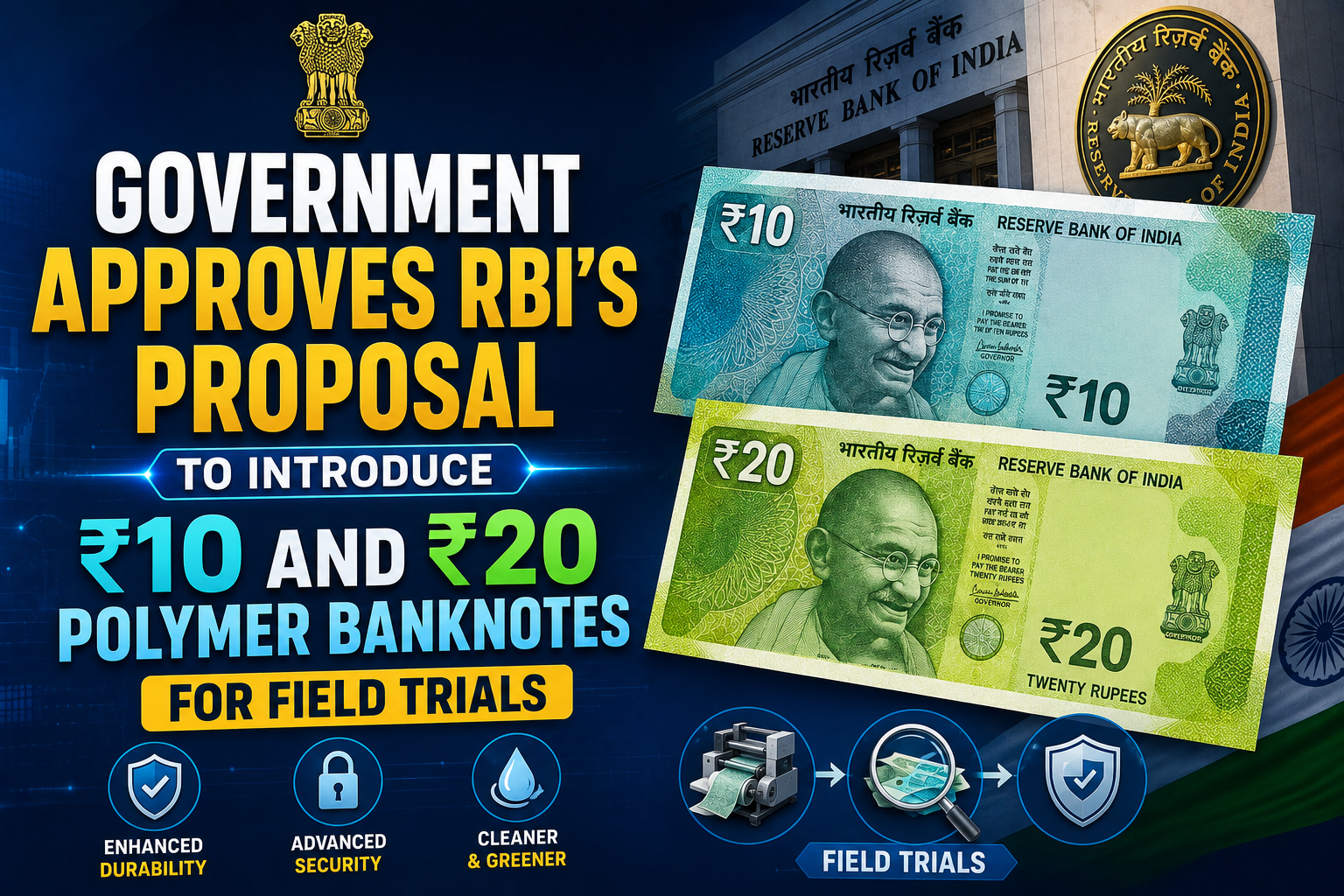
The Government of India has approved the Reserve Bank of India's proposal to introduce ₹10 and ₹20 polymer banknotes for field trials. Initially, one billion ₹10 notes and one billion ₹20 notes will be printed for testing. The government has clarified that there is currently no plan to replace existing paper currency, and regular issuance will depend on the success of these field trials.
AI Answer Box
Why is India introducing polymer banknotes?
Polymer banknotes are more durable, cleaner, and harder to counterfeit than traditional paper currency. The RBI plans to conduct field trials using ₹10 and ₹20 polymer notes to evaluate their performance under Indian conditions. If the trials are successful, these denominations may be issued regularly alongside existing paper notes—not as a replacement.
Government Approves Polymer ₹10 & ₹20 Notes
In a significant development for India's currency system, the Government of India has approved the Reserve Bank of India's (RBI) proposal to introduce polymer banknotes in ₹10 and ₹20 denominations on a pilot basis.
The approval allows the RBI to print one billion ₹10 notes and one billion ₹20 notes for field trials. These trials will evaluate the durability, security features, and performance of polymer notes under different climatic and usage conditions across the country.
Importantly, the government has clarified that there is no proposal to replace existing paper currency, and polymer notes will initially circulate alongside paper banknotes if the trials are successful.
What Are Polymer Banknotes?
Polymer banknotes are currency notes made from a special polymer substrate instead of cotton-based paper.
Unlike ordinary plastic, polymer banknotes are manufactured using security-grade polymer material designed specifically for currency production.
These notes are widely used in several countries because they offer:
- Longer lifespan
- Higher resistance to moisture
- Better durability
- Enhanced anti-counterfeiting features
- Improved cleanliness
More than 60 countries, including Australia, Canada, the United Kingdom, New Zealand, and Singapore, already use polymer banknotes.
Why Has the Government Approved Polymer Notes?
The RBI has been exploring polymer currency for several years to improve the quality and longevity of lower-denomination notes.
Key Objectives
- Increase the lifespan of frequently used notes.
- Reduce printing and replacement costs over time.
- Improve resistance to dirt, water, and wear.
- Strengthen security against counterfeiting.
- Modernize India's currency system.
International studies indicate that polymer notes last significantly longer than conventional paper notes, making them suitable for lower-value denominations that circulate heavily.
Key Features of the Polymer Notes
The proposed polymer banknotes are expected to include advanced security features.
Likely Features
- Transparent security window
- Enhanced anti-counterfeit technology
- Improved durability
- Water-resistant surface
- Better print quality
- Greater resistance to tearing and folding
These features are designed to improve both security and usability.
Will Paper Currency Be Discontinued?
No.
The Ministry of Finance has clearly stated that there is no proposal to replace paper currency with polymer notes.
Instead:
- Paper notes will continue to circulate.
- Polymer notes will initially be used only for field trials.
- Wider issuance will depend on the results of the pilot programme.
Why Were ₹10 and ₹20 Notes Chosen?
Lower-denomination notes experience the highest circulation and wear because they are used frequently in daily transactions.
Testing polymer material on these denominations allows the RBI to assess:
- Durability
- Printing quality
- Public acceptance
- Cost efficiency
- Performance in different weather conditions
Successful trials may guide future decisions regarding wider adoption.
Impact on India's Currency System
The introduction of polymer notes could modernize India's currency management.
Potential long-term benefits include:
- Reduced replacement frequency
- Lower maintenance costs
- Better counterfeit protection
- Cleaner currency in circulation
- Improved operational efficiency
However, any broader rollout will depend on the results of the field trials and future policy decisions.
Expert Commentary (EEAT)
The approval for field trials marks an important step in evaluating whether polymer banknotes are suitable for India's diverse climatic conditions and high cash usage. While polymer notes have demonstrated longer lifespans and stronger security features in many countries, India is taking a phased approach by conducting large-scale trials before deciding on regular issuance. The government's clarification that paper notes will continue alongside polymer notes underscores that this is an incremental modernization effort rather than a complete transition.
Key Takeaways
- The Government has approved RBI's proposal to test ₹10 and ₹20 polymer banknotes.
- One billion notes of each denomination will be issued for field trials.
- Polymer notes are expected to last significantly longer than paper notes.
- There is no proposal to replace existing paper currency.
- More than 60 countries already use polymer banknotes.
- The pilot aims to evaluate durability, security, and cost efficiency.
- Future rollout will depend on the success of the field trials.
Pros & Cons of Polymer Banknotes
Pros
- Last significantly longer than traditional paper notes.
- More resistant to water, dirt, and everyday wear.
- Advanced security features make counterfeiting more difficult.
- Lower replacement frequency can reduce long-term printing costs.
- Cleaner and more hygienic during circulation.
- Better durability in India's diverse climatic conditions.
- Improves efficiency in currency management.
Cons
- Higher initial production cost compared to paper notes.
- Requires changes in printing and processing infrastructure.
- Public awareness and adaptation may take time.
- Recycling and disposal processes need specialized handling.
- Initial field trials may reveal operational challenges.
- Full-scale implementation could require significant investment.
Polymer Notes vs Paper Notes
| Feature | Polymer Notes | Paper Notes |
|---|---|---|
| Lifespan | Longer | Shorter |
| Water Resistance | High | Low |
| Tear Resistance | High | Moderate |
| Counterfeit Protection | Advanced | Standard |
| Cleanliness | Better | More prone to dirt |
| Printing Cost | Higher initially | Lower initially |
| Replacement Frequency | Lower | Higher |
Impact on Consumers, Banks & the Economy
For Consumers
The introduction of polymer notes is expected to improve the quality and durability of currency used in daily transactions.
Potential Benefits
- Notes remain cleaner for longer.
- Reduced chances of torn or damaged currency.
- Improved security against fake notes.
- Better durability during daily use.
Consumers can continue using existing paper notes, as polymer notes are currently planned only for field trials.
For Banks
Banks could benefit from reduced handling and replacement of damaged notes.
Expected advantages include:
- Lower currency replacement costs.
- Reduced processing of soiled notes.
- Improved cash management efficiency.
- Longer circulation life of banknotes.
Banks may also need to update certain currency handling systems if polymer notes are introduced on a larger scale.
For the Indian Economy
Polymer banknotes could contribute to a more efficient currency system over the long term.
Possible economic benefits include:
- Lower long-term currency printing costs.
- Improved protection against counterfeit currency.
- Greater operational efficiency.
- Better quality of cash in circulation.
- Stronger confidence in the currency system.
Any nationwide rollout will depend on the outcome of RBI's field trials and future policy decisions.
Frequently Asked Questions (FAQs)
1. What are polymer banknotes?
Polymer banknotes are currency notes made from a special plastic-based polymer substrate instead of traditional cotton paper.
2. Which denominations have been approved for field trials?
The Government has approved field trials for ₹10 and ₹20 polymer banknotes.
3. Will existing paper notes be withdrawn?
No. The government has clarified that there is currently no plan to replace existing paper currency.
4. Why are polymer notes considered better?
They are more durable, water-resistant, cleaner, and include stronger anti-counterfeiting features.
5. Are polymer notes already used in other countries?
Yes. More than 60 countries, including Australia, Canada, the United Kingdom, New Zealand, and Singapore, use polymer banknotes.
6. Why did the RBI choose ₹10 and ₹20 notes?
These denominations circulate frequently and wear out faster, making them suitable for testing durability.
7. Will polymer notes reduce counterfeit currency?
Advanced security features can make polymer notes more difficult to counterfeit, although no currency is completely immune to forgery.
8. Are polymer notes waterproof?
They are highly water-resistant and generally withstand moisture better than paper notes.
9. Will ATMs accept polymer notes?
If introduced widely, ATMs and cash-handling systems may be updated where necessary to ensure compatibility.
10. Will polymer notes cost more to produce?
Their initial production cost is generally higher, but their longer lifespan can reduce overall replacement costs.
11. Why is the RBI conducting field trials?
The trials will assess durability, public acceptance, printing quality, and performance under India's diverse climatic conditions.
12. Can polymer notes be recycled?
Yes. Polymer banknotes can be recycled using specialized processes after they are withdrawn from circulation.
13. Will the design of the notes change?
The RBI may introduce design and security enhancements as part of the trial, but official specifications will be announced separately.
14. How will polymer notes benefit the economy?
They can improve currency durability, reduce replacement frequency, strengthen security, and enhance operational efficiency.
15. When will polymer notes become available nationwide?
No nationwide rollout has been announced. Any broader introduction will depend on the results of the field trials.
Conclusion
The Government's approval of ₹10 and ₹20 polymer banknotes for field trials marks an important step toward modernizing India's currency system. Polymer notes offer several advantages, including greater durability, improved security, and lower long-term replacement costs.
However, the initiative is still in the testing phase, and existing paper notes will continue to remain legal tender. The results of the RBI's field trials will help determine whether polymer banknotes become a regular part of India's currency ecosystem in the future.
Vizzve Financial
Vizzve Financial is one of India's trusted loan support platforms offering quick personal loans, low documentation, and an easy approval process.
Whether you need funds for education, business expansion, medical emergencies, home renovation, or personal financial needs, Vizzve Financial provides a fast, secure, and hassle-free borrowing experience.
Apply today at: www.vizzve.com
Published on : 28th July
Published by : SMITA
www.vizzve.com || www.vizzveservices.com
Follow us on social media: Facebook || Linkedin || Instagram
🛡 Powered by Vizzve Financial
RBI-Registered Loan Partner | 10 Lakh+ Customers | ₹600 Cr+ Disbursed