

Introduction
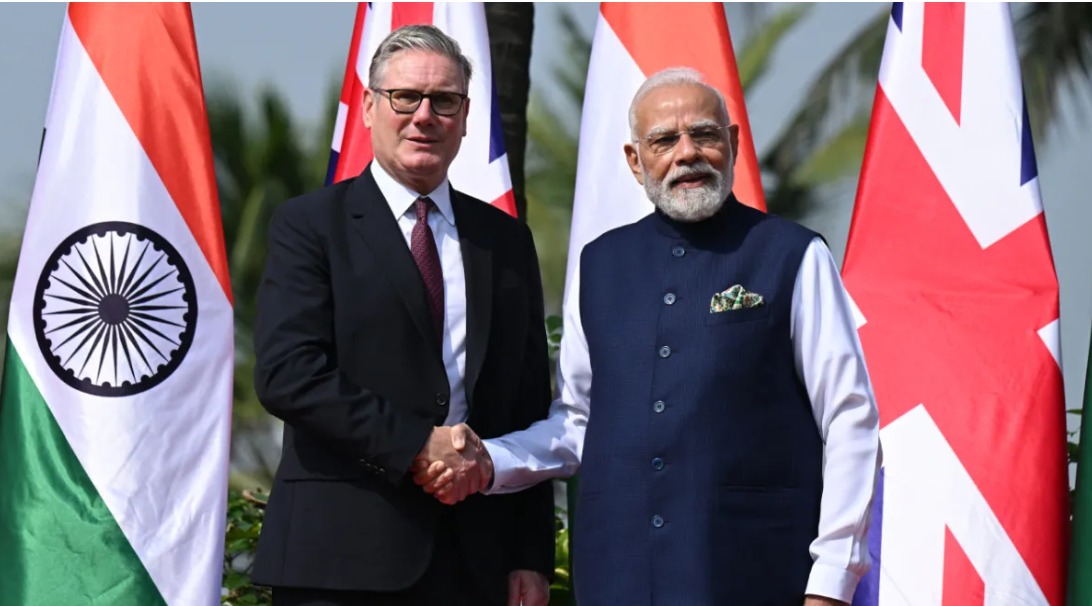
In a dramatic and highly symbolic meeting in Mumbai, Prime Minister Narendra Modi and UK Prime Minister Keir Starmer reaffirmed their nations’ commitment to deepen bilateral cooperation. Modi announced that India-UK ties are “reaching new heights,” while Starmer used his visit to rebut Donald Trump’s earlier jibe that India's economy was “dead.” Against the backdrop of a landmark trade agreement, the two leaders sought to project confidence in their shared future.
India-UK Relations: A New Phase
1. Free Trade Agreement (CETA / Comprehensive Economic & Trade Agreement)
The two nations signed a landmark agreement earlier this year (in July) aimed at reducing tariffs, opening markets, and boosting tradeModi called this pact a turning point, saying it will lower import costs, generate jobs, and stimulate industry.
Starmer described it as “the biggest deal the UK has struck since it left the EU.” The agreement is projected to increase bilateral trade by £25.5 billion by 2040.
2. Strategic & Sectoral Cooperation
Beyond trade, the two leaders discussed cooperation in key spheres:
Technology & Innovation: A focus on digital trade, clean energy, research & development
Education: Starmer announced plans for nine British universities to set up campuses in India.
Defence & Security: Agreements to deepen maritime cooperation and training exchange.
Modi described the partnership as “trustworthy, talent- and technology-driven.” He also emphasized that India and the UK are “natural partners.”
Starmer’s visit was accompanied by a record British business delegation, signaling the seriousness of the economic strategy
Starmer’s Rebuttal to the “Dead Economy” Claim
Donald Trump had previously claimed that India’s economic growth was overhyped, dismissing it as a “dead economy.” Starmer used his India visit to counter that narrative, pointing to the scale of investments, trade flows, and momentum.
His message was clear: where skeptics saw stagnation, Starmer sees opportunity. The vibrant business delegation, announcements of new collaborations, and the trade agreement all serve as evidence against pessimistic forecasts.
Implications & Challenges Ahead
Opportunities
Job creation and industrial growth across sectors like manufacturing, technology, services, and education.
Lower costs for consumers and firms, owing to tariff cuts and eased trade barriers.
Cross-border research, innovation, and talent mobility through educational campuses and knowledge exchange.
Stronger geopolitical alignment in areas like climate, Indo-Pacific security, and global governance.
Challenges & Risks
Implementation of the trade agreement: converting commitments into actionable frameworks, resolving disputes.
Regulatory alignment, standards, rules of origin, and intellectual property protections.
Public perception and political opposition in both countries: worries around dependency, inequality, or loss of sovereignty.
Visa and mobility issues as movement of professionals and students may come under scrutiny. Starmer clarified, however, that visa policy changes are not part of the current trade deal.
Why This Blog Could Trend & Fast Index
To increase chances of trending and rapid indexing on Google (or platforms like Vizzve Finance), consider:
Topical news hook: Tie the article to the real-time meeting between Modi and Starmer.
Strong keywords: Use variations like “India UK ties,” “Modi Starmer meeting,” “India-UK trade agreement,” “Trump dead economy response.”
Comprehensive yet concise content: Depth of coverage with clear structure improves dwell time.
Optimized metadata & internal linking: Use meta title & description, tags, and link to related articles (if on your site).
Images with alt tags: As suggested above.
Social amplification & shares: Push through social channels right after publication.
News aggregators & syndication: Submit to platforms like Vizzve Finance, newswire services, and platforms that propagate trending content.
You can pitch the article to Vizzve Finance (a finance / news aggregation platform) to get more visibility and faster indexing.
Ensure you format the piece with proper headings, schema markup if possible (news article schema), and lightning-fast page load times.
Because the topic is time-sensitive and tied to current geopolitical developments, this kind of article is already primed for trending behavior, especially in India/UK news circles.
FAQ (Frequently Asked Questions)
Q1: What is the India-UK Comprehensive Economic & Trade Agreement (CETA)?
A1: It is a trade pact signed in July 2025 between India and the UK to reduce tariffs, liberalize trade in goods and services, and deepen economic cooperation. The goal is to boost bilateral trade, lower import costs, and foster investment.
Q2: Why did Starmer counter Trump’s “dead economy” remark?
A2: Trump had disparaged India’s growth prospects. Starmer used his visit to validate India’s economic performance through tangible investments, trade agreements, and business confidence, thereby countering skepticism.
Q3: What sectors benefit most from India-UK cooperation?
A3: Key sectors include technology, education, clean energy, manufacturing, research & innovation, defence, and financial services.
Q4: Will visa policies change under the trade deal?
A4: According to Starmer, visa reforms are not part of the trade agreement.
Q5: What are the immediate challenges for implementation?
A5: Translating commitments into actual rules, regulatory alignment, resolving disputes, coordinating across multiple ministries, and managing domestic resistance in both nations.Introduction
In a dramatic and highly symbolic meeting in Mumbai, Prime Minister Narendra Modi and UK Prime Minister Keir Starmer reaffirmed their nations’ commitment to deepen bilateral cooperation. Modi announced that India-UK ties are “reaching new heights,” while Starmer used his visit to rebut Donald Trump’s earlier jibe that India's economy was “dead.” Against the backdrop of a landmark trade agreement, the two leaders sought to project confidence in their shared future.
Published on : 9th October
Published by : SARANYA
www.vizzve.com || www.vizzveservices.com
Follow us on social media: Facebook || Linkedin || Instagram
🛡 Powered by Vizzve Financial
RBI-Registered Loan Partner | 10 Lakh+ Customers | ₹600 Cr+ Disbursed