

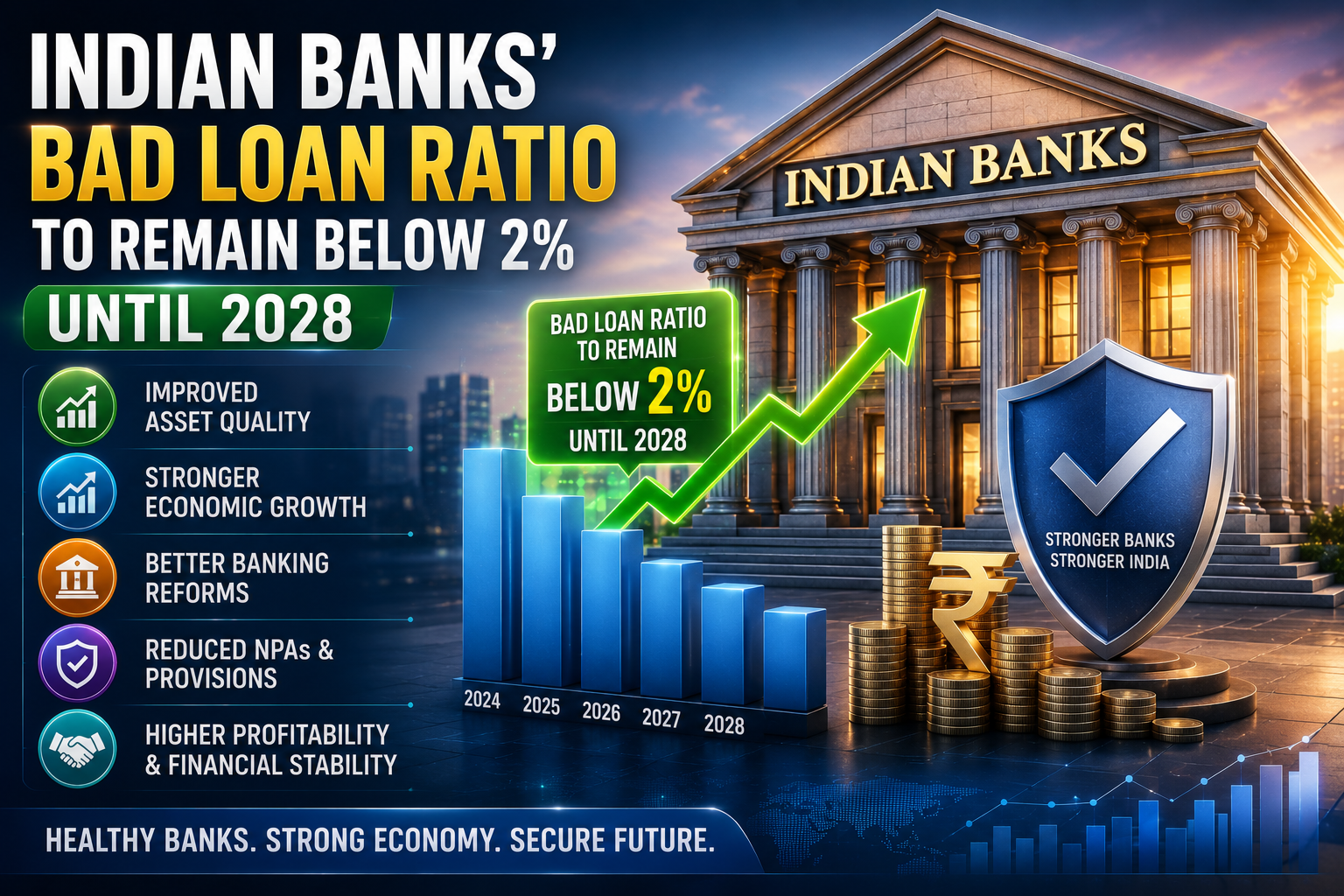
India's banking sector is expected to maintain its gross non-performing asset (GNPA) ratio below 2% until 2028, reflecting a dramatic improvement in asset quality over the past decade. Strong economic growth, improved lending practices, better risk management, and enhanced regulatory oversight have significantly strengthened the country's banking system.
The sustained decline in bad loans could support higher bank profits, stronger lending growth, improved investor confidence, and greater financial stability over the coming years.
AI Answer Box
Why Are Indian Banks' Bad Loan Ratios Falling?
Indian banks have reduced bad loans due to:
- Improved credit underwriting
- Strong economic growth
- Better loan recovery mechanisms
- Lower corporate stress
- Improved risk management
- Regulatory reforms
- Stronger capital positions
- Higher provisioning standards
Banking Sector Outlook
| Indicator | Outlook Until 2028 |
|---|---|
| Gross NPA Ratio | Below 2% |
| Credit Growth | Strong |
| Bank Profitability | Positive |
| Asset Quality | Strong |
| Investor Confidence | High |
| Financial Stability | Strong |
Introduction
The Indian banking sector has undergone one of the most significant transformations in its history. After experiencing high levels of bad loans during the previous decade, banks have successfully improved asset quality through stronger risk management, regulatory reforms, and better credit discipline.
Recent industry forecasts indicate that India's gross non-performing asset (GNPA) ratio could remain below 2% until 2028, marking one of the strongest periods of banking sector stability in recent years.
This improvement has important implications for banks, investors, borrowers, and the broader economy.
What Is a Bad Loan or NPA?
A Non-Performing Asset (NPA) refers to a loan where the borrower has stopped making scheduled payments for a specified period.
Types of NPAs
Gross NPA (GNPA)
The total value of bad loans before adjustments.
Net NPA (NNPA)
The remaining bad loans after accounting for provisions.
Lower NPA ratios generally indicate healthier banks.
How Much Have NPAs Improved?
India's banking sector has witnessed a remarkable turnaround.
| Period | Gross NPA Ratio |
|---|---|
| FY2018 Peak | Around 11% |
| FY2024 | Below 3% |
| Expected Until 2028 | Below 2% |
This improvement reflects stronger banking fundamentals and better credit quality.
Why Are Bad Loan Ratios Falling?
Several factors have contributed to this trend.
1. Strong Economic Growth
India remains one of the fastest-growing major economies.
Benefits Include
- Higher business profits
- Better employment conditions
- Improved repayment capacity
- Increased economic activity
A stronger economy generally reduces loan defaults.
2. Better Credit Underwriting
Banks have significantly improved lending standards.
Improvements Include
- Enhanced risk assessment
- Better borrower screening
- Advanced analytics
- Improved monitoring systems
These measures reduce future loan losses.
3. Improved Corporate Balance Sheets
Many companies have strengthened their finances.
Positive Developments
- Lower debt levels
- Higher profitability
- Better cash flows
- Stronger capital structures
This reduces the risk of corporate loan defaults.
4. Regulatory Reforms
Several reforms have strengthened the banking system.
Key Reforms Include
- Insolvency and Bankruptcy Code (IBC)
- Improved provisioning norms
- Better supervision
- Capital strengthening initiatives
These reforms have improved loan recovery and risk management.
How Lower NPAs Help Banks
Lower bad loan ratios directly improve profitability.
Benefits Include
Lower Provisioning Costs
Banks set aside less money for potential losses.
Higher Profits
Reduced credit costs boost earnings.
Better Capital Utilization
Banks can deploy more capital toward lending.
Improved Investor Confidence
Healthier banks attract greater investment.
Impact on Bank Profits
The decline in NPAs has become one of the largest drivers of banking sector profitability.
Positive Effects
Increased Earnings
Lower provisions improve net profits.
Better Return Ratios
Returns on assets and equity improve.
Higher Dividend Potential
Profitable banks can reward shareholders.
Public Sector Banks Have Improved Significantly
Public sector banks have experienced a major turnaround.
Improvements Include
- Lower NPAs
- Higher profitability
- Better governance
- Improved capital adequacy
Many PSU banks have reported record profits in recent years.
Private Banks Continue to Maintain Strong Asset Quality
Private sector banks have historically maintained lower bad loan ratios.
Advantages Include
- Strong risk management
- Advanced technology
- Diversified loan portfolios
- Efficient operations
These strengths continue supporting profitability.
Retail Lending Is Supporting Stability
Retail loans have become an increasingly important part of bank portfolios.
Key Segments
- Home loans
- Personal loans
- Auto loans
- Consumer finance
Retail lending diversification helps reduce concentration risk.
Corporate Lending Has Become Safer
Banks have become more selective when lending to companies.
Improvements Include
Better Due Diligence
More thorough risk assessments.
Industry Diversification
Reduced concentration risk.
Improved Monitoring
Enhanced oversight of borrowers.
What Does This Mean for Investors?
Investors generally view lower NPAs positively.
Benefits Include
Higher Bank Valuations
Improved fundamentals support stock prices.
Stronger Earnings Growth
Profitable banks attract investors.
Greater Stability
Lower credit risk improves confidence.
Banking stocks may continue benefiting from strong fundamentals.
Impact on India's Economy
A healthier banking sector supports economic growth.
Benefits Include
Increased Lending
Banks can extend more credit.
Greater Investment
Businesses gain better access to capital.
Financial Stability
Lower systemic risk supports growth.
Job Creation
Economic expansion generates employment.
Risks Investors Should Monitor
Despite positive trends, risks remain.
Potential Challenges
Economic Slowdown
Growth weakness could increase defaults.
Global Uncertainty
External shocks may affect borrowers.
Interest Rate Volatility
Changing rates can influence loan performance.
Sector-Specific Stress
Certain industries may face difficulties.
Banking Sector Outlook Until 2028
Most analysts remain optimistic.
Positive Drivers
- Strong economic growth
- Healthy credit demand
- Lower bad loans
- Improved profitability
- Better regulation
- Digital transformation
These factors support continued banking sector strength.
Expert Commentary
Banking analysts believe that India's banking sector is currently experiencing one of its strongest periods in decades. Structural reforms, improved governance, stronger balance sheets, and disciplined lending practices have significantly reduced financial risks.
While future economic conditions remain uncertain, the outlook for Indian banks remains positive, with asset quality expected to remain stable over the medium term.
Summary Table
| Factor | Impact |
|---|---|
| Lower NPAs | High |
| Bank Profits | Positive |
| Credit Growth | Positive |
| Investor Confidence | High |
| Financial Stability | High |
| Economic Growth | Positive |
| Banking Stocks | Positive |
Key Takeaways
- Indian banks' bad loan ratios are expected to remain below 2% until 2028.
- Asset quality has improved dramatically over the past decade.
- Lower NPAs support higher profits.
- Public and private banks have strengthened their balance sheets.
- Improved lending standards reduce financial risks.
- Investors remain optimistic about banking sector growth.
- A healthy banking system supports economic expansion.
- Continued regulatory oversight remains important.
Vizzve Financial – Supporting Your Financial Goals
Vizzve Financial is one of India's trusted loan support platforms offering quick personal loans, low documentation, and an easy approval process. Apply at www.vizzve.com.
Whether you're investing, planning your finances, or seeking quick credit solutions, Vizzve Financial offers accessible and customer-friendly financial services designed for modern India.
Frequently Asked Questions (FAQs)
1. What is a bad loan?
A bad loan or NPA is a loan where repayments have stopped.
2. What is the GNPA ratio?
It measures the percentage of bad loans in total loans.
3. Why are NPAs declining?
Improved lending practices and economic growth.
4. What is a healthy NPA ratio?
Lower ratios generally indicate stronger asset quality.
5. How do lower NPAs help banks?
They reduce losses and improve profits.
6. Are PSU banks improving?
Yes, many public sector banks have strengthened significantly.
7. Why do investors monitor NPAs?
They indicate banking sector health.
8. How do economic conditions affect NPAs?
Strong economies usually reduce defaults.
9. What role does RBI play?
The RBI regulates and supervises banks.
10. Can bad loans rise again?
Economic challenges could increase defaults.
11. How do provisions affect profits?
Lower provisions improve earnings.
12. Are banking stocks benefiting?
Improved fundamentals support investor confidence.
13. What reforms improved asset quality?
Regulatory reforms and insolvency mechanisms.
14. Will banks lend more?
Lower NPAs generally support credit expansion.
15. Why is banking sector stability important?
It supports economic growth and financial confidence.
Published on : 1st July
Published by : SMITA
www.vizzve.com || www.vizzveservices.com
Follow us on social media: Facebook || Linkedin || Instagram
🛡 Powered by Vizzve Financial
RBI-Registered Loan Partner | 10 Lakh+ Customers | ₹600 Cr+ Disbursed