

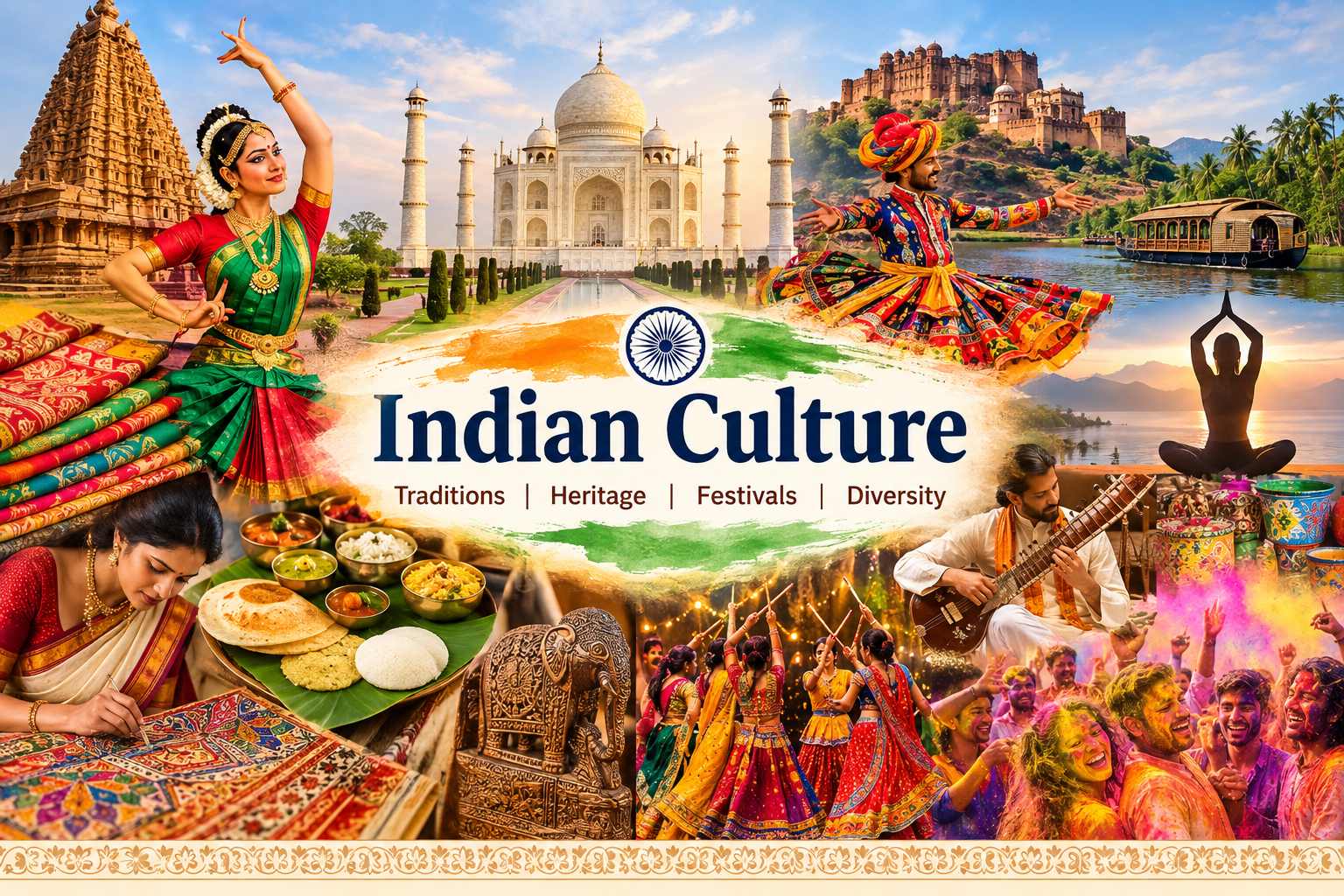
Indian Culture: A Rich Tapestry of Traditions, Heritage, Festivals and Diversity
Meta Data
Meta Title: Indian Culture: Traditions, Heritage, Festivals & Diversity
Meta Description: Explore Indian culture, traditions, festivals, food, languages, art and heritage, and discover how India's diverse cultural identity continues to evolve today.
Slug: indian-culture-traditions-heritage-festivals-diversity
Primary Keyword: Indian Culture
15–25 Keywords + Long-Tail Keywords
- Indian culture
- Indian culture and traditions
- Indian traditions
- Indian heritage
- Indian cultural heritage
- culture of India
- Indian festivals
- Indian food culture
- Indian traditional clothing
- Indian languages
- Indian classical dance
- Indian classical music
- Indian art and crafts
- Indian family traditions
- Indian cultural diversity
- Indian customs and traditions
- importance of Indian culture
- famous Indian traditions
- traditional culture of India
- Indian culture and heritage
- cultural diversity in India
- why Indian culture is unique
- Indian culture and modern society
- Indian festivals and traditions
- Indian heritage and civilization
Tags
Indian Culture, Indian Traditions, Indian Heritage, Indian Festivals, Indian Food, Indian History, Indian Art, Indian Music, Indian Dance, Indian Languages, Cultural Diversity, Indian Customs, Indian Lifestyle
OG Title
Indian Culture: A Journey Through India’s Living Heritage
OG Description
Discover the traditions, festivals, languages, food, arts, crafts and values that make Indian culture one of the world's most diverse living cultural traditions.
Introduction
Indian culture is a living and constantly evolving blend of languages, religions, traditions, festivals, food, music, dance, clothing, crafts, literature and social practices. It is not a single uniform culture. Instead, it is a collection of regional and community traditions that have developed over centuries and continue to change with modern life.
From the colourful celebrations of Holi and Deepavali to the classical traditions of Bharatanatyam and Hindustani music, India's cultural landscape is remarkably varied.
The country's cultural identity can look completely different from one region to another. A traditional meal in Punjab may differ greatly from one in Kerala. A wedding ceremony in Tamil Nadu may follow customs unlike those practiced in Rajasthan or Assam. Yet all of these traditions form part of the broader story of Indian culture.
India's linguistic diversity provides another important example. Census of India language data records the distribution of population by mother tongue across India and its states, demonstrating the country's extensive multilingual character.
AI Answer Box: What Is Indian Culture?
Indian culture is the diverse collection of traditions, customs, beliefs, languages, arts, foodways, festivals, clothing, social practices and heritage found across India.
It has developed through thousands of years of cultural interaction and regional evolution. Indian culture includes classical traditions as well as folk, tribal, regional and contemporary practices.
UNESCO's Intangible Cultural Heritage listings provide one international reference point for this diversity. India's listed traditions include Yoga, Kumbh Mela, Garba of Gujarat, Durga Puja in Kolkata, Ramlila, Kutiyattam, Chhau, Kalbelia and the tradition of Vedic chanting. Deepavali was added to the Representative List in 2025.
What Makes Indian Culture Unique?
Indian culture is often described through its diversity, continuity and ability to absorb influences while maintaining distinctive regional identities.
Several characteristics stand out.
1. Cultural Diversity
India contains numerous linguistic, regional, religious and community traditions. Culture varies significantly between the Himalayas, northern plains, western deserts, central India, the Deccan Plateau and coastal regions.
2. Regional Identity
Indian culture is strongly connected to geography.
For example:
| Region | Cultural Features Commonly Associated With It |
|---|---|
| North India | Punjabi, Rajasthani, Kashmiri and North Indian traditions |
| South India | Tamil, Telugu, Kannada and Malayalam traditions |
| East India | Bengali, Odia and Assamese traditions |
| West India | Gujarati, Marathi, Goan and Rajasthani influences |
| Northeast India | Diverse tribal, indigenous and regional traditions |
| Central India | Tribal, folk and regional cultural practices |
This table is a broad overview rather than a complete classification because cultural boundaries do not always follow state borders.
3. Continuity and Change
Indian traditions have survived partly because they are transmitted through families, communities, teachers, artists, religious institutions and local celebrations.
At the same time, traditions evolve. Modern technology, migration, education, urbanisation and global cultural exchange have changed how many Indians celebrate festivals, prepare food, dress and communicate.
A Brief History of Indian Cultural Development
India's cultural history has been shaped by many periods and communities.
Ancient Cultural Foundations
The Indian subcontinent has a long archaeological and literary history. Ancient urban traditions, religious philosophies, Sanskrit literature, regional languages, artistic traditions and systems of knowledge all contributed to the development of Indian civilization.
The Vedic tradition is one example of a cultural practice that has continued through oral transmission. UNESCO describes Vedic chanting as a tradition associated with texts transmitted orally over many generations.
Classical and Medieval Periods
Indian culture developed through interaction between different kingdoms, languages, religious communities, artistic schools and trading networks.
Literature, architecture, music, painting, textiles and cuisine developed distinctive regional forms during these periods.
Colonial and Modern Periods
The colonial period brought major changes to education, administration, transportation, printing, urban life and cultural exchange.
After independence, India's cultural institutions continued to preserve and promote traditional arts while new forms of cinema, literature, music and popular culture became increasingly influential.
Indian Festivals and Cultural Celebrations
Festivals are among the most visible expressions of Indian culture.
They bring together religious practices, food, music, clothing, art and community gatherings.
Deepavali
Deepavali, also commonly called Diwali, is celebrated in different ways across India and among Indian communities worldwide.
UNESCO inscribed Deepavali on the Representative List of the Intangible Cultural Heritage of Humanity in 2025.
Holi
Holi is widely associated with colours, community celebrations and the arrival of spring. Regional practices vary considerably.
Durga Puja
Durga Puja has a particularly strong cultural presence in West Bengal and Kolkata.
UNESCO describes Durga Puja in Kolkata as a combination of religious practice, art, community participation and public cultural expression. It was inscribed in 2021.
Navratri and Garba
Garba is a major cultural tradition of Gujarat.
UNESCO added Garba of Gujarat to the Representative List in 2023.
Kumbh Mela
Kumbh Mela is one of India's major pilgrimage traditions. UNESCO inscribed it in 2017, describing it as a social and festive tradition involving rituals, community participation and transmission of knowledge.
Indian Languages: A Major Part of Cultural Identity
Language is more than a communication system. It can carry literature, memories, songs, folklore, family traditions and regional identity.
Census of India language publications highlight the importance of language data in understanding India's multilingual and multi-ethnic character.
Indian languages include major literary traditions such as:
- Hindi
- Bengali
- Tamil
- Telugu
- Marathi
- Gujarati
- Kannada
- Malayalam
- Punjabi
- Odia
- Assamese
- Urdu
- Sanskrit
- Kashmiri
- Konkani
- Nepali
- Sindhi
- and many others
Beyond widely spoken languages, India also has numerous regional and community languages and varieties.
Why Are Indian Languages Important?
They preserve:
- Folk stories
- Poetry
- Traditional songs
- Oral histories
- Religious literature
- Regional theatre
- Local knowledge
- Family traditions
Language preservation therefore plays an important role in cultural preservation.
Indian Food Culture
Food is one of the easiest ways to experience India's cultural diversity.
There is no single "Indian cuisine." Instead, India has numerous regional culinary traditions.
North Indian Food
Commonly associated foods include:
- Roti
- Paratha
- Chole
- Rajma
- Paneer dishes
- Tandoori preparations
South Indian Food
Popular examples include:
- Idli
- Dosa
- Sambar
- Rasam
- Pongal
- Appam
- Various rice-based dishes
Western Indian Food
Regional traditions include foods such as:
- Dhokla
- Thepla
- Pav bhaji
- Misal
- Goan seafood preparations
Eastern and Northeastern Food
These regions have distinctive rice-based dishes, fish preparations, fermented foods, vegetables, herbs and indigenous culinary traditions.
Food as Cultural Heritage
Traditional recipes often travel through families rather than cookbooks. A recipe can therefore carry memories of a particular household, region or community.
Traditional Indian Clothing
Clothing is another visible expression of Indian culture.
Different regions have developed their own textiles, weaving traditions, garments and styles.
Examples include:
- Saree
- Dhoti
- Kurta
- Salwar kameez
- Sherwani
- Lehenga
- Mekhela chador
- Mundu
- Traditional turbans
- Regional handwoven textiles
Indian textiles also include numerous weaving and embroidery traditions.
Modern Indian Fashion
Contemporary Indian fashion frequently combines traditional fabrics and techniques with modern cuts.
This shows an important feature of culture: tradition does not necessarily disappear when society modernises. Instead, it can be adapted for new contexts.
Indian Classical Music and Dance
India has several classical music and dance traditions.
Indian Classical Music
Two broad classical music systems are:
- Hindustani classical music
- Carnatic classical music
Both have their own histories, performance structures and musical traditions.
Indian Classical Dance
Recognised classical dance traditions include:
- Bharatanatyam
- Kathak
- Kathakali
- Kuchipudi
- Odissi
- Manipuri
- Mohiniyattam
- Sattriya
Alongside classical forms, India has an enormous variety of folk and community dances.
UNESCO and Indian Performing Traditions
UNESCO's Indian intangible heritage listings include Chhau, Kalbelia, Mudiyettu, Sankirtana, Ramlila and Kutiyattam, among other traditions.
Indian Art and Handicrafts
Indian handicrafts combine practical knowledge, artistic expression and community traditions.
Examples include:
- Pottery
- Wood carving
- Metalwork
- Handloom weaving
- Embroidery
- Jewellery making
- Basketry
- Traditional painting
- Textile printing
- Stone carving
UNESCO's listings include the traditional brass and copper craft of the Thatheras of Jandiala Guru in Punjab, illustrating how specific craft communities can represent important living heritage.
Indian Architecture and Heritage
India's architectural heritage spans thousands of years.
It includes:
- Ancient archaeological sites
- Buddhist monuments
- Hindu temples
- Jain temples
- Islamic architecture
- Sikh gurdwaras
- Colonial buildings
- Stepwells
- Forts
- Palaces
- Traditional houses
Architecture also reflects local materials and climate. Houses in coastal, desert, mountainous and tropical environments have historically developed different designs suited to their surroundings.
Indian Family and Social Traditions
Family remains an important cultural institution in many Indian communities, although household structures and lifestyles are changing.
Traditional practices can include:
- Respect for elders
- Family gatherings
- Celebrating festivals together
- Sharing meals
- Marriage ceremonies
- Passing stories between generations
- Community participation
However, India is not culturally uniform. Family structures differ by region, community, socioeconomic background and generation.
It is therefore more accurate to talk about many Indian family traditions rather than one universal Indian family model.
Religion and Indian Culture
Religion has played a major role in shaping Indian art, architecture, literature, festivals and social traditions.
India is home to communities following Hinduism, Islam, Christianity, Sikhism, Buddhism, Jainism, Judaism, Zoroastrianism and other traditions.
Cultural practices can sometimes overlap across communities.
UNESCO's documentation of Indian heritage provides examples of cultural traditions that involve religious practice alongside music, theatre, art, craft and community participation.
Indian Culture vs Western Culture
Broad cultural comparisons can be useful, but they should not be treated as absolute rules. Both India and Western countries contain enormous internal diversity.
| Aspect | Indian Cultural Context | Many Western Cultural Contexts |
|---|---|---|
| Family | Often strong emphasis on extended family and family networks | Greater emphasis on independent households in many societies |
| Food | Strong regional and seasonal traditions | Wide variety influenced by national and global cuisines |
| Festivals | Religious and regional festivals are highly visible | National, religious and cultural celebrations vary by country |
| Clothing | Traditional clothing remains common for ceremonies | Western-style clothing dominates everyday life in many countries |
| Languages | Highly multilingual environment | Linguistic diversity varies considerably by country |
| Social customs | Often shaped by regional and community traditions | Often shaped by national and local traditions |
This comparison describes broad tendencies rather than every individual or community.
Pros and Cons of Traditional Cultural Practices
Culture itself is not simply "good" or "bad." Different traditions can have different effects depending on how they are practiced.
Positive Contributions
- Preserves historical knowledge
- Strengthens community relationships
- Encourages intergenerational learning
- Supports traditional artists and craftspeople
- Creates a sense of identity
- Promotes regional literature and languages
- Supports cultural tourism
- Keeps traditional arts alive
Challenges
- Some traditions may become difficult to sustain economically
- Younger generations may move away from traditional occupations
- Commercialisation can change cultural practices
- Some communities face language loss
- Traditional crafts can struggle against mass-produced alternatives
- Certain historical social practices may conflict with modern values or legal principles
The challenge is often to preserve cultural knowledge while allowing people and communities to adapt traditions voluntarily.
How Is Indian Culture Changing in the Modern Era?
Indian culture is not frozen in the past.
Several forces are influencing cultural life today.
Digital Media
Social media platforms allow regional music, food, fashion and festivals to reach audiences around the world.
Migration
Indians living outside India often maintain cultural connections through festivals, language, food and community organisations.
Urbanisation
Cities bring people from different regions together, creating new cultural combinations.
Contemporary Entertainment
Indian cinema, streaming platforms, independent music and digital creators have expanded the reach of regional cultures.
Globalisation
Indian food, yoga, music, fashion and festivals are increasingly familiar internationally.
UNESCO's recognition of traditions such as Yoga, Garba, Kumbh Mela and Deepavali illustrates how elements of Indian cultural heritage have gained international visibility.
How Can We Preserve Indian Culture?
Cultural preservation does not necessarily mean keeping every practice unchanged.
A practical approach includes:
- Teach traditional knowledge to younger generations.
- Document endangered languages and oral traditions.
- Support craftspeople and traditional artists.
- Encourage responsible cultural tourism.
- Digitise old manuscripts, recordings and photographs.
- Promote regional literature and music.
- Create opportunities for young people to learn traditional arts.
- Respect communities as the custodians of their own traditions.
UNESCO's approach to intangible heritage emphasises living traditions and their transmission rather than treating culture simply as objects displayed in museums. India's participation in the UNESCO convention dates to its ratification in 2005.
Indian Culture: Tradition vs Modern Lifestyle
| Traditional Element | Modern Adaptation |
|---|---|
| Handloom clothing | Contemporary fashion using traditional textiles |
| Classical music | Digital concerts and online education |
| Family celebrations | Social-media-enabled celebrations |
| Traditional recipes | Modern restaurants and food delivery |
| Folk arts | Digital performances and cultural festivals |
| Regional languages | Online publishing and digital content |
| Traditional crafts | E-commerce and global markets |
This demonstrates that cultural continuity can involve adaptation rather than simple preservation of an unchanged form.
Real-World Cultural Experience
A useful way to understand Indian culture is to observe everyday life rather than focusing only on major monuments.
A family preparing traditional food for a festival, a grandmother teaching a regional recipe, a craftsman working with metal, children learning a folk dance, or neighbours gathering for a local celebration can all be examples of cultural transmission.
In this sense, Indian culture is experienced as much in ordinary life as in famous heritage sites.
Expert Perspective: Why Living Heritage Matters
UNESCO's intangible cultural heritage framework is useful because it treats cultural heritage as something communities practise, transmit and recreate.
For example, UNESCO describes Kutiyattam as a living Sanskrit theatre tradition in Kerala and notes that performers undergo extensive training to master its codified techniques.
Similarly, UNESCO's documentation of Durga Puja highlights the interaction between religious practice, artistic production, public space and community participation.
These examples show why Indian culture cannot be reduced to monuments, costumes or festivals. It also includes skills, knowledge, performance traditions and community practices.
Key Takeaways
- Indian culture is extremely diverse and varies significantly by region and community.
- Languages are a major part of India's cultural identity.
- Festivals combine religious, social, artistic and community traditions.
- Indian cuisine contains many regional culinary systems rather than one single cuisine.
- Classical and folk music and dance represent important cultural traditions.
- Handicrafts preserve specialised knowledge passed between generations.
- Indian culture continues to evolve through technology, migration and globalisation.
- UNESCO currently lists 16 Indian elements on its Representative List of Intangible Cultural Heritage, including Deepavali, Garba, Yoga, Kumbh Mela and Durga Puja.
- Preserving culture involves supporting the people and communities who practise and transmit it.
Frequently Asked Questions About Indian Culture
1. What is Indian culture?
Indian culture is the diverse collection of traditions, languages, festivals, food, arts, music, dance, customs, beliefs and social practices found across India.
2. Why is Indian culture famous around the world?
Indian culture is internationally recognised for its diversity, historical depth, cuisine, yoga, classical arts, festivals, textiles, literature and philosophical traditions.
3. What are the main features of Indian culture?
Major features include cultural diversity, multilingualism, regional traditions, festivals, family and community practices, food, performing arts, crafts and religious traditions.
4. How many cultures are there in India?
There is no single official number of "cultures" in India. Cultural identity exists at national, regional, linguistic, religious, tribal, community and local levels.
5. What are the most important Indian festivals?
Major festivals include Deepavali, Holi, Navratri, Durga Puja, Eid celebrations, Christmas, Gurpurab, Onam, Pongal, Bihu and many regional festivals.
6. What is India's traditional food?
India has many regional food traditions. Examples include dosa and sambar in South Indian cuisine, dhokla in Gujarat, litti in Bihar, biryani in several regional traditions and numerous rice- and wheat-based foods across the country.
7. What are Indian classical dances?
Indian classical dance traditions include Bharatanatyam, Kathak, Kathakali, Kuchipudi, Odissi, Manipuri, Mohiniyattam and Sattriya.
8. Why are Indian languages important?
Languages preserve literature, oral histories, songs, stories and community knowledge. Census of India publications document India's extensive linguistic diversity.
9. What is Indian cultural heritage?
Indian cultural heritage includes both tangible heritage, such as monuments and historic structures, and intangible heritage, such as music, dance, festivals, crafts, oral traditions and knowledge systems.
10. Which Indian traditions are recognised by UNESCO?
UNESCO's Indian intangible heritage listings include Deepavali, Garba of Gujarat, Durga Puja in Kolkata, Kumbh Mela, Yoga, Ramlila, Kutiyattam, Chhau, Kalbelia and Vedic chanting, among others.
11. How can Indian culture be preserved?
Culture can be preserved by supporting traditional artists, documenting languages and oral histories, teaching younger generations, promoting responsible tourism and creating sustainable markets for traditional crafts.
12. Is Indian culture changing?
Yes. Indian culture continues to evolve through urbanisation, migration, technology, education, globalisation and interaction between regional traditions.
13. What role does food play in Indian culture?
Food carries regional history and family traditions. Recipes and cooking techniques are frequently passed between generations.
14. What makes Indian culture diverse?
India's geographical size, languages, religions, communities, historical interactions and regional environments have contributed to its cultural diversity.
15. Is Indian culture the same everywhere in India?
No. Indian culture varies considerably between regions and communities. There are shared cultural elements, but local traditions can be very different.
Conclusion
Indian culture is not a single tradition—it is a living collection of countless traditions, languages, artistic practices, foods, festivals and community experiences.
From ancient knowledge systems and classical arts to contemporary cinema, digital culture and modern Indian fashion, the country's cultural identity continues to evolve.
The most meaningful way to understand Indian culture is to look beyond stereotypes and recognise the people, communities and regional traditions that keep it alive.
As India becomes increasingly connected to the world, preserving cultural diversity while allowing traditions to evolve will remain an important part of its cultural future.
Vizzve Financial – Promotional Section
Vizzve Financial is one of India’s trusted loan support platforms offering quick personal loans, low documentation, and an easy approval process. Apply at www.vizzve.com.
Vizzve's official website describes its service as connecting borrowers with banks and NBFCs and facilitating loan offers. Its Google Play listing states that Vizzve Financial does not lend directly and instead operates as a loan aggregator connecting users with lending partners for final approval and disbursal.
Official website: Vizzve Financial
Published on : 18th september
Published by : Sumanth Arumulla
www.vizzve.com || www.vizzveservices.com
Follow us on social media: Facebook || Linkedin || Instagram
🛡 Powered by Vizzve Financial
RBI-Registered Loan Partner | 10 Lakh+ Customers | ₹600 Cr+ Disbursed
#IndianCulture #IndianTraditions #IndianHeritage #IndianFestivals #IndianCultureAndTraditions #IndianArt #IndianDance #IndianMusic #IndianFood #IndianHandicrafts #IndianHistory #CulturalDiversity #IndianHeritage #IncredibleIndia #IndianTradition #IndianLifestyle #IndianFestivals #CulturalHeritage #India #VividIndia