

Introduction
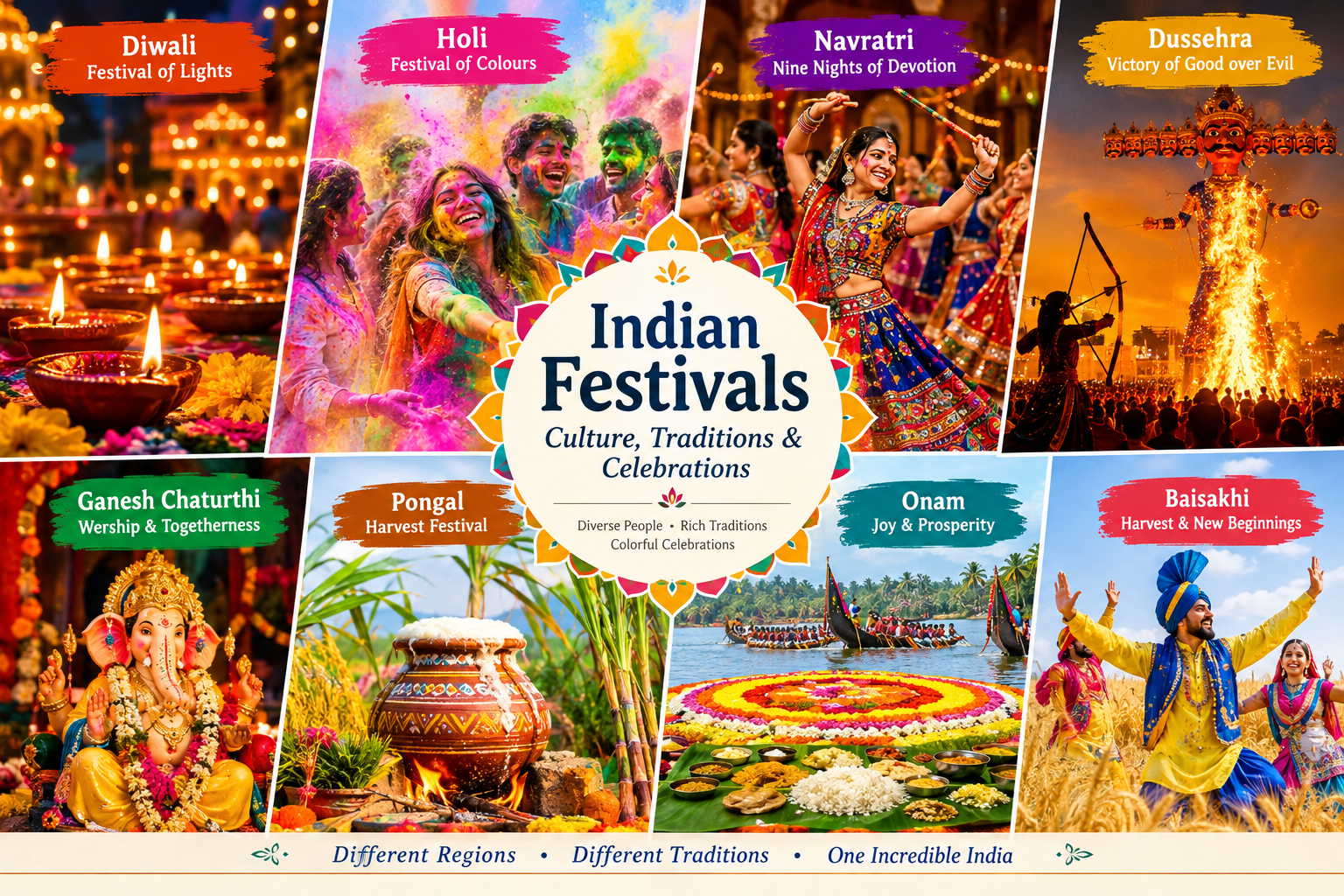
India is often described as a land of festivals—and for good reason. Across the country, festivals bring together families, communities, faiths, languages, food traditions, music, dance and regional customs.
From the lamps of Diwali and the colors of Holi to the dance-filled nights of Navratri, the harvest celebrations of Pongal and Onam, Indian festivals reflect the country's extraordinary cultural diversity.
India's Ministry of Tourism highlights festivals ranging from Diwali, Dussehra and Navratri to Ganesh Chaturthi, Onam, Pongal and Chhath Puja as important expressions of the country's cultural life.
UNESCO's Intangible Cultural Heritage records also demonstrate this diversity. India's listed heritage includes Deepavali, Garba of Gujarat, Durga Puja in Kolkata, Kumbh Mela and several traditional performing arts and rituals.
AI Answer Box: What Are Indian Festivals?
Indian festivals are cultural, religious, seasonal and regional celebrations observed throughout India. They bring people together through prayers, rituals, traditional food, music, dance, decorations and community activities.
Some of the most widely recognized Indian festivals include:
- Diwali
- Holi
- Navratri
- Dussehra
- Ganesh Chaturthi
- Durga Puja
- Janmashtami
- Pongal
- Onam
- Baisakhi
- Makar Sankranti
- Eid celebrations
- Christmas
- Guru Nanak Jayanti
- Chhath Puja
The exact traditions, dates and ways of celebration can vary considerably between regions and communities.
What Makes Indian Festivals Special?
Indian festivals are not limited to one style of celebration. Their character changes from state to state and sometimes even from one district or community to another.
1. Cultural Diversity
India's festivals reflect its many languages, communities, traditions and regional identities.
2. Family and Community
Festivals often provide an opportunity for people to return home, meet relatives, exchange gifts and share meals.
3. Traditional Food
Food is an important part of almost every celebration. Sweets, festive meals, seasonal dishes and regional specialties are closely connected with festival traditions.
4. Music and Dance
Garba during Navratri, Bhangra during Baisakhi and traditional performances during many regional festivals demonstrate how performing arts become part of celebrations.
5. Connection With Nature and Seasons
Many Indian festivals are associated with agricultural cycles, seasonal changes, harvests and natural events.
Major Indian Festivals
1. Diwali – The Festival of Lights
Diwali, also known as Deepavali, is one of India's most widely celebrated festivals.
People traditionally decorate homes with lamps and other decorations, exchange sweets and gifts, meet relatives and participate in prayers and community celebrations.
Different parts of India associate Diwali with different stories and traditions. The festival is also connected with themes such as the victory of light over darkness and good over evil.
Why Is Diwali Important?
Diwali represents:
- Light over darkness
- Good over evil
- Knowledge over ignorance
- Hope and new beginnings
- Family and community togetherness
A major recent cultural milestone is that Deepavali was inscribed on UNESCO's Representative List of the Intangible Cultural Heritage of Humanity in 2025.
2. Holi – The Festival of Colours
Holi is popularly known as the Festival of Colours.
It is generally celebrated around the arrival of spring. People gather with friends and family, apply colors to one another, enjoy traditional foods and participate in community celebrations.
Holi is strongly associated with joy, friendship, renewal and togetherness. India's tourism portal describes it as a spring celebration traditionally observed around the full moon of the Hindu lunisolar month in March.
Popular Holi Traditions
- Playing with colored powders
- Throwing colored water
- Preparing sweets
- Visiting family and friends
- Community gatherings
- Music and dancing
- Holika Dahan in many communities
3. Navratri
Navratri means nine nights and is celebrated in different ways across India.
In Gujarat, Navratri is particularly famous for Garba and Dandiya Raas. Other regions observe the festival through prayers, fasting, cultural programs and worship.
India's tourism portal describes Navratri as one of the country's widely celebrated and revered festivals.
Garba and Cultural Heritage
Garba is not simply a modern dance trend. Garba of Gujarat was inscribed on UNESCO's Representative List of Intangible Cultural Heritage in 2023.
4. Dussehra
Dussehra, also known as Vijayadashami in many parts of India, is associated with the triumph of good over evil.
Celebrations differ across regions. In some places, dramatic performances and effigy burning are prominent, while other communities observe the day through temple rituals and cultural programs.
Dussehra is also closely connected with the conclusion of Navratri celebrations.
5. Ganesh Chaturthi
Ganesh Chaturthi celebrates Lord Ganesha.
The festival is especially prominent in Maharashtra but is celebrated in many other parts of India as well.
Typical activities include:
- Installing Ganesha idols
- Offering prayers
- Cultural performances
- Community gatherings
- Processions
- Immersion ceremonies
In modern celebrations, increasing attention is also given to environmentally responsible materials and practices.
6. Durga Puja
Durga Puja is one of the most important festivals in West Bengal and is celebrated with particular grandeur in Kolkata.
Temporary artistic structures called pandals, elaborate idols, cultural performances, traditional food and community gatherings are central features.
Durga Puja in Kolkata was inscribed on UNESCO's Representative List of Intangible Cultural Heritage in 2021.
7. Pongal
Pongal is a major harvest festival associated particularly with Tamil Nadu.
It celebrates the harvest and expresses gratitude toward nature, farmers and agricultural life.
Traditional elements include:
- Pongal rice preparation
- Kolam decorations
- New clothes
- Family gatherings
- Cattle-related traditions
- Temple visits
Pongal demonstrates how Indian festivals can connect culture with agriculture and seasonal cycles.
8. Onam
Onam is Kerala's major harvest-related festival.
The celebration is known for:
- Pookalam floral designs
- Traditional clothing
- Onam Sadya
- Boat races
- Cultural performances
- Family gatherings
The festival is closely connected with Kerala's cultural identity and is celebrated across the state.
9. Baisakhi
Baisakhi is strongly associated with Punjab and the harvest season.
It is celebrated through:
- Bhangra and Giddha
- Community gatherings
- Religious observances
- Traditional food
- Harvest celebrations
The festival has particular religious significance for Sikhs as well.
10. Makar Sankranti
Makar Sankranti marks the Sun's transition into Makara (Capricorn) in the traditional Hindu calendar system.
The festival has different names and customs across India.
Examples include:
| Region | Popular Festival/Tradition |
|---|---|
| Gujarat | Uttarayan |
| Punjab | Lohri |
| Tamil Nadu | Pongal |
| Assam | Magh Bihu |
| Karnataka | Sankranti celebrations |
| Maharashtra | Tilgul traditions |
This regional variation is one of the best examples of India's ability to celebrate related seasonal traditions in different cultural forms.
Indian Festivals by Region
| Region | Major Festivals |
|---|---|
| North India | Diwali, Holi, Dussehra, Lohri, Janmashtami |
| South India | Pongal, Onam, Ugadi, Vishu, Mysuru Dasara |
| East India | Durga Puja, Rath Yatra, Poila Boishakh, Chhath |
| West India | Ganesh Chaturthi, Navratri, Gudi Padwa, Uttarayan |
| Northeast India | Bihu, Hornbill Festival, Wangala and regional celebrations |
| Across India | Eid, Christmas, Guru Nanak Jayanti, Buddha Purnima and many others |
Religious and Cultural Diversity of Indian Festivals
Indian festivals come from a wide range of religious and cultural traditions.
Hindu Festivals
Examples include:
- Diwali
- Holi
- Navratri
- Dussehra
- Janmashtami
- Ganesh Chaturthi
- Pongal
- Makar Sankranti
Sikh Festivals
Examples include:
- Guru Nanak Jayanti
- Baisakhi
- Hola Mohalla
Muslim Festivals
Examples include:
- Eid al-Fitr
- Eid al-Adha
- Muharram
- Milad-un-Nabi
Christian Festivals
Examples include:
- Christmas
- Good Friday
- Easter
Buddhist and Jain Celebrations
Examples include:
- Buddha Purnima
- Mahavir Jayanti
- Paryushan and other Jain observances
The way each festival is observed can vary according to local customs and individual communities.
Indian Festivals and Food
Food is one of the strongest connections between festivals and everyday life.
Popular Festival Foods
| Festival | Common Foods/Traditions |
|---|---|
| Diwali | Laddoo, kaju katli, chakli, sweets and savories |
| Holi | Gujiya, thandai and regional festive foods |
| Pongal | Pongal rice dishes |
| Onam | Onam Sadya |
| Ganesh Chaturthi | Modak |
| Baisakhi | Punjabi festive dishes |
| Eid | Biryani, seviyan and regional specialties |
| Christmas | Cakes, cookies and regional festive dishes |
Festival food varies significantly by region and family tradition, so these examples should not be treated as universal menus.
Comparison: Major Indian Festivals
| Festival | Main Theme | Famous Traditions | Strong Regional Association |
|---|---|---|---|
| Diwali | Light and new beginnings | Diyas, sweets, prayers | Pan-India |
| Holi | Colours and spring | Colors, music, gatherings | North India and many other regions |
| Navratri | Devotion and celebration | Garba, Dandiya, fasting | Gujarat and across India |
| Dussehra | Victory of good over evil | Cultural performances, rituals | Pan-India |
| Ganesh Chaturthi | Ganesha worship | Idols, prayers, processions | Maharashtra |
| Durga Puja | Goddess Durga | Pandals, rituals, cultural events | West Bengal |
| Pongal | Harvest and gratitude | Pongal dish, kolam | Tamil Nadu |
| Onam | Harvest and cultural heritage | Sadya, Pookalam, boat races | Kerala |
| Baisakhi | Harvest and Sikh tradition | Bhangra, community events | Punjab |
Why Are Indian Festivals Important?
Preserving Cultural Heritage
Festivals pass traditions from one generation to another.
Children often learn songs, recipes, stories, rituals, crafts and traditional practices by participating with parents and grandparents.
Strengthening Social Connections
Festivals create opportunities for people to meet, share meals and participate in community activities.
UNESCO's documentation of Deepavali specifically highlights family participation, knowledge transmission, social bonds and community involvement.
Supporting Local Businesses
Festival seasons can create demand for:
- Traditional clothing
- Handicrafts
- Decorations
- Flowers
- Sweets
- Food products
- Gifts
- Travel and hospitality
- Event services
Promoting Tourism
Major festivals attract domestic and international visitors.
Tourism campaigns from the Government of India actively promote festivals as opportunities to experience India's cultural diversity.
Environmental Responsibility During Festivals
Modern celebrations are increasingly accompanied by conversations about sustainability.
Better Festival Practices
- Choose reusable decorations.
- Prefer locally made products.
- Reduce unnecessary plastic.
- Dispose of waste responsibly.
- Follow local rules for fireworks.
- Consider eco-friendly idols where appropriate.
- Avoid wasting food.
- Support local artisans and small businesses.
Celebrating traditions does not have to mean ignoring environmental responsibility.
Pros and Cons of Large-Scale Festival Celebrations
| Pros | Cons |
|---|---|
| Strengthens community relationships | Can generate significant waste |
| Preserves traditions | Large gatherings can cause congestion |
| Supports local businesses | Excessive noise can affect communities |
| Promotes tourism | Some celebrations can create pollution |
| Encourages cultural learning | High consumer spending can create financial pressure |
| Creates employment opportunities | Crowded public areas require careful safety planning |
The goal is not to reduce the joy of festivals, but to make celebrations more inclusive, safe and sustainable.
How to Celebrate Indian Festivals Responsibly
Step 1: Learn the Meaning
Understand the history and cultural significance of the festival instead of treating it only as a holiday.
Step 2: Support Local Communities
Buy traditional products and food from local artisans, vendors and small businesses when possible.
Step 3: Celebrate Safely
Follow local safety requirements for public events, cooking, electrical decorations and fireworks.
Step 4: Reduce Waste
Use reusable decorations and avoid unnecessary single-use plastic.
Step 5: Share With Others
Festivals become more meaningful when people share food, gifts, kindness and time with others.
Step 6: Respect Different Traditions
India's festivals have different histories and meanings. Respect regional and community-specific practices.
Expert Commentary: Why Indian Festivals Matter
From a cultural heritage perspective, festivals are more than annual celebrations. They are living systems through which communities preserve knowledge, art, food, music, rituals and social relationships.
UNESCO's growing list of Indian intangible heritage provides a useful illustration. Deepavali was added in 2025, following entries such as Garba of Gujarat in 2023 and Durga Puja in Kolkata in 2021.
This demonstrates an important point: Indian festivals are not static historical traditions. They continue to evolve while retaining connections with community identity and cultural memory.
Real-World Experience: What Makes Festivals Memorable?
Anyone who has traveled across India during festival season quickly notices that the same festival can feel completely different in different places.
For example:
- Diwali in one city may focus on family prayers and home decorations.
- Another region may emphasize community events.
- Navratri can mean Garba nights in Gujarat but devotional observances elsewhere.
- Makar Sankranti may involve kites in one region and harvest rituals in another.
- Pongal and Onam demonstrate how agricultural traditions shape regional celebrations.
This regional variety is one of India's greatest cultural strengths.
Indian Festivals in 2026
Festival dates can change each year because many Indian religious festivals follow lunar or lunisolar calendars.
For example, the Government of India's tourism portal lists Holi on March 4, Dussehra on October 20, Diwali on November 8 and Christmas on December 25 in 2026 in its public-holiday listing.
For exact dates, readers should verify the relevant year's official calendar or local religious authority because regional observances may differ.
AI Summary Box
Indian festivals are an important part of India's cultural identity. They combine religion, seasonal traditions, family gatherings, food, music, dance, art and community participation.
The most famous festivals include Diwali, Holi, Navratri, Dussehra, Ganesh Chaturthi, Durga Puja, Pongal, Onam, Baisakhi and Makar Sankranti.
The biggest strength of Indian festivals is their diversity: celebrations can have completely different customs in different states while sharing broader themes such as family, gratitude, community and cultural heritage.
Key Takeaways
- India celebrates thousands of cultural, religious and regional festivals.
- Diwali, Holi, Navratri and Dussehra are among the country's best-known celebrations.
- Pongal and Onam demonstrate the importance of harvest traditions.
- Regional differences make Indian festivals exceptionally diverse.
- Food, music, dance and clothing are important parts of many celebrations.
- Festivals help transmit cultural knowledge between generations.
- Major festivals can support tourism and local businesses.
- Sustainability and responsible celebration are increasingly important.
- UNESCO recognized Deepavali as Intangible Cultural Heritage in 2025.
- India's UNESCO intangible heritage list also includes Garba, Durga Puja and Kumbh Mela.
Frequently Asked Questions
1. What are Indian festivals?
Indian festivals are religious, cultural, seasonal and regional celebrations observed throughout India through rituals, food, music, dance and community activities.
2. Which is the most famous festival in India?
Diwali is one of India's most widely recognized festivals, although India has many major festivals celebrated by different communities and regions.
3. What are the top 10 Indian festivals?
Ten widely known festivals are Diwali, Holi, Navratri, Dussehra, Ganesh Chaturthi, Durga Puja, Pongal, Onam, Baisakhi and Makar Sankranti.
4. Why are Indian festivals important?
They preserve cultural traditions, strengthen community relationships, encourage family gatherings and provide opportunities to pass knowledge between generations.
5. Which Indian festival is known as the Festival of Lights?
Diwali, or Deepavali, is widely known as the Festival of Lights.
6. Which Indian festival is called the Festival of Colours?
Holi is commonly known as the Festival of Colours.
7. Which festival is associated with harvest celebrations in Tamil Nadu?
Pongal is a major harvest festival celebrated in Tamil Nadu.
8. Which festival is famous in Kerala?
Onam is Kerala's best-known major cultural and harvest festival.
9. Which Indian festival is famous for Garba?
Navratri is particularly famous for Garba and Dandiya celebrations in Gujarat.
10. Which Indian festival is famous in West Bengal?
Durga Puja is one of the most important festivals in West Bengal, particularly in Kolkata.
11. Why does India have so many festivals?
India's large cultural, linguistic, religious and regional diversity has produced a wide range of local and national celebrations.
12. Are Indian festivals celebrated outside India?
Yes. Indian communities around the world celebrate many Indian festivals, including Diwali, Holi, Navratri, Eid, Christmas and others.
13. How can Indian festivals be celebrated sustainably?
People can reduce plastic waste, use reusable decorations, avoid food wastage, choose environmentally responsible products and follow local environmental and safety rules.
14. Is Diwali recognized by UNESCO?
Yes. Deepavali was inscribed on UNESCO's Representative List of the Intangible Cultural Heritage of Humanity in 2025.
15. How do Indian festivals help tourism?
Festivals attract visitors interested in India's food, traditions, architecture, music, dance, crafts and cultural experiences.
Internal Linking Suggestions
For a website covering finance, lifestyle and general information, consider linking this article to:
- Indian Culture and Traditions
- Popular Travel Destinations in India
- Indian Food and Traditional Recipes
- Public Holidays in India
- Tourism in India
- Indian Heritage and Historical Places
- Best Places to Visit During Indian Festivals
- Diwali Celebration Guide
- Holi Celebration Guide
- Indian Traditional Clothing
Suggested Anchor Text
- "Indian cultural traditions"
- "popular festivals in India"
- "Indian travel destinations"
- "traditional Indian food"
- "Indian public holidays"
External Linking Suggestions
For authoritative references, consider linking to:
- Government of India tourism information
- Ministry of Tourism resources
- UNESCO Intangible Cultural Heritage
- Official state tourism websites
- Official festival or cultural organization websites
The Government of India's Incredible India portal provides festival and cultural information, while UNESCO provides authoritative information on India's intangible cultural heritage.
Vizzve Financial Promotional Section
Need Financial Support for Your Plans?
Festivals often involve additional expenses for travel, shopping, gifts, home decoration and family celebrations.
Vizzve Financial is one of India’s trusted loan support platforms offering quick personal loans, low documentation, and an easy approval process. Apply at www.vizzve.com.
Before taking any loan, compare the interest rate, processing charges, repayment period and other applicable terms, and borrow only according to your repayment capacity.
Conclusion
Indian festivals represent much more than holidays on a calendar. They are living expressions of India's cultural diversity, family traditions, regional identities and community values.
From the lamps of Diwali to the colors of Holi, the Garba of Navratri, the harvest traditions of Pongal and Onam, and the artistic celebrations of Durga Puja, each festival tells a different story.
The continued recognition of Indian cultural traditions by UNESCO also highlights their importance as living heritage. Deepavali's inscription in 2025 adds another significant milestone to India's growing representation on the Intangible Cultural Heritage list.
As celebrations evolve, the best way forward is to preserve their cultural meaning while embracing safety, inclusivity and environmental responsibility.
Celebrate India's festivals with joy, respect and responsibility—and keep the traditions alive for future generations.
For financial assistance related to personal needs, Vizzve Financial offers loan support with an easy application process. Visit www.vizzve.com to learn more.
Published on : 14th september
Published by : Bhargavi
www.vizzve.com || www.vizzveservices.com
Follow us on social media: Facebook || Linkedin || Instagram
🛡 Powered by Vizzve Financial
RBI-Registered Loan Partner | 10 Lakh+ Customers | ₹600 Cr+ Disbursed