

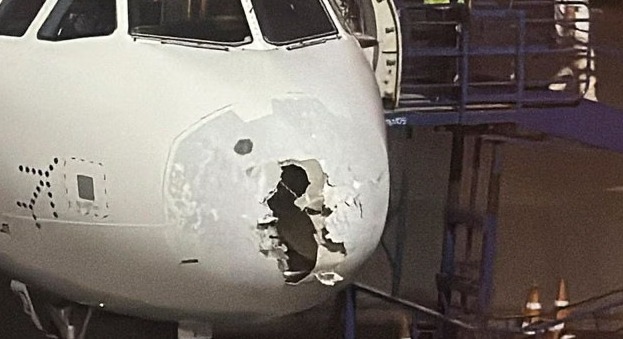
In a concerning development, the pilots of an IndiGo flight from Delhi to Srinagar have reported to the Directorate General of Civil Aviation (DGCA) that their request to alter course due to a severe hailstorm threat was denied by both the Indian Air Force (IAF) and Lahore Air Traffic Control (ATC).
According to sources, the incident occurred on [insert date if known], when the flight crew detected intense weather activity en route to Srinagar. In line with standard aviation safety protocols, the pilots sought permission to deviate from their planned route to avoid the turbulent weather system.
However, the pilots claim that both the IAF and Lahore ATC — which jointly manage certain northern airspaces — denied the request for a route deviation. This decision left the flight crew with limited options to navigate safely through the adverse weather conditions.
The matter has since been escalated to the DGCA, India’s civil aviation regulator. An official investigation may follow to assess whether proper procedures were followed by the authorities involved and whether passenger safety was compromised.
Flight safety experts have highlighted that weather-related route deviations are a routine and vital part of aviation safety. Any denial of such requests must be backed by compelling reasons, especially when passenger and crew safety is at stake.
IndiGo, the IAF, and the DGCA have not issued official statements as of now. Meanwhile, the aviation community is closely monitoring the outcome of this case, which may raise important questions about cross-border airspace coordination and safety governance.
FAQ
Q1: What happened with the IndiGo Delhi-Srinagar flight?
A: Pilots of an IndiGo flight from Delhi to Srinagar reported that their request to deviate from the planned flight path to avoid a hailstorm was denied by both the Indian Air Force (IAF) and Lahore Air Traffic Control (ATC).
Q2: Why did the pilots request a route deviation?
A: The request was made to avoid a potentially dangerous hailstorm detected en route — a common and necessary safety procedure in aviation during adverse weather.
Q3: Who denied the route change and why?
A: Both the IAF and Lahore ATC reportedly denied the deviation. The reasons for the denial have not been officially disclosed yet.
Q4: Was the safety of the flight compromised?
A: While no injuries or incidents were reported, the denial of a weather-related route change raises concerns about potential safety risks. The DGCA may investigate to determine if proper safety protocols were followed.
Q5: What action has IndiGo taken?
A: IndiGo has submitted a report to the Directorate General of Civil Aviation (DGCA). An official statement from the airline is still awaited.
Q6: What will the DGCA do now?
A: The DGCA is expected to assess the report submitted by the pilots. If necessary, it may initiate a formal inquiry into the incident, including coordination issues between civil and military ATC authorities.
Q7: How common are route deviation requests in aviation?
A: Route deviations due to weather are standard practice and are generally approved unless there are overriding security or airspace management concerns.
Q8: What is the role of Lahore ATC in Indian airspace?
A: Some portions of northern Indian airspace border or overlap with airspace managed by Lahore ATC, especially for high-altitude international routing. Coordination is occasionally required across borders.
Publish on may 23,2025 by :selvi