

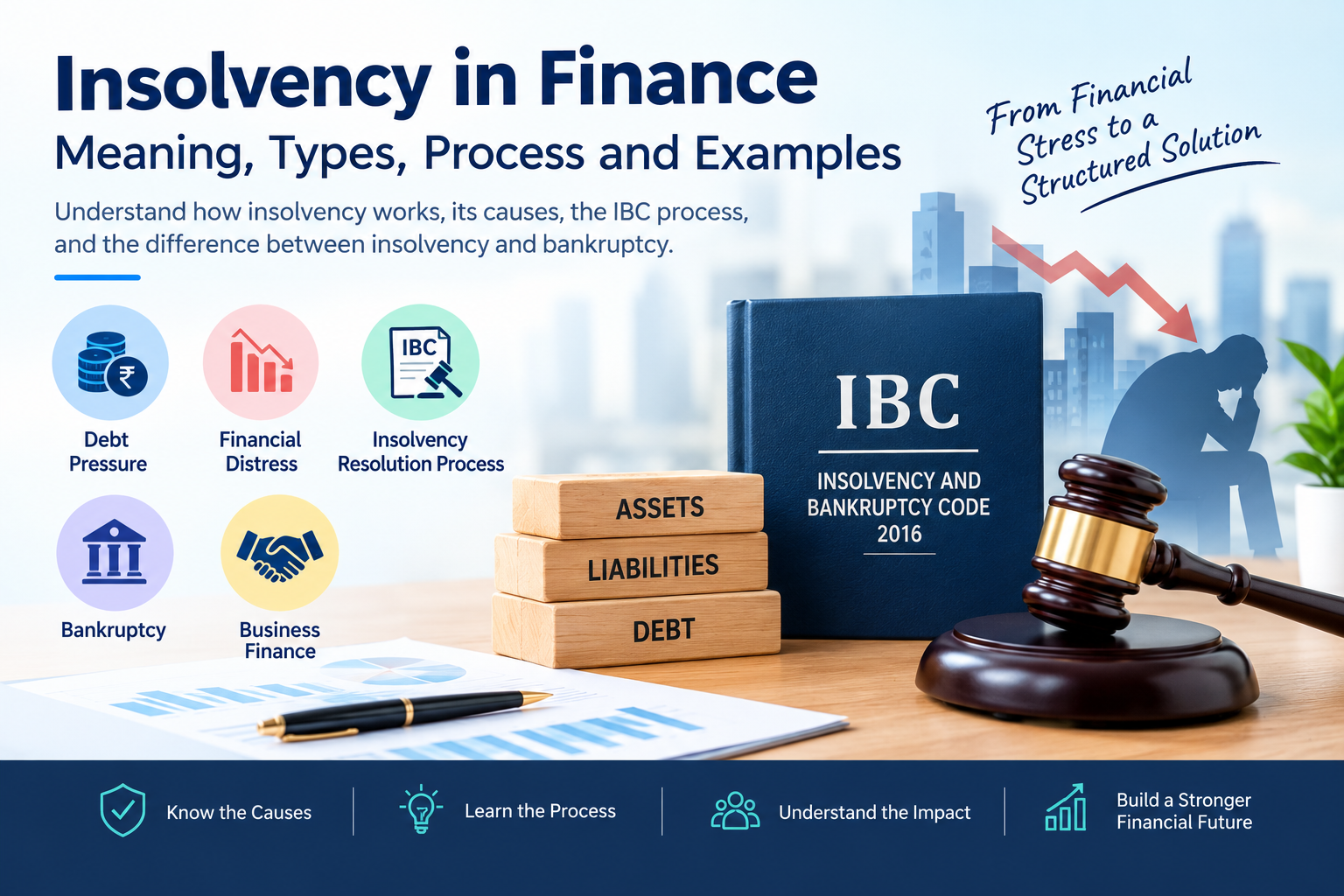
Insolvency in finance means a person or business is unable to meet its financial obligations when they become due, or its financial position shows that its liabilities are greater than the value of its assets, depending on the applicable legal test.
In simple words, insolvency means serious financial difficulty in paying debts.
For example, imagine a company has to pay ₹10 lakh to its lenders and suppliers, but it does not have enough cash or other available resources to meet its payments. If this problem becomes serious and continues, the company may face insolvency proceedings under the applicable law.
Insolvency is an important topic because it affects:
-
Companies
-
Banks and lenders
-
Employees
-
Suppliers
-
Investors
-
Creditors
-
Customers
-
The wider economy
India's main legal framework for insolvency and bankruptcy is the Insolvency and Bankruptcy Code, 2016 (IBC). The framework aims to provide a structured process for resolving insolvency and, where resolution is not possible, dealing with liquidation or bankruptcy according to the applicable provisions.
AI Answer Box: What Is Insolvency in Finance?
Insolvency is a financial condition in which a person or business cannot meet its debts or financial obligations as they become due, or meets another applicable legal test of insolvency.
Simple example
A business has monthly payments of ₹5 lakh but regularly has only ₹2 lakh available to meet those obligations.
If the business cannot arrange the required funds and the financial problem continues, it may face serious financial distress and potentially insolvency proceedings.
In one line:
Insolvency = A serious inability to meet financial obligations.
Insolvency does not automatically mean that a company has closed down. A formal insolvency process may provide an opportunity to restructure or resolve its financial problems.
What Does Insolvency Mean in Finance?
The word insolvency describes a financial condition rather than simply meaning that someone missed one payment.
A temporary cash shortage does not necessarily mean that a business is legally insolvent.
For example, a profitable company might temporarily have less cash because a large customer has not paid an invoice yet. The company may still have valuable assets and future income.
Therefore, insolvency should be understood using the relevant financial facts and legal framework.
Two Common Ways to Understand Insolvency
1. Cash-Flow Insolvency
Cash-flow insolvency refers to a situation where a person or business cannot pay debts when they become due.
Example
A company has assets worth ₹50 lakh but needs to make a ₹10 lakh payment today and does not have enough available cash.
It may face a liquidity problem even though its total assets are valuable.
2. Balance-Sheet Insolvency
Balance-sheet insolvency is a general financial concept in which liabilities exceed the value of assets.
Example
| Financial position | Amount |
|---|---|
| Total assets | ₹20 lakh |
| Total liabilities | ₹30 lakh |
| Difference | -₹10 lakh |
Here, liabilities are greater than assets.
However, the exact legal meaning and test for insolvency can vary depending on the applicable law and circumstances. Financial distress should therefore not be confused with a formal legal finding.
What Causes Insolvency?
Insolvency can happen for many reasons.
Common Causes
1. High Debt
A business may borrow heavily and later struggle to make principal and interest payments.
2. Falling Sales
If customers reduce their purchases, business revenue may decline.
3. Poor Cash Flow
A company can have sales and profits on paper but still face difficulty if cash does not arrive on time.
4. Rising Costs
Higher raw-material, salary, rent, transport or financing costs can put pressure on a business.
5. Business Losses
Long-term losses can reduce the company's financial strength.
6. Economic Problems
A recession, supply-chain disruption, changing demand or industry slowdown can affect businesses.
7. Poor Financial Management
Weak budgeting, excessive borrowing and poor planning can increase financial risk.
What Happens When a Company Becomes Insolvent?
Insolvency does not have one identical outcome for every company.
Depending on the facts and applicable law, the process may involve:
-
Identifying financial distress.
-
Starting an appropriate legal process.
-
Appointment of an insolvency professional where required.
-
Collection and verification of claims.
-
Assessment of the company's financial position.
-
Consideration of a resolution plan.
-
Approval or rejection of an eligible resolution plan.
-
Liquidation if resolution does not succeed, where applicable.
Under India's corporate insolvency framework, the Corporate Insolvency Resolution Process (CIRP) is designed as a time-bound process. The IBBI explains that the normal period is 180 days, with extensions possible in specified circumstances, subject to the statutory maximum framework.
Insolvency and Bankruptcy Code in India
The Insolvency and Bankruptcy Code, 2016, commonly called the IBC, created a comprehensive legal framework for insolvency and bankruptcy in India.
The Ministry of Corporate Affairs describes the IBC as a framework intended to support time-bound insolvency resolution, maximise asset value, promote entrepreneurship and balance stakeholder interests.
The Insolvency and Bankruptcy Board of India (IBBI) is the regulator responsible for important parts of the insolvency ecosystem.
The IBBI regulates areas including insolvency professionals and processes under the IBC framework.
Important current point
The IBBI continues to update its legal framework and regulations. Its 2026 legal-framework records include amended regulations for corporate insolvency resolution, liquidation, pre-packaged insolvency resolution and personal guarantors.
Therefore, anyone dealing with an actual insolvency case should check the latest applicable IBC provisions, regulations and professional advice, rather than relying only on a general educational article.
What Is Corporate Insolvency?
Corporate insolvency refers to financial distress involving a company that may become subject to an insolvency resolution process under the applicable legal framework.
The objective is not simply to shut down every financially troubled company.
Where possible, the system provides a route for resolution, which can help preserve the value of a viable business.
Simple example
Suppose a manufacturing company has:
-
Valuable factories
-
Employees
-
Customers
-
Technology
-
Orders
But it has accumulated large debts and cannot meet its financial obligations.
A resolution process may provide an opportunity for eligible stakeholders to find a solution rather than immediately destroying the business value.
Insolvency Resolution vs Liquidation
These two terms are often confused.
| Insolvency Resolution | Liquidation |
|---|---|
| Focuses on finding a solution | Focuses on winding up and selling assets where applicable |
| Attempts to preserve business value | Assets may be sold to meet claims |
| Can involve a resolution plan | Proceeds are distributed according to the applicable legal priority |
| Business may continue under a successful plan | Business may cease or be dealt with according to liquidation rules |
The purpose of insolvency resolution is generally to find a viable solution where possible. Liquidation may follow when resolution does not succeed or when the law provides for it.
Insolvency vs Bankruptcy
Insolvency and bankruptcy are related, but they are not exactly the same thing.
Insolvency
Insolvency describes a financial condition or situation involving inability to meet obligations or another applicable legal test.
Bankruptcy
Bankruptcy is generally a formal legal status or process governed by applicable law.
Insolvency describes financial trouble; bankruptcy refers to a formal legal process or status under the applicable framework.
The exact legal meaning depends on the person or entity involved and the law that applies.
Insolvency vs Bankruptcy: Simple Comparison
| Feature | Insolvency | Bankruptcy |
|---|---|---|
| Basic idea | Financial inability or distress | Formal legal process/status |
| Can occur before formal proceedings? | Yes | Usually involves a formal legal framework |
| Applies to | Businesses and individuals depending on law | Depends on applicable law |
| Main concern | Ability to meet obligations | Legal resolution of financial failure |
| Possible outcome | Resolution or other legal process | Bankruptcy-related resolution or consequences |
Who Is Affected by Insolvency?
Insolvency can affect many groups.
Creditors
Lenders and suppliers may be owed money.
Employees
Employees may be affected if the company reduces operations or closes.
Owners and Investors
Shareholders may lose some or all of their investment depending on the outcome.
Customers
Customers may experience delays or changes in products and services.
Government
Insolvency can affect taxes, employment and economic activity.
Why Is Insolvency Important for the Economy?
A strong insolvency system is important for a healthy credit market.
If businesses fail, lenders need a structured method for dealing with unpaid debt.
An effective insolvency system can:
-
Encourage responsible lending
-
Improve confidence among investors
-
Help recover value from distressed businesses
-
Support entrepreneurship
-
Reduce uncertainty for creditors
-
Help viable businesses survive financial difficulties
The IBC was introduced in India with objectives including time-bound resolution, maximisation of asset value, promotion of entrepreneurship and balancing stakeholder interests.
Simple Example of Insolvency
Imagine ABC Manufacturing Ltd.
The company has:
-
Assets: ₹50 crore
-
Total debt: ₹70 crore
-
Falling sales
-
Regular payment difficulties
The company cannot comfortably meet its financial obligations.
A formal process, where applicable, can examine:
-
What the company owns
-
What it owes
-
Who its creditors are
-
Whether the business can be rescued
-
Whether a resolution plan is possible
-
Whether liquidation becomes necessary
This example is simplified for educational purposes. Actual insolvency cases involve detailed legal, financial and procedural requirements.
How Does the Insolvency Resolution Process Work?
A simplified corporate process can be understood in these steps:
Step 1: Financial Default or Distress
The company faces serious financial difficulty or a qualifying default under the applicable framework.
Step 2: Legal Application
An eligible party may initiate the applicable insolvency process according to the IBC and relevant rules.
Step 3: Admission
The adjudicating authority considers the application according to the law.
Step 4: Insolvency Professional
An insolvency professional may be appointed as required under the process.
Step 5: Claims
Creditors submit relevant claims, which are examined under the applicable regulations.
Step 6: Resolution Plan
Eligible resolution applicants may propose plans for dealing with the company's financial situation.
Step 7: Decision
The resolution plan is considered under the applicable legal process.
Step 8: Resolution or Liquidation
If a plan is successfully approved, the company may proceed according to that plan. If resolution fails or liquidation is required, the applicable liquidation process may follow.
The IBBI's regulations provide detailed procedures covering activities such as public announcements, claim submission and verification.
Pros and Cons of an Insolvency Framework
Pros
-
Provides a structured process: Creditors and debtors have a defined legal framework.
-
Can preserve business value: Viable businesses may have an opportunity for resolution.
-
Improves credit discipline: Businesses and lenders have greater clarity about consequences of default.
-
Supports recovery: Creditors have a formal mechanism for dealing with claims.
-
Encourages better financial management: Businesses have an incentive to monitor debt and cash flow.
Cons and Challenges
-
Process can be complex: Insolvency cases involve legal and financial procedures.
-
Costs can arise: Professional, legal and administrative costs may be involved.
-
Recovery may be uncertain: Creditors may not recover the entire amount owed.
-
Business value can decline: Delay or operational problems can reduce asset value.
-
Stakeholder interests can conflict: Creditors, owners, employees and other parties may have different priorities.
Insolvency and Loan Repayment
Insolvency is also relevant to lending and loan recovery.
When a borrower misses a payment, it does not automatically mean the borrower is insolvent.
A missed EMI may result from:
-
Temporary cash-flow problems
-
Salary delays
-
Business losses
-
Unexpected expenses
-
Other financial difficulties
However, repeated defaults may indicate deeper financial stress.
For lenders and borrowers, early communication can sometimes help identify possible solutions before financial problems become more serious.
How Can Businesses Reduce Insolvency Risk?
Businesses can take several basic financial management steps.
1. Monitor Cash Flow
Track money coming into and going out of the business.
2. Control Debt
Borrowing should be matched with the business's ability to repay.
3. Maintain Emergency Funds
A financial buffer can help manage unexpected problems.
4. Track Receivables
Businesses should follow up on unpaid customer invoices.
5. Control Costs
Regularly review unnecessary expenses.
6. Plan for Different Scenarios
Businesses should consider what would happen if sales fall or costs increase.
7. Seek Professional Advice Early
Legal and financial advice can be valuable when serious financial distress appears.
Insolvency: Quick Summary Table
| Question | Simple Answer |
|---|---|
| What is insolvency? | Serious financial inability to meet obligations or another applicable legal test |
| Is insolvency the same as bankruptcy? | No |
| Can a company recover from insolvency? | A resolution process may provide a route where legally and commercially possible |
| What is IBC? | India's Insolvency and Bankruptcy Code, 2016 |
| What is CIRP? | Corporate Insolvency Resolution Process |
| Who regulates key insolvency institutions? | IBBI |
| What happens if resolution fails? | Liquidation may follow where applicable |
| Does one missed EMI mean insolvency? | No, not automatically |
Expert Commentary
Insolvency should be treated as a financial warning that requires careful analysis, not simply as another word for "loan default." A company can experience short-term liquidity pressure without being legally insolvent, while a company with valuable assets can still face serious problems if it cannot meet payments when due.
From a financial-management perspective, early identification of cash-flow problems is important. Businesses that monitor debt, receivables, expenses and working capital can identify financial stress earlier and consider appropriate professional advice.
For actual insolvency proceedings, the latest law, regulations and case-specific facts matter. The IBBI's legal framework is regularly updated, including amendments recorded during 2026.
Key Takeaways
-
Insolvency means serious financial difficulty involving debts or financial obligations.
-
Insolvency and bankruptcy are related but not identical concepts.
-
A single missed payment does not automatically prove insolvency.
-
Corporate insolvency can involve a formal resolution process.
-
India's major insolvency framework is the Insolvency and Bankruptcy Code, 2016.
-
IBBI regulates important parts of India's insolvency ecosystem.
-
The objective of resolution is generally to find a viable solution where possible.
-
Liquidation can become relevant when resolution is unsuccessful or otherwise required.
-
Good cash-flow and debt management can reduce insolvency risk.
-
Actual insolvency matters should be evaluated using the latest applicable law and professional advice.
Frequently Asked Questions
1. What is insolvency in finance?
Insolvency is a financial condition involving an inability to meet financial obligations when they become due or another applicable legal test of insolvency.
2. What is insolvency in simple words?
In simple words, insolvency means a person or business is facing serious difficulty in paying its debts or meeting financial obligations.
3. Is insolvency the same as bankruptcy?
No. Insolvency describes financial difficulty or a legal condition, while bankruptcy generally refers to a formal legal process or status under applicable law.
4. What causes insolvency?
Common causes include excessive debt, falling sales, poor cash flow, high costs, business losses and weak financial management.
5. What is the Insolvency and Bankruptcy Code?
The Insolvency and Bankruptcy Code, 2016 is India's principal legal framework for insolvency and bankruptcy matters covered by the Code. It was introduced to create a structured and time-bound system for insolvency resolution.
6. What is CIRP?
CIRP means Corporate Insolvency Resolution Process. It is the formal process used for eligible corporate insolvency cases under the IBC.
7. Does a missed loan payment mean insolvency?
No. A missed payment may indicate financial difficulty, but one missed payment alone does not automatically mean that a person or company is insolvent.
8. What happens after insolvency?
Depending on the circumstances and applicable law, the process may result in resolution, restructuring or liquidation.
9. Can an insolvent company continue operating?
In some circumstances, a company may continue operations during a resolution process. The exact position depends on the applicable process and decisions taken under the law.
10. Who regulates insolvency processes in India?
The Insolvency and Bankruptcy Board of India (IBBI) is the key regulator for important parts of India's insolvency ecosystem under the IBC.
Internal Linking Suggestions
For a finance website such as Vizzve Financial/Vizzve Microseva, consider linking this article naturally to relevant pages or articles such as:
-
Loan Repayment
-
Loan Settlement
-
Loan Tenure
-
Personal Loans
-
Business Funding
-
Expenditure
-
Net Worth
-
Debt Management
-
Financial Planning
Use descriptive anchor text rather than repeatedly using the exact same keyword.
External Linking Suggestions
For authoritative information, consider linking to:
-
Insolvency and Bankruptcy Board of India (IBBI) — for current regulations, legal framework and insolvency information.
-
Ministry of Corporate Affairs (MCA) — for government notifications and information relating to the IBC.
Because insolvency rules can change, official regulatory sources should be preferred over outdated third-party summaries.
Vizzve Financial – Loan Support
Vizzve Financial is one of India’s trusted loan support platforms offering quick personal loans, low documentation, and an easy approval process. Apply at www.vizzve.com.
Loan availability, eligibility, interest rates, fees and approval are subject to applicable terms and conditions.
Conclusion
Insolvency is an important concept in finance because it shows when a person or business is facing serious difficulty in meeting its financial obligations.
For a Class 10 student, the easiest definition is:
Insolvency means a financial situation where a person or business cannot properly meet its debts or financial obligations.
In India, the Insolvency and Bankruptcy Code, 2016 provides an important legal framework for dealing with eligible insolvency and bankruptcy matters. The system focuses on structured resolution and, where necessary, liquidation.
Understanding insolvency helps students and readers understand how debt, businesses, banks, creditors and the wider economy are connected.
Published on : 28th september
Published by : MD HEDAYATULLAH
www.vizzve.com || www.vizzveservices.com
Follow us on social media: Facebook || Linkedin || Instagram
🛡 Powered by Vizzve Financial
RBI-Registered Loan Partner | 10 Lakh+ Customers | ₹600 Cr+ Disbursed