

Introduction
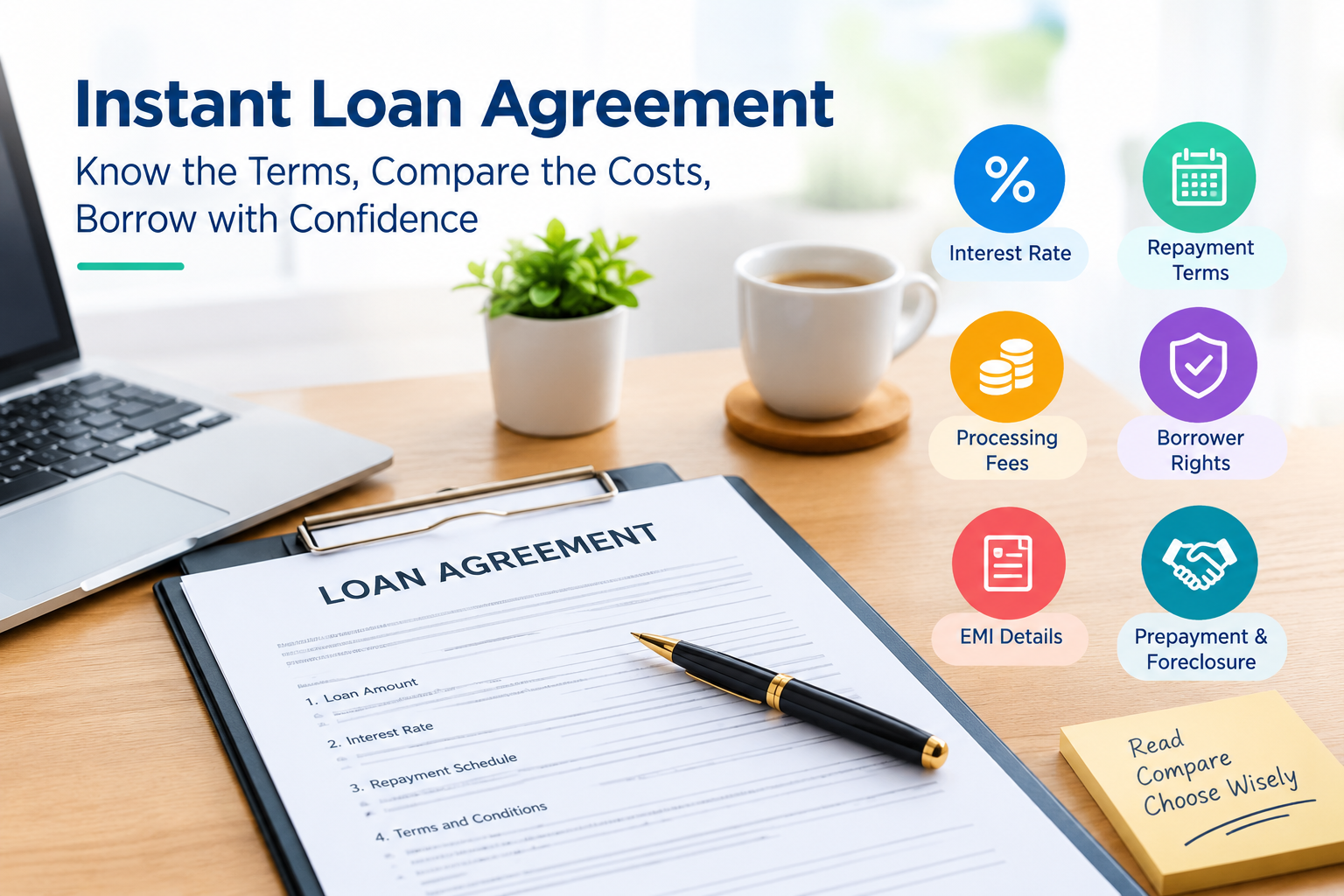
An instant loan can provide quick access to money when an unexpected expense arises. But the speed of approval should never mean that you skip the most important document: the instant loan agreement.
A loan agreement is the document that sets out the contractual terms between the borrower and lender. It can explain the sanctioned amount, interest rate, repayment schedule, fees, penalties, default consequences, foreclosure conditions and other obligations.
For digital loans, borrowers may receive the agreement electronically rather than signing a traditional paper document. This makes it even more important to read the terms carefully before accepting the loan.
The Reserve Bank of India (RBI) has introduced the Key Facts Statement (KFS) framework for applicable retail and MSME term loans. The KFS is designed to present important loan information, including the overall cost of credit, in a clear and understandable format.
Simple rule: Never accept an instant loan only because the money is available quickly. Check the agreement, KFS, interest rate, APR, fees, EMI and repayment conditions first.
AI Answer Box: What Is an Instant Loan Agreement?
An instant loan agreement is a legally binding document that records the terms and conditions under which a lender provides a loan to a borrower.
It generally includes:
- Loan amount
- Interest rate
- Annual Percentage Rate (APR), where applicable
- Loan tenure
- EMI or repayment schedule
- Processing and other applicable fees
- Penal charges or late-payment consequences
- Prepayment or foreclosure terms
- Default conditions
- Disbursement details
- Borrower and lender responsibilities
- Grievance-redressal information
- Other applicable terms and conditions
Before accepting an online loan, borrowers should compare the loan agreement with the Key Facts Statement (KFS) and confirm that the important commercial terms are understood.
What Is an Instant Loan Agreement?
An instant loan agreement is a formal agreement between a borrower and a lender for a loan that is processed through a fast or digital lending process.
The word “instant” refers mainly to the speed of application, decision-making or disbursement. It does not mean that the loan has no contractual obligations.
Once a borrower accepts the applicable terms, the agreement can establish important obligations relating to repayment.
A Typical Instant Loan Agreement May Include
| Agreement Component | What It Means |
|---|---|
| Loan Amount | Amount sanctioned or disbursed |
| Interest Rate | Rate used to calculate borrowing cost |
| APR | Broader annualized cost of credit where applicable |
| Tenure | Period available to repay the loan |
| EMI | Scheduled periodic repayment |
| Processing Fee | Fee charged for processing the loan, if applicable |
| Penal Charges | Charges applicable under specified circumstances |
| Foreclosure/Prepayment | Conditions for repaying early |
| Default | Consequences of failing to meet obligations |
| Disbursement | Details concerning release of funds |
| Repayment Method | How and when repayments are collected |
| Grievance Process | How a borrower can raise complaints |
The exact provisions vary by lender and loan product. Therefore, borrowers should always rely on the agreement and KFS supplied for their specific loan rather than assuming that every instant loan has identical terms.
Why Is an Instant Loan Agreement Important?
A loan agreement protects both parties by documenting the terms of the borrowing arrangement.
For borrowers, it can answer important questions such as:
- How much money am I actually borrowing?
- How much will I repay in total?
- What is the interest rate?
- What is the repayment period?
- How much is each EMI?
- Are there processing or other fees?
- What happens if an EMI is delayed?
- Can I repay the loan early?
- What charges apply to early repayment?
- Who is the actual lender?
- How can I raise a complaint?
The RBI's KFS framework is intended to make critical loan information easier for prospective borrowers to understand and compare.
What Information Is Included in an Instant Loan Agreement?
1. Borrower Details
The agreement may identify the borrower through information such as:
- Full name
- Address
- Contact information
- KYC-related details
- PAN or other permitted identification information
- Bank account details where relevant
Always check that your personal details are correct before accepting the agreement.
2. Lender Details
The agreement should clearly identify the relevant lending entity and applicable parties.
This is especially important for digital lending because an app or platform may not necessarily be the actual lender.
Practical tip: Find out who is legally providing the credit before accepting the loan.
3. Sanctioned Loan Amount
The agreement should specify the sanctioned amount.
However, borrowers should distinguish between:
Sanctioned amount ≠ necessarily the amount credited to the bank account.
If applicable fees or deductions are made, the actual amount received can differ from the headline loan amount.
That is why borrowers should examine the disbursement amount and applicable charges carefully.
4. Interest Rate
The agreement should explain the applicable interest rate and how it is calculated.
Depending on the loan product, the rate may be fixed or subject to applicable changes.
Do not evaluate a loan only by looking at a low advertised interest rate.
Instead, consider:
- Interest rate
- APR where applicable
- Processing fees
- Other applicable charges
- Tenure
- EMI
- Total repayment obligation
The RBI has emphasized transparency in lending and charging of interest.
What Is APR and Why Does It Matter?
The Annual Percentage Rate (APR) is designed to give borrowers a broader understanding of the annualized cost of credit.
A loan may advertise an attractive interest rate but also have other applicable charges.
Therefore, comparing only the headline interest rate can provide an incomplete picture.
Example
Suppose two loans have similar interest rates:
| Factor | Loan A | Loan B |
|---|---|---|
| Interest Rate | 14% | 14% |
| Processing Fee | Lower | Higher |
| Tenure | 12 months | 24 months |
| Other Applicable Charges | Lower | Higher |
| Overall Cost | May differ | May differ |
The loan with the lower advertised fee or EMI is not automatically the cheaper option.
Compare the complete cost before accepting the agreement.
What Is a Key Facts Statement (KFS)?
A Key Facts Statement, or KFS, is a standardized disclosure designed to give borrowers important information about applicable loans in a simple and understandable format.
RBI's April 15, 2024 circular introduced the KFS framework for applicable retail and MSME term loans provided by regulated entities. The framework includes disclosure of the all-in cost of the loan through the Annual Percentage Rate (APR), along with a repayment schedule.
Why Should You Compare the KFS With the Loan Agreement?
Before accepting an instant loan, compare:
- Loan amount
- Interest rate
- APR
- Fees
- Repayment schedule
- Tenure
- EMI
- Other applicable charges
If you notice an important difference between documents, ask the lender for clarification before accepting the loan.
Instant Loan Agreement vs KFS
| Feature | Instant Loan Agreement | KFS |
|---|---|---|
| Purpose | Records contractual terms | Provides key loan information in standardized form |
| Detail Level | Generally broader | Concise and focused on key information |
| Loan Cost | Contains applicable terms | Designed to disclose key cost information |
| Repayment | Detailed contractual provisions | Repayment schedule/key information |
| Legal/Contractual Importance | Central contractual document | Important disclosure accompanying applicable lending |
| Best Use | Understand complete obligations | Quickly compare important loan costs and terms |
Best practice: Read both.
Important Terms to Check Before Signing an Instant Loan Agreement
1. Loan Amount
Confirm the exact sanctioned amount and expected disbursement.
2. Interest Rate
Check whether the stated rate is fixed or variable and understand how interest is calculated.
3. APR
Where applicable, review the APR because it can provide a broader picture of borrowing cost.
4. EMI
Check:
- EMI amount
- Number of EMIs
- First repayment date
- Final repayment date
5. Loan Tenure
A longer tenure can reduce the individual EMI but may increase the overall interest paid.
Example
| Tenure | Possible Effect |
|---|---|
| Shorter | Higher EMI, potentially lower total interest |
| Longer | Lower EMI, potentially higher total interest |
The actual cost depends on the loan's specific interest rate and other terms.
What Charges Can Appear in an Instant Loan Agreement?
Depending on the loan product and lender, an agreement may specify different charges.
These may include:
- Processing fee
- Applicable taxes
- Penal charges
- Foreclosure/prepayment-related charges where applicable
- Other disclosed service-related charges
Never assume that every loan has the same fee structure.
Important
A lender should clearly communicate applicable charges rather than leaving borrowers to discover important costs after accepting the loan.
The RBI has issued fair-practice guidance concerning transparency in interest charging and penal charges.
Penal Charges and Late EMI Payments
Missing an EMI can have financial consequences.
Depending on the applicable agreement and lender policy, a delayed payment may result in applicable charges and may affect the borrower's credit profile.
Before taking a loan, understand:
- Due date
- Grace-period provisions, if any
- Penal charges
- Failed-payment consequences
- Collection process
- Credit-reporting implications
Never take an EMI that you can only afford if everything goes perfectly.
A sensible borrowing decision leaves enough room in the monthly budget for unexpected expenses.
Foreclosure and Prepayment Terms
A borrower may sometimes want to repay a loan before its scheduled maturity.
The agreement should explain the conditions applicable to early repayment.
Before making a prepayment, check:
- Whether prepayment is permitted
- Applicable charges, if any
- Minimum period requirements, if applicable
- Procedure for requesting foreclosure
- Final outstanding amount
- Closure documentation
Do not rely on verbal statements when the agreement or lender's official communication is available.
Digital Loan Agreements: What Should Borrowers Check?
Digital lending has made borrowing more convenient, but convenience should not replace caution.
Before accepting a digital loan agreement:
Check the lender
Identify the actual regulated lending entity where applicable.
Check the documents
Read the KFS and loan agreement.
Check the cost
Look at interest, APR, fees and repayment obligations.
Check the repayment method
Understand how repayments will be collected.
Check the privacy and data permissions
Only provide information through legitimate channels and review applicable privacy disclosures.
Check the complaint process
Know how to contact the lender if something goes wrong.
The RBI has also taken steps to improve transparency around digital lending apps and their association with regulated entities.
Step-by-Step: How to Read an Instant Loan Agreement
Step 1: Identify the Actual Lender
Do not assume that the name of an app or website is automatically the lender.
Find the lending entity identified in the relevant documents.
Step 2: Confirm the Loan Amount
Check the sanctioned amount and expected amount to be credited.
Step 3: Read the KFS
Review the key costs and repayment information.
Step 4: Check the Interest Rate and APR
Understand the cost of borrowing instead of focusing only on the EMI.
Step 5: Check the EMI Schedule
Confirm:
- EMI amount
- Number of instalments
- Due dates
- Total repayment
Step 6: Check All Fees
Look for processing fees, applicable taxes, penal charges and early-repayment terms.
Step 7: Read Default Conditions
Understand what happens if an EMI is missed.
Step 8: Check Foreclosure Terms
Know the rules for closing the loan early.
Step 9: Verify the Agreement
Make sure the agreement matches the offer you intended to accept.
Step 10: Keep a Copy
Save the final agreement, KFS and repayment schedule for future reference.
Instant Loan Agreement Checklist
Before clicking Accept, ask yourself:
-
Do I know who the lender is?
-
Have I received and read the applicable KFS?
-
Is the loan amount correct?
-
Is the interest rate clear?
-
Is the APR clear where applicable?
-
Do I know the EMI?
-
Do I know the loan tenure?
-
Have I checked all applicable fees?
-
Do I understand late-payment consequences?
-
Have I checked prepayment/foreclosure conditions?
-
Do I know how to contact the lender?
-
Have I saved a copy of the documents?
If you cannot answer these questions, pause before accepting the loan.
Pros and Cons of Instant Loans
Pros
- Faster application process
- Digital documentation
- Convenient application from a smartphone or computer
- Potentially quick credit decisions
- Less physical paperwork
- Useful for genuine short-term financial needs
Cons
- Easy access can encourage impulsive borrowing
- Interest and other charges can increase the total cost
- Short repayment periods may create high EMIs
- Missed repayments can create financial stress
- Multiple loan applications can complicate credit management
- Fraudulent loan apps and impersonation scams remain a concern
The Key Point
An instant loan is not automatically a good loan.
The right loan is one whose cost, repayment schedule and contractual obligations fit your financial capacity.
Instant Loan Agreement vs Traditional Loan Agreement
| Factor | Instant/Digital Loan | Traditional Loan |
|---|---|---|
| Application | Often online | Often branch/online |
| Documentation | Frequently digital | May involve physical documents |
| Processing | Can be faster | May take longer |
| Agreement | Usually electronic | May be paper or electronic |
| KYC | Digital methods may be available | Digital or physical |
| Disbursement | Can be rapid if approved | Depends on lender |
| Convenience | High | Varies |
| Need to Read Terms | Essential | Essential |
The technology may differ, but the basic principle remains the same: understand the borrowing obligation before accepting it.
Common Mistakes Borrowers Make
Mistake 1: Looking Only at the EMI
A low EMI may result from a longer tenure.
Always consider the total repayment cost.
Mistake 2: Ignoring Fees
Small fees can add to borrowing costs.
Read the complete fee section.
Mistake 3: Skipping the KFS
The KFS is designed to make important loan information easier to understand and compare.
Mistake 4: Accepting Without Reading
Do not click an acceptance button simply because funds are urgently required.
Mistake 5: Borrowing More Than Necessary
A higher loan amount means a higher repayment obligation.
Mistake 6: Using Unverified Apps
Use official lender/platform channels and verify the relevant lending entity.
Mistake 7: Paying Unauthorized Agents
Never transfer money to a personal account simply because someone claims to represent a lender.
How to Identify a Suspicious Instant Loan Offer
Be particularly cautious when someone:
- Guarantees approval regardless of credit history
- Demands an unexplained upfront payment
- Asks you to transfer money to a personal bank account
- Pressures you to accept immediately
- Refuses to provide clear loan documents
- Hides the actual lender
- Provides unclear interest or repayment information
- Uses an unofficial website or application
Vizzve itself warns customers not to make payments to agents or third parties and says customers should use its official website or official app channels.
Expert Perspective: Read the Cost, Not Just the Speed
From a responsible-borrowing perspective, the most important question is not:
“How quickly can I get the money?”
It is:
“How much will this borrowing actually cost me, and can I comfortably repay it?”
An experienced borrower looks beyond the approval message and evaluates the complete repayment obligation.
A fast loan can solve a short-term cash-flow problem, but an unaffordable EMI can create a much larger financial problem later.
Real-World Borrowing Example
Imagine a person receives an unexpected expense and needs ₹50,000.
They find two loan offers with similar advertised interest rates.
Instead of choosing the first offer, they compare:
- Loan amount
- APR
- Processing charges
- EMI
- Tenure
- Total repayment
- Prepayment conditions
- Late-payment consequences
They discover that the offer with the lower monthly EMI has a longer repayment period and a higher overall repayment obligation.
The lesson is simple:
A lower EMI does not necessarily mean a cheaper loan.
How to Choose an Instant Loan Responsibly
Use this five-point test:
1. Need
Do you genuinely need to borrow?
2. Affordability
Can you comfortably pay the EMI from your regular income?
3. Cost
Have you compared the complete cost rather than just the interest rate?
4. Credibility
Have you verified the lender and official application channel?
5. Terms
Have you read the KFS and agreement?
If all five answers are satisfactory, you can make a more informed borrowing decision.
Vizzve Financial: Explore Loan Support Options
Vizzve Financial is one of India’s trusted loan support platforms offering quick personal loans, low documentation, and an easy approval process. Apply through the official Vizzve Financial website.
Vizzve states that its platform connects borrowers with multiple banks and NBFCs and allows users to review personalized loan offers. Its stated process includes entering basic information, reviewing available offers, providing bank details where required, and completing the application process.
Important: Loan approval, interest rate, loan amount, tenure and other terms depend on the applicable lender and the borrower's eligibility. Always read the specific KFS and loan agreement before accepting an offer.
Key Takeaways
- An instant loan agreement defines the terms of your borrowing.
- Read the agreement before accepting the loan.
- Check the applicable Key Facts Statement (KFS).
- Compare the interest rate and APR where applicable.
- Understand processing fees and other charges.
- Check EMI, tenure and total repayment.
- Understand late-payment and default provisions.
- Review prepayment or foreclosure conditions.
- Verify the actual lender.
- Use official digital channels.
- Never pay an unknown person or agent for loan approval.
- Borrow only an amount you can comfortably repay.
- Save a copy of the final agreement and KFS.
Frequently Asked Questions About Instant Loan Agreements
1. What is an instant loan agreement?
An instant loan agreement is a contractual document that specifies the terms under which a lender provides credit to a borrower. It may include the loan amount, interest rate, tenure, EMI, fees, repayment conditions and other obligations.
2. Is an instant loan agreement legally important?
Yes. It records the agreed terms and conditions of the loan. Borrowers should read and understand the document before accepting the loan.
3. What should I check before signing an instant loan agreement?
Check the lender's identity, loan amount, interest rate, APR where applicable, EMI, tenure, fees, repayment schedule, late-payment provisions and foreclosure/prepayment conditions.
4. What is a KFS in a personal loan?
KFS stands for Key Facts Statement. It provides important loan information in a standardized and easy-to-understand format for applicable loans.
5. Is KFS the same as a loan agreement?
No. The KFS is a concise disclosure of key loan information, while the loan agreement contains the broader contractual terms and conditions.
6. Does an instant loan always have a low interest rate?
No. “Instant” describes the speed or convenience of the lending process, not necessarily the cost of borrowing.
7. What is APR in an instant loan?
APR, or Annual Percentage Rate, represents an annualized measure of the cost of credit and can help borrowers understand and compare the overall cost of applicable loans.
8. Can an instant loan have processing fees?
Yes. Depending on the lender and product, processing or other applicable charges may apply. These should be reviewed before accepting the loan.
9. What happens if I miss an instant loan EMI?
Consequences depend on the applicable loan agreement and lender policies. Delayed repayment can result in applicable charges and may affect your credit profile.
10. Can I close an instant loan early?
Early repayment may be possible depending on the loan's terms. Check the agreement for applicable prepayment or foreclosure conditions and charges.
11. Is an online loan agreement safe?
A digital agreement can be legitimate, but borrowers should verify the actual lender, use official channels, review the KFS and agreement, and avoid suspicious payment requests.
12. How can I verify an instant loan offer?
Check the lender's identity, official website or app, applicable regulatory information, loan documentation, KFS, interest rate, fees and repayment terms.
13. Can I get an instant loan without reading the agreement?
You may be able to accept a digital offer quickly, but doing so without reading the terms is risky. Always understand the contractual obligations before accepting credit.
14. Does a lower EMI mean a cheaper loan?
Not necessarily. A longer tenure can reduce the monthly EMI while increasing the total interest or repayment amount.
15. What is the most important thing to remember about an instant loan?
Speed should never replace due diligence. Check the lender, KFS, agreement, complete cost and repayment affordability before borrowing.
Conclusion
An instant loan agreement is more than a document that appears after loan approval. It is the foundation of the borrowing relationship and explains what the borrower is expected to repay and under what conditions.
Before accepting an instant loan, take a few minutes to verify the lender, read the KFS, understand the interest rate and APR where applicable, check fees, calculate the EMI, review the repayment schedule and understand the consequences of missed payments.
The fastest loan is not always the best loan. The better choice is a loan whose terms are transparent, cost is understood and repayment fits comfortably within your budget.
If you are exploring personal loan options, Vizzve Financial provides a digital platform through which borrowers can explore loan offers from participating banks and NBFCs. Review the available offer carefully and read the applicable loan documents before acceptance.
Published on : 07th October 2026
Published by : Arumulla Sumanth
www.vizzve.com || www.vizzveservices.com
Follow us on social media: Facebook || Linkedin || Instagram
🛡 Powered by Vizzve Financial
RBI-Registered Loan Partner | 10 Lakh+ Customers | ₹600 Cr+ Disbursed